Elite units: Fallschirmjäger Airborne InfantryBackground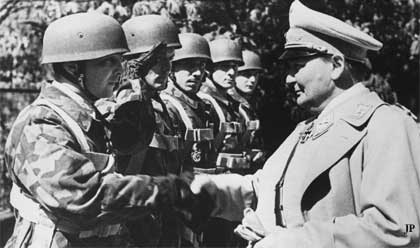 Reichsmarschall Herman Göring, founder of the Fallschirmjäger meets decorated paratroopers
The Fallschirmjäger ( Paratroopers) were the airborne infantry branch of the German Luftwaffe before and during World War II. They, together with the Heer's Gebirgsjäger (Mountain troops) are considered the elite infantry units of the Wehrmacht.
In the 1930s Hermann Göring, Chief of the Luftwaffe, after having observed Soviet airborne infantry maneuvers, became committed to the creation of Germany's airborne infantry. in 1935, Göring created Germany's first dedicated airborne regiment. The unit was incorporated into the newly formed Luftwaffe later that year and training commenced. Göring also ordered that a group of volunteers be drawn for parachute training. These volunteers would form a cadre for a future Fallschirmtruppe ("parachute troops"). For the entirety of WW2, the Fallschirmjäger was commanded by General Kurt Student.
In addition to parachute units, the Fallschirmjäger also deployed glider-borne and airmobile troops in its forces.
Equipment & WeaponsThe Fallschirmjäger units usually used the standard Wehrmacht weapons such as the Kar98k rifle, MP38 & MP40 sub-machine guns and the MG34 & MG 42 medium machine guns. Also in use are heavier support weapons such as the 82mm mortar and the 150mm infantry gun. However, some specialized weapons were created for the Fallschirmjäger to better improve their combat performance. Two of these was the FG 42 light machine gun/automatic rifle and the 75mm Leichtgeschutz 40 recoilless gun. Parachute units were also issued a gravity knife, used to quickly cut away parachute lines. However, due to reason that will be elaborated later, paratroopers made their combat jumps mostly unarmed, with only carrying a pistol, knives and grenades during the jump. Weapons and other equipment are dropped separately from the paratroopers in crates and light trailers.
 Fallschirmjäger at a rally point retrieving their weapons. Note the camouflaged jump smocks and paratrooper helmets.
Uniform-wise, the Fallschirmjäger wore the light blue uniforms of the Luftwaffe, instead of the field grey uniforms of the Heer. A green jump smock (later camouflaged) were worn over the uniform. This jump smock is originally supposed to be disposed after landing, but due to the camouflage being so effective for concealment, paratroopers usually wore them for combat. Paratroopers wore side lacing jump boots, while other units usually wore standard Wehrmacht jackboots. Knee and elbow pads are also issued to the paratroopers. A special helmet was also designed, based on the standard Stahlhelm but with its brim removed and with extra padding & more secure chinstraps more suited to parachuting.
ParachutesThe Fallschirmjäger used the RZ-16 and RZ-20 series parachutes. These design suspended the paratrooper from a single strap on his back, instead of the more recognizable double straps that suspended a paratrooper from his shoulders. This single-strap design forced the paratrooper to forcefully jump from the airplane in a horizontal manner to ensure the parachute deploys correctly. This also meant that the paratrooper descended on a facedown angle that made landing dangerous: instead of landing on their feet, the facedown angle forced the paratrooper to do a forward roll while landing. Although padded knee pads were standard issue, landing caused many knee injuries.
 A descending Fallschirmjäger. Note the single strap parachute and the paratrooper's face-down angle.
Because of the rough landing expected for the paratroopers, this forced the paratroopers to jump 'clean' without any weapons or equipment that can potentially hurt the paratrooper during his forward roll. Only smaller weapons can be carried, causing considerable danger to the unarmed paratroopers from the enemy as they attempted to retrieve their heavier weapons from containers dropped separately, especially during opposed landings.
Why these types of parachutes were used by the Fallschirmjäger in the first place is certainly puzzling, since Luftwaffe pilots and flight crews used the double strap parachute designs.
OperationsThe Fallschirmjäger were used extensively during the earlier western campaign of WW2. Fallschirmjäger units participated in the invasion of Norway, Denmark, Belgium and The Netherlands. A particularly impressive operation is the capture of the Belgian fort of Eben Emael, which controlled the crossing of the Albert canal, one of the primary routes of the Wehrmacht.
The fort consisted of a massive concrete shell with multiple gun emplacements and was manned by 1,200 Belgian troops. The Fallschirmjäger actually landed part of their forces on top of the fort and rapidly attacked the artillery casements and pillboxes with flame throwers, demolition charges, and hollow charge grenades. Due to the surprise and despite being at both a numerical and firepower disadvantage it took the Fallschirmjäger only hours to take control of the fort.
 Fallschirmjäger landing during the Invasion of Crete
The invasion of Crete during Operation Merkur eventually became the apex and also the undoing of the Fallschirmjäger. Crete needed to be captured to control the Mediterranean sea, but the presence of the British Royal Navy around the island precluded any Axis amphibious landings. Göring suggested an airborne invasion would be feasible. This would be different from the Fallschirmjäger's earlier campaigns where it was only part of the invasion forces. This time the entire invasion force is to be based on the Fallschirmjäger alone. During the invasion 14,000 Fallschirmjäger was landed against 15,000 commonwealth & Greek troops.
The first wave of landings achieved some initial surprise, but determined enemy resistance in the rough terrain of the island caused many casualties among the paratroopers. The delay in capturing Maleme Airport also meant that heavy weapons and troop reinforcements were unable to be flown in from the mainland during the first days of the invasion, exacerbating the losses. In the end however, the airborne invasion was a success and the Commonwealth-Greek units was forced to retreat by sea to Egypt but at a heavy price was paid, with nearly 7,000 casualties were suffered by the Fallschirmjäger and hundreds of transport airplanes shot down or damaged beyond repair.
Although the invasion of Crete was a success, Hitler was horrified at the losses sustained by the elite Fallschirmjäger and decreed no more large-scale drops will be allowed in the future. As of that moment, the Fallschirmjäger lost their airborne capabilities and thereafter operated as ground-based elite light infantry. However, they retained their combat prowess and later commonly deployed as dependable combat 'firemen', ready to be rapidly deployed wherever the Wehrmacht needed a breakthrough or to resolutely defend a strategic position.


 Military Thread V25
  Apr 26 2018, 04:47 PM


 ohwait maybe Jf-17 Thunder


 Quote
Quote


 0.1319sec
 0.77
0.77
 7 queries
 GZIP Disabled