Things that you should read to know 'more' click the link below
Read MeFrequently Asked Questions
IntroductionThese are some of the common questions which are frequently asked by Arowana owners and the answers to these questions. As much as possible, we'll make sure that the contents provided here are unbiased, accurate & repeatable.
Q. What are suitable companions for my Arowana?
We are compiling a list of suitable companions for Arowanas. As the aggressiveness of Arowanas differ greatly, even very compatible species may be attacked by your Arowana. This list is to be used as a guide based on feedback from Arowana owners around world.
Q. I heard that we should not have planted tanks and Arowanas.
It's not a matter of keeping Arowanas with planted tanks which is bad, but the additional maintenance which is required to keep the tank clean. Planted tanks usually mean that there's gravel in the tank and although gravel is pleasant to look at, it can trap debris / waste products produced by your Arowana. This can foul up the water conditions rather quickly and if proper care is not taken, the water can deteriorate very quickly and cause problems / diseases for your Arowana. There's an excellent article regarding the upkeeping of Discus in planted tanks which could help any one in attempting a Arowana & planted tank setup. Click here.
Q. My Arowana is not eating. Help!
Probably the first sign of more serious problems to come, there are many reasons why arowanas refuse to eat. One of the least worrying & common problems is overfeeding. By continuously feeding excessively, arowanas tend to break into a "starving phase" and stop eating completely until they feel like eating again. The best solution to this problem is to monitor your feeding and feed only what your arowana is able to eat comfortable and stop when it shows signs of slowing down (or about 80% of it's eating capacity).
More often than not, an arowana that is not eating is a sign to more serious problems like sudden stress or even diseases. Check the tank water parameters for any unusual warnings like an ammonia spike or a sudden drop in pH or temperature. If the water parameters look fine and there are no visible signs of diseases, your arowana might be suffering from an internal disease. Monitor the arowana closely over the next few days and proceed with treatment as necessary.
Q. I'm going on a vacation for a week, what about feeding?
Most fishes are able to go without food for weeks so it's nothing to worry about. Feed your arowana slightly more the day before you leave and also slightly more on the day you come back.
Q. How do I know if my Arowana is a male or a female?
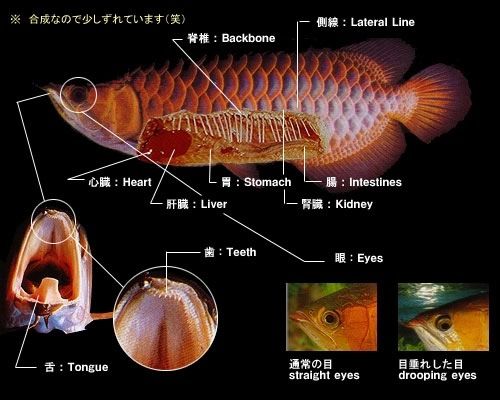
There isn't a sure-fire way of telling the sex of an Arowana. One way which could indicate the gender of the Arowana is by looking at it's mouth. Males usually have "deeper" mouths because their are mouth breeders and the space is required to hold the eggs/frys until they are ready to venture. A sort of protection if I'm not wrong.
Q. I want to keep 2 Arowanas in the same tank. Will they fight?
It is not advisable to keep 2 arowanas in the same tank as injuries are unavoidable and death of one fish is almost certain on most ocassion. Arowanas are very territorial fishes and they usually do not tolerate the company of another "competitor". Multiple arowanas can be kept together only if the numbers are large enough (e.g. 6-10). With such a large number, the aggression is reduced and the arowanas too, will find it hard to establish any form of territory. A large tank however, is needed to house such a large number of arowanas. The only exception to keeping 2 arowanas in the same tank is when the arowanas have paired off after courtship and are ready for breeding. This is VERY rare and only attempted by a very small number of experienced owners.
Q. My pH is 7.5, will my Arowana be fine?
Arowanas prefer water parameters that are slightly acidic (6.0-7.0). There's no doubt that an arowana can live comfortable in a slightly alkaline tank, but in the long run, the stresses of a different water climate could result in the weakening of the fish and makes it susceptible to diseases.
Q. Is aquarium salt necessary during each water change?
In a word, No. Aquarium salt has numerous benefits like prevention of diseases as well as improving gill functions but it's not absolutely essential during water changes.
Forum F.A.Q. Topics Views
Quote from Arofanatics.com
This post has been edited by c0c0nut: Apr 2 2007, 04:44 PM 


 Apr 2 2007, 11:37 AM, updated 18y ago


 Quote
Quote




 0.0261sec
 0.33
0.33
 6 queries
 GZIP Disabled