Welcome Guest ( Log In | Register )

Bump Topic Topic Closed RSS Feed
4 Pages < 1 2 3 4 >Bottom

Outline · [ Standard ] · Linear+

 Oil & Gas Careers V12 - Upstream & Downstream, Market still slump, slow, snail pace...

views
     
feekle
post Apr 16 2020, 11:00 AM

Bibo ergo sum!
******
Senior Member
1,922 posts

Joined: Apr 2009
From: Constellation Cygnus
KUALA LUMPUR: Serba Dinamik Bhd has secured a RM7.71bil (US$1.78bil) contract to construct an innovation hub, academic campus, related facilities and IT infrastructure in Abu Dhabi.

It said on Wednesday its unit Serba Dinamik International Ltd had accepted a letter of award from Block 7 Investments L.L.C (Block 7) to undertake the project which will be on and engineering, procurement and construction basis.

The project shall cover the innovation hub which includes the development of offices, restaurants, exhibition centres and IT centres; academic campus; and accommodation which includes apartments and hotels, over a total build-up area of 455,000 sqm.

“The project forms part of Block 7’s initiatives to create a global incubator for the advancement of innovators for the technology, property, financial as well as energy sectors, to be positioned as a new landmark for Abu Dhabi, ” Serba Dinamik said.

It added the scope of work includes but not limited to design, engineer, procure, supervise, manage, supply, transport, construct, commission and the remedying of any defects in connection with the project.

Serba Dinamik would have to complete the project within 1,460 days from the commencement date.


SD is in propery business now
feekle
post Apr 20 2020, 09:35 AM

Bibo ergo sum!
******
Senior Member
1,922 posts

Joined: Apr 2009
From: Constellation Cygnus
Shell Wins $340MM in Floater Dispute Arbitration

Sabah Shell Petroleum Co. Ltd. (SSPC) has won $339.7 million following an arbitration with a subsidiary of MISC Berhad, on the heels of SSPC's half-a-billion-dollar counterclaim for defective work involving the construction and lease of the Gumusut-Kakap semi-floating production system.

The Asian International Arbitration Centre issued the award on April 8, according to an April 10 announcement from MISC.

The SSPC award included $236.38 million for defects rectification work, $15 million for liquidated damages, and $88.32 million as refund for an overpayment of additional lease rate originally awarded to MISC's semi-floating production system for April 2014 to January 2020. The Centre also awarded costs of $12.75 million to SSPC, and an interest rate of 6.65% applies from the date of the award until payment, according to MISC.

"SSPC is entitled to set-off the above claims against moneys owed by SSPC to GKL under the contract, including but not limited to the lease rate," MISC said in a written statement.

Separately, Gumusut-Kakap Semi-Floating Production System Ltd. (GKL) received $222.13 for its claims related to the project, however $88.79 million will be deducted as manpower costs. The remaining $133.34 million will be converted to a lower, additional lease rate.

"The new additional lease rate is payable from the date of the award. The base rate is unaffected by the award and will continue for the fixed term," MISC said in a statement.

Back in November 2012, GKL signed a Semi FPS lease agreement with SSPC for the construction and lease of the semi-FPS. But a dispute surfaced with SSPC over outstanding additional lease rates, payment for completed works and other related costs for the construction of the semi-FPS.

This resulted in GKL pursuing arbitration in September 2016. The following year, it won $255 million and $10.9 million as payment of completed variation works following two adjudication decisions in its favor.

However, SSPC denied GKL’s claims and filed a $588 million counterclaim for defective work, limited functionality of the Semi-FPS, liquidated damages and a refund of the sum paid to GKL under the adjudication rulings.
feekle
post May 13 2020, 11:24 PM

Bibo ergo sum!
******
Senior Member
1,922 posts

Joined: Apr 2009
From: Constellation Cygnus
QUOTE(waghyu @ May 12 2020, 05:51 PM)
Tank top almost everywhere. We need to reboot global warming. No to Tesla, kill employment and kill Oil&Gas big salary.
*
The future is electric like it or not. O&G is like dinosaur already. Move on or get left behind. hmm
feekle
post May 14 2020, 07:53 AM

Bibo ergo sum!
******
Senior Member
1,922 posts

Joined: Apr 2009
From: Constellation Cygnus
QUOTE(Salary @ May 14 2020, 12:41 AM)
Not in our lifetime. O&G goes beyond personal transportation. Here’s a good article to read up - https://energy.economictimes.indiatimes.com...oil-demand/3851
*
Of course, that's what kodak thought when they refuse to go digital before & stick with film. Not similar but kinda related.
Again reduction in transportation can boost supplies for other such as power generation, pharmaceutical, construction (roads) etc.

This post has been edited by feekle: May 14 2020, 07:56 AM
feekle
post May 14 2020, 07:54 AM

Bibo ergo sum!
******
Senior Member
1,922 posts

Joined: Apr 2009
From: Constellation Cygnus
QUOTE(waghyu @ May 14 2020, 03:15 AM)
Electric is more costly than fossil fuel powered vehicle. Its much more efficient and convenient and safe. I’m talking overall cycle cost, not charging battery alone cost.
*
Yea. Like any other tech, by time it will get cheaper when there's competition.

This post has been edited by feekle: May 14 2020, 07:55 AM
feekle
post May 18 2020, 11:14 AM

Bibo ergo sum!
******
Senior Member
1,922 posts

Joined: Apr 2009
From: Constellation Cygnus
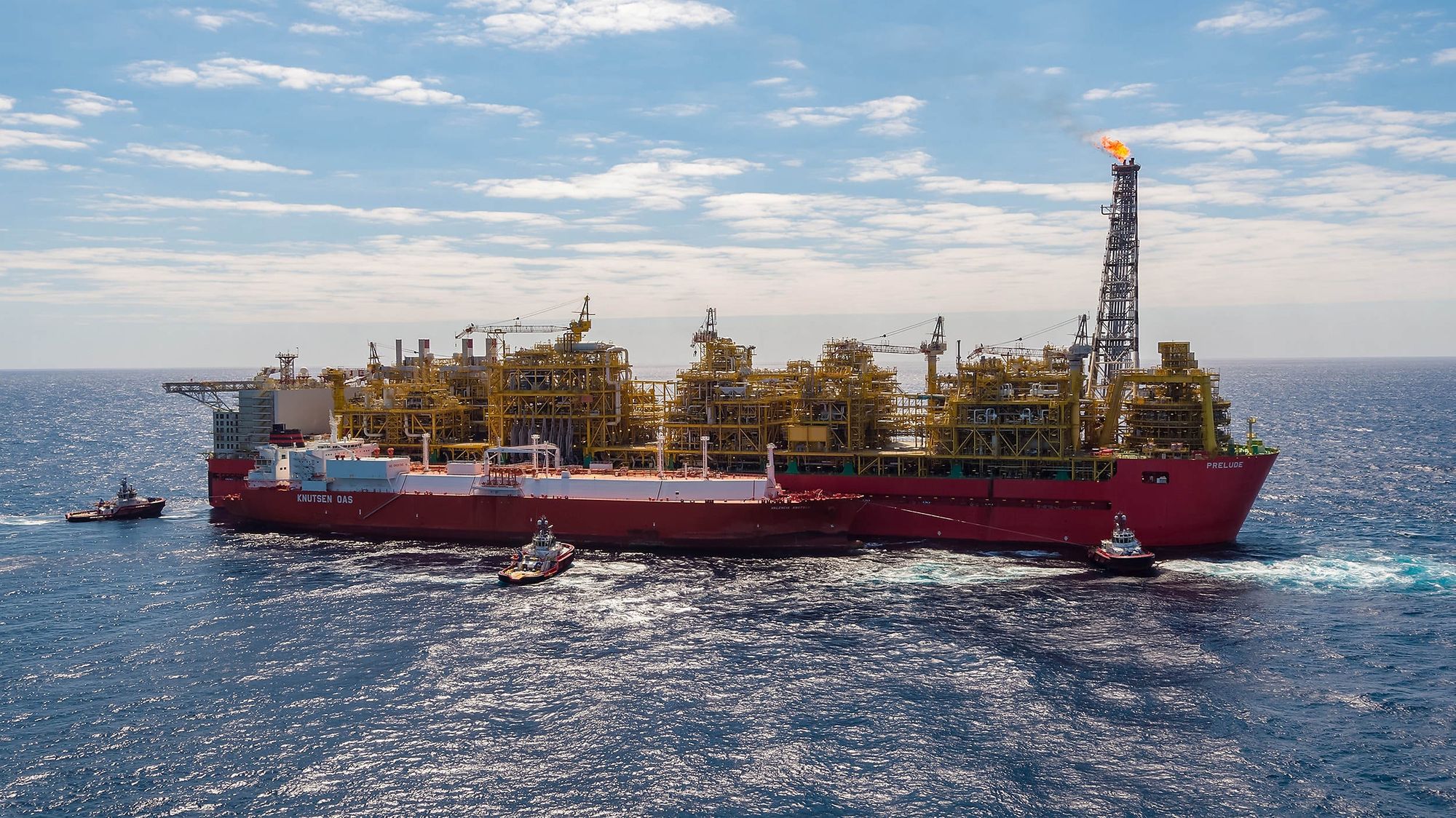
Shell's giant $US17B Prelude floating LNG is late, expensive, dirty and so far unreliable. An exclusive look at how a failed investment for Shell is a terrible deal for Australia.
user posted image

ANALYSIS

Shell's Prelude floating LNG facility off the WA coast was to be the first of many that would open up stranded gas reserves around the world thanks to the technical and project management prowess of Anglo-Dutch oil and gas giant Shell.

It has not turned out that way.

When the 488m-long giant arrived in Australia almost three years ago, Shell expected to receive cashflow from the Prelude in 2018.

While the Prelude did export LNG at about half its capacity for the second half of 2019, it is now idle.

Moored far off the Kimberley coast it is plagued with technical problems, dwindling gas reserves and safety processes condemned by the regulator despite Shell and its partners spending about $US19.3 billion ($A30.0 billion) to the end of 2019.

Neither Shell and its partners nor Australia have gained anything near what they expected from the giant experiment.

Cost overruns, delays and to date unreliable production means investors in Prelude are unlikely ever to pay Australia for the gas they export as the payment is linked to profit. Company income tax related to Prelude, if any, will be minimal.

The Prelude also used negligible local content during construction and is making a significant contribution to Australia's greenhouse gas emissions.

Shell has escaped scrutiny over Prelude's cost by not issuing an estimate when the project was sanctioned or supplying updates during construction.

Shell chief executive Ben van Beurden was asked about the cost of Prelude in 2018.

"We don't disclose cost on projects, so I'm also not in a position to disclose whether it is any different to what we have previously not disclosed and I don't want an make an exception in this case," van Beurden said.

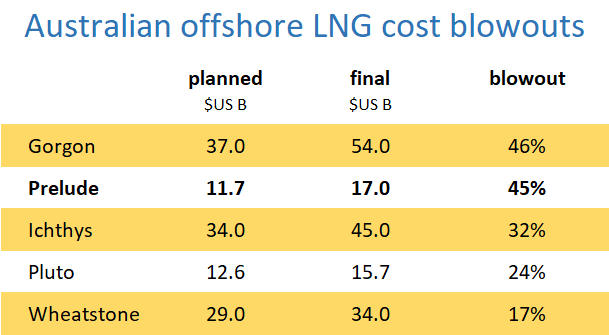
However, when Prelude was sanctioned in 2011 then Shell executive director of upstream international business Malcolm Brinded said the cost would be around $US3 billion to $US3.5billion per million tonnes of LNG capacity. So Brinded expected Prelude, that should produce 3.6 million tonnes of LNG a year, to cost between $US10.8 and $US12.6 billion: an average of $US11.7 billion.

Prelude's cost blowout
The cost of Prelude to date may be $US19.3 billion, according to the 2019 accounts of OPIC Australia Pty Ltd, a subsidiary of CPC of Taiwan, that owns 5% of Prelude.

OPIC said construction costs had "totalled US$964 million as at December 2019" for its 5% share, indicating a 100% cost of $US19.3 billion.

Comparisons of costs are not straight forward. Differing accounting policies covering foreign exchange and other issues muddy the waters. The $US329 million spent by OPIC in 2013 to join the project Shell sanctioned in 2011 may have covered some pre-sanction activities such as exploration and front-end engineering design.

However, the OPIC accounts do indicate that the cost estimate of $US17 billion ($A26 billion) from respected oil and gas consultancy Wood Mackenzie widely reported last year was reasonable.

Operators of all the other recent LNG projects offshore WA issued both initial cost estimates and the final cost. A comparison using Wood Mackenzie's estimate shows that Prelude's 45% cost overrun puts it in the same league Chevron's notoriously troubled Gorgon project.
user posted image

While the Prelude was designed to weigh as much as six large aircraft carriers, its construction cost was not expected to be more than that for three new Australian submarines.

Shell's 67.5% share of the cost overrun is $US3.6 billion: substantially more than the estimated $US2 billion Shell has spent since 2016 moving to lower-carbon energy.

The long road to Prelude
Prelude is one of three attempts by Shell to deploy off Australia the floating LNG technology it started developing about 25 years ago.

Woodside embraced partner Shell's floating LNG technology for the Sunrise field in 2001 after it failed to gain access to ConocoPhillips' pipeline from Bayu Undan to Darwin.

Browse, another Woodside-operated project with Shell as a major partner, chose floating LNG in 2013 after plans to build an onshore plant on the Kimberley coast collapsed. Three years later, Woodside dropped the $US40 billion project.

Shell committed to build a floating LNG facility for its 100%-owned Prelude field in 2011. Later it sold interests to Japan's Inpex (17.5%), Korea's KOGAS (10%) and Taiwan's CPC (5%).

Shell partnered with Technip to design the facility in France and Malaysia and Samsung to construct the giant in its Korean shipyard. The Prelude facility was due to be delivered to the field off the Kimberley coast in 2015, and first gas would flow in 2016 according to the Prelude environmental impact statement.

Combining the world's largest floating structure and a complex and novel LNG plant was an enormous design and construction challenge that did not go smoothly.

The Prelude arrived in Australian waters in July 2017 – 1½ years late – but it was not the end of the problems.

"It's like an offshore platform, and a bunch of pipelines, and an onshore LNG plant, and a storage facility, and utilities, and a hotel for 300 people, and a port, and all of that on a floating facility," Shell vice president for Prelude Rob Jager told The West Australian in 2019.
"Its individual parts in and of themselves are not hugely complex but putting it all together in a confined space is what makes it challenging," Jager said.

A troubled start-up
Prelude shipped its first cargo of LNG in June 2019 but has not had a smooth ride since.

The LNG produced is reported to be unsuitable for some markets as it contains too much ethane.

Transferring LNG between the Prelude and an LNG carrier alongside through rigid loading arms that contain the -160℃ liquid has proven complex.

In January offshore safety regulator NOPSEMA banned many maintenance activities until Shell fixed its procedures for the safety-critical isolation of equipment before maintenance. NOPSEMA said there was a "significant risk to the health and safety of persons at the facility."

Weeks later the Prelude's problematic steam-driven power system failed again, but this time the diesel back-up generator did not power up. Basic amenities such as toilets stopped working, and Shell quickly reduced the number of crew.

Shell had chosen steam-fired power due to its "proven high reliability in a marine setting" instead of gas turbines that are less polluting and more common offshore.

The Prelude is currently not in production with a reduced crew due to COVID-19 concerns.

Boiling Cold understands designer Technip has still not entirely handed over responsibility for the Prelude to Shell. The construction contract requires a Performance Test Report that demonstrates the Prelude has run at full capacity for 72 hours for Technip to complete its commitments.

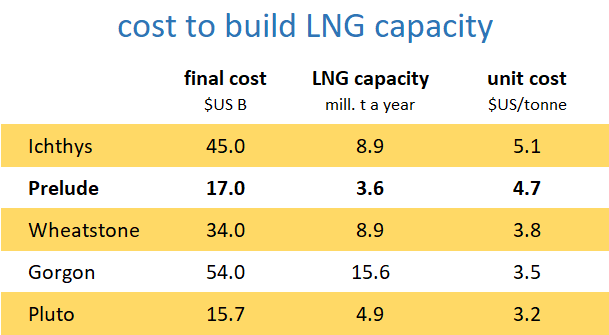
Cost overruns have made Prelude an expensive piece of kit to produce LNG compared to all the recent Australian offshore LNG projects except nearby Ichthys.
user posted image

Shell said floating LNG would have significant cost benefits over land-based Australian projects when asked by a WA Parliament inquiry into floating LNG in 2013.

CPC's Australian subsidiary has recorded total impairment losses of $US377 million to the end of 2019 on its investment of US$964 million: a write-down of 39%.

Where is the gas?
Between the first cargo in mid-2019 and the shutdown in early 2020 Prelude was producing LNG at about half its design capacity. A late start-up or a slow ramp-up to full capacity typically hurt investors in two ways – more spending and less revenue.

Prelude is suffering from the delay in a third way: it is losing gas reserves to the Ichthys facilities about 20km to the south. The two projects have separate adjacent petroleum titles, but a line on a map does not impede the flow of gas through a reservoir.

The Inpex-led Ichthys project has drilled subsea wells just 3.5km from Prelude's wells. They are understood to tap the same accumulation of gas and to be enjoying the early high production wells can achieve before the pressure in the reservoir subsides.

When Shell sanctioned Prelude it planned to tap the nearby Concerto field next. Later, Shell decided it was necessary to develop the Crux field 160km away instead of Concerto. Shell has now delayed the sanction of Crux planned for 2020 after the recent collapse in oil prices.

Prelude's inability to operate reliably at full capacity has delayed the need for more gas.

Shell's decades-long development of floating LNG that consumed more than 1.6 million hours of design was not meant to end this way.

When Shell approved Prelude in 2011 chair of Shell in Australia Ann Pickard said: "this will be a game-changer for the energy industry."

Brinded said Shell's ambition was to develop floating LNG projects across the globe.

"Our design can accommodate a range of gas fields, and our strategic partnership with Technip and Samsung should enable us to apply it progressively faster for future projects," Brinded said.
The oil and gas PR machine went into overdrive. In 2017 the University of WA produced a "study" with oil and gas lobby group APPEA called FLNG The Floating Phenomenon.

UWA vice-chancellor Dawn Freshwater in the report's introduction said "FLNG remains a strong candidate for the next generation of gas projects" and Australia's challenge was to "ensure we remain at the forefront of innovation."

But Australia had little input into Shell's floating LNG innovation and even less into building the giant Prelude facility.

The cost, schedule and reliability failures of Prelude, with its very low Australian content in design or construction, should finally put an end to the myth that the problems with recent Australian LNG projects originated in Australia.

The recurring themes have been issues missed in the design phase done mostly overseas and problems with facilities built in Asian shipyards that must be corrected when they arrive in Australian waters.

Chevron chief executive John Watson said in 2017 that the US giant should have done additional engineering work and had more robust plans before approving the Gorgon project in 2009. The company attributed delays at Wheatstone to the late arrival of modules from Malaysia and a lack of engineering before the final investment decision.

The Ichthys offshore facilities from Korea were plagued with thousands of electrical fittings in hazardous areas that could have caused a fatal explosion.

One industry veteran described the final stages of recent LNG projects as "Aussies tasked with piecing the Lego together with parts broken or delivered late and half the instructions missing."
Boiling Cold understands there was a strong push within Shell for the Prelude to leave Korea before it was ready to tick a box on an internal corporate target.

The floating carbon dioxide factory
While Australia saw little benefit from the construction of Prelude, it will have its carbon emissions as a liability on its books for decades.

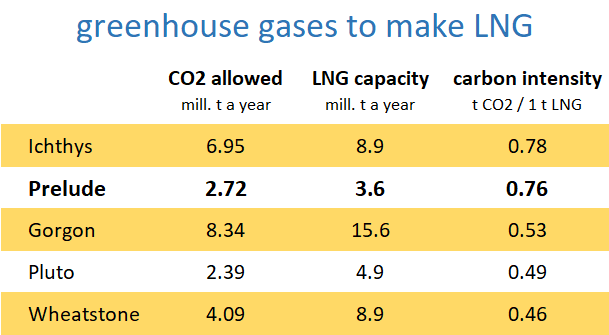
When Shell issued Prelude's environmental impact statement in 2009, it estimated annual greenhouse gas emissions would be equivalent to 2.29 million tonnes of carbon dioxide. A decade later Prelude is allowed to emit 2.72 million tonnes of CO2e a year under the safeguard mechanism administered by the Clean Energy Regulator.

This 20% increase in allowed emissions compared to what was promised in 2009 means LNG from Prelude is the second most carbon-intensive product from the recent offshore LNG boom in Australia.
user posted image

When LNG projects start-up emissions are often high for a few months, but Prelude's initial performance has been appalling. In the 12 months to June 2019 Prelude emitted 2.3 million tonnes of greenhouse gases for just one cargo of LNG.

During the current shutdown gas flowing from the wells is more than Prelude requires to power itself and the excess gas is being flared, adding more carbon emissions with no resultant production.

Shell's environmental plan to flare only during "emergency situations, shutdowns and unplanned outages" did not contemplate shutdowns becoming commonplace rather than exceptional.

The oil and gas giant's total carbon emissions for 2019 were 70 million tonnes. Shell's share of Prelude's allowed emissions is 1.84 million tonnes a year. Floating LNG is adding little to Shell's production but an enormous amount to its carbon footprint.

Shell, like all investors in Australian LNG, has little incentive to reduce emissions as the Federal Government routinely lifts allowable emission limits if they are breached.

The Paris Agreement commits Australia to reduce its emissions by 26% to 28% from 2005 levels by 2030. Every extra tonne of CO2 Prelude emits will eventually have to be countered elsewhere in the economy by spending to reduce emissions, the purchase of offsets or reduced economic activity.

And Australia gets…?
While the broader Australian economy will eventually shoulder the burden of Prelude's carbon emissions, Australia is likely to receive little company tax and no payments for the gas extracted.

CPC in Taiwan, for example, does not own its Australian subsidiary OPIC Australia directly but through a company registered in the well-known tax haven Panama. OPIC Australia owed related companies $US1.02 billion at December 2019, more than the total it has spent on Prelude.

The interest payments on this debt will reduce any company income tax paid should the Prelude ever turn a profit. Most foreign investors in Australian oil and gas use similar arrangements.

Shell will be able to use losses on Prelude to reduce the tax it pays on other Australian investments such as the North West Shelf, Gorgon and QGC LNG projects.

The nearby Ichthys project is forecast never to pay Australia for the gas it extracts according to the analyst Inpex hired to report on the project's economic impact, ACIL Allen executive director WA and NT Mr John Nicolaou.

Prelude is less likely than Ichthys to pay for its gas as the Petroleum Resource Rent Tax rewards delayed projects with annual escalations in credits for capital expenditure.

Prelude may operate reliably at full capacity in the future, but the returns to all the investors will be poor at best.

Shell, that wants to offload high-carbon projects from its portfolio, will find it difficult to sell out of Prelude. No other company would wish to responsibility for the unique and complex technology.

Australia, after receiving little benefit from Prelude's construction and no gas domestic gas supply, is unlikely to receive financial returns from Prelude apart from operating expenditure with further costs inevitable somewhere in the economy to counter Prelude's carbon emissions.

A prelude is defined as an introduction to something important.

What Shell's Prelude should introduce is the understanding that Australia should not rely on bright shiny promises from proponents of resource projects.

OPIC Australia was asked for comment and did not respond. Shell declined to comment.

SOS

feekle
post Jun 6 2020, 05:22 PM

Bibo ergo sum!
******
Senior Member
1,922 posts

Joined: Apr 2009
From: Constellation Cygnus
QUOTE(ZZMsia @ Jun 6 2020, 11:26 AM)
Ex Petronas director Omar Mustapha tweet:

He is the first CEO in this company’s history to not serve out his full term. Rather than conspire with the indefensible he chose to walk away. To relinquish power & prestige on principle is a rare act of courage & character. I salute & thank him for 37 years of loyal service.
*
Pfft..big deal...now he is MAS chairman.
feekle
post Jun 13 2020, 08:57 AM

Bibo ergo sum!
******
Senior Member
1,922 posts

Joined: Apr 2009
From: Constellation Cygnus
KUALA LUMPUR (June 12): Serba Dinamik Holdings Bhd has inked a RM320 million deal with Petroliam Nasional Bhd (Petronas) to acquire the Teluk Ramunia fabrication yard in Johor.

The asset comprises four adjoining parcels of industrial land totalling 68.78 hectares. Erected on the land are warehouses, workshops, fabrication yard and other ancillary buildings.

The yard has the capacity to perform steel fabrication of offshore platforms and other structures of up to 50,000 tonnes.

According to previous reports, Petronas bought the yard for RM296 million in 2011 from Sime Darby Engineering Sdn Bhd, just a year after the latter paid RM530 million to acquire the asset from Ramunia Holdings Bhd.

Petronas had bought the yard for RM296 million in 2011 from Sime Darby Engineering Sdn Bhd, just a year after the latter had paid RM530 million to acquire the asset from Ramunia Holdings Bhd.

In a statement today, Serba Dinamik said its unit Serba Dinamik Group Bhd has agreed to buy the asset from Petronas Asset Sdn Bhd, a wholly-owned subsidiary of Petronas.

Serba Dinamik group managing director and chief executive director Datuk Mohd Karim Abdullah said the deal would allow the group to further expand its capabilities.


“These facilities will assist in enabling various contract securements, therefore, strengthening both our onshore and offshore activities and further improving our value chain in maintenance and engineering, procurement, construction and commissioning (EPCC) jobs.

“We find that there are plenty of opportunities in which we can expand our EPCC capabilities, and these opportunities lie not only in Malaysia, but across the region and Middle East as well,” he said.

Established in 1993, Serba Dinamik, through its subsidiaries, provides engineering solutions servicing to the oil and gas and power generation industries with operations in Malaysia, Indonesia, United Arab Emirates, Bahrain and the UK.

The group posted a higher net profit of RM133.60 million for the first quarter ended March 31, 2020 , up 18.9% from RM112.37 million a year earlier, as all its business segments registered growth.

Quarterly revenue rose 29.9% to RM1.27 billion from RM984.38 million, due to higher call-out works under its operation and maintenance business, as well as higher EPCC activities.

Despite the sharp plunge in oil prices in recent months, Serba Dinamik said its existing contracts are still being drawn down and honoured as oil production is still running.

The counter closed one sen or 0.56% lower at RM1.76 today with 1.23 million shares exchanging hands. This valued the group at RM5.97 billion


Market spoiler is entering fabrication business.

This post has been edited by feekle: Jun 13 2020, 08:58 AM
feekle
post Jun 17 2020, 03:17 PM

Bibo ergo sum!
******
Senior Member
1,922 posts

Joined: Apr 2009
From: Constellation Cygnus
QUOTE(SGSuser @ Jun 17 2020, 02:35 PM)
why market spoiler haha
*
low prices. In bintulu area the owner family have many businesses which the locals will know.
And the owner son is the chairman of transfame. See the connection there.

This post has been edited by feekle: Jun 17 2020, 03:38 PM
feekle
post Jun 17 2020, 04:05 PM

Bibo ergo sum!
******
Senior Member
1,922 posts

Joined: Apr 2009
From: Constellation Cygnus
QUOTE(SGSuser @ Jun 17 2020, 04:02 PM)
Itu kan just one of the director punya family business...not the ceo & founder punya
*
ya correction one of the director punya.
feekle
post Jun 17 2020, 06:01 PM

Bibo ergo sum!
******
Senior Member
1,922 posts

Joined: Apr 2009
From: Constellation Cygnus
QUOTE(ayamxxx @ Jun 17 2020, 04:17 PM)
No. can see in transfame website
feekle
post Sep 28 2020, 10:30 AM

Bibo ergo sum!
******
Senior Member
1,922 posts

Joined: Apr 2009
From: Constellation Cygnus
war is going on, expect oil price to rise abit.
feekle
post Oct 23 2020, 11:30 AM

Bibo ergo sum!
******
Senior Member
1,922 posts

Joined: Apr 2009
From: Constellation Cygnus
Blow to Sabah’s O&G dreams as Shell downsizes operations in Kota Kinabalu

KOTA KINABALU: Sabah’s ambition to be an oil and gas powerhouse has suffered a blow with Shell’s decision to withdraw from the state in a big way.

The withdrawal, though unlikely to upend operations, is crippling from a visual and economic viewpoint.

Currently, the multi-national company’s upstream and downstream operations are housed in the 14-storey Plaza Shell, a landmark building owned by developer Hap Seng Group and sits at the heart of the city’s central business district here, with some 200 Shell staff occupying four floors.

It was a proud moment for the company when it officially opened the office back in November 2015, with the top management saying then it represented the company’s long presence, partnership and progress in the state.

But sources said staff were told in an internal meeting last week the company had decided to trim its operations in the state capital and ship to Miri in Sarawak, the company’s traditional upstream headquarters.

The sources also claimed that staff from the upstream office in Kuala Lumpur would be transferred to Miri.

Shell Malaysia confirmed in a short email reply to questions from FMT that such an exercise would take place although it did not specify the number of staff involved, the destination location or the main reason for such a move.

“We will reduce our office footprint in Kota Kinabalu, however Sabah remains an important state to Shell,” the company said.

“We continue to be committed to our upstream deepwater and downstream operations as we contribute to the development of communities in Sabah.”

Sarawak’s Tourism, Arts and Culture Assistant Minister Sebastian Ting was quoted in a Borneo Post report last week as saying he was all-out for Shell’s plan to set up a new office in Miri.

He told the local daily that according to a source, Shell was looking at establishing a new office there that could accommodate at least 1,000 employees, some of whom would be from other regional offices.

He welcomed the move, saying it would bring economic windfall to Miri.

Oil and gas analyst Renato Lima de Oliveira said the move was likely due to a combination of factors but mainly because of the low oil prices this year, which had not recovered, and the acceleration of the energy transition.

“Due to this, cost cutting has been rampant. All major companies are cutting capital expenditure and administrative costs. So it is not surprising to hear about a consolidation of staff in one area.

“I think the question becomes why one state over the other and how much the company can save from this exercise. There might be strategic, operational and accounting reasons for that,” said de Oliveira, who is an assistant professor at the Asia School of Business.

From a business owner’s perspective, Sabah Employers Association president Yap Cheen Boon said, the move might not have much impact on employment.

However, he wondered whether it would affect the state’s image and investor confidence seeing that a major industry player had chosen to take such a business decision.

“Let’s look at the numbers first – 22.5% of Sabah’s GDP (gross domestic product) is contributed by the oil and gas industry and only 81,000 people are employed in the sector, despite such significance.

“They are among the highest paid employees in Sabah, denoting high technology uptake which is common for the sector.

“So seeing Shell moving its upstream operations out of Sabah will not have a major impact in terms of employment, but it will certainly impact on (among others) business sentiments,” he told FMT.

Yap said a big player shipping out from Plaza Shell would arouse unease, as the Sabah government had been actively getting into ”the oil and gas game”.

“Also, there will be fewer opportunities for locals to be trained and employed in the upstream oil and gas business,” he said, adding this would also inadvertently impact on Sabah’s GDP through taxes and duties payable to the state.

“So, from the point of economy, any business moving out is always not good, when investments and business expenditure are supposed to move in instead.”

Yap said there would be an economic fallout in the state capital. “Imagine what 1,000 highly-paid people will contribute to Kota Kinabalu’s industry on a daily basis. And now imagine pulling out 100 to 200 from Sabah, straightaway we have less consumption and less spending in KK.”

Meanwhile, de Oliveira said the forecast for future production growth was unfortunately not optimistic for Sabah.

“Currently, about 20% of the country’s oil and gas production comes from the state, with 317,000 barrels of oil equivalent (BOE) per day.

“For 2030, the number will rise just slightly, to 378,000 BOE, reaching 24% of the country’s production. Sarawak, on the other hand, is slated to grow from 802,000 BOE to 973,000 BOE, with a share of 63% of the total oil and gas production of the country.

“Clearly, the volumes are moving more and more to East Malaysia, but even more to Sarawak. So, that concentration of production is likely to drive more resources, including human capital, to the state, if everything stays constant,” he said.

He, however, pointed out that future production growth forecast was based on existing fields and those yet to be commissioned, adding this could change with more exploration activities and new findings in Sabah.

Besides its downstream business, Shell operates the deepwater oil fields offshore Sabah namely Gumusut-Kakap and Malikai, both producing a combined 220,000 barrels per day (BPD).

The company’s offshore operations started in 1958, when Shell drilled the first offshore well in the Sabah Basin.

Source
feekle
post Nov 16 2020, 12:30 PM

Bibo ergo sum!
******
Senior Member
1,922 posts

Joined: Apr 2009
From: Constellation Cygnus
Shell Malaysia appoints Amir Hamzah as new MD of Shell MDS

KUALA LUMPUR (Nov 11): Shell Malaysia today announced the appointment of Amir Hamzah Abu Bakar as the new managing director (MD) and general manager manufacturing of Shell MDS (Malaysia) Sdn Bhd, effective Oct 1, 2020.

In a statement today, the group said Amir will be responsible for managing and leading gas-to-liquids (GTL) manufacturing, marketing, sales and overall operational and financial performance of Shell MDS.

Shell MDS is the world’s first commercial GTL plant located in Bintulu, Sarawak.

The group said Amir will be based in Bintulu and will be leading the manufacturing and commercial teams of more than 450 people to produce and market high quality GTL specialties, as well as wax products under the brand name of SARAWAX, to customers and distributors in more than 50 countries.

“Prior to joining Shell in 2009, Amir spent almost two decades of his career in petrochemical, polymers and chemicals manufacturing in Malaysia, Indonesia and Australia. In Shell, he helmed several leadership roles inclusive of site production manager for Shell Jurong Island, Singapore; and managing director and general manager for Shell Refining Company Bhd in Port Dickson, Negeri Sembilan,” said Shell.

According to Shell, Amir was appointed as asset manager for one of Shell’s non-operated ventures in Sakhalin, Russia in January 2017.

During his tenure, the asset received Shell Integrated Gas Best Asset of the Year for outstanding overall asset performance.

Chairman of Shell Malaysia Datuk lain Lo commented: “We are happy to have our very own talent, known for his strong operational leadership leading our GTL business.

“Amir has been instrumental and has contributed towards a stronger and more sustainable operational capability and asset performance, in his previous role. I am confident that he will further drive our Shell MDS plant in bringing value for our customers and for Shell,” he added.

Edited by Lam Jian Wyn


feekle
post Nov 27 2020, 09:47 AM

Bibo ergo sum!
******
Senior Member
1,922 posts

Joined: Apr 2009
From: Constellation Cygnus
QUOTE(ZZMsia @ Nov 26 2020, 10:25 PM)
Heard wood group KL almost no staffs.
*
They still have ongoing asset rejuvenation contract with BSP right.
feekle
post Dec 18 2020, 03:22 PM

Bibo ergo sum!
******
Senior Member
1,922 posts

Joined: Apr 2009
From: Constellation Cygnus
KUALA LUMPUR (Dec 17): Deleum Bhd said today that its 60%-owned unit Deleum Primera Sdn Bhd (DPSB) is seeking RM19.88 million from its executives, Petronas Carigali Sdn Bhd executives and its own sub-contractors, in a civil suit DPSB filed against them in November over an alleged illegal scheme.

The alleged scheme, as previously reported, was purportedly initiated to defraud Petronas Carigali in relation to multiple maintenance and services contracts between the Petronas’ unit and DPSB.

"The sum set out in the statement of claim filed on Nov 5, 2020 by DPSB against various defendants on a joint and several liability basis amounts to RM19,876,389.87. This amount claimed is based on the forensic investigation by PwC Consulting Associates (M) Sdn Bhd (PwC) and is presently subject to the court’s determination.

"PwC’s forensic investigation and the execution of the ad interim (holding over) Forthwith Delivery Up Order are ongoing. Furthermore, there is an ad interim (holding over) Mareva (Freezing) Injunction against the relevant defendants," Deleum said in a stock exchange filing today.

In filing the suit, DPSB had also applied for an Anton Pillar order, together with the Mareva injunction. An Anton-Pillar order is an attempt by DPSB to seek further evidence in respect of the purported illegal scheme. The company also lodged a report to the Malaysian Anti-Corruption Commission (MACC) over the alleged illegal scheme on Nov 25.

So far, two senior executives working for DPSB have been interviewed by MACC in its investigations into the scheme. It is understood that the MACC investigation also covers the potential involvement of Deleum's top management and executives of both DPSB and Petronas Carigali.

In a Dec 14 report, The Edge wrote, citing sources, that the MACC was following closely the money trail from Petronas Carigali through DPSB and its sub-contractors, and into Petronas Carigali executives, to understand the modus operandi involved in the illegal scheme, as it suspects it is a wider scheme involving the Petronas subsidiary and its main contractors through their sub-contractors.

It also wrote that Petronas Carigali was understood to have taken action against its staff, based on a message from Petronas president and CEO Tengku Muhammad Taufik Tengku Aziz, who noted that an internal probe is being conducted.

DPSB, however, had denied any involvement of the company's top management in the scheme. It also denied any alleged understating of profits for the company’s financial year ended Dec 31, 2019 (FY19), and any other allegations of false accounting.

Deleum shares closed 1.5 sen or 2.33% higher at 66 sen apiece today, after 819,500 shares were traded, with a market capitalisation of RM265.03 million.


Edited by : Tan Choe Hoe
feekle
post Dec 28 2020, 10:25 PM

Bibo ergo sum!
******
Senior Member
1,922 posts

Joined: Apr 2009
From: Constellation Cygnus


The Edge Malaysia


December 28, 2020 18:00 pm +08

This article first appeared in The Edge Malaysia Weekly, on December 21, 2020 - December 27, 2020.

-A+A

A RM20 million suit by Deleum Primera Sdn Bhd (DPSB) against four of its senior executives for purported breach of fiduciary duty has been met with a countersuit by the executives, who allege that DPSB’s parent company Deleum Bhd was aware of the kickbacks that were being paid to executives of Petronas Carigali Sdn Bhd to ensure jobs continued to go to DPSB.

The allegations are contained in DPSB’s suit against its director and CEO, Mazrin Ramli, senior general manager and director, Khairulazmi Mohamad Karudin, two other DPSB executives and two Petronas Carigali tender evaluation committee members, as well as the counterclaim by Mazrin and Khairulazmi against DPSB.

DPSB is 60%-owned by Deleum Services Sdn Bhd, which in turn is wholly-owned by Deleum, a public-listed company.

Mazrin and Khairulazmi each own 13.3% of DPSB while another 13.3% is owned by director Halmi Khalid, who has not been sued by DPSB.

DPSB’s suit was filed by Messrs Lim Chee Wee Partnership on Nov 5 at the Kuala Lumpur High Court. Court documents sighted by The Edge found the filing was done following a special audit by PwC Consulting Associates (M) Sdn Bhd that was ordered by Deleum.

Apart from the four DPSB executives and two Petronas Carigali executives in the tender department, DPSB is also suing three of its subcontractor companies: Synergy Spectacular Sdn Bhd, Semi Hermatics Engineering Sdn Bhd and Hydra Admiral Sdn Bhd.

According to the court documents, the ordered audit discovered improprieties and the possible siphoning of money and kickbacks used to maintain DPSB’s contract with the national oil company. DPSB was awarded a painting and alternative blasting services contract by Petronas in 2014 and another contract in 2017.

The audit found an excel spreadsheet in question containing terms such as “Cash Out Schedule” and “bonus”, which the auditors said were tell-tale terms indicating illegal payouts.

The sheet also included terms such as “actual” and “dummy”, denoting separate accounting figures for each.

“As a result of the ‘illegal’ scheme, DPSB suffered losses and damages amounting to RM19.876 million, where the sum is likely to be higher, and the company reserves its right to amend its claims and to add co-defendants in claiming the amount,” read DPSB’s statement of claim.

On Dec 14, theedgemarkets.com reported that the Malaysian Anti-Corruption Commission (MACC) had questioned two senior executives of Deleum and that it was following the money trail between Petronas Carigali and DPSB as well as its sub-contractors to understand the illegal scheme and bigger picture.

Petronas president and CEO Tengku Muhammad Taufik Tengku Aziz had confirmed that forensic investigations were being carried out and appropriate action was being taken, as the national oil company does not tolerate bribery.

In a filing to Bursa Malaysia, Deleum confirmed the probe of two of its senior executives in DPSB but denied that executives of the public-listed company were involved in any way. It also confirmed the filing of the suit.

Discovery of fraud

According to court documents, in early 2020, Deleum suspected DPSB’s illegal activities and a subsequent forensic investigation in late August found alleged improprieties and the siphoning of money through kickbacks between DPSB, Petronas Carigali officers and the three companies.

This was discovered as the spreadsheet showed cash payments worth millions of ringgit to Mazrin, following alleged secret dealings between DPSB and Synergy Spectacular and commissions paid to Petronas Carigali staff.

Other allegations include: a conspiracy between Mazrin and other defendants with Semi Hermatics resulting in a RM1.34 million payment to the subcontractor; that Mazrin also paid for overseas holiday trips for himself and other Petronas Carigali employees using company funds, though purportedly as kickbacks to ensure DPSB got the contract.

DPSB is seeking damages amounting to some RM20 million, and a declaration that the four DPSB staff, including Mazrin and Khairul­azmi, breached their fiduciary duty, trust, contractual obligations and duty of fidelity.

Mazrin and three others claim suit mala fide

Mazrin, Khairulazmi and the two DPSB employees who are being sued claimed in their defence and counterclaim dated Nov 26, sighted by The Edge, that the suit filed against them was done in bad faith with the purpose of hiding three factors:

•    To hide the weaknesses of DPSB’s procurement based on the poor performance of the company in 2018, 2019 and this year;

•    To blackmail and pressure the minority equity owners of the company, namely Mazrin and Khairulazmi, so that Deleum can acquire their shares at a lower price and for the listed company — through its subsidiary Deleum Services, which owns the 60% stake — to make a huge profit through the buyout; and

•    To hide and cover up the order, knowledge and directive given either directly or indirectly by Deleum to them, through Deleum Services, on its business strategy, setting-up of slush funds and others.

The defence and counterclaim pointed to an amendment to the MACC Act 2009 and the insertion of Section 17A, where senior officers of a listed company can be charged for corruption by an organisation.

The defence filed by Messrs Haniff Khatri also said the company performed well between 2012 and 2017 and maintains that the business strategy of the parent company is to hold good ties with Petronas through “connection and favours”.

“At all material times, the business strategy involves hidden costs in order to maintain the contract and the formation of slush funds, which purpose is to support the operational costs, entertainment and promotion or commission costs,” it said in its defence.

They claimed that this practice was within the knowledge of senior management of both Deleum and its holding company Deleum Services. They further claimed that Deleum, at its board meeting on June 10 this year, had indicated plans to buy out the 40% of DPSB not held by Deleum.

Because of the insertion of Section 17A of the MACC Act, they claimed that Deleum was in a hurry to cover its tracks.

Mazrin, Khairulazmi and the two other DPSB employees being sued claim the company’s action is an abuse of the court process and they are seeking general, exemplary damages, interests and costs of the action.


feekle
post Jan 13 2021, 09:27 AM

Bibo ergo sum!
******
Senior Member
1,922 posts

Joined: Apr 2009
From: Constellation Cygnus
KUCHING: Serba Dinamik Holdings Bhd will spend RM100mil on the revival project of its recently-acquired Teluk Ramunia (TR) yard in Kota Tinggi, Johor.

The revival project, which is expected to commence in the current quarter is to restore the yard’s operational capability of up to 50,000 tonnes in offshore platform steel fabrications and other structures.


“The revival of the TR Yard’s operations is at the preliminary planning stage and the group has formed a dedicated project management team to oversee the restoration works and yard operations.

“Works to revive the TR Yard’s operations are expected to take up to 24 months and entails, among others, site clearing, setting up of security and perimeter fencing and installation of fabrication-related machineries and equipment, ” according to independent non-executive chairman Datuk Mohamed Nor Abu Bakar in a circular to shareholders last week.

The circular is related to Serba Dinamik’s proposed private placement, which is expected to raise gross proceeds of RM538.9mil.


The fund raising exercise entails the issuance of 336.83 million placement shares or 10% of the company’s existing number of issued shares.

The issue price of the placement shares will be determined by a book-building exercise expected to be participated by local and foreign institutional investors.

Serba Dinamik will seek its shareholders approval for the proposed placement of about 101 million shares to its group managing director/CEO Datuk Mohd Abdul Karim Abdullah at an EGM on Jan 20.

This private placement is the second in eight months to be carried out by the company. In May 2019, Serba Dinamik raised RM456.7mil from another private placement.

Of the proceeds, RM200mil is utilised to pare down bank borrowings and RM245.6mil for group’s working capital.

Mohamed Nor said revival of the TR yard would enable the group to differentiate itself from other competitors by having in-house fabrication capabilities, particularly when bidding for offshore and marine contracts in the oil and gas sector.

The project is expected to be completed in phases by fourth quarter-2022.

Concurrently, Serbia Dinamik plans to commence leasing of certain areas and buildings within the yard, and perform minor fabrication works under the group’s engineering, procurement, construction and commissioning (EPCC) segment this year.

Serba Dinamik paid RM320mil in cash to acquire the TR Yard from Petronas Assets Sdn Bhd, a wholly-owned unit of Petroliam Nasional Bhd (Petronas) last September. The yard, which covers 169.96 acres, comprises four adjoining parcels of industrial land, sitting on which are industrial buildings that housed warehouses, workshops, fabrication yard and other ancillary buildings.

“With the acquisition of the TR Yard, the group will be able to participate in various seizable projects, such as decommissioning works, offshore transport and installation, integrated hook-up and commissioning services, topside maintenance and other related services.

“The TR Yard will complement the group’s upstream offshore and marine engineering services with its existing onshore engineering capabilities by leveraging its service offering through future strategic partnerships and business synergies with the group’s Pengerang Eco-Industrial Park and Bintulu Integrated Energy Hub which will give the group access to suitable facilities, resources and network of expertise for its one-stop engineering services, ” said Mohamed Nor.

The group plans to emerge as a global one-stop engineering solutions provider for various industries in the next three to five years.

Mohamed Nor said Serba Dinamik group’s order book had received a major boost after securing the Abu Dhabi Innovation Hub project and Abu Dhabi Data Centre project with contract value of RM7.7bil and RM1.5bil respectively.

From the proceeds of the private placement, the group intends to set aside RM326.5mil to fund the two mega projects and for general working capital.

According to Mohamed Nor, both the Abu Dhabi projects are currently in the planning stage and the their initial construction phase is expected to commence in the current quarter.

Serba Dinamik will utilise RM100mil from the impending private placement to further reduce its bank borrowings which currently stood at more than RM4bil.


New player is coming to rock the boat guys
feekle
post Mar 16 2021, 02:59 PM

Bibo ergo sum!
******
Senior Member
1,922 posts

Joined: Apr 2009
From: Constellation Cygnus
QUOTE(ZZMsia @ Mar 15 2021, 10:52 AM)
how about the previous deleum case? sudah krik krik krik?
feekle
post Sep 2 2021, 10:27 AM

Bibo ergo sum!
******
Senior Member
1,922 posts

Joined: Apr 2009
From: Constellation Cygnus
QUOTE(ZZMsia @ Sep 2 2021, 07:53 AM)
Do u know if O..might have any ongoing projects?
*
A friend just left Omite. seems like nothing in the pipelines at the moment after previous sail away.

4 Pages < 1 2 3 4 >Top
Topic ClosedOptions
 

Change to:
| Lo-Fi Version
0.1064sec    0.38    7 queries    GZIP Disabled
Time is now: 2nd December 2025 - 01:52 PM