Welcome Guest ( Log In | Register )

65 Pages « < 13 14 15 16 17 > » Bottom

Outline · [ Standard ] · Linear+

 LYN Catholic Fellowship V02 (Group), For Catholics (Roman or Eastern)

views
     
khool
post Aug 28 2017, 02:05 PM

Getting Started
**
Junior Member
225 posts

Joined: Mar 2008


Memorial of Saint Augustine, Bishop and Doctor of the Church
Lectionary: 425


user posted image

Reading 1 (1 Thes 1:1-5, 8b-10)

Paul, Silvanus, and Timothy to the Church of the Thessalonians
in God the Father and the Lord Jesus Christ:
grace to you and peace.

We give thanks to God always for all of you,
remembering you in our prayers,
unceasingly calling to mind your work of faith and labor of love
and endurance in hope of our Lord Jesus Christ,
before our God and Father,
knowing, brothers and sisters loved by God, how you were chosen.
For our Gospel did not come to you in word alone,
but also in power and in the Holy Spirit and with much conviction.
You know what sort of people we were among you for your sake.
In every place your faith in God has gone forth,
so that we have no need to say anything.
For they themselves openly declare about us
what sort of reception we had among you,
and how you turned to God from idols
to serve the living and true God and to await his Son from heaven,
whom he raised from the dead, Jesus,
who delivers us from the coming wrath.

Responsorial Psalm (Ps 149:1b-2, 3-4, 5-6a and 9b)

R. The Lord takes delight in his people.
or:
R. Alleluia.

Sing to the LORD a new song
of praise in the assembly of the faithful.
Let Israel be glad in their maker,
let the children of Zion rejoice in their king.
R. The Lord takes delight in his people.
or:
R. Alleluia.

Let them praise his name in the festive dance,
let them sing praise to him with timbrel and harp.
For the LORD loves his people,
and he adorns the lowly with victory.
R. The Lord takes delight in his people.
or:
R. Alleluia.

Let the faithful exult in glory;
let them sing for joy upon their couches;
Let the high praises of God be in their throats.
This is the glory of all his faithful. Alleluia!
R. The Lord takes delight in his people.
or:
R. Alleluia.

Alleluia (Jn 10:27)

R. Alleluia, alleluia.
My sheep hear my voice, says the Lord;
I know them, and they follow me.
R. Alleluia, alleluia.

Gospel (Mt 23:13-22)

Jesus said to the crowds and to his disciples:
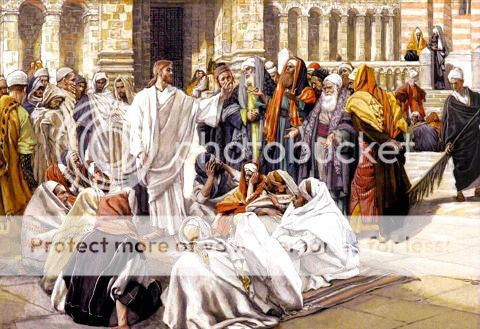
"Woe to you, scribes and Pharisees, you hypocrites.
You lock the Kingdom of heaven before men.
You do not enter yourselves,
nor do you allow entrance to those trying to enter.

"Woe to you, scribes and Pharisees, you hypocrites.
You traverse sea and land to make one convert,
and when that happens you make him a child of Gehenna
twice as much as yourselves.

"Woe to you, blind guides, who say,
'If one swears by the temple, it means nothing,
but if one swears by the gold of the temple, one is obligated.'
Blind fools, which is greater, the gold,
or the temple that made the gold sacred?
And you say, 'If one swears by the altar, it means nothing,
but if one swears by the gift on the altar, one is obligated.'
You blind ones, which is greater, the gift,
or the altar that makes the gift sacred?
One who swears by the altar swears by it and all that is upon it;
one who swears by the temple swears by it
and by him who dwells in it;
one who swears by heaven swears by the throne of God
and by him who is seated on it."
user posted image

REFLECTION

Woe to you,… Hypocrites. Jesus pronounces this invective against the scribes and Pharisees who hinder people from
going to heaven. Instead of making them saints, these religious leaders are making people evil. They invent a lot of
unnecessary things in the name of religion and require people to do them. They abuse their little knowledge and
prestige. They take advantage of people’s ignorance.

Jesus calls these spiritual teachers hypocrites. They will be punished severely for misleading the people. They will
not enter the Kingdom of heaven. That is the consequence of their pretentions.

It is true that we need teachers; it is dangerous to handle faith and Scriptures just by oneself or without a good
reference. But if even the teachers do not know their own theology, anything can happen. Theology puts all things
about faith and traditions into their proper places. It is a kind of check and balance. It prevents or minimizes
misinterpretation or erroneous conclusion.

Do you know and live your faith enough to teach it by word and example?

SOURCE: “365 Days with the Lord 2017,” ST. PAULS Philippines, 7708 St. Paul Rd., SAV, Makati City (Phils.) http://www.ssp.ph/
user posted image

khool
post Aug 28 2017, 02:07 PM

Getting Started
**
Junior Member
225 posts

Joined: Mar 2008


user posted image

khool
post Aug 28 2017, 02:12 PM

Getting Started
**
Junior Member
225 posts

Joined: Mar 2008


WORD Today

user posted image

Today's Readings are reminders of the true intention of religion.

In the Gospel, Jesus reminds us who are in a position to teach the faith, not to focus too much on the rules and technicalities of the faith to the point of scaring and driving away those we are supposed to bring to Christ. Rules are necessary to keep order and technicalities to keep the faith pure. But we need good judgment and patience not to let strict implementation "lock the Kingdom of heaven" and "not allow entrance to those trying to get in."

We also need to keep in mind what Jesus teaches about correcting others, to do it privately and to do it with love and for love (Matthew 18:15).

In the First Reading, St. Paul, writing to his spiritual children in the church of Thessalonica, shows them gentleness, encouragement and love. He praises their "work of faith and labor of love, and endurance in hope of our Lord Jesus Christ."

Try to recall the last time you praised and encouraged those under you.

Finally, the Responsorial Psalm reminds us that "The Lord takes delight in His people."

Let us pray we are bringing God His delight.


Source: https://www.facebook.com/CatholicMassReflec...503882399914449

khool
post Aug 28 2017, 02:39 PM

Getting Started
**
Junior Member
225 posts

Joined: Mar 2008


Saint Augustine: Theologian, Bishop, and Doctor
By Jean M. Heimann

user posted image

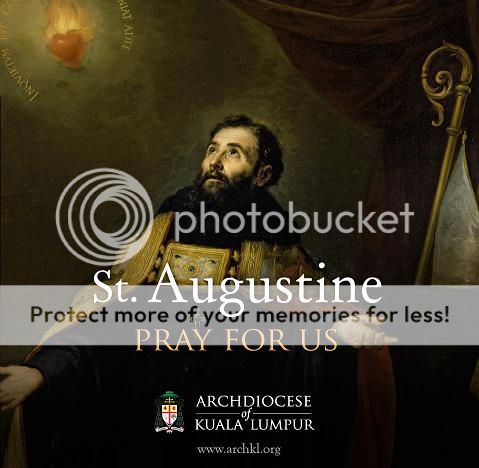
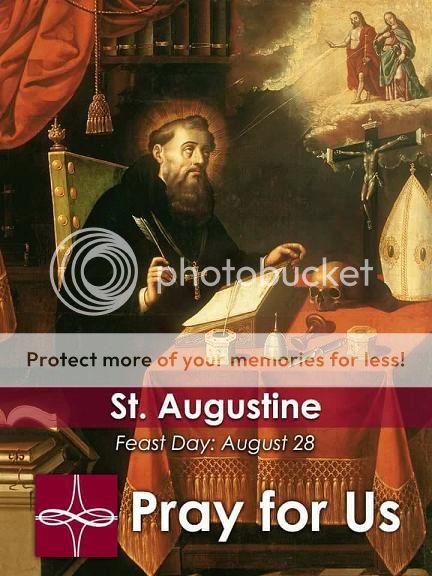
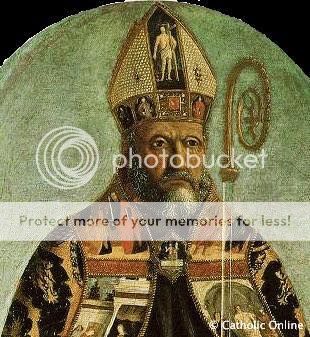
August 28th is the feast of Saint Augustine, a Western Father of the Church whose conversion to Christianity is well-known as one of the most important events in the history of the Church. He was an illustrious theologian, a brilliant bishop, and a great Doctor of the Church. Saint Augustine is the patron of theologians, brewers, printers, and sore eyes.

Saint Augustine was born in Tagaste, Africa in 354 to Patricius, a pagan Roman official, and to Monica, a devout Christian. Monica raised Augustine in the Christian faith, but when he went to college to study law in Carthage, he turned away from his Christian beliefs and led a life of immorality and hedonism.

At age 15, he took a took a mistress who bore him a son, Adeodatus, which means “the gift of God,” and at age 18, he and his friend, Honoratus became members of the Manichaean heretical sect, which accepted the dual principle of good and evil and promoted a lax moral code.

The late Venerable Archbishop Fulton J. Sheen explained his attraction to the heresy: “The conflict between flesh and spirit in him was resolved by the heresy of Manichæanism because it enabled him to pursue a voluptuous life without ever being held accountable for it. He could say that the evil principle within him was so strong, so deep, and intense that the good principle could not operate.”

Augustine turned away from his pursuit of law to literary endeavors and won poetic tournaments and made a name for himself in the world of philosophy. Augustine made plans to teach in Rome, but instead went to Milan, where he had planned to promote paganism.

When he arrived in Milan, he learned of the scholarship and the oratorical skills of Ambrose, the Bishop. Out of admiration for the bishop’s oratorical gifts, Augustine frequently listened to the eloquent homilies of Ambrose. Later on, Augustine spent hours in his company, discussing philosophy. He also borrowed books from the bishop’s personal library to read.

Through the persistent prayers of his mother, St. Monica, and the help of Saint Ambrose of Milan, Augustine finally left the Manicheans and converted to Christianity. On Holy Saturday in 378, both Augustine and his illegitimate son were baptized into the Church by Saint Ambrose.

St. Monica died in Ostia (modern Italy) and Saint Augustine remained in Italy, for a time, praying, studying and writing, before returning to Tagaste, Africa, where he sold all his possessions and distributed the money to the poor. He was ordained as a priest in 391. He was later made bishop of Hippo at the age of 41 and became one of the four great founders of religious orders and a Doctor of the universal Church. Saint Augustine of Hippo died on August 30, 430.

His over 1700 writings include sermons, treatises, scriptural commentaries, and his classic books Confessions and The City of God.

Saint Quotes

user posted image

God has no need of your money, but the poor have. You give it to the poor, and God receives it. – Saint Augustine

The honors of this world, what are they but puff, and emptiness and peril of falling? – Saint Augustine

What do you possess if you possess not God? – Saint Augustine

Unhappy is the soul enslaved by the love of anything that is mortal. – Saint Augustine

user posted image

The love of worldly possessions is a sort of bird line, which entangles the soul, and prevents it flying to God. – Saint Augustine

This very moment I may, if I desire, become the friend of God. – Saint Augustine

God bestows more consideration on the purity of the intention with which our actions are performed than on the actions themselves. – Saint Augustine

I will suggest a means whereby you can praise God all day long, if you wish. Whatever you do, do it well, and you have praised God. – Saint Augustine

user posted image

This is the business of our life. By labor and prayer to advance in the grace of God, till we come to that height of perfection in which, with clean hearts, we may behold God. – Saint Augustine

God in his omnipotence could not give more, in His wisdom He knew not how to give more, in His riches He had not more to give, than the Eucharist. – Saint Augustine

Our life and our death are with our neighbor. – Saint Augustine

Conquer yourself and the world lies at your feet. – Saint Augustine


user posted image

QUOTE
Prayer of Saint Augustine
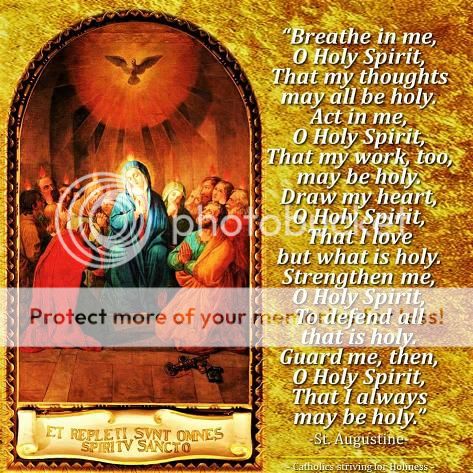
Breathe in me O Holy Spirit, that my thoughts may all be holy; Act in me O Holy Spirit, that my work, too, may be holy; Draw my heart O Holy Spirit, that I love but what is holy; Strengthen me O Holy Spirit, to defend all that is holy; Guard me, then, O Holy Spirit, that I always may be holy. Amen.


user posted image

Source: http://www.jeanmheimann.com/2017/08/saint-...-bishop-doctor/

khool
post Aug 29 2017, 10:14 AM

Getting Started
**
Junior Member
225 posts

Joined: Mar 2008


Memorial of the Passion of Saint John the Baptist
Lectionary: 426/634


user posted image

Reading 1 (Jeremiah 1:17-19)

But you, gird up your loins;
stand up and tell them everything that I command you.
Do not break down before them,
or I will break you before them.
And I for my part have made you today a fortified city,
an iron pillar, and a bronze wall, against the whole land—
against the kings of Judah, its princes, its priests,
and the people of the land.
They will fight against you;
but they shall not prevail against you,
for I am with you, says the Lord, to deliver you.

Responsorial Psalm (Ps 139:1-3, 4-6)

R. You have searched me and you know me, Lord.

O LORD, you have probed me and you know me;
you know when I sit and when I stand;
you understand my thoughts from afar.
My journeys and my rest you scrutinize,
with all my ways you are familiar.
R. You have searched me and you know me, Lord.

Even before a word is on my tongue,
behold, O LORD, you know the whole of it.
Behind me and before, you hem me in
and rest your hand upon me.
Such knowledge is too wonderful for me;
too lofty for me to attain.
R. You have searched me and you know me, Lord.

Alleluia (Mt 5:10)

R. Alleluia, alleluia.
Blessed are those who are persecuted for the sake of righteousness,
for theirs is the Kingdom of heaven.
R. Alleluia, alleluia.

Gospel (Mk 6:17-29)

Herod was the one who had John the Baptist arrested and bound in prison
on account of Herodias,
the wife of his brother Philip, whom he had married.
John had said to Herod,
"It is not lawful for you to have your brother's wife."
Herodias harbored a grudge against him
and wanted to kill him but was unable to do so.
Herod feared John, knowing him to be a righteous and holy man,
and kept him in custody.
When he heard him speak he was very much perplexed,
yet he liked to listen to him.
She had an opportunity one day when Herod, on his birthday,
gave a banquet for his courtiers,
his military officers, and the leading men of Galilee.
Herodias' own daughter came in
and performed a dance that delighted Herod and his guests.
The king said to the girl,
"Ask of me whatever you wish and I will grant it to you."
He even swore many things to her,
"I will grant you whatever you ask of me,
even to half of my kingdom."
She went out and said to her mother,
"What shall I ask for?"
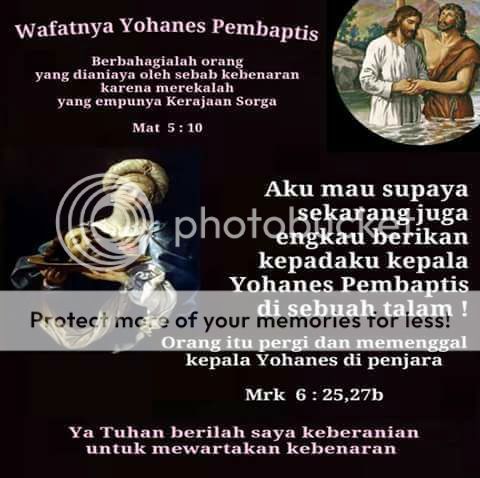
She replied, "The head of John the Baptist."
The girl hurried back to the king's presence and made her request,
"I want you to give me at once
on a platter the head of John the Baptist."
The king was deeply distressed,
but because of his oaths and the guests
he did not wish to break his word to her.
So he promptly dispatched an executioner with orders
to bring back his head.
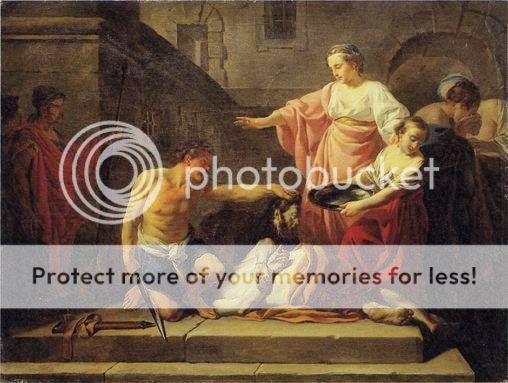
He went off and beheaded him in the prison.
He brought in the head on a platter and gave it to the girl.
The girl in turn gave it to her mother.
When his disciples heard about it,
they came and took his body and laid it in a tomb.

user posted image

REFLECTION

user posted image

They… took his body and laid it in a tomb. The disciples here are John the Baptist’s. Like any other popular preacher
or charismatic leader of groups like the Pharisees, Sadducees, Herodians, Essenes, and Qumran people, John the
Baptist has his disciples or followers.

It must shock his disciples to learn of John’s execution. What a waste of the life of a holy man! And all because of
Herod’s mistakes: his illicit relationship with the wife of his brother Philip, his tactless oath to give whatever is
asked, and his cowardice to take back a bad promise. Herod’s recklessness victimizes John whom he wants to keep.
The remains of John are probably discarded unceremoniously. His disciples are quick to take his body and pay him
their last respects before burying him.

The action of John’s disciples presages how also Jesus’ body will be taken from the cross and laid in a tomb.
Do you treat your dead with care, respect, love, and devotion?

SOURCE: “365 Days with the Lord 2017,” ST. PAULS Philippines, 7708 St. Paul Rd., SAV, Makati City (Phils.)
http://www.ssp.ph/

Saint of the Day: Beheading of St John the Baptist

St John, the baptizer, lived in a desert until the day when he
started preaching penance, to “prepare for the Lord a perfect people”. His hearers were urged to be faithful and
honest in fulfilling their worldly duties and to be baptized in the Jordan for the remission of repented sins. On the
day when Jesus submitted to this ceremony, the Father manifested him to the world: “This is my beloved Son in whom I
am well pleased!” (Mt 3:17)

John gathered many disciples together and taught them to lead a life of prayer and fasting. Then, for having openly
rebuked King Herod Antipas for his incestuous relationship with Herodias, his half-brother’s wife, he was arrested
and imprisoned in the mountain fortress of Machaerus. Herodias never forgave him and did not rest until Herod ordered
the Precursor’s decapitation, the result of a rashly taken oath on the occasion of Salome’s notorious dance at
Herod’s birthday celebrations. All this took place about a year before Jesus’ own Passion.

Reflection: “Such was the quality and the strength of the man who accepted the end of this present life by shedding
his blood after the long imprisonment” (St Bede the Venerable).

Source: https://www.facebook.com/stpaulspubindia/po...445040325574166

user posted image


This post has been edited by khool: Aug 29 2017, 05:49 PM
khool
post Aug 29 2017, 01:48 PM

Getting Started
**
Junior Member
225 posts

Joined: Mar 2008


khool
post Aug 29 2017, 02:03 PM

Getting Started
**
Junior Member
225 posts

Joined: Mar 2008


WORD Today
August 29, 2017
(A reflection on the Bible readings in today's Holy Mass)


user posted image

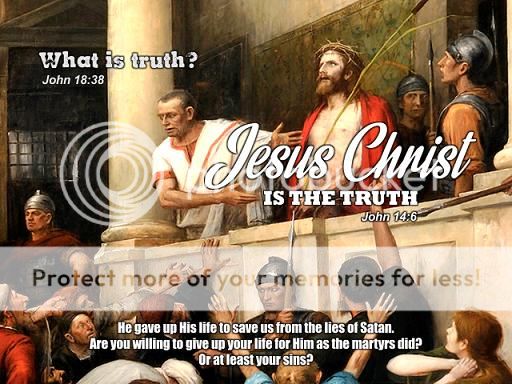
God's Truth is eternal because He is eternal. His truth does not change with time because He is unchanging. And so is His command to all His creatures to stand up and speak His truth.

In the First Reading, many centuries before Jesus, His Father commanded Prophet Jeremiah, "Get yourself ready! Stand up and say to them whatever I command you. Do not be terrified by them, or I will terrify you before them."

Jeremiah obeyed and suffered greatly for doing so

Today we honor the Martyrdom of John the Baptist. He was beheaded to silence God's Truth that he spoke of. We read in the Gospel how bravely he denounced the adultery of King Herod and his brother's wife Herodias.

Throughout the centuries, thousands would follow St. John the Baptist to martyrdom for standing up for the Truth that is Jesus Christ.

We recall St. Paul, who said, "Do not be deceived: Neither the sexually immoral, nor idolaters, nor adulterers, nor men who have sex with men, nor thieves, nor the greedy, nor drunkards, nor slanderers, nor swindlers will inherit the Kingdom of God." (1 Corinthians 6:9-10 NIV)

He too was beheaded.

Today the world wants to behead Christ's Truth and replace it with a thousand personal "truths". We are told that there is no more sin, only "personal choices". We are told to quietly live our faith and let others have their "choice" of truth.

But as followers of Christ, we cannot believe these lies. Sin will always be sin. God's command to His prophets Jeremiah, John the Baptist and Paul to denounce sin is also for all of us who share in Christ's prophetic mission. For pointing out what is sinful, we could lose our head, or our job, or a benefactor, or our popularity, or a friend. But that's the cost of following Christ's command to love one another - body and soul.

When we finally stand before Jesus our Judge, He will ask what battle we fought for Him. He will show us His battle wounds. Can you show Him yours?

Source: https://www.facebook.com/CatholicMassReflec...503975117600758

user posted image

khool
post Aug 29 2017, 02:07 PM

Getting Started
**
Junior Member
225 posts

Joined: Mar 2008


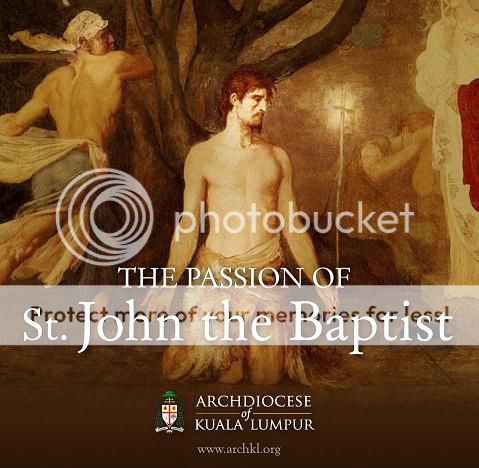
The Passion of Saint John the Baptist

user posted image
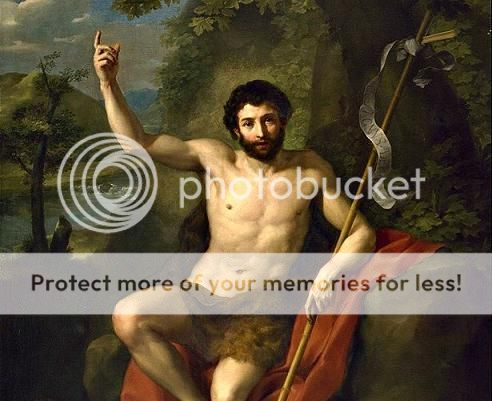
St. John the Baptist Preaching in the Wilderness

On June 24, we celebrated the birthday of Saint John the Baptist; on August 29, we commemorate the anniversary of his martyrdom, also known as the Passion of Saint John the Baptist.

After he had baptized Jesus, John the Baptist began to condemn Herod Antipas, the governor of Galilee. John had the courage to confront Herod and condemn him for the scandal of his illegal union with his sister-in-law Herodias, whose husband was still alive. John the Baptist stated, “It is not lawful for you to have her.” With those words, Herod threw him into prison.

Not only did Herod fear John and his disciples, he also knew that he was a virtuous man, so he did not kill him. However, Herodias was determined to bring about John’s death so she contrived a plot to do just that. Herod gave an eloquent banquet to celebrate his birthday. His full court was present as well as many other powerful and influential Palestinians. Herodias’s daughter Salome pleased Herod so much when she danced to entertain the company that he promised her whatever she would ask–even half of his kingdom. Salome went to her mother to ask what she should request. Herodias replied, “The head of John the Baptist.”

Due to his pride, Herod, though remorseful, could not refuse the request; hence, he directed a soldier of the guard to behead John in prison. John’s head was placed on a platter and taken to Salome, who delivered it to her mother.

When John’s disciples heard what had happened, they took away his body and laid it in a tomb, where he was venerated in the 4th century.

What Saint John the Baptist Teaches us

Saint John the Baptist stepped out boldly in faith to condemn the sin and point out the truth. Sinners hate the truth. They do not want others to tell them that what they are doing is wrong because it means that they will need to change their evil ways. However, they don’t want to stop sinning because they are in love with their sin. They are comfortably attached to it and often addicted to it.

Saint John the Baptist called for repentance, for conversion of heart and acceptance of God’s ways. He not only spoke about penance and conversion, but he lived a very austere life. He lived off the land, eating grasshoppers and honey. He dressed in rough clothing made of camel hair. He was completely detached from the material things around him. His reason for doing this was to prepare the way for the Savior. His example of holiness encourages each of us to examine our lives both interiorly and exteriorly.

As we await Christ’s final coming in the dessert of our hearts, we need to spend time in silence, to discern exactly what Christ is calling us to do in the Kingdom. We need to ask the Holy Spirit to open our hearts and minds, to enlighten us daily that we will know His will and have the courage to carry it out in our lives. We, too, need to prepare for His coming, through fasting, prayer and penance, detaching ourselves from material things, and from the sins to which we are so selfishly attached.

Exteriorly, we are called to speak out boldly against the immoralities that occur in our world today — abortion, euthanasia, adultery, human trafficking, and so much more. By virtue of our Baptism and Confirmation, we have been given the graces and the gifts to act prudently and with fortitude. Like Saint John the Baptist, through our prayer and penance, and our public witness, we, too, can prepare the way for Jesus, for ourselves and for others.

Source: http://www.jeanmheimann.com/2017/08/passio...t-john-baptist/

TSyeeck
post Aug 30 2017, 12:00 AM

Look at all my stars!!
*******
Senior Member
3,573 posts

Joined: Apr 2006


Does The Catholic Church Believe in Ghosts?

user posted image

Everyone wonders from time to time if a ghost may be in their presence. Some of us hope to catch a glimpse of one of our loved ones that have passed on. We want to know that they are okay. But as Catholics, should we believe in ghosts on earth? We hear of real life ghost interactions all the time on television and in books, but are they real? And if they are real, are they good? These occurrences that people speak of could possibly be true, but contrary to popular belief, the ghosts that are seen are not human souls that are trapped on earth with a special mission in order to get to heaven. Sorry, it does not work like the movies. If you see a ghost, it is more likely to be a demon that has transformed into a ghost or spirit of a human being to lead us away from the truth.

The Catholic Church very much believes in the spiritual realm. Ephesians 6:11-12 says, “Put you on the armor of God so that you may be able to stand firm against the tactics of the devil. For our struggle is not with the flesh and blood but with the principalities, with the powers, with the world rulers of this present darkness, with the evil spirits in the heavens.” This scripture tells us we should be prepared for evil spirits in the darkness who seek to ruin our souls. The church discourages us from trying to contact the dead because it can be hard to tell if the messages being received are from a deceased relative, an angel, a saint, or a demon. Demons know how to manipulate us, so we would not know if the spirit is evil or good. If you feel like you are being contacted by a spirit, you should discuss it with a priest before ever trying to interact with them. Although you may not have contacted them, they can appear to us on their own. If this happens, seek spiritual counseling with a priest. He should be able to tell you if the spirit is evil or sent from God. If he can’t, he can put you in touch with an exorcist priest.

As per the Catechism of the Catholic Church, we are forbidden as Catholics to seek out the dead, or demons. CCC 2116 tells us that all forms of divination are to be rejected, and anything else that is meant to unveil the future such as consulting horoscopes, astrology, palm reading, interpretation of omens and lots, the phenomena of clairvoyance, and recourse to mediums should also be rejected. Over time, these practices will give us the desire for power which would contradict the honor, respect and loving fear that we owe to God alone. In CCC 2117 we are told we should not use magic to have a supernatural power over others or ourselves. Even if the magic seems like it is for something good, such as one’s own sickness, we would not be respecting the virtue of religion. As Catholics, we should pray for what ails us, seeking God’s powers and not our own.

The only time souls can contact us is if they are sent from God himself. God only sends them for our salvation. So, forget the Ouija boards, or tarot cards and just pray. If you want magic, prayer is where the real magic lies.
khool
post Aug 30 2017, 02:58 PM

Getting Started
**
Junior Member
225 posts

Joined: Mar 2008


Wednesday of the Twenty-first Week in Ordinary Time
Lectionary: 427


user posted image

Reading 1 (1 Thes 2:9-13)

You recall, brothers and sisters, our toil and drudgery.
Working night and day in order not to burden any of you,
we proclaimed to you the Gospel of God.
You are witnesses, and so is God,
how devoutly and justly and blamelessly
we behaved toward you believers.
As you know, we treated each one of you as a father treats his children,
exhorting and encouraging you and insisting
that you walk in a manner worthy of the God
who calls you into his Kingdom and glory.

And for this reason we too give thanks to God unceasingly,
that, in receiving the word of God from hearing us,
you received it not as the word of men, but as it truly is, the word of God,
which is now at work in you who believe.

Responsorial Psalm (Ps 139:7-8, 9-10, 11-12ab)

R. You have searched me and you know me, Lord.

Where can I go from your spirit?
From your presence where can I flee?
If I go up to the heavens, you are there;
if I sink to the nether world, you are present there.
R. You have searched me and you know me, Lord.

If I take the wings of the dawn,
if I settle at the farthest limits of the sea,
Even there your hand shall guide me,
and your right hand hold me fast.
R. You have searched me and you know me, Lord.

If I say, "Surely the darkness shall hide me,
and night shall be my light"–
For you darkness itself is not dark,
and night shines as the day.
R. You have searched me and you know me, Lord.

Alleluia (1 Jn 2:5)

R. Alleluia, alleluia.
Whoever keeps the word of Christ,
the love of God is truly perfected in him.
R. Alleluia, alleluia.

Gospel (Mt 23:27-32)

Jesus said,
"Woe to you, scribes and Pharisees, you hypocrites.
You are like whitewashed tombs, which appear beautiful on the outside,
but inside are full of dead men's bones and every kind of filth.
Even so, on the outside you appear righteous,
but inside you are filled with hypocrisy and evildoing.

"Woe to you, scribes and Pharisees, you hypocrites.
You build the tombs of the prophets
and adorn the memorials of the righteous,
and you say, 'If we had lived in the days of our ancestors,
we would not have joined them in shedding the prophets' blood.'
Thus you bear witness against yourselves
that you are the children of those who murdered the prophets;
now fill up what your ancestors measured out!"

user posted image

REFLECTION

With this image, Jesus denounces the hypocrisy of the scribes and Pharisees who appear beautiful on the outside but are rotten inside. Instead, these teachers of religion should strive to look nice both in and out or be consistently good within and without. As they take care of their external appearance, they should clean up their internal garbage. They should not deceive people and use religion to victimize the unsuspecting innocent.

The scribes and Pharisees build monuments and make images or memorials to saints and prophets. They present themselves as better than their ancestors who murdered the prophets. But they are also killers, because they are trying to silence Jesus and his disciples.

Jesus demands sincerity in the practice of religion. Those who are interested must listen to him. They are not in church to gain recognition and to be served. True adherents of religion are formed and trained to be God-centered and other-centered.

You are a true believer of Jesus when you look to others’ interests before your own.

SOURCE: “365 Days with the Lord 2017,” ST. PAULS Philippines, 7708 St. Paul Rd., SAV, Makati City (Phils.) http://www.ssp.ph/

user posted image

khool
post Aug 30 2017, 03:00 PM

Getting Started
**
Junior Member
225 posts

Joined: Mar 2008


"Who is God?"

user posted image

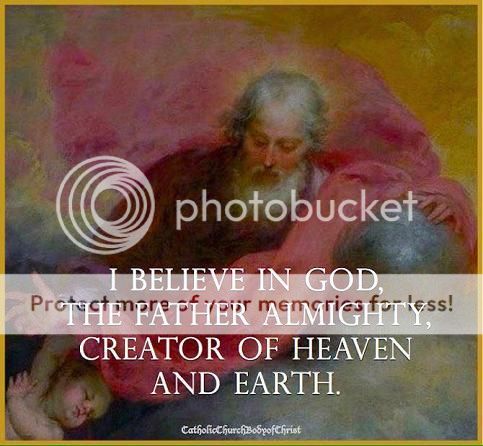
My brothers and sisters, do you ever find yourself asking "Who is God?"

Man has always felt that tug towards the divine, toward something out there that he could not understand but wants to. Our culture is always trying to achieve the bigger, better deal. We want the most beautiful spouses, the most money, the biggest houses. We want a lot of stuff! Despite all of this, man wants more. At some point, even the richest people on the earth realize that there is more to life than getting more.

The something more is God. Every time we say something is beautiful, good, or even right, we are saying it is in comparison to that which is ultimate good and truth. That is God. We may not know that we are comparing these things in our lives to God, but we are. This is why Mother Teresa was considered one of the most beautiful women ever. Her radiance reflected God.

We look at the beginnings of the universe - at the Big Bang theory, at evolution, at the fossil record - yet we cannot find the human spirit, the human soul.

God is a pure spirit. As the Spirit is immortal, without end, but also without beginning. Everything is always present to Him and He exists outside of time. Since He does not change, there is nothing that is missing from Him.

He is all knowledge, which is the knowledge of everything on heaven and that was, is, and will to be. We as human beings have enough trouble even understanding ourselves, let alone the person next to us, and any given time. God is such pure knowledge that he knows more of us then we know, and more of others than they could ever revealed to us.

He is all love, which is the choice for the alternate good for all at all times. God's love is creative, which is shown in the creativity of the universe and all that is around us. There is variety from the smallest creature to the most complex person. In all times, God's love allows for free will. God freely chooses us when He does not have to or has no need to. His love is given totally, holding nothing of His divine nature back from us. His love, like His promises, will never fail, as God never changes.

In every description, we fall short of the true nature of God due to the fact that we are using human language - which is created by humans, who are created by God - to describe the Creator!

+ Peace and blessings - may your day be filled with happiness and peace +

user posted image

khool
post Aug 30 2017, 03:04 PM

Getting Started
**
Junior Member
225 posts

Joined: Mar 2008


user posted image

khool
post Sep 5 2017, 09:23 AM

Getting Started
**
Junior Member
225 posts

Joined: Mar 2008


Tuesday of the Twenty-second Week in Ordinary Time
Lectionary: 432


user posted image

Reading 1 (1 Thes 5:1-6, 9-11)

Concerning times and seasons, brothers and sisters,
you have no need for anything to be written to you.
For you yourselves know very well
that the day of the Lord will come like a thief at night.
When people are saying, "Peace and security,"
then sudden disaster comes upon them,
like labor pains upon a pregnant woman,
and they will not escape.

But you, brothers and sisters, are not in darkness,
for that day to overtake you like a thief.
For all of you are children of the light
and children of the day.
We are not of the night or of darkness.
Therefore, let us not sleep as the rest do,
but let us stay alert and sober.
For God did not destine us for wrath,
but to gain salvation through our Lord Jesus Christ,
who died for us, so that whether we are awake or asleep
we may live together with him.
Therefore, encourage one another and build one another up,
as indeed you do.

Responsorial Psalm (Ps 27:1, 4, 13-14)

R. I believe that I shall see the good things of the Lord in the land of the living.

The LORD is my light and my salvation;
whom should I fear?
The LORD is my life's refuge;
of whom should I be afraid?
R. I believe that I shall see the good things of the Lord in the land of the living.

One thing I ask of the LORD;
this I seek:
To dwell in the house of the LORD
all the days of my life,
That I may gaze on the loveliness of the LORD
and contemplate his temple.
R. I believe that I shall see the good things of the Lord in the land of the living.

I believe that I shall see the bounty of the LORD
in the land of the living.
Wait for the LORD with courage;
be stouthearted, and wait for the LORD.
R. I believe that I shall see the good things of the Lord in the land of the living.

Alleluia (Lk 7:16)

R. Alleluia, alleluia.
A great prophet has arisen in our midst
and God has visited his people.
R. Alleluia, alleluia.

Gospel (Lk 4:31-37)

Jesus went down to Capernaum, a town of Galilee.
He taught them on the sabbath,
and they were astonished at his teaching
because he spoke with authority.
In the synagogue there was a man with the spirit of an unclean demon,
and he cried out in a loud voice,
"What have you to do with us, Jesus of Nazareth?
Have you come to destroy us?
I know who you are–the Holy One of God!"
Jesus rebuked him and said, "Be quiet! Come out of him!"
Then the demon threw the man down in front of them
and came out of him without doing him any harm.
They were all amazed and said to one another,
"What is there about his word?
For with authority and power he commands the unclean spirits,
and they come out."
And news of him spread everywhere in the surrounding region.

user posted image

REFLECTION

I know who you are – the Holy One of God! Though the title “the Holy One of God” rightly applies to Jesus (cf Lk 1:35), this is not a profession of faith by the demon but an attempt to gain power over him. In the Bible and among ancient oriental peoples, to name someone is to control him through the knowledge of his power and mission. Elsewhere, in his encounter with the Gerasene demoniac, Jesus asks the possessed man, “What is your name?” Overpowered by Jesus, he replies, “Legion is my name. There are many of us” (Mk 5:9).

Here in Luke, the demon has an inkling that Jesus is someone close to God who has the power to destroy him. His frantic attempt to control Jesus does not succeed, however. Guided by the Spirit of God, Jesus drives the devil out of the man, without harming him. The people are amazed about Jesus’ word that has authority and power – like the word of God that commanded the universe to come into being at creation.

“Resist the devil, and he will flee from you” (Jas 4:7).

SOURCE: “365 Days with the Lord 2017,” ST. PAULS Philippines, 7708 St. Paul Rd., SAV, Makati City (Phils.) http://www.ssp.ph/

user posted image

This post has been edited by khool: Sep 6 2017, 09:51 AM
khool
post Sep 5 2017, 01:45 PM

Getting Started
**
Junior Member
225 posts

Joined: Mar 2008


khool
post Sep 5 2017, 05:11 PM

Getting Started
**
Junior Member
225 posts

Joined: Mar 2008


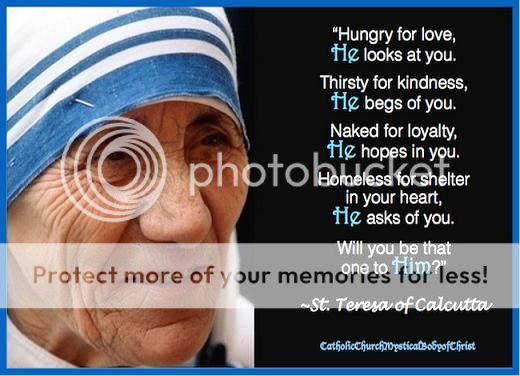
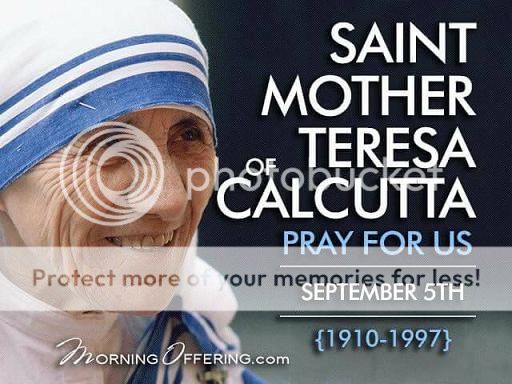
St. Teresa of Calcutta (August 26, 1910- September 5, 1997)

user posted image

Born to Albanian parents in what is now Skopje, Macedonia, Gonxha (Agnes) Bojaxhiu was the youngest of the three children who survived. For a time, the family lived comfortably, and her father’s construction business thrived. But life changed overnight following his unexpected death.

During her years in public school, Agnes participated in a Catholic sodality and showed a strong interest in the foreign missions. At age 18, she entered the Loreto Sisters of Dublin. It was 1928 when she said goodbye to her mother for the final time and made her way to a new land and a new life.

The following year she was sent to the Loreto novitiate in Darjeeling, India. There she chose the name Teresa and prepared for a life of service. She was assigned to a high school for girls in Calcutta, where she taught history and geography to the daughters of the wealthy. But she could not escape the realities around her—the poverty, the suffering, the overwhelming numbers of destitute people.

In 1946, while riding a train to Darjeeling to make a retreat, Sister Teresa heard what she later explained as “a call within a call. The message was clear. I was to leave the convent and help the poor while living among them.” She also heard a call to give up her life with the Sisters of Loreto and instead, to “follow Christ into the slums to serve him among the poorest of the poor.”

After receiving permission to leave Loreto, establish a new religious community, and undertake her new work, Sister Teresa took a nursing course for several months. She returned to Calcutta, where she lived in the slums and opened a school for poor children.

Dressed in a white sari and sandals–the ordinary dress of an Indian woman–she soon began getting to know her neighbors—especially the poor and sick—and getting to know their needs through visits.

The work was exhausting, but she was not alone for long. Volunteers who came to join her in the work, some of them former students, became the core of the Missionaries of Charity. Others helped by donating food, clothing, supplies, and the use of buildings.

In 1952, the city of Calcutta gave Mother Teresa a former hostel, which became a home for the dying and the destitute. As the order expanded, services were also offered to orphans, abandoned children, alcoholics, the aging, and street people.

For the next four decades, Mother Teresa worked tirelessly on behalf of the poor. Her love knew no bounds. Nor did her energy, as she crisscrossed the globe pleading for support and inviting others to see the face of Jesus in the poorest of the poor.

In 1979, she was awarded the Nobel Peace Prize. On September 5, 1997, God called her home.

Mother Teresa of Calcutta, the tiny woman recognized throughout the world for her work among the poorest of the poor, was beatified October 19, 2003. Among those present were hundreds of Missionaries of Charity, the order she founded in 1950, as a diocesan religious community. Today the congregation also includes contemplative sisters and brothers and an order of priests. Blessed Teresa was canonized by Pope Francis on September 4, 2016.

Source: https://www.facebook.com/CatholicOrthodoxyB...463969580350624

user posted image


This post has been edited by khool: Sep 6 2017, 09:50 AM
khool
post Sep 6 2017, 09:47 AM

Getting Started
**
Junior Member
225 posts

Joined: Mar 2008


Wednesday of the Twenty-second Week in Ordinary Time
Lectionary: 433


user posted image

Reading 1 (Col1:1-8)

Paul, an Apostle of Christ Jesus by the will of God,
and Timothy our brother,
to the holy ones and faithful brothers and sisters in Christ in Colossae:
grace to you and peace from God our Father.

We always give thanks to God, the Father of our Lord Jesus Christ,
when we pray for you,
for we have heard of your faith in Christ Jesus
and the love that you have for all the holy ones
because of the hope reserved for you in heaven.
Of this you have already heard
through the word of truth, the Gospel, that has come to you.
Just as in the whole world it is bearing fruit and growing,
so also among you,
from the day you heard it and came to know the grace of God in truth,
as you learned it from Epaphras our beloved fellow slave,
who is a trustworthy minister of Christ on your behalf
and who also told us of your love in the Spirit.

Responsorial Psalm (Ps 52:10, 11)

R. I trust in the mercy of God for ever.

I, like a green olive tree
in the house of God,
Trust in the mercy of God
forever and ever.
R. I trust in the mercy of God for ever.

I will thank you always for what you have done,
and proclaim the goodness of your name
before your faithful ones.
R. I trust in the mercy of God for ever.

Alleluia (Lk 4:18)

R. Alleluia, alleluia.
The Lord sent me to bring glad tidings to the poor
and to proclaim liberty to captives.
R. Alleluia, alleluia.

Gospel (Lk 4:38-44)

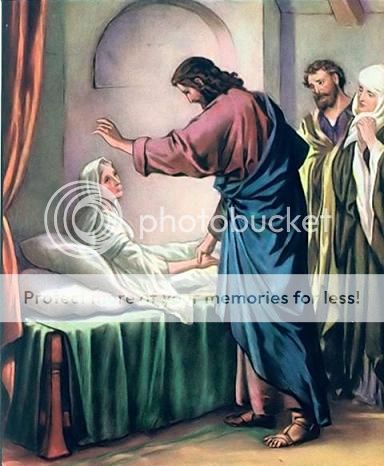
After Jesus left the synagogue, he entered the house of Simon.
Simon's mother-in-law was afflicted with a severe fever,
and they interceded with him about her.
He stood over her, rebuked the fever, and it left her.
She got up immediately and waited on them.

At sunset, all who had people sick with various diseases brought them to him.
He laid his hands on each of them and cured them.
And demons also came out from many, shouting, "You are the Son of God."
But he rebuked them and did not allow them to speak
because they knew that he was the Christ.

At daybreak, Jesus left and went to a deserted place.
The crowds went looking for him, and when they came to him,
they tried to prevent him from leaving them.
But he said to them, "To the other towns also
I must proclaim the good news of the Kingdom of God,
because for this purpose I have been sent."
And he was preaching in the synagogues of Judea.

user posted image

REFLECTION

They interceded with Him about Her. In Luke’s arrangement of materials from his source (Mk 1:29-31), Simon is mentioned here for the first time. He is presented as a married man (cf 1 Cor 9:5) owning a house; his mother-in-law is either staying with him or visiting there. Luke alters his source to stress the miraculous element, especially since the subject is a woman (the evangelist shows special interest in women in his Gospel). He heightens the scene: the fever is described, the healing is commanded, and the result is immediate.

Thus, Jesus’ concern for both men and women, for those possessed by evil spirits, and for the sick, is brought out here. Situated as it is before the call of Simon, the healing also helps the reader to understand Simon’s eagerness to do what Jesus says and to follow him. Simon and his family receive God’s blessing through Jesus, the “prophet” from Nazareth.

Do you believe that prayers help the sick? Do you pray for the grace of healing for members of your family and friends?

SOURCE: “365 Days with the Lord 2017,” ST. PAULS Philippines, 7708 St. Paul Rd., SAV, Makati City (Phils.) http://www.ssp.ph/

user posted image

This post has been edited by khool: Sep 6 2017, 02:27 PM
khool
post Sep 6 2017, 12:30 PM

Getting Started
**
Junior Member
225 posts

Joined: Mar 2008


khool
post Sep 7 2017, 10:03 AM

Getting Started
**
Junior Member
225 posts

Joined: Mar 2008


Thursday of the Twenty-second Week in Ordinary Time
Lectionary: 434


user posted image

Reading 1 (Col 1:9-14)

Brothers and sisters:
From the day we heard about you, we do not cease praying for you
and asking that you may be filled with the knowledge of God's will
through all spiritual wisdom and understanding
to walk in a manner worthy of the Lord,
so as to be fully pleasing, in every good work bearing fruit
and growing in the knowledge of God,
strengthened with every power, in accord with his glorious might,
for all endurance and patience,
with joy giving thanks to the Father, who has made you fit to share
in the inheritance of the holy ones in light.
He delivered us from the power of darkness
and transferred us to the Kingdom of his beloved Son,
in whom we have redemption, the forgiveness of sins.

Responsorial Psalm (Ps 98:2-3ab, 3cd-4, 5-6)

R. The Lord has made known his salvation.

The LORD has made his salvation known:
in the sight of the nations he has revealed his justice.
He has remembered his kindness and his faithfulness
toward the house of Israel.
R. The Lord has made known his salvation.

All the ends of the earth have seen
the salvation by our God.
Sing joyfully to the LORD, all you lands;
break into song; sing praise.
R. The Lord has made known his salvation.

Sing praise to the LORD with the harp,
with the harp and melodious song.
With trumpets and the sound of the horn
sing joyfully before the King, the LORD.
R. The Lord has made known his salvation.

Alleluia (Mt 4:19)

R. Alleluia, alleluia.
Come after me, says the Lord,
and I will make you fishers of men.
R. Alleluia, alleluia.

Gospel (Lk 5:1-11)

While the crowd was pressing in on Jesus and listening to the word of God,
he was standing by the Lake of Gennesaret.
He saw two boats there alongside the lake;
the fishermen had disembarked and were washing their nets.
Getting into one of the boats, the one belonging to Simon,
he asked him to put out a short distance from the shore.
Then he sat down and taught the crowds from the boat.
After he had finished speaking, he said to Simon,
"Put out into deep water and lower your nets for a catch."
Simon said in reply,
"Master, we have worked hard all night and have caught nothing,
but at your command I will lower the nets."
When they had done this, they caught a great number of fish
and their nets were tearing.
They signaled to their partners in the other boat
to come to help them.
They came and filled both boats
so that the boats were in danger of sinking.
When Simon Peter saw this, he fell at the knees of Jesus and said,
"Depart from me, Lord, for I am a sinful man."
For astonishment at the catch of fish they had made seized him
and all those with him,
and likewise James and John, the sons of Zebedee,
who were partners of Simon.
Jesus said to Simon, "Do not be afraid;
from now on you will be catching men."
When they brought their boats to the shore,
they left everything and followed him.

user posted image

REFLECTION

Put out into deep water. Luke patterns the call of Simon to a prophetic call, like the call of Isaiah (Is 6:1-8). Granted a “vision” of something grand and divine, both figures see themselves as “sinners” unworthy to be in the presence of the Lord. Isaiah calls himself “a man of unclean lips, living among a people of unclean lips,” while Peter kneels before Jesus and begs him, “Depart from me, Lord, for I am a sinful man” (v 8). But confessing one’s sinfulness does not lead to despair or helplessness. Greater than one’s fear is the attraction of the divine. The Lord is mysterium tremendum ac fascinosum – a tremendous, fearful mystery, yet also a fascinating one. So the vision that begins in fear ends up in “following” and “being sent.” Isaiah is sent as a prophet to Israel, while Peter – along with his companions – is tasked to be a “fisher of men.”

“‘Duc in altum – Put out into deep water
and lower your nets for a catch.’ These words
ring out for us today, and they invite us
to remember the past with gratitude, to live
the present with enthusiasm, and to look forward
to the future with confidence” (St. John Paul II).

SOURCE: “365 Days with the Lord 2017,” ST. PAULS Philippines, 7708 St. Paul Rd., SAV, Makati City (Phils.) http://www.ssp.ph/

user posted image

khool
post Sep 7 2017, 10:04 AM

Getting Started
**
Junior Member
225 posts

Joined: Mar 2008


user posted image

user posted image

user posted image

khool
post Sep 7 2017, 10:09 AM

Getting Started
**
Junior Member
225 posts

Joined: Mar 2008


CLENCHED FISTS
Father Henri Nouwen


Dear God,
I am so afraid to open my clenched fists!
Who will I be when I have nothing left to hold on to?
Who will I be when I stand before you with empty hands?
Please, help me to gradually open my hands
and to discover that I am not what I own,
but what you want to give me.
And what you want to give me is love, unconditional, everlasting love.

Amen.


65 Pages « < 13 14 15 16 17 > » Top
 

Change to:
| Lo-Fi Version
0.0207sec    0.48    6 queries    GZIP Disabled
Time is now: 2nd December 2025 - 10:19 AM