
Welcome Guest ( Log In | Register )

Outline · [ Standard ] · Linear+

> China's One Belt One Road is doomed to fail., Incoming white elephant mega projects

views
     
TSnews channel
post May 20 2017, 02:12 PM, updated 9y ago

New Member
*
Newbie
0 posts

Joined: Jul 2016
WHY CHINA’S ‘ONE BELT, ONE ROAD’ PLAN IS DOOMED TO FAIL?


Eerie similarities with Japanese scheme 20 years ago suggests a future of white elephants, wasted money and corruption on a scale never seen before

By Tim Holland

user posted image
Japanese PM Keizo Obuchi had a similar, ill fated idea to China's One Belt One Road in the 1990's.


Facing a deep slowdown after years of investment-fuelled growth that culminated in a huge property and stock market bubble, the leaders of Asia’s largest economy come up with a cunning plan. By launching an initiative to fund and construct infrastructure projects across Asia, they will kill four birds with one stone.

They will generate enough demand abroad to keep their excess steel mills, cement plants and construction companies in business, so preserving jobs at home. They will tie neighbouring countries more closely into their own economic orbit, so enhancing both their hard and soft power around the region. They will further their long term plan to promote their own currency as an international alternative to the US dollar. And to finance it all, they will set up a new multi-lateral infrastructure bank, which will undermine the influence of the existing Washington-based institutions, with all their tedious insistence on transparency and best practice, by making more “culturally sensitive” soft loans. The result will be the regional hegemony they regard as their right as Asia’s leading economic and political power.

If you think you’ve seen this movie before, you probably have. That could be an outline of China’s “One Belt, One Road” initiative, launched last year to great fanfare, and relentlessly promoted by loyal officials ever since. But it’s actually a description of a strikingly similar plan rolled out by Japanese prime minister Keizo Obuchi in the 1990s. That too promised to provide work for Japan’s recession-hit construction sector by building Japanese-funded infrastructure projects around Asia. And it even included a proposal – never realised – to establish an Asian Monetary Fund to lend to regional governments on easier terms than either the IMF or World Bank.

Unfortunately for Beijing, the precedent is hardly encouraging. From the start the scheme was plagued by bickering over conditions and allegations of corruption. A handful of infrastructure projects did get built, but the reality fell woefully short of Tokyo’s grandiose dreams. Far from cementing Japan’s economic ascendancy across Asia, the project left a legacy of bad blood, and marked the beginning of a financial retreat from around the region that Japan has only recently begun to reverse.
user posted image

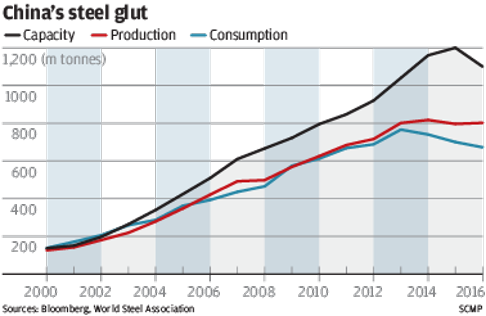
All the signs are that China’s One Belt, One Road plan will similarly fail in its main objectives. First, the idea that infrastructure projects in Central and South East Asia could absorb a sizeable portion of China’s excess industrial capacity is simply unrealistic. Consider steel. Currently China’s steel mills can turn out some 1.1 billion tonnes of the metal annually. Yet even with economic stimulus efforts in full swing, no one expects domestic demand to exceed 700 million tonnes this year. It is hard to imagine China building enough roads, ports and pipelines across Asia to use up the extra 300 million tonnes of capacity, especially when you consider that the World Steel Association forecasts demand in the European Union, the world’s largest economy, to be just 150 million tonnes this year.

Beijing could try. But if it did, it would run into another problem. Asia needs infrastructure development, but the region’s capacity to absorb new projects is limited. As China has learned at home, building a new high speed rail line or state of the art airport is easy enough given plentiful funding. But building a high speed rail line that is economically viable is altogether more difficult. Inevitably, if Beijing attempts to pursue projects at a pace and in a number sufficient to make a dent in its excess capacity, it will end up building white elephants, wasting money, and encouraging corruption on a scale never before seen.

These constraints mean China’s ambition of using lending tied to the One Belt, One Road initiative to help promote the yuan as Asia’s international currency of choice is also destined to fail. What policy-makers had in mind was something akin to the Marshall Plan, by which the United States pumped money into Western Europe in the late 1940s to fund post-war reconstruction, so confirming the US dollar’s position as the world’s dominant reserve currency. But 1940s Europe was very different from Central Asia today. Europe’s physical infrastructure may have been destroyed by war, but its know-how and institutional strength in depth were largely intact. Rebuilding on such foundations was relatively straightforward.

Developing Asia’s foundations are still under construction. But while physical capital like a new port or railway can be built in just a few years, building the human and institutional capital that allow that port to operate efficiently and to contribute effectively to economic and social progress is a slower process. The two need to go hand in hand, which is why multi-lateral lenders like the World Bank lay such heavy stress on best practice. The senior officials charged with implementing China’s grand plan appreciate these capacity constraints, and appear to be scaling down their ambitions. That’s sensible, but it means the One Belt, One Road initiative will fall far short of its original objectives, just as its Japanese forerunner did almost 20 years ago.
user posted image
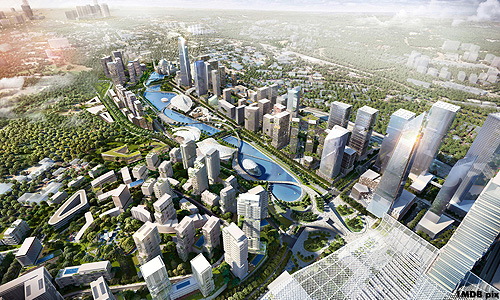
Bandar Malaysia rclxs0.gif

Credit: http://www.scmp.com/week-asia/opinion/arti...lan-doomed-fail

This post has been edited by news channel: May 20 2017, 02:27 PM
TSnews channel
post May 20 2017, 02:28 PM

New Member
*
Newbie
0 posts

Joined: Jul 2016
QUOTE(Currylaksa @ May 20 2017, 02:14 PM)
Wah TS punyer post history veli anti-China  ohmy.gif
*
You want pro China stuff?
TSnews channel
post May 20 2017, 02:54 PM

New Member
*
Newbie
0 posts

Joined: Jul 2016

BEIJING: Malaysia is committed to help fully realise China’s “project of the century” to reshape more than half the world through a land and sea route called the One Belt, One Road initiative (OBOR) which world leaders gathered here are confident will facilitate significant economic and cultural exchange.
Prime Minister Datuk Seri Najib Razak, at a press conference at the end of the two-day Belt and Road Forum for International Cooperation here, described developments following Malaysia’s support for OBOR and its close ties with China as “very exciting”, not just for businessmen but also the people through the creation of more jobs.
“The opportunities are enormous. Traditionally, it was the West exporting capital to the East and they opened factories and the people in the East were their workers. Now, it is the East exporting capital to the West and also to other parts of Asia and they are able to create jobs, bring technology, and provide markets.
“So, there is now a paradigm shift in the world economic order which we are well positioned to benefit from due to our strong links with China. This is a wonderful opportunity for us to advance the Malaysian economy together with the Chinese economy.”
Najib said Chinese President Xi Jinping had stressed that whatever implemented would be on a win-win basis, with shared benefit and prosperity.
On the second and final day of the forum, a Leaders’ Roundtable was held at the picturesque Yanqi Lake International Conference Centre in the northeast suburbs of Beijing.
The forum, which was held at the China National Convention Centre on the first day, was launched by Xi, who conceptualised OBOR or the Belt and Road Initiative (BRI) in 2013.

Credit: https://www.nst.com.my/news/nation/2017/05/...obor-initiative
TSnews channel
post May 20 2017, 03:23 PM

New Member
*
Newbie
0 posts

Joined: Jul 2016
QUOTE(Boldnut @ May 20 2017, 03:09 PM)
Senang cakap doom to fail.... so many nay sayers, but whats their alternative solution then?
*
I think even KL-SG bullet train also doom to fail. We can built them. But is it economically viable? Like Malaysian F1 project. bye.gif
TSnews channel
post May 20 2017, 03:27 PM

New Member
*
Newbie
0 posts

Joined: Jul 2016
QUOTE(Subang Nuclear Reactor @ May 20 2017, 03:19 PM)
doom to fail or not

i myself benefited from it

wahahaha
*
Kecian. console.gif
TSnews channel
post May 20 2017, 03:28 PM

New Member
*
Newbie
0 posts

Joined: Jul 2016
QUOTE(joe_star @ May 20 2017, 03:22 PM)
1 thing for sure

TONGSHAN IS COMING MADAFAKAS
*
China already pokai. Bandar Malaysia says Hello
TSnews channel
post May 20 2017, 03:30 PM

New Member
*
Newbie
0 posts

Joined: Jul 2016
QUOTE(Kojke @ May 20 2017, 03:28 PM)
If it is linked all the way to Kunming, it will be.
*
Correct. We can build them. But it's not economically viable.
TSnews channel
post May 20 2017, 04:10 PM

New Member
*
Newbie
0 posts

Joined: Jul 2016
QUOTE(kamfoo @ May 20 2017, 04:05 PM)
Western imperialism always want Asia fail
*
China's OBOR needs USD 5 TRILLIONS. You think these monies are coming from where?

China itself already has USD 35 trillions debt.

China OBOR is just like Madir' Vision 2020. Great slogan, emptiness in the end.

Well it is according Art of War. Say 1 thing and doing another one.
TSnews channel
post May 20 2017, 04:21 PM

New Member
*
Newbie
0 posts

Joined: Jul 2016
QUOTE(Kojke @ May 20 2017, 04:12 PM)
Talking from the point of the west (US especially), everything china do will be doomed. If not doomed kita kasi dia doom.
*
Money money money.

Building them needs money

Operating and maintaining them needs money.

It's ok if the economic model works / economically viable.

But look at the sampah countries around OBOR.

It's more like grand project masuk scheme to leaders and cronies.
TSnews channel
post May 20 2017, 05:15 PM

New Member
*
Newbie
0 posts

Joined: Jul 2016
QUOTE(AllnGap @ May 20 2017, 05:02 PM)
u cannot compare just like that. china is a communist party.
whatever is also controlled by central government.

this debt is self release debt by own government. nobody can stop them.

releasing this 5 trillion could open up more than this amount alone n generate growth for next 30years
*
Quite incorrect. Debt is a debt. Unless the money never cross the Chinese border. OBOR is 60+ nations projects with China being the Santa Claus with imperialism agenda.

China central bank governor repeatedly thinking out loud that its nation debt must be addressed ASAP. But the CCP cronies still not songlap enough and keep printing government backed bonds. At the end after the bubble, only stupid investors that own these worthless debt instrument and ordinary people would bear the consequences.

CCP motto: who cares the nation collapse. I am getting my riches and secretly transfer the black money oversea. rclxm9.gif
TSnews channel
post May 23 2017, 10:20 AM

New Member
*
Newbie
0 posts

Joined: Jul 2016
QUOTE(shirohamada @ May 20 2017, 05:35 PM)
what shit are you smoking?
chinese train is already chugging along into bongistan.

http://www.bbc.com/news/av/uk-38667988/fir...rives-in-london
*
You don't understand OBOR. It's 60+ nation projects. Look at the OBOR map and those nations involved.

1. Fund & control from China <==local governments won't like it for long. Songlap and cronism is worldwide. Local cronies and new local leaderships need to songlap too.

2. Few weak links collapsed means the entire OBOR links collapsed. It's easy for the OBOR opponents to change the course. India for example. USA for example. Bijan be replaced by someone else for example. OBOR route stuck at MY rolleyes.gif


So, right now what we can see here is local government supports for China FDIs. Hey! Who doesn't want short term benefit of FDI? Good for local political purpose. War monger president Xi got his short term reputation enhanced. Bijan got his numbers as well.

Long term vision is doomed to fail because of #1 and #2

* * *

Also, your example is flaw. Malaysian F1 had been running for many years. It's not economically viable in the end.

Also, think about the coming South China Sea conflict. China OBOR will be the Malay word obor which means burning stick.

Bump Topic Add ReplyOptions New Topic
 

Change to:
| Lo-Fi Version
0.0163sec    0.82    6 queries    GZIP Disabled
Time is now: 10th December 2025 - 04:31 AM