

 Military Thread V22
  Sep 19 2016, 08:35 PM


QUOTE(MilitaryMadness @ Sep 19 2016, 11:59 AM)
Today I learned: Britain planned a D-Day assault on Malaya with 100,000 soldiers

Planned landing beaches of Operation Zipper
After British has successfully beaten back the Japanese Army in Burma, plans were drawn up by Lord Mountbatten to invade Malaya and eventually liberate Singapore from the Japanese. The plan was split up into three stages, the landing operation (Operation Zipper), the drive south towards Singapore (Operation Mailfist) and the drive north to clear peninsular Malaya up to the Thai border (Operation Broadsword).
The landing operation, Operation Zipper, was to be launched in September 1945. It called for a large task force headed by the Battleship HMS Nelson and 2 escort carriers (HMS Attacker and HMS Hunter) to launch from India and Burma. Air support from 500 aircraft based in Burma, Ceylon and Cocos Islands was also arranged. The plan was for the landing force to land near Port Swettenham (Port Klang) and Port Dickson and secure them as staging areas for further operations. Two Divisions of Commonwealth troops and a Brigade of British Troops totaling nearly 50,000 men were allocated for the landing force. Japanese resistance was expected to be light to medium. A diversionary operation by Force 136, led by Tun Ibrahim Ismail were to launch attacks to try and convince the Japanese that any landings will be conducted on the Kra Isthmus, north of Malaya.
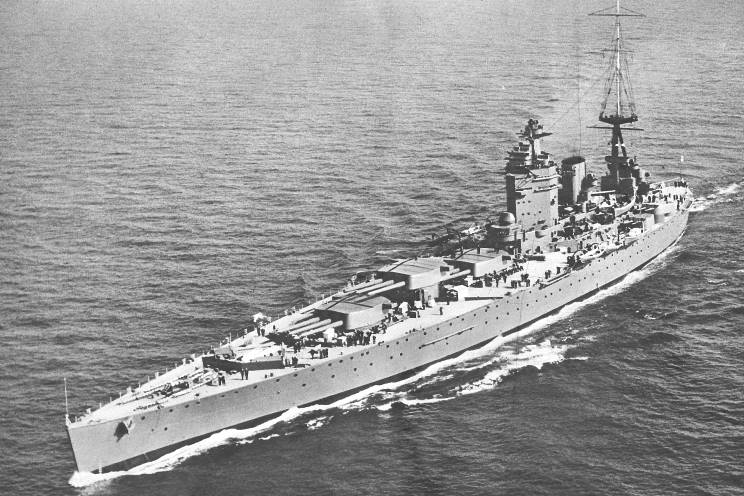
The Battleship HMS Nelson
The drive south towards Singapore, Operation Mailfist, was to be launched after the landing force has succesfully secured their objectives, scheduled as December 1945. Two further Commonwealth troops Divisions and a British Brigade are to be landed as soon as the port is secured and advance south through the Malayan Peninsula to liberate Singapore. The plan was to advance south through the coastal plains with Naval fire support provided by the Battleship and air support from the two escort carriers. Planning timetables expected the offensive would reach Singapore on March 1946. Two Monitors (MHS Roberts and HMS Abercrombie), special bombardment ships with two 15-inch cannons each were to bombard Japanese defences on Singapore Island in a preparatory operation.
The drive north to secure the Malayan peninsula, Operation Broadsword, was to be conducted simultaneously as Operation Mailfist. Smaller resources were allocated for this operation as Japanese defences were expected to concentrate on defending Singapore and only light resistance is expected elsewhere. Further operations to secure the peninsula's East Coast and recapture Northern Borneo would later be planned with US support from the Philippines.
In the end, Operation Zipper was rendered moot by the Japanese surrender in August 1945, after the dropping of the US Atomic bombs on Japan. As the the invasion task force has not fully assembled yet at the time, a small detachment sailed towards Singapore to secure it from the surrendered Japanese Army under Operation Tiderace. After parts of the fleet landed to secure North and central Malaya (Penang island and Morib beach) a force led by the Heavy cruiser HMS Sussex landed unopposed on Keppel Harbor.

A memorial indicating the landing of 46th Indian Beach group on Morib beach, part of Operation Tiderace
During the afternoon of 9 September, General Sheishiro Itagaki, accompanied by Vice Admiral Shigeru Fukudome and his aides, were brought aboard HMS Sussex in Keppel Harbour to discuss the surrender. They were received by Lieutenant-General Sir Philip Christison and Major-General Robert Mansergh. By 1800 hours, the Japanese had surrendered their forces on the island. An estimated 77,000 Japanese troops from Singapore surrendered, plus another 26,000 from Malaya.

Formal surrender of Japanese forces in South East Asia. Lord Mountbatten is seated in the center of the allied delegates, in his white Royal Navy uniform.
The formal surrender of Japanese forces in South East Asia was signed on 12 September at Singapore City Hall. Lord Mountbatten arrived in Singapore to personally receive the articles of Japanese Surrender from General Itagaki. Thus ended the Japanese occupation of South East Asia.

good read. good read.Planned landing beaches of Operation Zipper
After British has successfully beaten back the Japanese Army in Burma, plans were drawn up by Lord Mountbatten to invade Malaya and eventually liberate Singapore from the Japanese. The plan was split up into three stages, the landing operation (Operation Zipper), the drive south towards Singapore (Operation Mailfist) and the drive north to clear peninsular Malaya up to the Thai border (Operation Broadsword).
The landing operation, Operation Zipper, was to be launched in September 1945. It called for a large task force headed by the Battleship HMS Nelson and 2 escort carriers (HMS Attacker and HMS Hunter) to launch from India and Burma. Air support from 500 aircraft based in Burma, Ceylon and Cocos Islands was also arranged. The plan was for the landing force to land near Port Swettenham (Port Klang) and Port Dickson and secure them as staging areas for further operations. Two Divisions of Commonwealth troops and a Brigade of British Troops totaling nearly 50,000 men were allocated for the landing force. Japanese resistance was expected to be light to medium. A diversionary operation by Force 136, led by Tun Ibrahim Ismail were to launch attacks to try and convince the Japanese that any landings will be conducted on the Kra Isthmus, north of Malaya.
The Battleship HMS Nelson
The drive south towards Singapore, Operation Mailfist, was to be launched after the landing force has succesfully secured their objectives, scheduled as December 1945. Two further Commonwealth troops Divisions and a British Brigade are to be landed as soon as the port is secured and advance south through the Malayan Peninsula to liberate Singapore. The plan was to advance south through the coastal plains with Naval fire support provided by the Battleship and air support from the two escort carriers. Planning timetables expected the offensive would reach Singapore on March 1946. Two Monitors (MHS Roberts and HMS Abercrombie), special bombardment ships with two 15-inch cannons each were to bombard Japanese defences on Singapore Island in a preparatory operation.
The drive north to secure the Malayan peninsula, Operation Broadsword, was to be conducted simultaneously as Operation Mailfist. Smaller resources were allocated for this operation as Japanese defences were expected to concentrate on defending Singapore and only light resistance is expected elsewhere. Further operations to secure the peninsula's East Coast and recapture Northern Borneo would later be planned with US support from the Philippines.
In the end, Operation Zipper was rendered moot by the Japanese surrender in August 1945, after the dropping of the US Atomic bombs on Japan. As the the invasion task force has not fully assembled yet at the time, a small detachment sailed towards Singapore to secure it from the surrendered Japanese Army under Operation Tiderace. After parts of the fleet landed to secure North and central Malaya (Penang island and Morib beach) a force led by the Heavy cruiser HMS Sussex landed unopposed on Keppel Harbor.
A memorial indicating the landing of 46th Indian Beach group on Morib beach, part of Operation Tiderace
During the afternoon of 9 September, General Sheishiro Itagaki, accompanied by Vice Admiral Shigeru Fukudome and his aides, were brought aboard HMS Sussex in Keppel Harbour to discuss the surrender. They were received by Lieutenant-General Sir Philip Christison and Major-General Robert Mansergh. By 1800 hours, the Japanese had surrendered their forces on the island. An estimated 77,000 Japanese troops from Singapore surrendered, plus another 26,000 from Malaya.
Formal surrender of Japanese forces in South East Asia. Lord Mountbatten is seated in the center of the allied delegates, in his white Royal Navy uniform.
The formal surrender of Japanese forces in South East Asia was signed on 12 September at Singapore City Hall. Lord Mountbatten arrived in Singapore to personally receive the articles of Japanese Surrender from General Itagaki. Thus ended the Japanese occupation of South East Asia.
never knew the strength of Japs army in Malaya almost 100,000...i thought they have just small numbers around 30-40k at most
 Quote
Quote


 0.1423sec
 0.52
0.52
 7 queries
 GZIP Disabled