Welcome Guest ( Log In | Register )

Bump Topic Topic Closed RSS Feed
19 Pages  1 2 3 > » Bottom

Outline · [ Standard ] · Linear+

> Military Thread V22

views
     
BorneoAlliance
post Sep 16 2016, 07:13 PM

New Member
*
Newbie
0 posts

Joined: Dec 2014

Armored Su-34 Will Become a 'Revolutionary' Ground Support Aircraft

user posted image

QUOTE
If the Su-34 is to turn into a genuine close air support aircraft, it will have to be able to confidently enter into the range of portable surface-to-air missiles, anti-aircraft guns and enemy small arms fire, the analyst noted. "For this reason, the Su-34 will need armor plates to protect the flight deck, engines, fuel tanks and flight control systems. The dome cabin and its front window must also be armored."
QUOTE
The plates of this armor, according to Vasilescu, will require the use of 15-30 mm titanium, nylon-coated to stop explosive fragmentation. The aircraft will need to be capable of withstanding armor-piercing projectiles and explosives between 23 and 57 mm.
QUOTE
Meanwhile, the analyst noted, the Su-34 already has advanced electronic countermeasures against MANPADS and short-range radar-guided missiles. This system consists of the L-150 Pastel radar warning system, APP-50 decoy flare launchers and the KNIRTI SPS-171/L005S electronic countermeasure system, the latter mounted on the plane's topside.
QUOTE
In addition, the aircraft has a multi-target, passive electronically scanned array forward radar, enabling it to 'hunt' for enemy aircraft and equipment at a range of between 200-250 km. The plane is also equipped with rearward-facing radar, and can be equipped with the M402 Pika side-looking radar. In addition, its L175V/KS418, Digital RF Memory-equipped jamming system allows it to be used as a battlefield jammer.
QUOTE
Vasilescu emphasized that when it comes to aircraft armor design and testing, "that's not so difficult for the Russians, given the successful experience with the Su-25's armor. The Su-25 has a length of 15.5 m, a 14.3 m wingspan and a height of 4.8 m, while the Su-34 is 23.3 m long, 14.7 m wide and has a height of 6.1 m."
QUOTE
Accordingly, the "Su-34's armor will weigh between 800 and 1,000 kg, as opposed to that of the Su-25, which weighs 500 kg. The process will be completed in 2018, when the first group of 12 Su-34s will become operational for ground attack missions."
QUOTE
Among the other benefits of an armored Su-34 is its capability to climb and cruise at heights between 8,000 and 12,000 m, allowing the pilot to familiarize himself with the tactical situation on the ground with the help of onboard sensors before swooping down for attack.
QUOTE
"The selection and continuous monitoring of selected targets is done using airborne radar and the Platan electro-optical targeting system, mounted on the fuselage. It is equipped with a laser target market which measures the distance to the target using laser telemetry."
QUOTE
The armored Su-34 is expected to carry out attacks on ground targets from heights between 1,000 to 3,000 meters, using small 50kg bombs, air-ground anti-tank missiles, S-5 rockets, as well as rounds from the onboard GSH-30-1 30 mm cannon.


Sputnik News
BorneoAlliance
post Sep 17 2016, 06:59 AM

New Member
*
Newbie
0 posts

Joined: Dec 2014
user posted image
BorneoAlliance
post Sep 20 2016, 08:43 PM

New Member
*
Newbie
0 posts

Joined: Dec 2014

Cloak of Darkness: Russia Testing Unique Smokescreen for Armata Tanks

user posted image

QUOTE
The system, developed by Electromashina research and production association, is installed on Armata tanks, Kurganets and Bumerang armored vehicles and detects laser beams or oncoming missiles and fires special smoke grenades, which make the fighting vehicle invisible both to the naked eye and to infrared scopes.
“The system is currently undergoing field trials and we expect to have this work done before this year is out,” a Defense Ministry representative told the newspaper, adding that live-fire tests of the system were slated for next year.

At the heart of the new system is a computer which calculates optimal trajectories of the smoke grenades to ensure maximum smoke cover while allowing the crew to engage the enemy unhindered.

“In Europe they have tried and failed to develop such a system, while in the US they have never developed anything like our  optical-electronic system, traditionally staking on passive protection reinforcing armor, improving maneuverability  and battlefield control in order to better protect against enemy anti-tank fire,” independent military expert Oleg Zheltonozhka, told Izvestia.

The new system ensures maximum protection against the two main types of guided antitank missiles: remote-controlled and laser-guided. The former will not be able to receive radio commands, while the latter will simply fail to “see” the laser beam itself.

It will also be able to effectively handle America’s unique self-homing Javelin antitank guided missiles.


Sputnik News
BorneoAlliance
post Sep 20 2016, 09:35 PM

New Member
*
Newbie
0 posts

Joined: Dec 2014

The U.S. Army Designs a New Hand Grenade After More Than 40 Years

user posted image

QUOTE
The Enhanced Tactical Multi-Purpose grenade, or ET-MP, will be able to switch between two modes and produce two different kinds of explosions, according to Picattiny. At the same time, it brings back an older “concussive” effect absent from the U.S. Army since the 1970s.

Adjust the grenade, and the operator can select a fragmentation or concussion mode.

The ET-MP is also safer for the thrower, Picatinny Arsenal added in an announcement this week. This is because the grenade will feature an electronic fuze, or delay mechanism, unlike the M67’s mechanical fuze. To simplify, an electronic fuze is more reliable over the long term and the detonation can be timed to be extremely precise.

However, the grenade appears to be just a design at this stage, with the Pentagon committing $1.1 million in funding for the 2017 fiscal year — tiny on the scale of other military programs.


War Is Boring
BorneoAlliance
post Sep 20 2016, 09:41 PM

New Member
*
Newbie
0 posts

Joined: Dec 2014

Watch the U.S. Navy Nearly Blow Up Its Own Ship (on Purpose)


Last July, the U.S. Navy subjected one of its newest ships, the USS Jackson, to so-called shock trials. Designed to test the ship's ability to withstand nearby underwater explosions, these test involve detonating a really big explosive charge right next to the ship. The trials, which took place off the coast of Florida, were so powerful they sent residents on shore running to the U.S. Geologic Survey to ask if an earthquake had taken place.

Now, video has emerged of the actual trials—and you can see why nearby residents were concerned.

During shock trials the Navy detonates a range of explosive charges underwater, from 2,000 pounds to 10,000 pounds. The fact that the column of water appears to rise about 50 percent higher than the 418-foot long ship suggests this was a 10,000-pound explosion.

The Navy reported that the Jackson had performed "exceptionally well" in the shock trials.

Popular Mechanics
BorneoAlliance
post Sep 20 2016, 09:52 PM

New Member
*
Newbie
0 posts

Joined: Dec 2014

British forces could get science-fiction style laser weapons to shoot down missiles and insect-like spy drones

user posted image

QUOTE
British forces could be equipped with tiny insect-inspired drones and a laser weapon which could bring down enemy missiles in mid-air.

The science fiction style kit is being developed with a new Ministry of Defence innovation fund worth £800million over the next decade.

Defence Secretary Michael Fallon said the fund would encourage hi-tech firms to develop new 'disruptive capabilities' for the armed forces.
Daily Mail UK
BorneoAlliance
post Sep 21 2016, 07:32 AM

New Member
*
Newbie
0 posts

Joined: Dec 2014

BorneoAlliance
post Sep 21 2016, 07:35 AM

New Member
*
Newbie
0 posts

Joined: Dec 2014

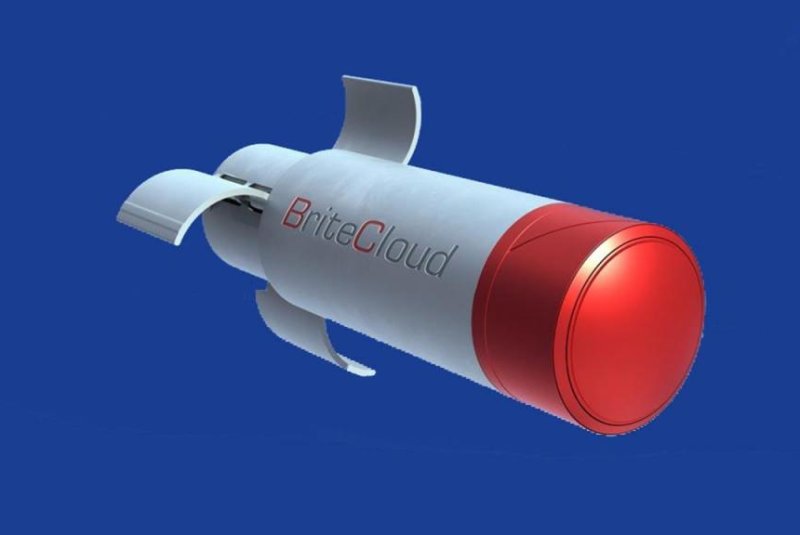
Britain orders miniature anti-missile jammers

user posted image

LONDON, Sept. 19 (UPI) -- Britain's Ministry of Defense has ordered miniature anti-missile jammers from Leonardo-Finmeccanica aircraft for its Typhoon fighter fleet.

The BriteCloud system will undergo flight trials on Royal Air Force Tornado aircraft later this year as the RAF develops a concept of operations for the technology before its deployment.

BriteCloud, similar in size and appearance to a beverage can, can be fired from an aircraft's flare dispenser. It then uses radar emissions to disrupt systems within radar-guided air-to-air and surface-to-air missiles.

"The cutting-edge technology behind BriteCloud demonstrates the MOD's commitment to harnessing and growing the incredible creativity in our Defense supply chain," said Defense Secretary Michael Fallon.

"Supported by our £178 billion [$231.3 billion] investment in equipment, these new decoy systems show that we are continually pushing the boundaries of innovation, making the most of Great British skills and brains to keep our Armed Forces safe from our adversaries."

The Ministry of Defense said it has been working with Leonardo-Finmeccanica to develop the BriteCloud system since 2012. Nearly $34.5 million has been invested in the system by the government.

The new contract order for the system is worth about $32.5 million.

UPI
BorneoAlliance
post Sep 21 2016, 07:40 AM

New Member
*
Newbie
0 posts

Joined: Dec 2014

US special forces might be getting this flying all-terrain vehicle

user posted image

user posted image

QUOTE
This all-terrain vehicle has the ability to take off from indigenous runways and transform into a light-sports aircraft using a parafoil wing. Reaching ground speeds of up to 70 mph and flight speeds of 40 mph, the SkyRunner can transport 2 occupants 240 miles, or 120 nautical miles, at an altitude of 10,000 feet.

The latest model of SkyRunner, equipped with a carbon-fiber body, will cost about $139,000.

After receiving FAA approval in June, a SkyRunner representative explained in an interview with Business Insider that they received interest and a verbal commitment from the US special forces community.

“The shocks [are what] won this particular group over,” said SkyRunner consultant Mike Mitchell. “Going off of a loading dock 4-5 feet tall … with such a soft landing was a big plus in their eyes.”

Rather than being offensively oriented, Mitchell explained that a military-grade SkyRunner would be primarily used for surveillance or recovery missions.


Business Insider Malaysia

This post has been edited by BorneoAlliance: Sep 21 2016, 07:44 AM
BorneoAlliance
post Sep 25 2016, 10:18 PM

New Member
*
Newbie
0 posts

Joined: Dec 2014

Hawkeye: Russia's New 5th Gen Radar 'Can See a Soldier's Helmet' During Combat

user posted image

“The UIC has devised fifth-generation phased array antenna which can see 10 cm small objects with photographic quality,” the unnamed representative said, adding that “the station can see objects as small as a soldier’s helmet and send target data to friendly forces on the ground.

He said that the new radar station had been developed to keep an eye on enemy installations and that its high resolution enabled it to accurately determine not only the type of a particular weapon or a fighting vehicle but also its make.

The station picks up moving targets, shows them on a grid chart in pixels or meters and color-codes oncoming and outgoing objects.

According to the UIC’s representative, this new technology of lateral visibility with a phased array antenna can be used on all existing types of aircraft.

Sputnik News
BorneoAlliance
post Sep 25 2016, 10:23 PM

New Member
*
Newbie
0 posts

Joined: Dec 2014

U.S. Navy's Zumwalt destroyer sidelined after engineering casualty

user posted image

NORFOLK, Va., Sept. 22 (UPI) -- The U.S. Navy's Zumwalt guided-missile destroyer has sustained an engineering casualty, less than a month before it is slated to be commissioned into service.

The casualty occurred on Monday during preparation to get underway at Naval Station Norfolk, the sea service told the U.S. Naval Institute.

The future DDG 1000 will stay in Norfolk to conduct an assessment of the casualty and to complete repairs.

Crews discovered the casualty after detecting a seawater leak in the propulsion motor drive lube oil auxiliary system for one of the ship's shafts, USNI reported.

While built-in redundancies in the ship's propulsion plant allows the first-in-class destroyer to operate with multiple engine configurations, it was determined that repairs should be done in port.

The Navy's newest and most technologically advanced surface ship was in the midst of a three-month journey to its San Diego home port.

The Zumwalt was scheduled to perform operational proficiency training, certifications and preparation ahead of its October commissioning.

UPI
BorneoAlliance
post Sep 25 2016, 10:26 PM

New Member
*
Newbie
0 posts

Joined: Dec 2014

Russian mechanized infantry unit arrives in Pakistan for joint military drills

user posted image

MOSCOW, September 23. /TASS/. A mechanized infantry unit of the Russian Southern Military Command has arrived in Pakistan to take part in the first ever joint military drills dubbed Friendship-2016, the Southern Military Command’s press service told journalist on Friday.

"The international drills will involve more than 70 servicemen of the Southern Military Command, including the Mountain Mobile Brigade’s personnel deployed to the Karachay-Cherkessia Republic (North Caucasus), and also officers from the headquarters’ staff. The Southern Military Command’s mechanized infantry servicemen are fully equipped and have their mountain gear with them, as well as ammunition for their standard weapons," the press service added.

It is planned that the Russian and Pakistani military servicemen will share their experience and employ teamwork in fighting in mountainous areas, particularly destroying illegal armed groups.

"The joint military drills are aimed at bolstering and building up military cooperation between the two countries," the press service noted.

TASS
BorneoAlliance
post Sep 27 2016, 06:02 PM

New Member
*
Newbie
0 posts

Joined: Dec 2014

BELL MADE A TILTROTOR DRONE WITH MISSILES FOR MARINES

user posted image

Runways are a hassle. Long, flat strips of unobstructed land are work to defend at the best of times, and can’t always be found in rugged terrain or on small islands. Yet having a fixed-wing plane fly air support is useful, because plane bodies are faster and much more efficient than helicopters. What’s the Marine Corps to do?

If you ask Bell Helicopter, the answer is obvious: a brand-new tiltrotor drone, unveiled today before a crowd of media and experts at that National Press Club in Washington, DC.

This is the V-247 Vigilant. The drone has a maximum speed of 345 mph, though it cruises most efficiently at 205 mph. It can fly at an altitude of up to 25,000 feet, can carry up to 2,000 pounds internally, and has a maximum flight time of 17 hours or a maximum range of 1,600 statute miles (though it can’t do all of this simultaneously). Bell provides an example mission of one where it carries a 600-pound payload to a target 500 miles away, hangs around for several hours, and then returns. And “target” here is key: the Vigilant isn’t just a scout. As designed, it can fire missiles, including Hellfires and its expected replacement, the Joint Air Ground Missile. It can also carry Mk50 torpedoes, making it deadly to enemies in the sea, as well as on land.

The Vigilant weighs 16,000 pounds empty, 29,500 pounds filled to the brim with something slung beneath it, and it has a wingspan of 65 feet with a 30-foot rotor diameter. Two V-247 Vigilants can fit inside a C-17 Globemaster transport, helping them get to where they’re needed. That makes the Vigilant about half the size of the troop-carrying V-22 Osprey tiltrotor, which is small for a plane but still a Group 5 drone for the military, which includes the heaviest and fastest drones.

Bell says it can start producing the V-247 as early 2023, and designed it to meet the needs of the Marine Corps. If the Corps bites, and if the Vigilant works as promised, by the end of the next decade Marines could fly into battle inside tiltrotor V-22s and request air support from tiltrotor V-247 drones, while at the same time soldiers from the Army arrive in Bell’s planned V-280 Valor transport.

Popular Science
BorneoAlliance
post Sep 27 2016, 06:06 PM

New Member
*
Newbie
0 posts

Joined: Dec 2014

China wants to build a US-style aircraft carrier

user posted image

QUOTE
Right now, China’s aircraft carrier uses a ski-jump design, where planes hit a ramp to launch of the ship. This greatly limits the maximum weight of the planes, meaning they can’t carry as much fuel or ordnance as land-launched variants can.
QUOTE
China has set out to develop a Catapult-Assisted Take-Off But Arrested Recovery (CATOBAR) variant of the Shenyang J-15 Flying Shark.
QUOTE
But now photos surfaced in Yeo’s piece suggest that China is trying to imitate these flat top carriers. Here’s a photo of a J-15 with additional nose landing gear (this is what the catapult couples with during launches).


Business Insider
BorneoAlliance
post Sep 27 2016, 06:12 PM

New Member
*
Newbie
0 posts

Joined: Dec 2014

Larsen and Toubro signs $99 million Vietnamese ship deal

user posted image

MUMBAI, Sept. 23 (UPI) -- Larsen and Toubro has signed a $99 million contract with the Vietnam Border Guard for high speed patrol vessels, the Indian company announced Thursday.

The contract calls for design and construction of the vessels, as well as transfer of design and technology, equipment and material kits for construction of follow-on vessels at a Vietnamese shipyard, the company said in a statement.

The vessels are for controlling and protecting sea security and sovereignty, anti-smuggling and search and rescue missions.

The 114-foot-long vessels are made of an aluminum alloy and reach speeds of 35 knots.

In keeping with the Indian government's "Make in India" policy, design and engineering of the ships will be done at the company's dedicated warship design center.

The company is currently executing Indian ministry of defense contracts for design and construction of 54 interceptor boats for the Indian coast guard, 28 of which have been delivered.

UPI
BorneoAlliance
post Sep 27 2016, 06:17 PM

New Member
*
Newbie
0 posts

Joined: Dec 2014

Taiwan Asks Google to Blur a Secret Island Base, Plan Backfires

user posted image

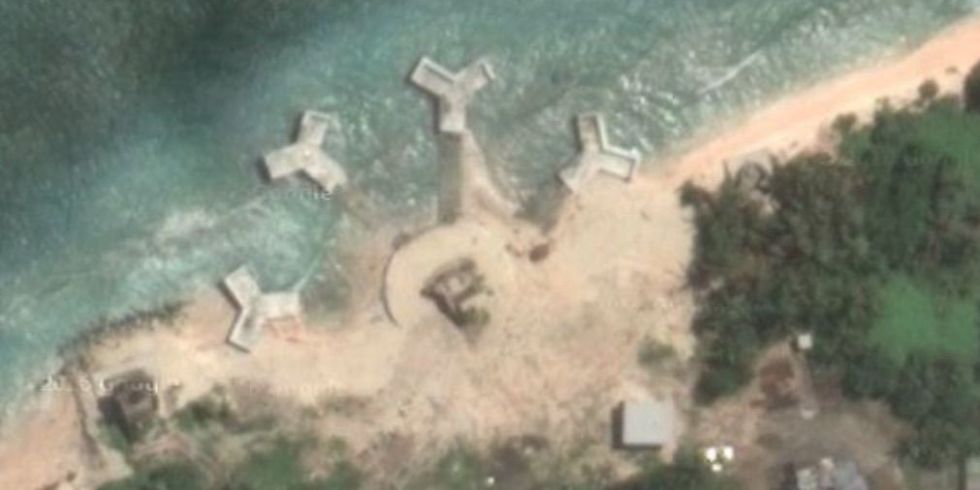
Taiwan had good reason to want to hide a secret island base in the South China Sea. The country is building military fortifications on the island whose legal status is claimed or disputed by multiple countries. Taiwan asked Google to blur out the base on Google Maps, but that request has now backfired because was made public.

The location is Itu Aba or Taiping Island. It lies 763 miles south of Taiwan in the Spratly Islands. Taiwan has controlled Itu Aba since the 1950s, but China and Vietnam have openly claimed the islands, and the nearby Philippines contends this one is legally only a "rock" that does not qualify for full territorial rights.

The request seems to involve four new concrete structures that have popped up on the north side of the island in the last eight months. In January 2016, the director of the Center of Strategic and International Studies' Asia Maritime Transparency Initiative visited Itu Aba with Taiwanese officials. At the time, the structures were not present.

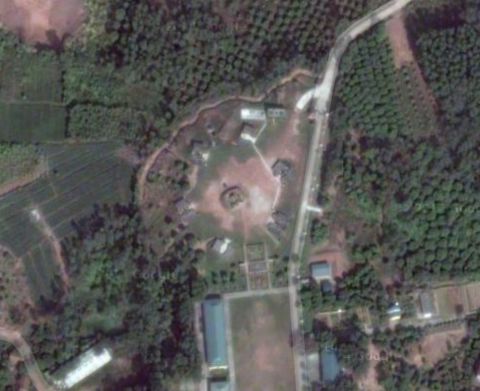
Right now, Google Maps shows a cluster of four Y-shaped concrete structures with what appears to be strua cture under construction in the center. This is consistent with an air defense battery made of either guns or missiles with search and tracking radars located in the center of the cluster. Here's a similar air defense facility protecting the Vietnamese Air Force base at Kep:

user posted image

It's unknown exactly what air defense weapon the structures are meant for, but they could be meant for Skyguard radar-controlled air defense guns, which can engage aircraft at low to medium altitudes at ranges of up to 13,000 feet.

This is not the first time Taiwan has bungled a secret operation visible in Google Maps. In 2009, Taipei disguised HF-2E land attack cruise missile trucks as commercial delivery trucks, complete with a fake company name, "Red Bird Express." After rumors began to circulate about the mysterious vehicles, a roof suddenly appeared over the truck parking lot.

Popular mechanics


BorneoAlliance
post Sep 27 2016, 06:31 PM

New Member
*
Newbie
0 posts

Joined: Dec 2014

Russian Armata Vehicles to Sport Smart Fire-Suppression Gear With 'Black Boxes'

user posted image

The recorders are part of the PPO-25 intelligent fire control system developed by Elektromashina Association.

The PPO-25 immediately locates a flare-up and puts it out by adjusting the direction and amount of the firefighting foam depending on the intensity of the blaze.

“The system has already undergone preliminary trials and is currently being tested on new types of armored vehicles,” Ilya Markin, the head of Elektromashina’s firefighting division, told Izvestiya.

He added that the system memorizes the entire sequence of fire extinguishing operations thus making it possible to determine the time, place and causes of the fire.

Independent military expert Oleg Zheltonozhko said that the appearance of onboard recorders on Armata, Kurganets and Bumerang fighting vehicles was necessitated by their technological complexity and price.

“Onboard recorders are normally installed on the most expensive and complex machines like planes, spaceships and helicopters, but the cost and complexity of the latest tanks and armored vehicles is now putting them in the same category,” Zheltonozhko said.

According to Viktor Murakhovsky, editor-in-chief of “Arsenal Otechestva” (Arsenal of the Motherland) journal, Russia’s T-72B3, T-80 and T-90 tanks now carry onboard systems of fire suppression, which respond to sudden temperature jumps caused by a fire and put out the flames using special foam.

The Russian Defense Ministry unveiled its next-generation Armata tank during last year’s May 9 Victory Day military parade in Moscow.

It also rolled out a bevy of heavy armored vehicles based on the Armata combat platform, such as the Kurganets-25 tracked infantry fighting vehicle and the Bumerang amphibious wheeled armored personnel carrier.

Sputniknews

The Kurganets and Bumerang IFVs are currently undergoing testing ahead of their first deployment slated for 2017.
BorneoAlliance
post Sep 28 2016, 07:25 AM

New Member
*
Newbie
0 posts

Joined: Dec 2014

Turkish Tanks Take a Pounding in Syria

user posted image

QUOTE
Today, Turkey fields three types of M-60s, including 658 M-60A3 TTS vehicles with improved thermal sights for night combat, and 170 Israeli-upgraded M-60A1 Sabra Mark II tanks, designated the M-60T in Turkish service. Ankara fields 104 more M-60A1 tanks that it has yet to upgrade to M-60Ts.
QUOTE
On April 21, video evidence appeared of Islamic State fighters firing a Kornet anti-tank missile at a Turkish M-60T tank, which was training Iraqi forces in Bashiqah, a town north of Mosul. Turkish troops returned fire and killed 32 Islamic State fighters, according to the Turkish army.
QUOTE
A picture of the vehicle released after the incident revealed that the missile damaged the vehicle — but it didn’t appear to fully penetrate.
QUOTE
It’s possible the missile didn’t cause a full kill because it struck the side of the Patton’s turret rather than the center of mass.
QUOTE
In May 2016, Kurdish fighters claimed the destruction of two Turkish M-60s. In video footage of one incident, an anti-tank team cheered as their missile struck a tank deployed behind sandbagged defensive positions on the top of a hill.
QUOTE
On Aug. 27 a Kurdish anti-tank team knocked out a Patton with a U.S.-made TOW missile, leading to the first Turkish death in the intervention. The destruction of a second Patton appeared on video shortly afterward.
QUOTE
On Aug. 27 a Kurdish anti-tank team knocked out a Patton with a U.S.-made TOW missile, leading to the first Turkish death in the intervention. The destruction of a second Patton appeared on video shortly afterward.
QUOTE
However, on Sept. 7, the Islamic State released video footage of two Turkish Pattons near Al Rai taking hits from missiles — again likely to be Kornets. Testifying to the power of the Russian-designed missiles, the first tank violently burst into the flames, while the second erupted in a cloud of smoke and debris.
QUOTE
The Firtinas have long-barreled 155 millimeter howitzers with a range of 30 to 40 kilometers depending on the ammunition.
QUOTE
On April 30, the Islamic State released a video depicting AT-13 Metis-M missiles taking out a platoon of three Firtinas in sandbagged positions. Like most self-propelled artillery, the Firtina’s armor is for stopping shrapnel and small arms, not guided missiles — leaving one to wonder why the vehicles were in such an exposed position in the first place.
QUOTE
Finally, the Otokar Kobra is a unique armored vehicle incorporating Humvee DNA. For one, it has the same suspension and wheel base. However, unlike the Humvee, it’s designed from the get-go with a mine-resistant v-shaped hull and better protection from small arms and shrapnel.
QUOTE
Despite reportedly having a good record surviving blasts from improvised explosive devices and mines, this has simply led to Kurdish fighters making bigger bombs. In August 2015, a 2,000 pound IED destroyed a Turkish army Kobra in Siirte province, killing its eight passengers.


War Is Boring
BorneoAlliance
post Sep 28 2016, 06:23 PM

New Member
*
Newbie
0 posts

Joined: Dec 2014

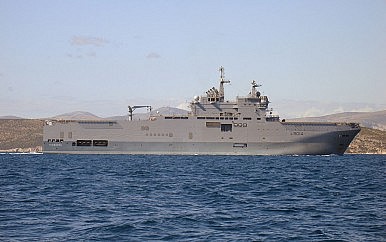
France Unveils Its Defense Strategy in the South China Sea and Beyond

user posted image

QUOTE
In less than two weeks, the situation in the South China Sea has deteriorated at an accelerated pace: a joint Sino-Russian naval exercise; plans for Japan-U.S. joint patrols in the same area; Taiwan building anti-craft gun towers on Itu Aba; Jakarta trying to get U.S. help to upgrade its naval bases.
QUOTE
France’s Jean-Yves Le Drian. This year, he pushed for coordinated EU patrols in the South China Sea.
QUOTE
According to the 2014 presentation of Asia-Pacific policy, France “has a duty to protect its citizens in Asia-Pacific countries whose number has increased by 220 percent over the last twenty years, to exceed 120,000 in 2012 – almost as large as the French population in sub-Saharan Africa.”
QUOTE
It also has a toehold in Asian military deals, with France a part of 40 percent of Southeast Asian submarine contracts and 20 percent of naval projects. French strategic companies like DCNS, DCI, and Thalès are already active in Asia. French companies are set to supply submarines to Malaysia, 12 attack submarines to Australia, and 36 Rafale fighter jets to India
QUOTE
The French Navy is also used to deploying in the the region. So far in 2016, three vessels have visited the South China Sea and, according to Senator André Trillard, France actually has a surveillance frigate and a patrol boat at all times in New Caledonia. The French Navy is the only European military force deployed in the South China Sea. It will not be difficult for Paris to ensure a “regular and visible presence.”
QUOTE
With six nuclear-powered submarines (SSNs) and four ballistic missile submarines (SSBNs) equipped with long-range nuclear warhead missiles, there’s no doubt that French Navy’s deterrent force will be heard. But, as specified by President Francois Hollande, “France will not go it alone.” European approval is needed.


The Diplomat
BorneoAlliance
post Sep 29 2016, 05:48 PM

New Member
*
Newbie
0 posts

Joined: Dec 2014

BAE SYSTEMS WANTS TO DEFEAT JAMMERS WITH THINKING

user posted image

QUOTE
Radar used to be a slow science. Electronic warfare is a blanket term that encompasses the radar signals used to detect an attack, the radios used to communicate that the attack is coming, and the specific radio interference sent to confuse enemy radars as they’re attacking. And in the Cold War, every part of this used to be analog.

“In Vietnam we learned what an SA-2 radar signal started looking like,” Joshua Niedzwiecki, director of the Sensor Processing and Exploitation group at BAE Systems, tells Popular Science. The SA-2 is a surface to air missile that destroyed a lot of U.S. Air Force planes, especially B-52 bombers, over Vietnam. “The paradigm then was we saw a new signal in an environment and got a lot of experts and put them in a room in a laboratory and had them start to dissect what those characteristics were, in order to build a prescription for a solution, what’s that antidote. That process took months.”

Niedzwiecki works for BAE Systems, American counterpart to the British defense giant, and we are speaking today because of a new technology that came from BAE’s research and transformed into something called “Cognitive Electronic Warfare.” I’ll get to the specifics of that in just a minute, but in order to understand the breakthrough, it’s helpful to understand the past.

“The current paradigm is extremely time-consuming, extremely cumbersome, and in the past, this was acceptable because the radio frequency technology was very static. Everything was analog hardware. If I built a radar system, all the things that make that signal look like it looks, were driven by analog components,” Niedzwiecki continued. “So they weren’t prone to change for years. Nowadays, you see radar that on every single radar pulse can change what operating frequency they’re working at, what their pulse width is, what their bandwidth is, because of digital processing technology and software-defined radios. By the time you’ve gone back to the lab to study what you saw, the threat is different, by the time you come back from your mission, the threat is different.”

The threat in electronic warfare is manifold. A hostile radar can guide missile after missile at incoming aircraft. A jammer that interferes with GPS can keep bombs from falling where they’re supposed to, or get troops lost on the ground. A strong signal at the right frequency can interfere with soldier’s radios, leaving them suddenly cut off from commanders and friends. On its own this is frustrating; but combined with the other, lethal parts of war (“kinetics”, in Pentagon jargon), what happens in the electromagnetic spectrum can shape battles.

This morning, BAE revealed a “lightweight, handheld tactical sensor” for cognitive electronic warfare. Developed for DARPA, the sensor is designed for soldiers and marines to carry into battle, where it will identify and classify new signals. In the previous, Cold War-era approach, American troops went into battle knowing only signals already identified, and after detecting a new signal, it would take months to have a response. Many systems, even ones that already had signals recorded in peacetime, can, according to Niedzwiecki, "have a “war reserve” mode, a waveform signature that we may not have seen before,” so there’s now guarantee that adapting to an old signal will protect against the signals that replace it.

Cognitive electronic warfare takes the burden of deciphering and countering new signals out of human minds in a lab, and entrusts it instead to AI and machine learning. If the cognitive system sees a signal similar to one it has seen before, it can respond accordingly. If the interference makes the radio signal weak, then the cognitive system might just put more power into the same radio signal. If the jamming makes some parts of the spectrum unworkable, then the cognitive system could look for a part of the spectrum that’s still open for communication, and redirect signals there. If the approach works, as captured by bit-error rate, the system learns and remembers. If it doesn’t, the cognitive system can try a different approach, changing up its response until something gets through.


Popular Science

19 Pages  1 2 3 > » 
Bump Topic Topic ClosedOptions New Topic
 

Change to:
| Lo-Fi Version
0.1223sec    0.12    7 queries    GZIP Disabled
Time is now: 8th December 2025 - 02:13 AM