
Welcome Guest ( Log In | Register )

Outline · [ Standard ] · Linear+

 A general guide to PCI-Express, and articles to avoid confusion

views
     
TSbgeh
post Mar 27 2004, 09:09 PM, updated 22y ago

Regular
******
Senior Member
1,814 posts

Joined: Jan 2003
Official PCI-Express webpage:
http://www.pcisig.com/specifications/pciexpress

Related links where where i got info from:
http://www.anandtech.com/systems/showdoc.html?i=1830


#1: It's a serial connection, like SATA

#2: It's backwards compatible with PCI in software/driver terms

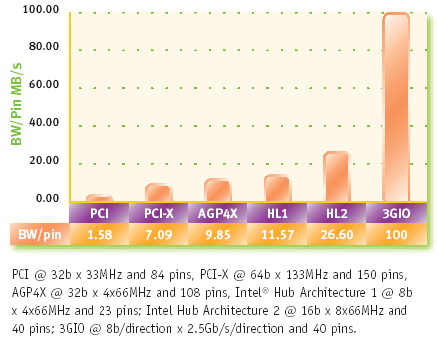
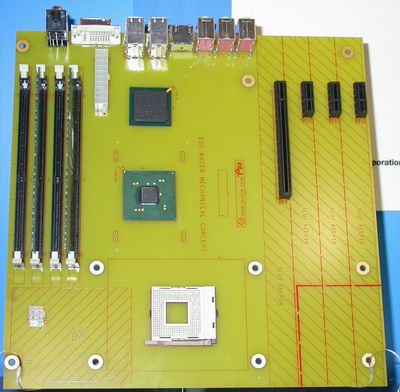
#3: It had a very high effective bandwidth per pin........meaning? the slots are very small, in fact, a PCI-e x1 is much smaller then the PCI slot you see today(btw, the long slot is a PCI-e x16 slot, short one is a PCI-e x1 slot)
user posted image
user posted image

#4: It is NOT only for graphics cards(AGP) but other cards like network cards bla bla bla

#5: 60 watts max for PCI Express, compared to 25 watts for AGP 8X. meaning? no more molex connectors that'lll spoil your case mod look tongue.gif

#6: I can't stress this enough, and don't know why this thing keeps happening
PCI-E IS NOT PCI-X
PCI-X is an PCI part with an extended bus because server operators found that the PCI bus was getting bottlenecked so a new part was made to alleviate it
user posted image
-this is PCI-X

This post has been edited by ikanayam: Mar 28 2004, 04:04 PM
ikanayam
post Mar 28 2004, 12:21 PM

there are no pacts between fish and men
********
Senior Member
10,544 posts

Joined: Jan 2003
From: GMT +8:00

Thank you very much bgeh for the simple and good explanation. thumbup.gif
I hope you will update this guide to make it even more informative.


Ok, let me elaborate a bit for those who are curious. The current PCI standard is a parallel design, which in the computer world generally means that the data bytes are spread out amongst many wires. The new PCI-Express standard is a serial connection, meaning each data byte is transferred along a single wire. Serial buses like the PCI-Express can usually be clocked much higher than parallel buses. Also, PCI-Exp is a point to point bus, which means that each device on the bus gets full bandwith and does not have to share with other devices on the bus. The current PCI standard is a shared bandwith bus, which means that if you have more than 1 device, the PCI bandwith is divided among the devices.

Some of the advantages of PCI-Express are a lower pin/wire count, which should make mainboard design and manufacturing cheaper, and also the ability to scale to much higher speeds than current PCI.

And once again, let me repeat what bgeh has stated above:
PCI-Express is NOT PCI-X
nUtZ`
post Mar 28 2004, 04:52 PM

Regular
******
Senior Member
1,868 posts

Joined: Jan 2003
Here's what i wrote at the other thread...

QUOTE

its not only for graphics card...

imagine.. your hard disk takes on average 40MB per second.. your 100Mb NIC takes about 10MB, USB 2 takes about 30MB per second (depending on device), firewire about 40MB... Imagine all of those are runing on the PCI bus.. at peak it PCI bus can give 133MB/s.. All your devices are starve for bandwidth..

So here's the benifit of PCI express,

1) It is not a bus.. each devices can have its full access to the bandwidth.. imagine it as an ethernet network

2) its scalable, manufacturer can decide to put 5 PCI-e 16x if they want or a mixture of PCI-e 1x to 32x...

3) physically its smaller then PCI, hence smaller mother board

4) It is flexible. PCI-e 16x can be use by the PCI-e 1X card...

5) possiblity of intergration of north and south bridge together.

So please don't think PCI express is only for graphics card.. its just ONE component out of many other components.


kenet
post Jul 27 2004, 03:24 PM

New Member
*
Newbie
3 posts

Joined: Jan 2003


iii..i extract some notes from The Nvidia Website.. http://www.nvidia.com/page/pci_express.html
PCI Express
NVIDIA is working hand-in-hand with Intel's workstation, desktop, and mobile engineering teams to help define, develop, and deploy PCI Express solutions.
http://www.nvidia.com/docs/CP/5518/PCI_Dawn_sm.jpg
NVIDIA has developed a high-speed x16 graphics interconnect designed to evolve current PCI technology and address the increasing bandwidth demands of emerging graphics applications for multiple markets, including desktop PCs, mobile solutions, workstations, servers, and embedded communications systems.

A Winning Combination for PCI Express:
Watch the video on Intel, NVIDIA, and the PCI Express collaboration.

The graphics processing unit (GPU) has the largest bandwidth appetite of all PC subsystems, and from the start NVIDIA has been a key contributor to the PCI Express architecture, as both a developer and supporter.

NVIDIA is excited to help shape this next-generation specification to ensure that NVIDIA GPUs get the necessary throughput required to push the visual envelope for a seamless multimedia experience with cinematic-quality graphics at its core.

NVIDIA is a key PCI Express SIG member and contributor to the following PCI SIGs:

Graphics
Protocol
Electrical
Mechanical
NEWCARD
Cable
Mobile
System BIOS
Board Design
Software
Thermal
Bus Functional Model


Change to:
| Lo-Fi Version
0.0144sec    0.58    5 queries    GZIP Disabled
Time is now: 16th December 2025 - 09:26 PM