Welcome Guest ( Log In | Register )

25 Pages « < 21 22 23 24 25 >Bottom

Outline · [ Standard ] · Linear+

 USA Stock Discussion v8, Brexit: What happens now?

views
     
zacknistelrooy
post Sep 21 2021, 07:24 PM

Regular
******
Senior Member
1,033 posts

Joined: Dec 2009
QUOTE(ChAOoz @ Sep 17 2021, 08:27 PM)
Ppi is working its ways through the supply chain. It will show up soon and yes inflation probably will follow. Are they able to sweep under the rug im not sure, wage inflation need to follow.

Again big co will report record profit, record revenue and have record share prices. But we all know this is not due to real productivity gain or anything but inflations doing work on their absolute number. Why fight against a money printer tho.
*
They have swept it under the rug for 20 years already. What is going to change now..

That is why I have been long Invitation Homes since last year purely on the bet they won't solve it.


zacknistelrooy
post Sep 23 2021, 09:42 PM

Regular
******
Senior Member
1,033 posts

Joined: Dec 2009
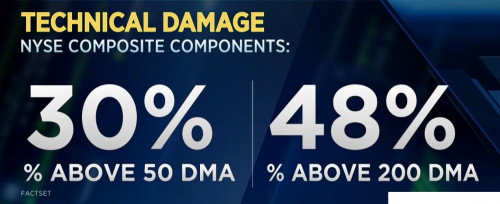
You all can decide if in the short term there has been enough damage based on data below.

user posted image


Also this past Monday was the top 10 put volume (SPY) in the past 15 years.

This post has been edited by zacknistelrooy: Sep 23 2021, 10:11 PM
zacknistelrooy
post Sep 24 2021, 05:22 PM

Regular
******
Senior Member
1,033 posts

Joined: Dec 2009
QUOTE(ChAOoz @ Sep 23 2021, 11:11 PM)
Market has been weak since beginning of march where the inflation fears and tapering news start to simmers.

But then the mega cap continue pulling the index so many doesn't feel it.

Anyway not going to short this. Its a fool errand, later when the fear and volatility finishes it might snap back stronger. Got burn enough to learn and stay away from such position. Better just hedge with value play stocks.
*
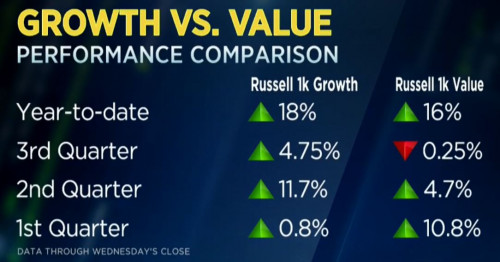
True to a certain extent but the equal weight S&P 500 index outperformed quite a bit against SPY up to May.

It has been rotation rotation rotation this year.

user posted image

Shorting will be back. Just need to be patient for specific moments like last year during Feb and March.

QUOTE(danmooncake @ Sep 24 2021, 04:12 AM)
On Monday, we all saw the possible doom and gloom because of Evergrande. Even I think this could be the bigger pull back.
Now, the market all happy again because of the Fed yesterday.

Darn.. once again, the Fed reigns supreme.  notworthy.gif

All aboard this gravy train one more time..  biggrin.gif
*
They have ran the market a number of times after FED meeting this year.

This and that ridiculous 50 day MA have been the playbook this year.

Why are they doing it so obliviously is anyone's guess but likely could be to increase complacency till they finally hit the jugular.
zacknistelrooy
post Sep 26 2021, 04:53 PM

Regular
******
Senior Member
1,033 posts

Joined: Dec 2009
user posted image

user posted image

zacknistelrooy
post Oct 2 2021, 05:41 PM

Regular
******
Senior Member
1,033 posts

Joined: Dec 2009
https://www.bloomberg.com/news/articles/202...demic-statement

QUOTE
Federal Reserve Vice Chair Richard Clarida traded between $1 million and $5 million out of a bond fund into stock funds one day before Chair Jerome Powell issued a statement flagging possible policy action as the pandemic worsened, his 2020 financial disclosures show.

Clarida’s trades, described in forms filed with the government ethics office, show the shifting of the funds out of a Pimco bond fund on Feb. 27, 2020, and on the same day buying the Pimco StocksPlus Fund and the iShares MSCI USA Min Vol Factor exchange-traded fund in similar dollar ranges. For the year, he listed five transactions.

The following day on Feb. 28, a Friday, at 2:30 p.m., Powell took the unusual step of releasing a statement saying the virus poses “evolving risks to economic activity.” In the same statement, Powell said the Fed was “closely monitoring developments and their implications for the economic outlook.”
Emergency Cut

The Fed announced a half percentage-point rate cut on March 3 following an emergency meeting of the Federal Open Market Committee.

“Vice Chair Clarida’s financial disclosure for 2020 shows transactions that represent a pre-planned rebalancing to his accounts,” a Fed spokesman who was speaking on behalf of the vice chair said. “The transactions were executed prior to his involvement in deliberations on Federal Reserve actions to respond to the emergence of the coronavirus and not during a blackout period. The selected funds were chosen with the prior approval of the Board’s ethics official.”

Read More: Powell Opens Review of Investment Rules for Fed Policy Makers

The transactions are likely to further heighten scrutiny of the ethics rules and governance of the U.S. central bank after two regional Fed chiefs announced their departures following revelations about their trading activity last year. One of the presidents, Eric Rosengren of Boston, said his resignation was due to a serious health condition.

Clarida, a former executive at Pacific Investment Management Company LLC, was visiting faculty and students at Yale University in New Haven, Connecticut, the day of the trading, and not in his office in Washington. His calendar for the month shows a single phone call with a Board member on Feb. 27 at 4:45 p.m. after the market close, as well as numerous meetings with Fed staff on prior days.

The Fed spells out clear guidelines for trading activity by policy makers. Its Voluntary Guide to Conduct for Senior Officials says “they should carefully avoid engaging in any financial transaction the timing of which could create the appearance of acting on inside information concerning Federal Reserve deliberations and actions.”

Read More: Trading Scandal That Rocked the Fed Offers Chance to Reshape It

It also says that they should avoid dealings that might “convey even an appearance of conflict between their personal interests, the interests of the system, and the public interest.”

February 2020 was a time of extreme moves in financial markets as investors reacted to the threat of the global spread of Covid-19. Stocks fell steeply and bond markets were in a powerful rally.

“The pandemic was spreading quickly and the economic outlook was evolving rapidly. That was not the appropriate time for top Fed officials to be making multi-million dollar changes to their portfolios,” said Andrew Levin, a Dartmouth College professor and former special advisor to the Fed’s Board. “The Fed should welcome an external review of all financial transactions made by Federal Reserve Board members last year.”


Not sure how Powell survives this so that probably means a new FED chair unless they can overlook all of this.

Plus more FED governor replacements.
zacknistelrooy
post Oct 7 2021, 05:26 PM

Regular
******
Senior Member
1,033 posts

Joined: Dec 2009
QUOTE(tkwfriend @ Oct 6 2021, 10:54 PM)
I just close SDOW
in @31 December 17 2021 for 3.3 and close 4.4

waiting to exit
32 December 17 2021 in for 3.30 wait to close @4.10

Sdow direct, x100 waiting to let go @34.55

having also TBT, & PST
*
Quite daring with TBT, & PST

The bond market has been more irrational than the stock market for 40 years.

I gave up on that trade in 2018 after Powell so easily gave in.
zacknistelrooy
post Oct 8 2021, 05:06 PM

Regular
******
Senior Member
1,033 posts

Joined: Dec 2009
QUOTE(tkwfriend @ Oct 7 2021, 06:13 PM)
Not daring, is actually trade base on information projected data  on timing.

This round environments are more devastating  compare to 2008
*
Fair enough and good luck.

I'm in bear put spread in TLT as my market view is neutral currently.
That has been something that has worked better at least for me compared to getting into the leveraged treasury ETF.


Quite an extreme view to compare current environment to 2008.
Other than the models you are using, is there any other reasons?


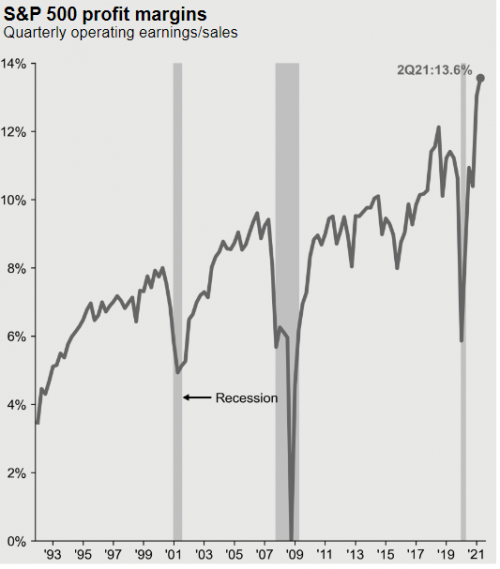
Among the the things do you expect profit margins to show weakness?
user posted image

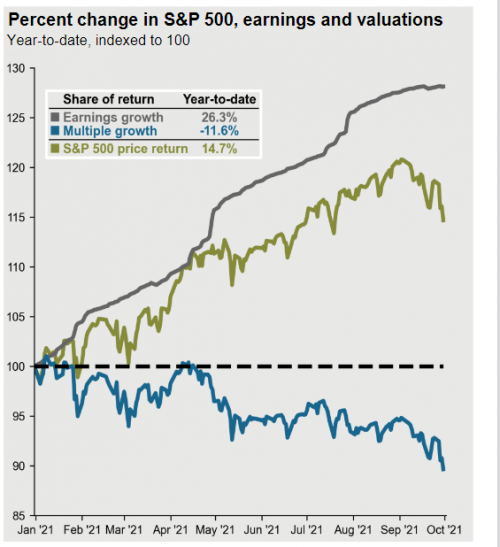
Also there has already been a multiple contraction.

user posted image

This post has been edited by zacknistelrooy: Oct 8 2021, 05:12 PM
zacknistelrooy
post Oct 18 2021, 06:36 PM

Regular
******
Senior Member
1,033 posts

Joined: Dec 2009
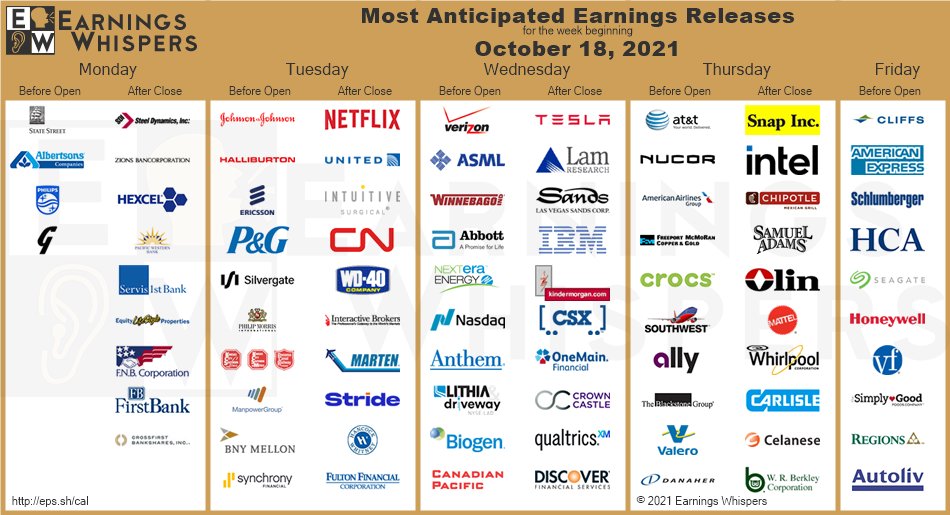
https://twitter.com/eWhispers/status/144933...4401539/photo/1

user posted image
zacknistelrooy
post Oct 19 2021, 06:01 PM

Regular
******
Senior Member
1,033 posts

Joined: Dec 2009
Federal Judges or Their Brokers Traded Stocks of Litigants During Cases

https://www.wsj.com/articles/federal-judges...ebshare_twitter

QUOTE
Mary Geiger Lewis acquired Walmart Inc. stock. Charles Norgle Sr. reported nearly a dozen buys and sells of Pfizer Inc. shares. Charles Siragusa had two accounts that bought Medtronic PLC stock.

None of that would be a problem, except for this: All are federal judges, and at the time of the trades, all were hearing cases involving those companies.

The Wall Street Journal discovered this trading in a broad investigation that identified 131 federal judges who heard hundreds of cases between 2010 and 2018 involving companies in which they or a family member owned stock—in violation of federal law and judicial-ethics rules.

Judges Lewis, Norgle and Siragusa were among 61 judges who didn’t just own stocks of companies that were litigants in their courtrooms. Accounts held by the judges or their families traded shares as suits were progressing, the Journal’s investigation found. Nearly half of the judges reported more than one trade while a case was in progress.

Federal law and ethics rules say judges must recuse themselves if they, their spouse or any minor children own even a single share of a company that is a plaintiff or defendant in a case before them.

Some judges, when contacted by the Journal, said they were unaware that brokers or advisers who managed accounts for them traded shares of the companies during the cases. But there is no exception for holdings in managed accounts. And federal law requires judges to inform themselves about their financial interests and make a reasonable effort to do the same regarding their spouse and any minor children.

Other judges said they failed to update their “recusal lists”—tallies that judges keep of parties they shouldn’t have in their courtrooms—in the middle of hearing cases. Federal courts use software to identify such parties, but the software can’t spot stocks judges buy unless the judges update their conflict lists.

Trading during a case “can happen only if the judge is recklessly indifferent to the conflict-of-interest rules in the statute and the Canons of Ethics,” said Arthur Hellman, an ethics specialist and law professor at the University of Pittsburgh, who was briefed on the Journal’s findings.

While Judge Walter Rice was hearing a case involving International Paper Co., his financial disclosure form shows, he sold between $15,001 and $50,000 of the company’s stock in December 2015. The sale earned a profit of between $15,001 and $50,000, the form shows. Judge Rice said that later that month, he gave his remaining shares to five charities. International Paper doesn’t appear on his later disclosure forms.

The case involved an effort to recoup cleanup costs from International Paper and other companies that operated a mill in Dayton, Ohio. During the case, which is pending, Judge Rice, an appointee of former President Jimmy Carter who serves in the Southern District of Ohio, has issued rulings both favorable and unfavorable to International Paper.

After being contacted by the Journal, Judge Rice informed parties to the case of the appearance of the conflict. “In all candor, I am remiss at checking this as thoroughly as I should,” he said.

Judge Rice said the stock was in an account whose manager “can buy or sell without getting my permission.” He said he wasn’t aware he owned International Paper shares, likely because he wasn’t reading the statements.


The only bright side is someone is doing investigative journalism on these issues.

Can't imagine what happens in countries that don't report on these things.

This post has been edited by zacknistelrooy: Oct 19 2021, 06:02 PM
zacknistelrooy
post Oct 20 2021, 07:03 PM

Regular
******
Senior Member
1,033 posts

Joined: Dec 2009
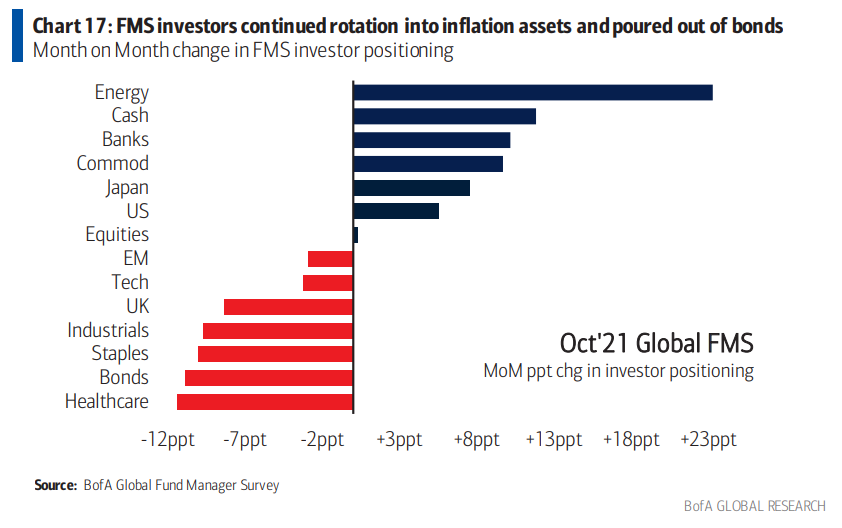
Fund Managers Sour on Global Growth Expectations, BofA Says

https://www.bloomberg.com/news/articles/202...to-a-record-low
QUOTE
Fund managers may be quickly souring on global growth and earnings expectations, but their positioning remains pro-risk as they slash bond holdings to a record low and buy U.S. equities.

This is a key takeaway from the latest Bank of America Corp. monthly fund manager survey, conducted in the week through Oct. 14. While the outlook for global growth turned negative for the first time since April 2020 and the overall survey was the least bullish in a year, the allocation to bonds fell to the lowest level ever as inflation woes drove expectations for higher rates, according to BofA strategists.

Investors boosted their exposure to U.S. equities to a 16% overweight, the most since November 2020, while the overall positioning in stocks remained “very high,” but steady at a net 50%.


user posted image
zacknistelrooy
post Oct 22 2021, 07:10 PM

Regular
******
Senior Member
1,033 posts

Joined: Dec 2009
US Federal Reserve bans officials from trading shares in wake of scandal

https://www.ft.com/content/0b99a7a9-21be-4e...35-14bba49d6216
QUOTE
The Federal Reserve has adopted new rules banning its policymakers and senior staff from buying individual shares and a string of other investments, as the US central bank tries to stamp out a growing furore over trading by top officials.

In a statement on Thursday, the Fed said that as a result of the new policies, its senior officials would be limited to “purchasing diversified investment vehicles, like mutual funds”.

As well as banning the acquisition of individual stocks, they would not be allowed to hold “investments in individual bonds, holding investments in agency securities (directly or indirectly), or entering into derivatives”, the Fed said.

The new rules are being introduced after questionable financial trades last year — which came to light in recent disclosures — led to the resignations in September of Eric Rosengren, the president of the Federal Reserve Bank of Boston, and Robert Kaplan, the president of Dallas Fed.

The furore over those trades caused Powell to call for a review of the rules around investments by the Fed’s top officials, which led to the tightening of the restrictions and disclosures announced on Thursday.

“These tough new rules raise the bar high in order to assure the public we serve that all of our senior officials maintain a single-minded focus on the public mission of the Federal Reserve,” said Jay Powell, the central bank’s chair.

Karine Jean-Pierre, principal deputy White House press secretary, told reporters on Thursday that the Biden administration respected the Fed’s independence. She wouldn’t comment on the central bank’s new trading rules, but added: “President Biden believes that all government agencies and officials, including independent agencies, should be held to the highest ethical standards, including the avoidance of any suggestions of conflicts of interest.”

The Fed said policymakers and senior staff would have to provide 45 days’ notice for any purchases or sales of securities, obtain approval for those transactions, and hold any investments for at least a year.

“Further, no purchases or sales will be allowed during periods of heightened financial market stress,” it said. Fed officials said that a trading blackout period would be declared during such times of turmoil which would work similarly to the trading blackout that already exists in the days surrounding meetings of the FOMC, the Fed’s policy-setting committee.

The trading scandal has come at an especially challenging time for the Fed, as it moves to shift monetary policy to slow its support for the recovery amid uncertainty over its leadership.

Powell’s term as chair of the central bank ends in February, and President Joe Biden has not said whether he would reappoint him to the post. The White House said on Thursday that the Biden continued to have “confidence” in Powell, however.

Fed officials said on Thursday that the new rules would lead to some divestitures by senior officials to comply with the tighter restrictions, which they would have some time to complete. They also include a requirement to disclose any transactions within 30 days.

Despite the urgency of Powell’s review, the new rules are not taking effect immediately: they will only be implemented once they are formally written and adopted by the US central bank, and when the Fed’s electronic systems are updated to process the disclosures and transactions.


Yet congress can still buy stocks........

zacknistelrooy
post Oct 26 2021, 08:17 PM

Regular
******
Senior Member
1,033 posts

Joined: Dec 2009
QUOTE(silverwave @ Oct 26 2021, 09:17 AM)
I can't believe TSLA could go up that much in a day ohmy.gif
*
In a market frenzy anything is possible.

Before touching on Tesla lets take a look at two stocks.


DWAC aka Trump stock went from $10 to $170 in two days.

Then there Bakkt Holdings Inc (BKKT) which is a crypto stock that has now at least in the pre market went to $45 and was around $9.50 last week.


Those are just one of the many moves in spec stocks this year.


For Tesla it has been a combo of option frenzy, short selling and pure speculation.


In the past two weeks Tesla options has been the top traded option and yesterday was responsible for 55% of all option volume in US markets.


$1,800 strike that is nearly 70% from here had 10,000 in volume. Quite common for Tesla.

user posted image

For more on options this person explains it relative well although I don't agree with everything he said.


Let enjoy these moves for now at least.
zacknistelrooy
post Oct 28 2021, 08:43 PM

Regular
******
Senior Member
1,033 posts

Joined: Dec 2009
Introducing Nanos by Cboe, Smaller and Simpler Options Designed for Retail Traders

https://ir.cboe.com/news-and-events/2021/10...-retail-traders

QUOTE
- Designed to make options trading more accessible for the retail trader
- Lower-price, simple tool for exploring options trading strategies
- Cash-settled (no delivery of physical shares) and European-style (no early exercise)
- Launching Nanos S&P 500 in first-quarter 2022, expanding S&P 500 Index options suite

CHICAGO, Oct. 27, 2021 /PRNewswire/ -- Cboe Global Markets, Inc. (Cboe: CBOE), a leading provider of global market infrastructure and tradable products, today announced plans to launch Nanos by Cboe, a first of its kind options contract designed to simplify options trading.  Nanos by Cboe help make options trading accessible for the everyday retail trader, allowing them to start small, learn as they go and grow their trading confidence.

Cboe plans to launch its first Nanos on the S&P 500 Index in first-quarter 2022. At a fraction of the size of a standard options contract, the one-multiplier, cash-settled Nanos S&P 500 contract answers the growing demand for a simpler, cost-effective way to gain broad exposure to the U.S. equity market. At 1/100th the size of an XSP1 option, the Mini-S&P 500 Index options contract, Nanos S&P 500 (ticker symbol: NANOS) help simplify the process of trading options, letting traders focus on understanding the market and refining their trading strategies.

The S&P 500 Index (SPX) options market is one of the most highly traded and liquid options markets across the globe and has served primarily institutional investors well for years, however, the higher price of a standard option contract can be a barrier to entry for retail traders. The smaller size of Nanos may help beginners gain confidence as they learn and apply basic trading strategies, utilize simplified analytics when identifying and sizing trades, and continue on a learning path.

"Our goal with Nanos is to use education to inspire and empower new market participants to pursue a sustainable financial future. We believe Nanos are more appropriately sized for retail traders and enable traders to better express their opinions on market movements at a comparatively lower premium price," said Ed Tilly, Chairman, President and CEO of Cboe Global Markets. "Through our Nanos S&P 500 product, we are broadening access to a greater universe of traders who can enjoy the potential benefits options provide, including hedging, asset allocation and income generation strategies."

Listed options are a time-tested and valuable investment tool that allow market participants to gain market exposure and manage their risk, however, it is important that new investors understand how to use options products and the potential risks2. To complement the launch of Nanos, the Cboe Options Institute plans to offer a new options introductory curriculum tailored to retail traders.

"Cboe Global Markets has a long-standing commitment to education, which better enables all types of investors to access our markets, understand our products and potentially benefit from our solutions," said Rob Hocking, Head of Derivatives Strategy at Cboe. "We are continuously evolving our education programs to offer more retail-centric content through the Options Institute, and we are thrilled to welcome a new generation of investors to options trading with the launch of Nanos."

The Nanos S&P 500 product complements Cboe's exclusive suite of S&P DJI Index options, which include S&P 500® Index (SPX) options, with A.M. and P.M. settled weekly and monthly expiring contracts, Mini-S&P 500 Index (XSP) options (which are one-tenth the size of SPX options), with P.M. settled weekly and monthly expiring contracts, and options on the S&P 500 ESG Index options and certain S&P Select Sector Indices with monthly expiring contracts. The creation of these new smaller contracts will provide market participants with additional tools to execute their U.S. large-cap equity trading strategies. Similar to standard SPX options, Nanos S&P 500 will be structured as European-style options (no early exercise) and cash-settled (no delivery or assignment of shares) at expiration with P.M. settlement. For additional information on Nanos by Cboe, visit www.cboe.com/nanos


zacknistelrooy
post Oct 29 2021, 10:47 PM

Regular
******
Senior Member
1,033 posts

Joined: Dec 2009
Burr’s Brother-in-Law Called Stock Broker, One Minute After Getting Off Phone With Senator

https://www.propublica.org/article/burrs-br...ne-with-senator

QUOTE
After Sen. Richard Burr of North Carolina dumped more than $1.6 million in stocks in February 2020 a week before the coronavirus market crash, he called his brother-in-law, according to a new Securities and Exchange Commission filing.

They talked for 50 seconds.

Burr, according to the SEC, had material nonpublic information regarding the incoming economic impact of coronavirus.

The very next minute, Burr’s brother-in-law, Gerald Fauth, called his broker.

ProPublica previously reported that Fauth, a member of the National Mediation Board, had dumped stock the same day Burr did. But it was previously unknown that Burr and Fauth spoke that day, and that their contact came just before Fauth began the process of dumping stock himself.

The revelations come as part of an effort by the SEC to force Fauth to comply with a subpoena that the agency said he has stonewalled for more than a year, and which was filed not long after ProPublica’s story.

In the filings, the SEC also revealed that there is an ongoing insider trading investigation into both Burr and Fauth’s trades.

It had previously been reported that federal prosecutors had decided not to charge Burr.

Burr’s spokesperson did not immediately respond to questions. Fauth’s lawyer and the SEC did not respond to questions. Fauth hung up on a ProPublica reporter.

According to the SEC, Fauth has cited a medical condition for why he cannot comply with the subpoena, even as he has been healthy enough to continue his duties at the National Mediation Board. In its filings, the SEC accuses Fauth of engaging in “a relentless battle” to dodge the subpoena.

In 2017, President Donald Trump appointed Fauth to the three-person board, a federal agency that facilitates labor-management relations within the nation’s railroad and airline industries. President Joe Biden reappointed him to the board.

On the day he received the call from Burr, Fauth sold between $97,000 and $280,000 worth of shares in six companies — including several that were hit particularly hard in the market swoon and economic downturn. According to the SEC, the first broker he called after hearing from Burr was out of the office, so he immediately called another broker to execute the trades.

In its filings, the SEC also alleges, for the first time, that Burr had material nonpublic information about the economic impact of the coming coronavirus crisis, based on his role at the time as chairman of the intelligence committee, as a member of the health committee and through former staffers who were directing key aspects of the government response to the virus.

The week after the trades, the market began its crash, falling by more than 30% in the subsequent month.

Burr came under scrutiny after ProPublica reported that he sold off a significant percentage of his stocks shortly before the market tanked, unloading between $628,000 and $1.72 million of his holdings on Feb. 13 in 33 separate transactions. The precise amount of his stock sales, more than $1.6 million, is also a new detail from this week’s SEC filings. In his roles on the intelligence and health committees, Burr had access to the government’s most highly classified information about threats to America’s security and public health concerns.

Before his sell-off, Burr had assured the public that the federal government was well prepared to handle the virus. In a Feb. 7 op-ed that he co-authored with another senator, he said “the United States today is better prepared than ever before to face emerging public health threats, like the coronavirus.”
Dozens of Traumatized Afghan Kids Struggle Inside a Shelter That’s Ill-Equipped to Care for Them

That month, however, according to a recording obtained by NPR, Burr had given a VIP group at an exclusive social club a much more dire preview of the economic impact of the coronavirus, warning it could curtail business travel, cause schools to be closed and result in the military mobilizing to compensate for overwhelmed hospitals.

Burr defended his actions, saying he relied solely on public information, including CNBC reports, to inform his trades and did not rely on information he obtained as a senator.

Alice Fisher, Burr’s attorney, told ProPublica at the time that “Sen. Burr participated in the stock market based on public information and he did not coordinate his decision to trade on Feb. 13 with Mr. Fauth.”

zacknistelrooy
post Nov 1 2021, 11:31 PM

Regular
******
Senior Member
1,033 posts

Joined: Dec 2009
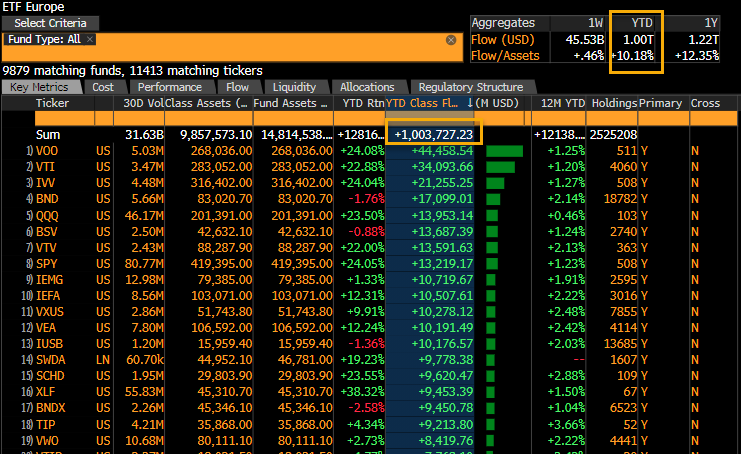
1 trillion in ETF inflows and it isn't even year end.

user posted image
zacknistelrooy
post Nov 3 2021, 07:52 PM

Regular
******
Senior Member
1,033 posts

Joined: Dec 2009
QUOTE(Trees @ Oct 30 2021, 03:07 PM)
I just came across something called covered call etf

I am currently studying it and search for this in forum got to this thread, means someone here discuss about it before.

Below are a video that I looked online

would like to know if anyone know what's the risk for this kind of instrument? is there anything i should be concerned about?
*
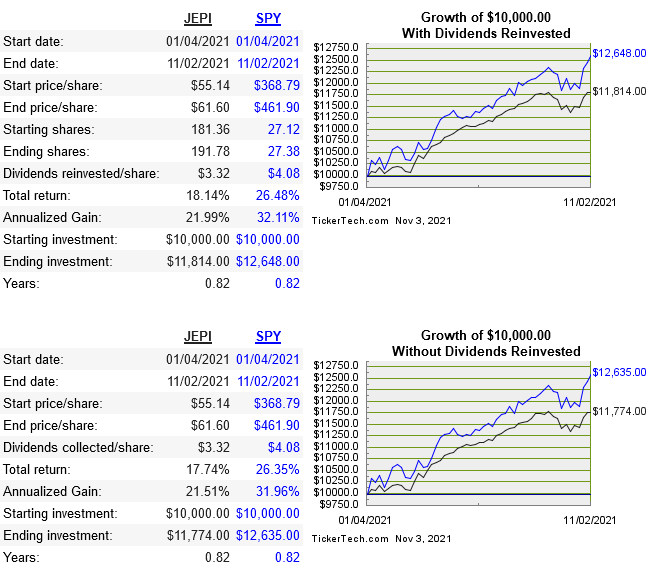
As previously said this strategy isn't going to work that well in a relentless up market. You can search some commentary in the thread about JEPI.

user posted image

The above shows the underperformance of JPMorgan Equity Premium Income ETF in the current environment even with and without dividend reinvested.

This post has been edited by zacknistelrooy: Nov 3 2021, 07:52 PM
zacknistelrooy
post Nov 4 2021, 04:26 PM

Regular
******
Senior Member
1,033 posts

Joined: Dec 2009
US warehouses running out of room amid supply chain crisis

https://abcnews.go.com/Business/us-warehous...ory?id=80906199
QUOTE
Warehouses in and around U.S. ports are running out of room, experts say, adding another challenge to the country's already crippled supply chain.

"We are either at or over capacity, and demand for space is the greatest I have ever seen," said Michael Sarcona, president of Sarcona Management Inc. He operates several warehouses in the Newark area, the third-largest port in North America.

Hundreds of thousands of shipping containers faced record backlog at U.S. ports over the past several weeks. Now that some have made landfall, the goods stored in those containers may soon outpace warehouse capacity.

Warehouse vacancy in the country has reached 3.6%, a record low, according to recent data from CBRE, an American commercial real estate services and investment firm.

"Three-and-a-half percent is effectively zero," said John Morris, executive managing director lead for CBRE's industrial and logistics business in the Americas. "For the year, we have basically an effective shortage of space of about 300 million square feet."

Even if retailers can get more products shipped to the U.S., Morris explained, they will struggle to find places to store them and move them along the supply chain.

"In an efficient supply chain, you want about 15% availability of warehouse capacity in these markets and across the country," said Craig Fuller, CEO and founder of FreightWaves, a global logistics industry data and analytics company. "At 3.6%, these warehouses are operating beyond their available capacity to even function properly."

Warehouses in the port of Los Angeles, the largest port in North America, have a record low vacancy of 1% , according to CBRE's analysis. This is the lowest vacancy CBRE has ever recorded for the port.

"That vacancy rate is down by more than half over the last year," said Chris Caton, the global head of strategy and analytics at Prologis, the world's largest logistics real estate developer. "So there is extreme scarcity in these port markets."

Warehouse vacancy at ports in central and northern New Jersey sit around 2%. Sarcona operates eight warehouse locations in Newark with a combined capacity of almost 2 million square feet, but has a team of employees and real estate agents urgently searching for more space.

How will this impact consumers?

Consumers likely won't be able to rely on online shopping the way they once did, according to experts.

"I'm worried that the inability of the supply chain to keep up, ends up having an impact on the wonderful growth we've seen in this omni-channel retail economy," said Morris, referring to online shopping platforms that allow consumers easy and timely access to big and small brand items.

"I think we've lost the predictability of when products are going to be delivered to consumers," said Fuller, explaining that sellers likely won't be able to guarantee delivery times this holiday season. "I've been ordering Christmas items since mid-October -- [because] if anyone tells you they can tell you when something's going to be delivered, they're either not truthful or they're misinformed."

Fuller believes the uncertainty could push consumers back into stores.

"I think people are going to find that as we get closer and closer to the Christmas holiday, that the items that they normally would be able to buy online, they're going to have to go into stores to get it," Fuller said.

How did this happen?

Rebounding consumer demand has led to record imports through U.S. ports on both coasts. Warehouses at those ports are the first stop for items coming into the U.S., and they're overwhelmed.


"Are we out of space? The answer is not yet," Morris said. "Is supply and construction keeping up with demand? Just barely... like... just barely."

zacknistelrooy
post Nov 9 2021, 11:25 PM

Regular
******
Senior Member
1,033 posts

Joined: Dec 2009
QUOTE(danmooncake @ Nov 4 2021, 11:35 PM)
Funny thing is they're running out of toilet papers soon (again!).. not enough truckers willing carry those items to the retail shops/consumers. Inflation gone up because of this logistic issue not because of manufacturing. Crazy world we live in.
*
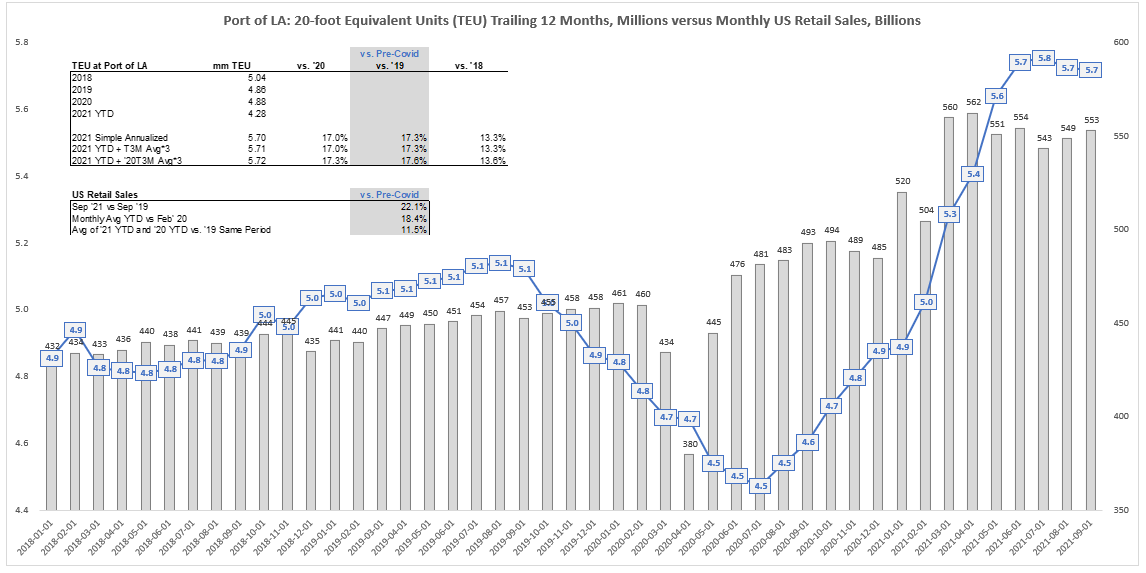
Past actions have come back to bite the world and combine that with off the charts demand is what we have now.

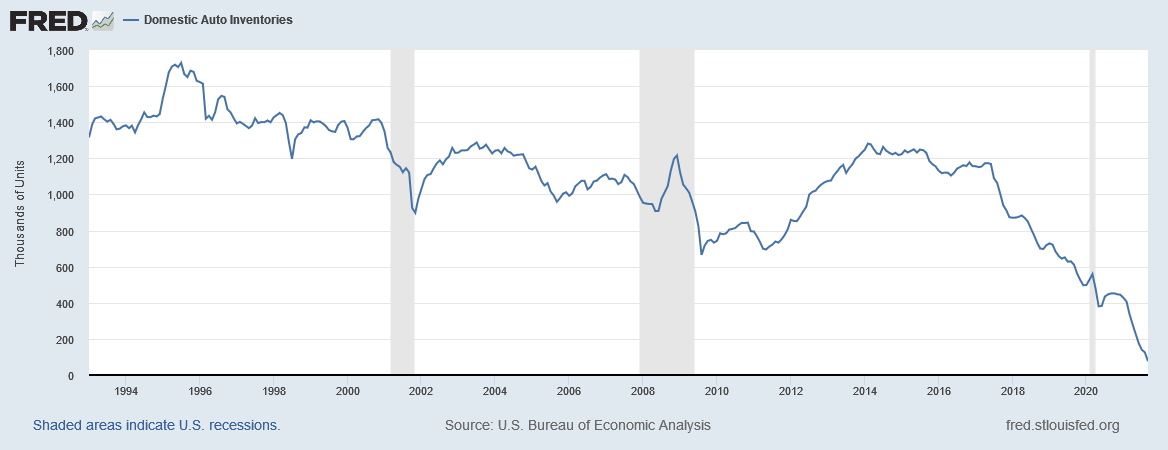
Years of squeezing every last bit for ROE and not saving much in inventory be it commodities or goods.

user posted image

Containers are way higher pre covid and add covid as potential complications is a recipe for disaster for supply chains.


user posted image

Barely been adding to inventories even before covid.
zacknistelrooy
post Nov 10 2021, 10:20 PM

Regular
******
Senior Member
1,033 posts

Joined: Dec 2009
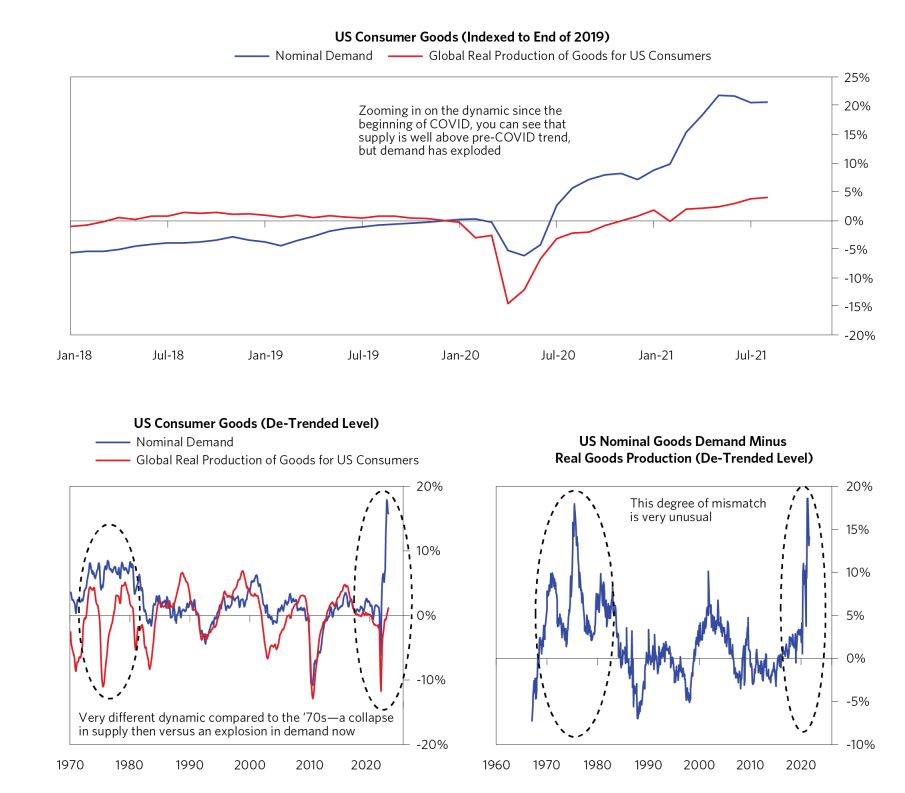
It’s Mostly a Demand Shock, Not a Supply Shock, and It’s Everywhere

https://www.bridgewater.com/its-mostly-a-de...-its-everywhere

QUOTE
MP3 created a self-reinforcing demand explosion that is getting harder, not easier, for supply to keep up with.

Even as supply disruptions and higher inflation persist, markets are discounting that they will soon subside, leaving inflation at central bank targets and allowing for very easy monetary policy for a very long time. We disagree. While the headlines tend to focus on the micro elements of the supply shock (the LA port, coal in China, natural gas in Europe, semiconductors globally, truckers in the UK, etc.), this perspective largely misses the macro cause that is likely to persist and for which there is no idiosyncratic solution. This is not, by and large, a pandemic-related supply problem: as we’ll show, supply of almost everything is at all-time highs. Rather, this is mostly an MP3-driven upward demand shock. And while some drivers of higher inflation have been transitory, we see the underlying demand/supply imbalance getting worse, not better.

The mechanics of combined monetary and fiscal stimulus are inherently inflationary: MP3 creates demand without creating any supply. The MP3 response we saw in response to the pandemic more than made up for the incomes lost to widespread shutdowns without making up for the supply that those incomes had been producing. This is very different than post-financial-crisis MP2, where QE, by and large, was not paired with significant fiscal stimulus but instead offset a credit contraction and, as a result, was not inflationary.

We’re now seeing the inflationary mechanics of MP3 play out and observing just how potent a tool it is. And while the composition of the demand it fueled will evolve (e.g., shift from goods back toward services as COVID recedes), demand is likely to remain highly elevated. There are still large stockpiles of latent spending due to the transformative effects that MP3 has had on balance sheets and the ongoing incentive provided by extremely low real yields, and more fiscal stimulus is on the way. Choking off demand would require central banks globally to move toward restrictive policies quickly, which looks unlikely.

In this research, we paint a picture of the surge in demand and how supply is straining to meet it virtually everywhere you look. There are not enough raw materials, energy, productive capacity, inventories, housing, or workers. We start with this broad-brush picture because the demand-driven nature of the problem results in a game of whack-a-mole: alleviating a shortage in one area will likely just exacerbate the problem elsewhere in the supply chain.


user posted image
zacknistelrooy
post Nov 12 2021, 07:47 PM

Regular
******
Senior Member
1,033 posts

Joined: Dec 2009
user posted image

25 Pages « < 21 22 23 24 25 >Top
 

Change to:
| Lo-Fi Version
0.0431sec    0.58    7 queries    GZIP Disabled
Time is now: 2nd December 2025 - 03:31 PM