Welcome Guest ( Log In | Register )

25 Pages « < 19 20 21 22 23 > » Bottom

Outline · [ Standard ] · Linear+

 USA Stock Discussion v8, Brexit: What happens now?

views
     
zacknistelrooy
post Apr 4 2021, 08:20 AM

Regular
******
Senior Member
1,033 posts

Joined: Dec 2009
Need a Mortgage Loan? Good Luck. Lenders Are Tightening Standards.

https://www.wsj.com/articles/the-mortgage-m...355802?mod=e2tw

QUOTE
The mortgage market is humming, but getting approved for a home loan is as difficult as it has been in years.

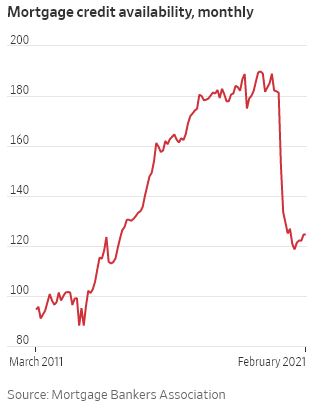
Mortgage credit availability, a measure of lenders’ willingness to issue mortgages, is near its lowest level since 2014, according to the Mortgage Bankers Association, or MBA.

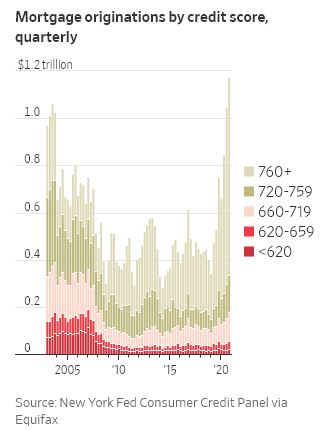
The tight lending environment illustrates a growing cleavage in the mortgage market: More home loans are being made than almost ever before, but they are going almost exclusively to borrowers with pristine credit histories and sizable down payments. Borrowers with credit qualifications that fall just outside the stellar category are finding fewer lenders willing to approve their applications. A segment of borrowers who would have qualified for a home loan early last year are now out of luck, deemed too much of a credit risk.

“Because mortgage credit is more difficult to obtain, it is a more competitive environment overall,” said Dr. Lawrence Yun, chief economist at the National Association of Realtors.

About 70% of mortgages issued in 2020 went to borrowers with credit scores of at least 760, up from 61% in 2019, according to the Federal Reserve Bank of New York.

The median credit score of borrowers approved for mortgages reached 786 in the fourth quarter of 2020, up from 770 during the same period in 2019.

Americans who want to break into the housing market this spring face plenty of other challenges. Home prices tend to fall in a slowing economy, but they have jumped during the coronavirus pandemic, keeping many families out of home ownership.

Home prices are increasing at the fastest pace in 15 years, propelled by a record-low supply of homes for sale and a flood of well-off workers looking for second homes or space for home offices. The median existing-home price topped $300,000 last summer and has stayed there ever since.

And mortgage rates, while still historically low, have risen meaningfully from last year’s record-setting lows, pushing monthly payments higher for would-be buyers.

The availability of mortgage loans plummeted as much as 35% year over year in 2020, when lenders wanted to protect themselves from making loans to borrowers who might lose jobs during the pandemic. The MBA’s mortgage credit index has drifted higher since last fall but remained about 31% lower in February than the same time last year.

“In one week last spring, jobless claims were in the millions,” said Tendayi Kapfidze, chief economist at LendingTree. “A borrower who was fine one week could be a much riskier borrower the next week.”

Lenders’ concerns about the financial stability of borrowers prompted them to increase verification of employment and income. Some borrowers were asked to sign statements affirming that they had no intention of requesting forbearance after being approved for a mortgage. Some lenders are asking that documents used in mortgage applications, such as bank statements and pay stubs, be no older than 30 days, where they once allowed them to be 60 days older or more.

Stricter credit requirements appeared most clearly at either end of the mortgage market. The average credit score for borrowers approved for Federal Housing Administration loans rose to 672 in the fiscal year 2020, up from 666 in 2019. FHA loans typically have lower incomes and smaller down payments.

At the same time, lenders upped requirements for jumbo mortgages, which tend to go to well-off buyers. Jumbo mortgages are too big to be sold to government-backed mortgage giants Fannie Mae and Freddie Mac, so banks often keep them on their own books and bear the risk of default.

Jeanne Griffin’s local credit union in Minnesota denied her mortgage application earlier this year. She said she was told her 713 credit score and the fact that her student loans were in pandemic-related forbearance disqualified her.

“They said if I had applied a year ago, I would have been approved,” said Ms. Griffin, who has close to $20,000 saved for a down payment.

The credit union encouraged her to begin making student-loan payments and pay off about $4,000 in credit-card debt before reapplying.

The meteoric growth of home prices has made some lenders reluctant to take on first-time home buyers or others they view as slightly risky. Lenders who were comfortable offering mortgages of $300,000 or $320,000 to borrowers with good-but-not-great credit histories might not be willing to lend the $350,000 or more now required to buy the same property.

Loan officers and underwriters weigh a handful of variables when determining whether to approve a mortgage application: employment history, income source, credit score and debt level, among others.

Are you looking to buy a house for the first time? Share your experience below.

Strict lending requirements play an important role in keeping the housing market healthy. Making sure that borrowers can afford mortgage payments is key to limiting defaults. Ultraliberal lending policies, including loan approvals for people with spotty income histories or mountains of debt, helped spark the 2008-09 financial crisis.

Lending standards are unlikely to expand meaningfully until housing demand ebbs, economists said. The dearth of homes for sale means lenders can select only the best from an abundance of applications.

Still, credit requirements should loosen slightly this year as interest rates rise, drying up refinancing, said Mike Fratantoni, the MBA’s chief economist.

“Since lenders aren’t being flooded with calls to refinance, more of their resources can be used to reach out to first-time buyers for purchases,” Mr. Fratantoni said.

Refinance loans are expected to comprise 46% of the mortgage market in 2021, down from 59% in 2020, according to the MBA.
user posted imageuser posted image

zacknistelrooy
post Apr 4 2021, 08:19 PM

Regular
******
Senior Member
1,033 posts

Joined: Dec 2009
QUOTE(icemanfx @ Apr 4 2021, 10:59 AM)
Implying u.s economic recovery is sustaining.
*
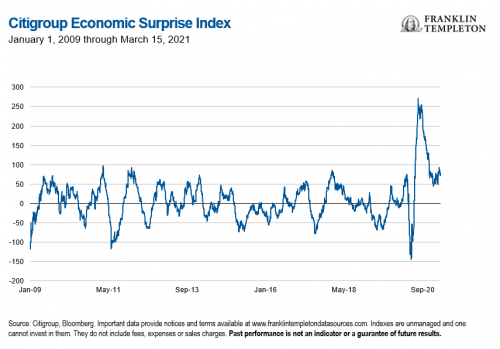
Yes but the Citigroup Economic Surprise Index is normalizing and is still at the high end of the range.

user posted image


Plus the unknown supply of housing that is stuck in courts for foreclosure while eviction moratorium is still in place and if lending standards are tightened then I find it hard to see how potentially that supply is going to be absorbed.

This also assumes that large part of stimulus for landlords doesn't reach them which until recently has been the case.


zacknistelrooy
post Apr 17 2021, 08:51 PM

Regular
******
Senior Member
1,033 posts

Joined: Dec 2009
New Investors Discover Tax Pitfalls of Robinhood and Other Trading Apps

https://www.wsj.com/articles/new-investors-...pps-11618565406

QUOTE
With 2020 tax bills coming due, a wave of new retail traders are waking up to the fact that it can be difficult, and often impossible, to make tax-minimizing moves on new brokerage platforms such as Robinhood, Webull, SoFi, Uphold and Public.com. Some don’t allow trading within tax-favored retirement accounts such as IRAs. Traders can also find it hard to track their “wash sales” that reduce tax benefits if they buy a stock within 30 days of selling the same stock at a loss.

Most vexing for investors like Mr. Leong is that despite the new platforms’ sophisticated technology they don’t make it easy to deploy a tax-wise technique known as “specific-lot identification.” Investors use it to lower their taxes, sometimes significantly, by choosing which shares to sell if they have lots bought at different prices and aren’t selling all of them.

Here’s why this issue matters. Tax laws allow investors with taxable accounts to use the losses they incur when they sell a stock that’s dropped to offset the taxes on gains from the sales of stocks that have climbed. The losses can also offset up to $3,000 of other income, such as wages, each year. Unused losses carry forward for use against future gains and other income.

“Now that I’ve done research on taxes, I wish I could sell the shares I choose, not a share selected by the ‘Sell’ button,” says Ashton Courson, age 26, a construction worker and manager from Portland, Ore., with about $17,200 in an account at Robinhood he’s not using much, in part for tax reasons.

The option of selling specific lots is readily available at traditional brokerage firms. But Webull, SoFi, Public and Uphold don’t allow it, and Robinhood makes it difficult. This fact shocks professional money managers.

“I think it’s absurd. Taxes are a huge component of investment returns, and it’s an area where investors have some control,” says Bill Mulvahill, a CPA and money manager at Trailhead Planners in Minneapolis.

What difference does tax management make to the bottom line? According to a recent study, systematically taking losses that reduced taxable gains boosted after-tax returns by an average of 0.82% a year from 1926 to 2018 for an investor in a 35% tax bracket. The gains could be larger under some circumstances, says one of the study’s authors, Terence Burnham of Chapman University, such as if an investor traded small or volatile stocks or shorted them.

zacknistelrooy
post Apr 18 2021, 08:47 AM

Regular
******
Senior Member
1,033 posts

Joined: Dec 2009
QUOTE(danmooncake @ Apr 17 2021, 09:58 PM)
Probably not a problem for non-US residents, where some they don't file US taxes at all.
But the new platform like Robinhood does make it difficult for US tax payers to report their cost basis.
*
Yup but something to consider for those involved in retail driven stocks since there could potentially be tax selling as IRS deadline is next month instead of this month.

user posted image

user posted image

Asia still lags behind in terms of stock holdings as above so the cap gains tax effect might be a factor soon in the markets as we also transition to long term cap gains.
zacknistelrooy
post Apr 26 2021, 11:03 PM

Regular
******
Senior Member
1,033 posts

Joined: Dec 2009
Last week Thursday was up there with all the weird things within the past year.

https://twitter.com/nytimes/status/1385239439396544513

user posted image

NYT broke the news few hours earlier but full details were not fully in sync with the Bloomberg piece that came out a few hours later.

Yet the market never sold of in the morning but only in the afternoon.

Be careful out there and stick to your long term goals.


https://www.bloomberg.com/news/articles/202...ains-like-wages

QUOTE
The White House plans to propose almost doubling the capital gains tax rate for those earning $1 million or more, to 39.6%, according to people familiar with the proposal. That wouldn’t affect many. Only about 0.32% of American taxpayers reported adjusted gross income of more than $1 million and capital gains or losses on their returns, according to Internal Revenue Service tax return data from 2018.


user posted image


In the end of the day those earning above $ 1mil will find a way to reduce or not pay either by borrowing against their assets or finding another loophole.

Comes back to retail driven stocks and potentially those tax fillers not knowing the way to reduce their tax bill.

This post has been edited by zacknistelrooy: Apr 26 2021, 11:07 PM
zacknistelrooy
post Apr 30 2021, 08:35 PM

Regular
******
Senior Member
1,033 posts

Joined: Dec 2009
https://www.gmo.com/asia/research-library/c...nd-em-ex-china/

QUOTE
China-only or a Regional Mandate?

Grouping works best when the components within the groups have high correlations to each other and low correlations to members of the other groups. A natural question with a “China-only” strategy is whether it should include other countries such as Korea and Taiwan. These two countries are similar to China in their above-average exposure to the consumer tech space and their leverage to global growth. They also have strong trade links with China and are geographically proximate. Countering the above supports for inclusion is the fact that China has a massive domestic market whereas Korea and Taiwan are far more export-oriented. Furthermore, while China’s economy is huge, incomes on a per capita basis are a fraction of those in Korea and Taiwan.10

As investors, we can measure the net effect of all the above through a study of correlations. Correlations of China with Korea and Taiwan have fluctuated around 0.7. Correlations of China with other major countries are generally lower, but still range from 0.4 to 0.6. At the very least, this suggests that there isn’t an incontrovertible case for an active manager to include Korea and Taiwan in his or her China mandate.
The Case for Top-down Is Even Stronger in EM ex-China than in EM

The ability to add alpha through top-down country or sector allocation decisions is a clear advantage in EM investing. Emerging markets have demonstrated on many occasions that local economic forces have more impact on individual stock prices than they do in developed countries. At GMO, we reflect this belief in our EM equity portfolios by incorporating country and sector specific signals in our models and by giving country and sector allocation a greater weight than stock selection in our process.

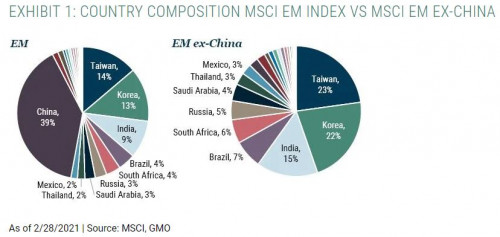
And this becomes particularly beneficial when the stock selection dimension shrinks. Neither quantitative nor fundamental stock pickers will welcome a drop of 40% in the size of their opportunity set. A top-down approach, on the other hand, will lose just 1 of 27 on the country dimension and nothing along the sector dimension.

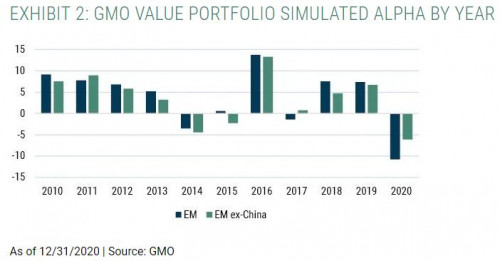
We use simulations to illustrate this. All the GMO EM equity portfolios typically allocate around 60% of their weight to country and sector allocation and around 40% to stock selection. Removing Chinese stocks should impact our EM portfolios by about 40% (proportion of EM stocks that are Chinese) of about 40% (weight of stock selection in our process), i.e., by roughly 16%. We should therefore expect an EM ex-China simulation to closely match an EM simulation. And that’s exactly what we find. The incorporation of top-down allocation allows us to transform an opportunity set hit of ~40% to a far more manageable decrease of ~16%. Exhibit 2 presents the similarity in annual alphas (versus their respective benchmarks) across the two simulations of our quantitative value strategy.


user posted image
user posted image

zacknistelrooy
post May 3 2021, 08:11 PM

Regular
******
Senior Member
1,033 posts

Joined: Dec 2009
No longer the most hated bull market.

https://www.wsj.com/articles/americans-cant...ket-11619947800
QUOTE
Americans are all in on the stock market.

Individual investors are holding more stocks than ever before as major indexes climb to fresh highs. They are also upping the ante by borrowing to magnify their bets or increasingly buying on small dips in the market.

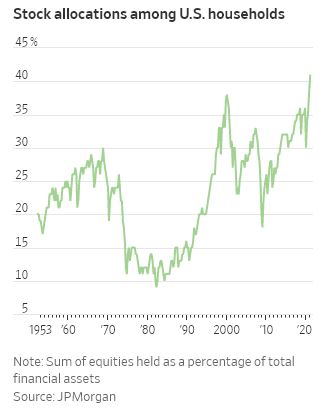
Stockholdings among U.S. households increased to 41% of their total financial assets in April, the highest level on record. That is according to JPMorgan Chase & Co. and Federal Reserve data going back to 1952 that includes 401(k) retirement accounts. JPMorgan’s Nikolaos Panigirtzoglou, who analyzed the data, attributed the elevated allocations to appreciating share prices alongside stock purchases.
user posted image
zacknistelrooy
post May 4 2021, 08:02 PM

Regular
******
Senior Member
1,033 posts

Joined: Dec 2009
QUOTE(yok70 @ May 4 2021, 07:38 AM)
I am still confused about how to calculate capital gain tax for stocks. Is it by sold price minus current average bought price?
*
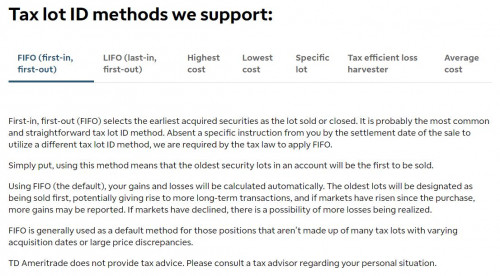
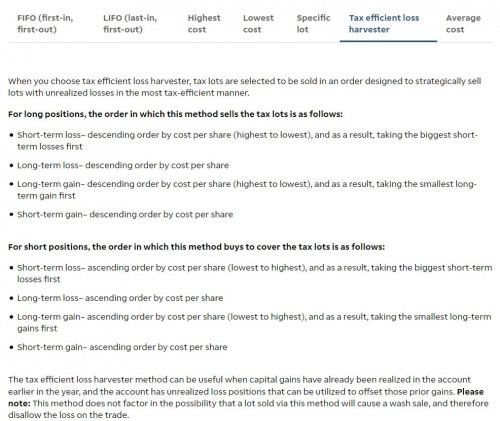
https://tickertape.tdameritrade.com/tools/c...ost-basis-15831

https://www.tdameritrade.com/education/taxe...-a-tax-lot.html

For the above, some of the new brokerages do not give that option and with a few wrong moves it could well be a big problem for those that file taxes.
zacknistelrooy
post May 6 2021, 07:59 PM

Regular
******
Senior Member
1,033 posts

Joined: Dec 2009
https://www.bloomberg.com/news/articles/202...r?sref=lSuy1ocu

QUOTE
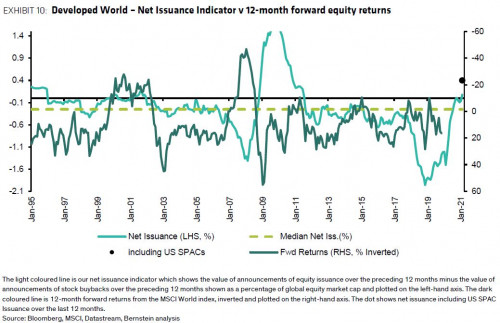
The ever-shrinking global stock market is no more.

Thanks to record issuance, the SPAC boom and the pandemic-fueled collapse in buybacks, the supply of equities across the developed world has turned positive for the first time in a decade, according to Sanford C. Bernstein. At $273 billion in the 12 months through the end of March, the hand-wringing over the de-equitization trends of the post-financial crisis era is well and truly over.

What started as a rush to shore up balance sheets during the Covid crisis has morphed into a spree of deals to tap relentless investor appetite for a market defying historic valuations. From Coinbase Global Inc. and Deliveroo Plc to celebrity blank-check firms, initial and secondary offerings jumped to a record $208 billion in the 13 weeks to April 9, Ned Davis Research data show.


user posted image
zacknistelrooy
post May 12 2021, 11:22 PM

Regular
******
Senior Member
1,033 posts

Joined: Dec 2009
QUOTE(yok70 @ May 7 2021, 09:09 PM)
I can't access the above two links. I think because I'm not tdamritrade client.
*
Probably because it is blocked in MY. It is a public link.

For your future reference if ever the days come and you need to know about it.

user posted image

user posted image


QUOTE(ozak @ May 11 2021, 08:45 PM)
I thought people abandon market and go into crypto now?

It is crypto cycle now.
*
Some professionals are already there and they have been keeping quiet about it.

If one looks hard enough then you can see their fingerprints especially in the mainstream crypto.


https://www.bloomberg.com/news/articles/202...e?sref=lSuy1ocu

QUOTE
After two decades in energy trading, the 51-year-old was lured by a former Goldman Sachs Group Inc. colleague this February into a new world of market-making in digital currencies.

Now he’s in fighting spirits -- unleashing old-school finance tricks to exploit the industry’s rampant inefficiencies, volatility and downright weirdness.

“All the fun that used to be had 30 years ago in the commodity markets and is no longer fun -- that fun is now in crypto,” says the U.S. chief executive officer at GSR Markets in Houston.

Griggs is among crypto newcomers deploying systematic strategies that are tried-and-tested in conventional asset classes -- price arbitrage, futures trading, options writing -- in a booming new corner of finance. As more mainstream investors get behind Bitcoin, boutique firms are joining the likes of Mike Novogratz in an ever-broadening crypto rally that keeps breaking records.

For example, in order to get an edge in its market-making strategy, BKCoin has recently installed servers at Asian crypto exchanges, a move known as co-location in the high-frequency world of stocks. It’s a sign the industry is growing up fast.

“In any emerging market we’ve seen these inefficiencies decrease over time,” said George Zarya, founder of Bequant, a crypto prime brokerage that caters to systematic traders. “There are more professional players that come in.”

zacknistelrooy
post May 24 2021, 06:39 PM

Regular
******
Senior Member
1,033 posts

Joined: Dec 2009
QUOTE(oOoproz @ May 19 2021, 11:06 PM)
I still believe there is a last leg to go, too early to short
*
Yup.

They need to dump more of their private assets on to the market like last week when they listed Oatly which is close to a 30 year old company. Blackstone is shareholder in that company....


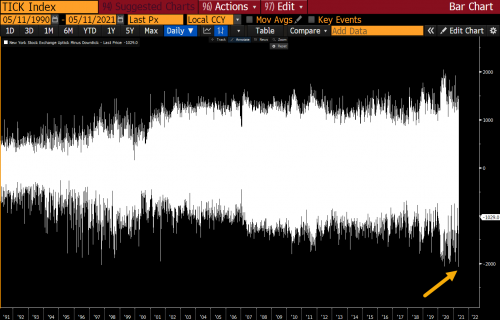
Even in the past two weeks they have avoided going after index stocks heavily and targeted a lot of the speculative stocks even with the worst cumulative stock selling in 30 years and matches covid levels last year.

user posted image
zacknistelrooy
post May 25 2021, 12:35 AM

Regular
******
Senior Member
1,033 posts

Joined: Dec 2009
QUOTE(oOoproz @ May 24 2021, 07:38 PM)
Interesting chart here, gonna look at it
*
It isn't a great indicator in normal selloffs and gives a lot of false positive but in extreme selloffs it gives you a good idea how bad is it and is the market close to a washout.
zacknistelrooy
post May 27 2021, 10:27 PM

Regular
******
Senior Member
1,033 posts

Joined: Dec 2009
QUOTE(GamaX320 @ May 25 2021, 11:11 PM)
can I know what software u using? bloomberg terminal?
*
That is Bloomberg Terminal but it isn't mine.

Bloomberg generally has the most accurate data but Thinkorswim has the data too under the ticker $TICK if you have an account with TD.

Public ones count it differently and sometimes aren't as accurate.
zacknistelrooy
post May 31 2021, 11:54 PM

Regular
******
Senior Member
1,033 posts

Joined: Dec 2009
https://www.ft.com/content/4fdf1805-7305-4a...3c-1c89a3550547

QUOTE
Archegos crashes the Spac party

DD readers know by now that the implosion of Bill Hwang’s Archegos Capital has been felt far and wide — from banks in the US to Europe and Asia.

And as the US Department of Justice begins its investigation into the collapsed family office, another unexpected casualty of the fallout has emerged: special purpose acquisition companies. Ever heard of them?

All jokes aside, banks are now becoming more wary about how much leverage they can extend to clients such as hedge funds, who are early investors in Spacs.

A quick lesson on the hedge fund trade: managers are typically allocated shares in the Spac at $10 a piece before it is listed. Here they can use leverage from their prime brokers to buy into the company. When time comes to sell out (hopefully at a profit) they pay back what they owe and keep the returns.

The strategy has proven to be a gold mine over the past year because shares in Spacs have been driven up by retail investors who can only buy into the company once it has already listed.

Because the cash invested in Spacs is put in a trust that earns interest and shareholders are allowed to ask for their money back, blank-cheque companies are seen as a relatively risk-free investment. So most hedge funds can usually get quite a bit of leverage from their prime brokers to juice their returns. But market experts say this doesn’t seem to be the case any more.

Archegos, whose collapse left major banks nursing more than $10bn in losses, has left many lenders with a sour taste.

Leverage restrictions are the latest setback for Spacs, which as recently as a few months ago were considered the hottest investment product on Wall Street. They have also started to fall out of favour amid poor performance and regulatory scrutiny.
zacknistelrooy
post Jun 8 2021, 10:29 PM

Regular
******
Senior Member
1,033 posts

Joined: Dec 2009
QUOTE(hehe86 @ Jun 7 2021, 02:46 AM)
Hi all, anyone know is there a similar website like this https://www.malaysiastock.biz/Latest-Announcement.aspx but for US stocks instead of Malaysia ones?

Thanks in advance
*
https://www.estimize.com/

The above should have what you are looking for but still not exactly like mystockbiz

Another option is below:

https://research.tdameritrade.com/grid/publ...ar/calendar.asp


Most others like https://www.marketbeat.com/earnings/beats-and-misses/ have bits and pieces and if you want the full data then you need to pay.

or https://atom.finance/

This post has been edited by zacknistelrooy: Jun 8 2021, 10:30 PM
zacknistelrooy
post Jun 9 2021, 09:03 PM

Regular
******
Senior Member
1,033 posts

Joined: Dec 2009
https://www.cnbc.com/2021/06/08/chipotle-hi...obox=1623237515

Chipotle Mexican Grill has hiked menu prices by roughly 4% to cover the cost of raising its workers’ wages.

QUOTE
Across the restaurant industry, chains such as Chipotle, Starbucks and McDonald’s have been increasing hourly pay for employees of company-owned locations in a bid to attract new workers and retain their current ones. Consumer demand has come roaring back for restaurant meals, but the workforce has been slower to return, pushing eateries to sweeten the deal. In May, the leisure and hospitality industries added 292,000 jobs, but employment in those fields is still down by 2.5 million compared with pre-pandemic levels, according to the Department of Labor.

In May, Chipotle said that it would raise hourly wages for its restaurant workers to reach an average of $15 an hour by the end of June. Company executives said at the Baird Global Consumer, Technology & Services Conference that they would be passing along the price of raising pay to consumers.

“It feels like the right thing, at the right time, and it feels like the industry is now going to have to either do something similar or play some kind of catch-up,” CFO Jack Hartung said at the virtual conference. “Otherwise you’ll just lose the staffing gain.”

CEO Brian Niccol said the company prefers not to raise its prices but that the move made sense in this scenario.

The timing of the price hikes coincides with rising ingredient costs across the restaurant industry as suppliers grapple with the return of demand. For now, Chipotle isn’t planning on further price increases.

“Ingredient costs, there’s talk about it. We’ll see where that leads,” Hartung said.

zacknistelrooy
post Jun 11 2021, 11:39 PM

Regular
******
Senior Member
1,033 posts

Joined: Dec 2009
Invesco Fires Next Shot in Fee War With Funds Charging Nothing

https://www.bloomberg.com/news/articles/202...harging-nothing

QUOTE
Invesco Ltd. launched two new exchange-traded funds Friday with management costs waived until the end of the year, further escalating the ETF industry’s long-running fee war.


The Invesco Nasdaq Biotechnology ETF (IBBQ) and Invesco PHLX Semiconductor ETF (SOXQ) will effectively cost nothing until Dec. 17, after which each will carry an expense ratio of 19 basis points, according to a press release from the firm.


Issuers across the $6.4 trillion ETF industry have been battling to have the lowest cost offerings for years in a bid to capture assets as the total number of funds surpasses 2,400. Earlier this year, State Street Global Advisors slashed fees on its two of its bond ETFs a day after BlackRock Inc. made a similar move.

Still, a zero expense ratio -- even for a limited period of time -- is relatively uncommon. BNY Mellon Investment Management released the first zero-fee bond fund last year as well as another zero-fee product tracking big American companies. But so far no other large asset managers have made comparable moves.

The IBBQ fund will provide exposure to about 270 innovative biotechnology companies, including some that helped with Covid-19 vaccines and treatments. Meanwhile, SOXQ will include 30 of the largest names in the semiconductor industry.

Invesco has about $343 billion in ETF assets, comprising roughly 5.5% of the total U.S. market, according to data compiled by Bloomberg.

zacknistelrooy
post Jun 13 2021, 11:09 PM

Regular
******
Senior Member
1,033 posts

Joined: Dec 2009
user posted image

https://www.bloomberg.com/news/articles/202...-for-your-bonds


QUOTE
A “massive rotation” into corporate bonds from equities may be on the horizon for U.S. pension funds as they become fully funded, according to strategists at Bank of America Corp.

Investment gains boosted the funded ratio of the 100 largest corporate plans to 98.8% in May, according to Milliman. That measure of defined benefit pension assets to liabilities has surged from 82% since July 2020, data from the risk management firm show.

If interest rates continue to rise, BofA expects the ratio to top 100%. That would trigger a significant move into high-grade debt by corporate pensions seeking to lock in gains, the bank said in a credit strategy note entitled “The elephant in the room.”

“I think this becomes a pretty big story, and it becomes a support for credit spreads in the back end of the curve especially,” Hans Mikkelsen, BofA’s head of high-grade credit strategy, said in an interview.

Corporate pensions that are over-funded will likely sell riskier assets like equities and buy annuities from insurance companies, Mikkelsen said. Insurance companies would then hedge with mostly longer maturity, investment-grade corporate bonds.

“These are legacy plans. It’s been a headache for a long time for companies to have them and have them be underfunded,” Mikkelsen said. “Now they may be able to make that problem go away without putting any new money into it.”

Private defined-benefit pension plans held $3.5 trillion in assets at the end of 2020, with nearly half of that in equities, according to data from the Federal Reserve.

BofA expects wider high-grade U.S. spreads in the short term, foreseeing a faster rate-hiking cycle than is currently priced in by the market. If that happens, pension reallocation would likely support long-dated credit and flatten the spread curve, Mikkelsen added.


This post has been edited by zacknistelrooy: Jun 13 2021, 11:10 PM
zacknistelrooy
post Jun 15 2021, 08:20 AM

Regular
******
Senior Member
1,033 posts

Joined: Dec 2009
QUOTE(ChAOoz @ Jun 14 2021, 11:38 AM)
Rotation will happen. I believe this will stabilise bond yield which is good.

3.5t in private pension fund and half of it is in equities. So basically fed realise printing money not only benefit the wealthy but also most working american. As long as everything don’t collapsed all is well, wallstreet and USD is still US best innovation everrr.
*
That is still to be seen though. Nowadays these rebalances have been having less of any effect on markets compared to even 5 years ago especially since they keep announcing it ahead of time.

Plus from projections the current yields won't really support the continued rise in funded ratio.


Yes it has helped working Americans but there are a ton of unintended consequences like the housing market and wage inflation that they will need to deal with.


https://www.cnbc.com/2021/06/14/paul-tudor-...her-prices.html
QUOTE
Billionaire hedge fund manager Paul Tudor Jones told CNBC on Monday he’s paying close attention to this week’s Federal Reserve policy meeting in light of recent economic data showing higher consumer prices.

“If they treat these numbers — which were material events, they were very material — if they treat them with nonchalance, I think it’s just a green light to bet heavily on every inflation trade,” Jones said on “Squawk Box.”

“If they say, ‘We’re on path, things are good,’ then I would just go all in on the inflation trades. I’d probably buy commodities, buy crypto, buy gold,” added Jones, who called the stock market crash in 1987 and is founder and chief investment officer of Tudor Investment.

On the other hand, Jones predicted that markets would be unsettled if the Fed comes out with a different tone Wednesday.

“If they course correct, if they say, ‘We’ve got incoming data, we’ve accomplished our mission or we’re on the way very rapidly to accomplishing our mission on employment,’ then you’re going to get a taper tantrum,” Jones said. “You’re going to get a sell-off in fixed income. You’re going to get a correction in stocks. That doesn’t necessarily mean it’s over.”
Will see if Paul Tudor Jones is right considering he hasn't gotten much macro moves right in the past 10 years at least.

Plus his objectives would be admittedly different compared to the average retail investor.
zacknistelrooy
post Jun 19 2021, 11:59 PM

Regular
******
Senior Member
1,033 posts

Joined: Dec 2009
https://www.wsj.com/articles/it-isnt-just-a...ket-11624008602

QUOTE
For years, individual investors’ trading activity rarely made a splash on Wall Street. That started to change in 2019, when online brokerages moved en masse to commission-free trading. The Covid-19 pandemic further accelerated individuals’ interest in stocks last year, allowing those stuck at home to try their hands at trading through historic market volatility.

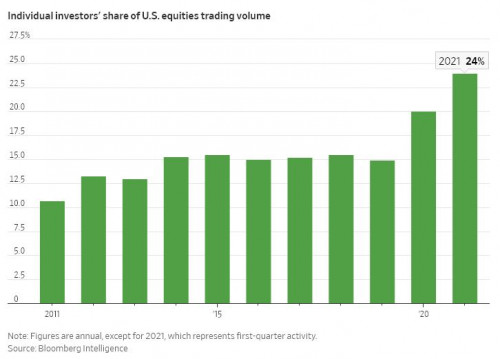
Together, those forces helped drive individual investors’ share of U.S. equities trading volume to 20% last year, roughly double the figure from a decade before, according to data from Larry Tabb, head of market-structure research at Bloomberg Intelligence.

This year that share has been growing. In January, when individuals piled into so-called meme stocks, retail investors’ activity was responsible for 26% of all shares traded in the U.S. stock market—with some online brokerages accounting for sizable chunks of total trading volume on their own. Activity from individual investors trading on Robinhood Markets Inc. accounted for roughly 4% of total U.S. share volume in January, Mr. Tabb estimates, while E*Trade Financial activity constituted 2.4%. His figures exclude trading activity by electronic-trading firms that execute individual investors’ trades.

Those figures have edged down since January, but Mr. Tabb expects individual investors’ elevated levels of activity to last.

“They definitely have influence, and they’re not going away,” he said. “We think for the next year or so, 18% to 22% of the market will be driven by retail.”

On a net basis, individual investors have poured a net $140.57 billion into the U.S. stock market this year, according to data through Monday from Vanda Research’s VandaTrack. That is up roughly 33% from the same period a year ago, and more than six times the amount during the same stretch in 2019.


user posted image

25 Pages « < 19 20 21 22 23 > » Top
 

Change to:
| Lo-Fi Version
0.4170sec    0.87    7 queries    GZIP Disabled
Time is now: 2nd December 2025 - 06:22 PM