

 Apr 7 2016, 08:25 AM, updated 10y ago


Thanks to its affordable and often feature-packed devices, Huawei has firmly entrenched itself as the third biggest smartphone manufacturer, behind Apple and Samsung. Over the past six months or so, the company has added new handsets to its bigger-screened Mate range and it's crafted the Nexus 6P on Google's behalf. But it's time to turn our attention back to the flagship P series. It's been a year since the P8 debuted, after all, so it's with barely any surprise whatsoever that we welcome the Huawei P9 today. Or the P9 family, we should say.

At first glance, the P9 doesn't look a whole lot different from its predecessor, the P8. It's slightly less angular, a hair thicker at 6.95mm (versus 6.4mm) but not particularly adventurous in its design. Not that there's anything wrong with Huawei's formula. The P9 is thin, light, extremely well-built and clad in aluminum, giving it a premium-y vibe. An almost edge-to-edge display dominates the front of the device, but there's no real upgrade in this department. Like the P8, the P9 sports a 5.2-inch IPS panel of full HD resolution (1,920 x 1,080).
There are a few visible details that speak of the bells and whistles Huawei has added to the P9. You won't find a fingerprint sensor on the back of the P8, for example, or a USB Type-C port on its bottom edge. Most important, the P8 doesn't have two rear-facing cameras like the P9, but more on that later.

The P9 is powered by Huawei's latest Kirin 955 octa-core processor -- four 2.5GHz and four 1.8GHz cores -- paired with 3GB of RAM and 32GB of internal storage. There's also a 64GB model with 4GB of RAM, and both configurations support microSD cards of up to 128GB. The P9 draws from a 3,000mAh battery, which is apparently good for a day and a half of frequent use. It also runs Android 6.0.1 Marshmallow under Huawei's Emotion UI (version 4.1), if you were wondering. That takes care of all the key specs, so it's time to move onto the P9's key selling point: its dual rear cameras.
The P9 is Huawei's first device produced under its new partnership with Leica. What does that mean, exactly? Well, apart from the German company's name on the back of the handset, the P9 has "Leica-approved" lenses. It's important to note, however, that these aren't manufactured by Leica. Huawei also worked with the company to redesign its camera app, but that's kind of where Leica's involvement ends.
Outfitting the P9 with two rear cameras was Huawei's doing -- and something it's done before. The P9 pairs two 12-megapixel sensors (1.25µm pixel size), one monochrome and one color. Huawei's Honor 6 Plus used two color sensors and, like HTC's Duo Camera arrangement, was useful for adding effects and manipulating the depth of field of images. You can still do all of this with the P9, of course, including changing focus and background blur after the fact.
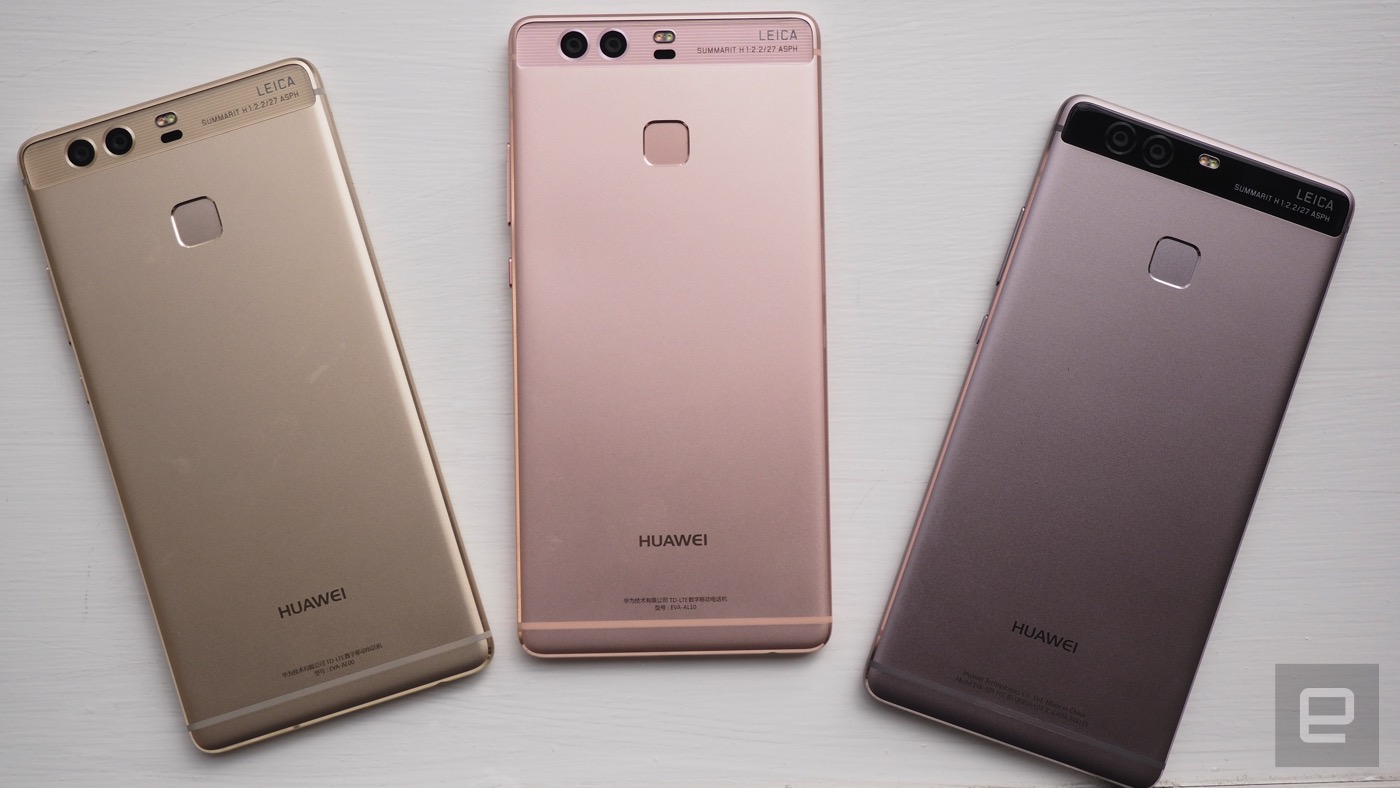
According to Huawei, switching one out for a monochrome sensor is good for two reasons. First, you can take raw black-and-white images, which should look a lot more detailed and natural compared with a filtered photo. Really, though, the monochrome sensor's main job is to improve color images with extra contrast and lighting data. Pairing the two, Huawei says, improves contrast by 50 percent and light capture by 300 percent, making for crisper images and good low-light performance (theoretically, at least).
The dual-camera setup is supported by laser focus for closeup shots and a small, two-tone flash. The new camera interface developed with Leica's help is incredibly simple. You will, however, find all the different shooting modes hiding in an off-screen menu, including three Leica-made color profiles. A small pop-up menu next to the shutter-release button on screen switches the camera into "pro" mode. This menu allows you to alter everything manually, from shutter speed to ISO value, white balance, focus mode, light metering and more.
Officially, there's no "Lite" variant of the P9 like there was for the P8. It is launching in two configurations later this month, however. The Huawei P9 with 3GB of RAM and 32GB of storage will be available from April 16th in Asia and Europe for €599 (roughly $684), while the 4GB/64GB version will sport a €649 (around $738) price tag. Only the Asian models will have dual-SIM functionality. Color options will vary by market, but the P9 comes in six getups: ceramic white, haze gold, rose gold, titanium grey, mystic silver and prestige gold.
More : http://www.engadget.com/2016/04/06/huawei-p9/
This post has been edited by chokia: Apr 7 2016, 08:27 AM
 Quote
Quote


 0.0161sec
 0.49
0.49
 5 queries
 GZIP Disabled