

 May 14 2008, 09:48 AM


Profile
Previously with the B.B.C. Loudspeaker Research Department and Bowers & Wilkins Loudspeakers Ltd. in England as an Advanced RD&D Engineer. Joined Edifier Ltd in 2004 after being with Monsoon Audio Inc. (Eastech).
“When I joined the Edifier Company” he recalls, “My first project was to help create an enhanced website with informative product descriptions. After that, I became deeply focused on bringing the British and European sound to the upcoming multi-media speaker systems” His career since then has been devoted to researching and developing leading edge technology for many other products that Edifier manufacture.
| You have a well documented history on the Internet of past achievements with some very well known Companies. Why did you join Edifier?
Well, it started when I was sent a link from a moderator of a well known forum. I checked out their website, and found some very interesting designs. I thought that some products looked quite European, and extremely well made. I contacted the Canadian operations, and they brought some samples over to me. I was very impressed with the superb fit and finish, with most systems being constructed of MDF wood, including the satellites. Many of the samples sounded very good as well. I felt joining this Company would be challenging, and yet very rewarding.
| What ideas did you have to bring to the Company?
My initial reaction was to somehow fuse the sound characteristics we had in the U.K. with the existing line up that was already in production. Not an easy task though by any means.
| Why is that?
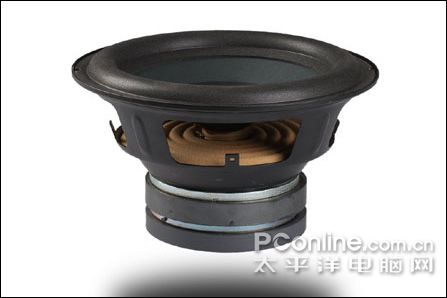
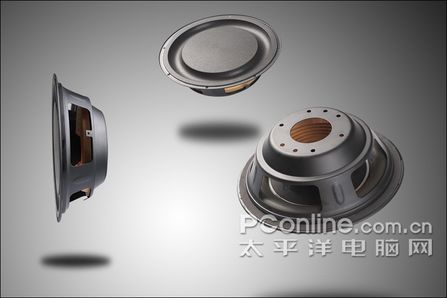
Basically, the actual loudspeaker drivers themselves would need to be upgraded with more technology pioneered by the B.B.C. Research Department, as well as some other European manufactures. Amplifier power and subwoofer performance would also need to be enhanced further, especially for the North American market. Additionally, two way crossovers for the satellites would have to be implemented on as many systems as possible.
| What do these crossovers do to the sound?
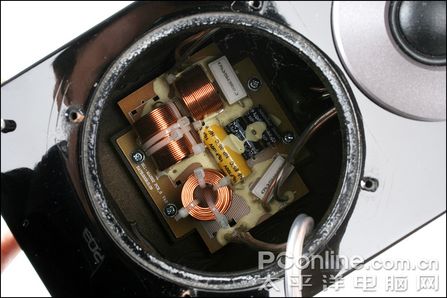
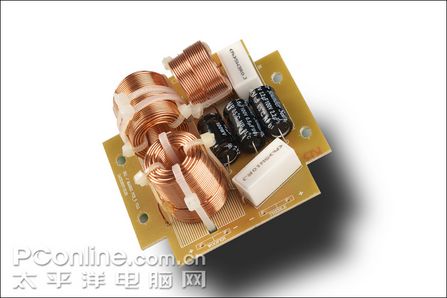
Basically, a crossover is better described as a frequency divider. The circuit takes the incoming signal and splits the audio spectrum, in this case for our satellites, into two groups of frequencies. For our satellites, we need the high frequencies to go to the tweeter, and the midrange frequencies to be sent to the midrange loudspeaker. Sonically, the sound will be smoother, and power handling increased.
| These crossovers sound complicated, is that true?
Well, they can be. Some designs use 12 elements (parts) or more. With multimedia speaker systems, the satellites are fairly small, so internal space is at a premium. So we tend to use simple but effective designs. More recently we are adopting more efficient loudspeaker transducer technology, so the need for overly complicated crossovers can be reduced. I like to keep the components to an absolute minimum.
| Can you tell us why?
Certainly, every time we introduce a component into the signal path from the amplifier, there is a risk of degrading the original signal. We do use more and more high quality polypropylene capacitors and air cored inductors to minimize this effect. A simple crossover tends to preserve signal integrity, and potentially will reduce many masking effects of the finest nuances and the subtlest of details.
| You mentioned earlier that Edifier uses wood for their systems, is that a good thing?
Yes, very much so. We use a high quality MDF wood on many of our systems. This material has excellent rigidity with good damping characteristics. We want to reduce cabinet vibrations to a minimum. Left unchecked, even the most minute of vibrations have a sound of their own, and will superimpose themselves onto the outgoing audio performance. These vibrations can make a system sound boxy, or at worst buzzy in nature. Many systems of our competitors use thin inexpensive plastic for their enclosures, and their choice of material is clearly audible.
| But Edifier use plastic on some models too?
That’s true, we do. However, we are using a very strong mineral filled polymer plastic that is braced internally with ribbing. We spend inordinate amounts of time testing and measuring vibration with leading edge computer analysis. We can plot a resonance, and add extra damping to greatly reduce and even eliminate the offending group of unwanted frequencies.
| How important is your Computer Analysis equipment with designing?
We choose the best system design hardware and software we can find. For example, we can simulate how a speaker will sound before building it. Simulation software is a vital tool for us. However, even with all the equipment we have at our disposal, nothing can replace the human ear. It is the listening team here and in China, who listen for weeks and even months that help balance the sound of the final product. We have to test our systems in different environments, different rooms, and with different equipment. They have to sound as lifelike as possible on all music styles from sources all over the World. Additionally, we have to satisfy the different tastes and preference for our listeners. Even then, we are not satisfied. We invite members of the public as well as our retailers to provide us with feedback, positive and negative.
| How different is a multimedia product from a true Hi-Fi one?
The principles are very much the same. We aim for a smooth clean sound that is effortless over long periods of time. One thing that is very different though is the listening distance. PC users tend to be only 18” – 24” away from the satellites. This closeness can bring out sonic flaws that maybe far less audible 6 or more feet away. This is yet another reason why our choice of materials are so critical.
| So far we have covered speakers, how about your amplifiers?
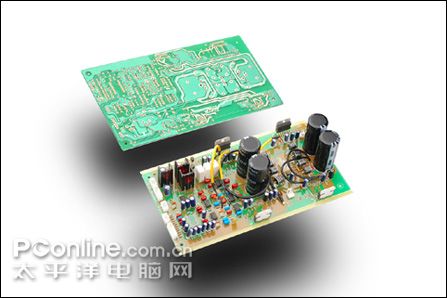
Great question. Amplifiers need to be powerful enough to drive our systems to very high output levels. Too little power can make a system sound strained and even damage transducers with clipping or overload distortion. Too much power on a system with transducers that are not designed for high power, will fail due to thermal breakdown. In the last two years, we are using more digital amplification. This technology is far more efficient, allowing us to implement high power in very confined spaces. We also have a proprietary technology called EIDC, or Electronic Intelligent Distortion Control. Simply put, it is a single microprocessor that collects and calculates the distortion level of the output signal. Additionally, it automatically adjusts the amplifier to protect the system from output overload, allowing for different input sources with varying input levels. The system is easy to upgrade by modifying the software characteristics.
| I read in the Press that Edifier has won some awards at the 2008 CES?
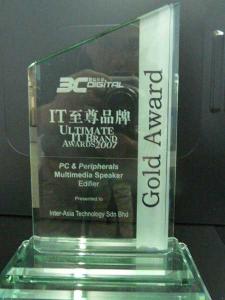
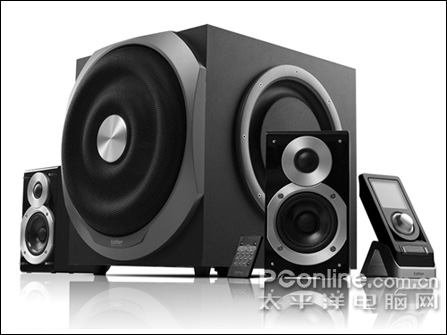
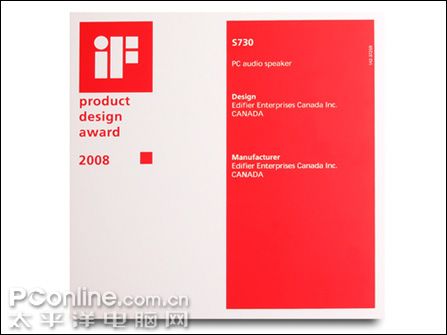
Yes, and we are very proud of these awards. The CES awards are for Innovation Design and Engineering for the E3350 model and our new Wireless Rainbow system. We also won an IF Product Design Award in Germany at CeBIT for our Rainbow and Signature S730 powerhouse system. These awards can only be achieved by extraordinary teamwork though. Each department and division has to work hand in hand to achieve the desired results.
| What do you see in the future for Edifier?
Another great question. I feel we will lead the Industry on a number of fronts. We have incredible styling designers, as well as engineering leaders on our teams. We plan to diversify our products into other areas, such as professional audio. I feel more Companies will come to us for our expertise in their acoustical needs such as Nokia have already done. We will be moving to a huge new Factory in southern China soon, that will be a standard by which others will be measured by. We also have one of the most comprehensive Anechoic Chambers in World. We will never rest though in bringing the best possible sound and product quality to any given price point.
| Thank you for your time Peter.
You are very welcome.
Peter Duminy
Director of Research and Engineering,
Edifier International H.K. and Edifier Canada
This post has been edited by Edifier: May 16 2008, 10:31 AM
Attached thumbnail(s)

 Quote
Quote


 Welcome to the Club




 0.0480sec
 0.17
0.17
 7 queries
 GZIP Disabled