Interesting article on USS Zumwalt, excerpts below.
At Sea Aboard the Zumwalt

Unusually for a ship on builder’s trials, the civilians were joined by about 130 members of the destroyer’s US Navy crew, on board to get their first chance to sit down and operate the ship that later this year they will call home.
This was the third night out for the Zumwalt on its second seriesof builder’s sea trials, the first “alpha” trials having been carried out in early December. The ship, which will eventually go to sea with a crew of 147, was carrying 388 souls, one of the highest numbers Zumwalt likely will ever carry during a planned service life of about 40 years.
The only objects protruding above the flat foredeck are the huge enclosures for the two 155mm guns of the advanced gun system (AGS), the largest naval guns installed as standard equipment to go to sea in decades. Ranged along the sides of the ship on the foredeck and along the flight deck aft are 80 missile cells in a new arrangement intended to use the blast shields of the cells to protect the ship, and keep the centerline free for the gun system. No railings or lifelines are visible, although stanchions can be rigged manually when in port. Those venturing out on deck must latch on to a safety line.
“The first trial we were out about a week, this time Monday to Thursday,” said Capt. James Downey, program manager for NAVSEA’s PMS 500 office which oversees the DDG 1000 program. He spoke March 23, the ship’s third night out. “The real point is to demonstrate those systems the same way we will do it for acceptance trials. This is a dress rehearsal for that, and to grade ourselves. We’ll collect all the data and go back and debrief and see how we did.”
Downey felt good about the Zumwalt’s stealth qualities. “I’m not worried about the RCS whatsoever,” he declared. “It’s looking good. It’s looking too good.” Despite his engineer’s caution, Downey was upbeat about the trials. “So far we haven’t had any failures — no equipment failures, no demonstration failures.”
Those on board reported the first two days of the trials were held in relatively rough weather, but the Zumwalt’s unusual, tumblehome hull performed as expected.
“The ship handled well. It’s been an exceptionally stable platform. It handled very well,” said US Navy Capt. James Kirk, who will become the Zumwalt’s first commanding officer.
During the trials, the twin rudders were put hard over at 30 knots. Kirk was impressed. “I would have thought the ship would have significantly more heel” during such a turn, he said. “It was only about a 7- to 8-degree heel.”
The Bridge
Situated on the O-2 level, or the second level of the superstructure, the bridge is a large space that will have only three regular watch standers. Two positions are adjacent at the center, one for the junior officer of the watch (JOOW) and another for the junior officer of the deck (JOOD). The officer of the deck (OOD) has no seat, but is expected to stand and move about. The three positions will be filled by officers, not enlisted sailors. Manual machinery controls are between the two seated watch standers, while control and computer panels are provided for each position. The ship can be steered by autopilot, keyboard or mouse instructions or by rotating a small black knob that serves as the ship’s wheel.
Ship Mission Center
The ship’s nerve center is a huge command and control space two decks high, projecting from the steel-enclosed O-2 level into the O-3 level at the base of the composite superstructure that surmounts the ship. Three large flat-panel displays dominate thefront of the room where 19 watch standers man console stationsin four rows. The general layout of the consoles is somewhat similar to the latest Aegis Baseline 9 with similar user stations and common displays, although in a much larger space. The firstand second rows handle weapons, including missiles, guns and anti-submarine and electronic warfare. Command and control positions occupy the third row, including seats for the commanding officer, tactical action officer and the engineering officer of the watch. Propulsion, engineering and information technology support personnel man the fourth row consoles.

(Aegis Baseline 9 layout)
Above and at the back of the SMC is a large, glassed-in second deck provided for mission planners, intelligence personnel or command staffs. There, they can function without disturbing the watch standers below while viewing the same common displays. Port and starboard of the SMC are additional enclosed spaces with more consoles and large panels to allow for specific mission planning or operations.
Below Decks
Down in the hull, a prominent feature is “Broadway,” a very large main-deck passageway running along the starboard side allowing ammunition and supplies to easily be moved to storageareas and magazines. The P-way, big enough for forklifts to drivethrough, is similar to those on the last generation of US battleships, which used the same descriptive term.
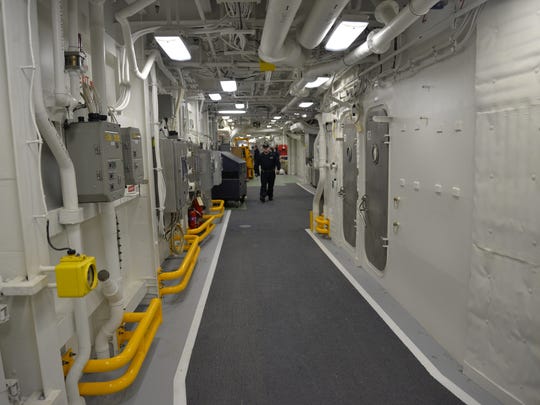
Amidships on the second deck are the mess areas. The wardroom for officers, goat locker for the chief petty officers, andmess for the crew are all served by the same, all-electric galley.
The two main machinery spaces each feature a power plant consisting of an advanced induction motor (AIM) and an MT-30 Rolls-Royce gas turbine together producing 39 megawatts, for a total output of 78 megawatts. Each AIM is directly connected to one of the ship’s two propeller shafts, eliminating the need for reduction gear. The machinery spaces are designed to be remotely operated.
Aft, a secondary ship’s mission center (SSMC) is installed on theport side. On a smaller scale than the large ship mission center, the SSMC is able to handle the same ship control functions as the SMC or the bridge and will function as the ship’s damage control center.
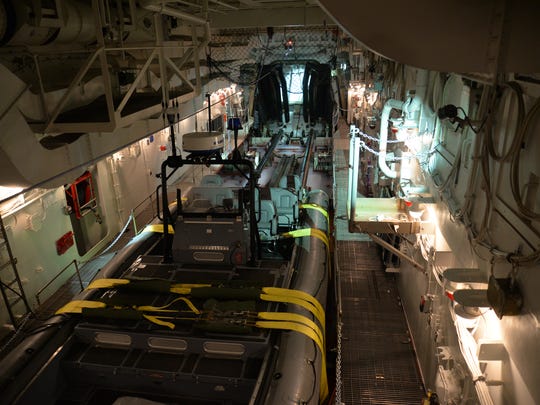
All the way aft is a large boat bay, big enough to store two 11-meter rigid-hull inflatable boats (RHIBs) one in front of the other. The RHIBs are on rails, and launch and recover on a titanium cradle that rises and tilts to connect with a heavy-duty rubber extendable ramp running through stern doors in the Zumwalt’s wide, flat transom. Nearby, berthing racks are installed for a 14-member special operations team, along with space for their weapons and gear.
Hangar and Flight Deck
No nets ring the flight deck, which instead features personal safety barriers. The PSBs reduce the ship’s signature and are automatic, unlike nets fitted on destroyers and cruisers which need to be raised and lowered by sailors. On the Zumwalt, the PSBs will rise as soon as a landing helicopter is trapped by the Aircraft Ship Integrated Secure and Traverse (ASIST) helicopter recovery and handling system. The ASIST latches on to the helo and moves it into the ship’s large hangar, which is fitted with a new, two-piece solid door that could be a prototype to replace doors on other ships.


 Military Thread V20
  Apr 24 2016, 06:09 PM


 anyway NATO now is all about top attack missile
 Quote
Quote



 0.0282sec
 0.55
0.55
 7 queries
 GZIP Disabled