Welcome Guest ( Log In | Register )

Bump Topic Topic Closed RSS Feed

Outline · [ Standard ] · Linear+

 Insurance Talk V3, Anything and everything about insurance

views
     
dasecret
post Apr 8 2016, 02:22 PM

Regular
******
Senior Member
1,498 posts

Joined: Nov 2012
QUOTE(cherroy @ Apr 8 2016, 11:46 AM)
In ILP, the so called "return" may be used to burn the future rise in premium of cost of insurance.
Somemore in ILP, the investment portion is not capital guaranteed, it can result in a loss as well, instead of "return".

ILP = insurance + UT.

Standalone medical = insurance without UT.
*
QUOTE(Ayrehn @ Apr 8 2016, 02:12 PM)

True also. But better than no returns at all right  laugh.gif

*
No, it's not necessarily better.
You pay for the UT, and what is the IRR of the investment linked UT compared to if you can buy any UT that is not provided by insurance company?

I'm a prudential client; and I can tell you the Inv linked funds performance is no where near what Eastspring investment (pure UT arm) funds are doing

If I can turn back time and choose my insurance plan again, I would check the linked fund returns on top of considering the coverage and benefits
dasecret
post Apr 8 2016, 02:52 PM

Regular
******
Senior Member
1,498 posts

Joined: Nov 2012
QUOTE(aarondotcom89 @ Apr 8 2016, 02:37 PM)
Opps sorry. I beg to differ. Not ALL companies got such clause.
Prudential do not have such clause. Showed in policy "Guaranteed Renewable".

I dont understand your point in cancelling your policies to protect whaaat?  confused.gif
You see, you're comparing the focus of an Insurance company with an Investment company.
I'm a Pru client too. As I'm super glad that Eastspring is doing superbly well, did you know they manage PRU funds too.

You have to know what your needs/wants are.

If you need protection, you don't go to Eastspring do you?
*
The clause referred to is cancelling the entire class of policies. Whilst it can be done, it's quite a drastic move. They won't do it if they don't want to pay 1 particular case or even 10 cases. It has to be ALL of the policies within that portfolio
But yes, it's in virtually all life policies

Investment Linked policies basically means you pay same amount of money throughout the policy tenure, but in the beginning insurance charge is lower and therefore the differential is invested into funds that supposedly help grow the cash value so that when you are older it will subsidise the higher insurance charge. So the rate of returns from the funds is crucial to determine whether or not you need to top up premium to keep your policy in force

The prulink equity fund return for last 1 year is -3.18% and cumulative 5 years is 22.89%

Compare this with

Eastspring Investment Equity Income fund last 1 year is 1.27% and cumulative 5 years is 73.66%

Compared this with

AIA EQUITY DIVIDEND FUND last 1 year is 1.47% and 3 years annualised is 8.73%

Hence why I say to compare investment linked fund returns before signing up an investment linked policy
Disclaimer: I don't own AIA policy and do not sell as well.
dasecret
post Apr 8 2016, 03:21 PM

Regular
******
Senior Member
1,498 posts

Joined: Nov 2012
QUOTE(Ayrehn @ Apr 8 2016, 03:13 PM)
AIA EQUITY DIVIDEND FUND 5years data?
And can you share the source of this information..
*
Sure
https://www.aia.com.my/content/dam/my/en/do...02_FFS_EDFA.pdf

They don't show 5 years data

Actually, prulink equity shows 3 years data
https://www2.prudential.com.my/export/sites...kequityfund.pdf

3 years cumulative 8.62% vs AIA 8.73% annualised returns (that 26.19% without considering compounding effect!)
dasecret
post Apr 8 2016, 03:35 PM

Regular
******
Senior Member
1,498 posts

Joined: Nov 2012
QUOTE(dasecret @ Apr 8 2016, 03:21 PM)
Sure
https://www.aia.com.my/content/dam/my/en/do...02_FFS_EDFA.pdf

They don't show 5 years data

Actually, prulink equity shows 3 years data
https://www2.prudential.com.my/export/sites...kequityfund.pdf

3 years cumulative 8.62% vs AIA 8.73% annualised returns (that 26.19% without considering compounding effect!)
*
QUOTE(Ayrehn @ Apr 8 2016, 03:27 PM)
That's a clearer view.
With a 0.11% difference, I'd still take Prudential over clauses where the company can decide to stop covering my life at any point of time they like.
*
Please read properly
What was presented in Prulink fact sheet is cumulative 8.62%, that works out to be 2.87% annualised; compared to AIA 8.73% annualised

Cumulative apple-to-apple comparison would be Prulink 8.62% vs AIA 26.19%

How la you want people to buy insurance from you bangwall.gif
dasecret
post Apr 8 2016, 03:45 PM

Regular
******
Senior Member
1,498 posts

Joined: Nov 2012
QUOTE(Ayrehn @ Apr 8 2016, 03:40 PM)
Woooo. Who is selling any insurance to you all here?
Sorry I don't.

Whats your take on Eastspring Investment Small Cap?
*
Good to hear that you are not.... I'm a lot less worried for the consumers out there already

EI small cap invest in different type of shares and hence I've not used it as a comparison to the investment linked funds. The returns are attractive, but its volatility is also very high. Definitely not the kind of funds to dump 100% of your capital into

Anyway, this is seriously OT. Please proceed to fund related threads for in-depth discussion
dasecret
post Apr 15 2016, 12:53 AM

Regular
******
Senior Member
1,498 posts

Joined: Nov 2012
QUOTE(cherroy @ Apr 14 2016, 09:52 PM)
Even with ILP, the cost of insurance also increase with age.
*
QUOTE(lifebalance @ Apr 14 2016, 09:57 PM)
yeap, as explained in the following post that the investment returns will be used to pay off future higher cost of insurance.
*
I think the best way to compare, is to compare the indicative insurance charge that is provided in both uforlife and ILP quotation. and I've done it for prudential and allianz, it's somewhat similar, not significantly cheaper or more expensive.

The investment returns to pay off future higher cost simply mean you pay more in the beginning so that the investment can grow. But if I set the same amount aside when I buy uforlife and invest it myself, I would not be confined to the limited investment linked funds offered by the insurer my policy is with

Honestly, if I were to do it again, that's how I would do it *disgrunted prulink client* rclxs0.gif
dasecret
post May 5 2016, 11:17 PM

Regular
******
Senior Member
1,498 posts

Joined: Nov 2012
QUOTE(lifebalance @ May 5 2016, 09:13 PM)
Oic you mean those like maybank or wise card

You may use aeon watami for cash back on insurance. AIA also tied up with Public Bank to give 2% rebate

https://www.pbebank.com/Personal-Banking/Ca...redit-Card.aspx
*
Watami card has been discontinued from this month 😢
dasecret
post May 6 2016, 12:00 PM

Regular
******
Senior Member
1,498 posts

Joined: Nov 2012
QUOTE(adele123 @ May 5 2016, 11:47 PM)
slightly OT...
i guessed that much. not that i didn't think of it. just to point out the t&c, the uob vox card and cimb cash rebate card specifically excludes insurance premium from their main cash rebate category. can't even get 0.3% from vox card for normal purchase of insurance. maybe can test if qualify for 5% if pay via those insurance companies' payment gateway.

not sure about pb vs, don't have it and can't find the t&c.

eventually i stick to using HLB essential for insurance. 0.6% for everything is not bad.
*
Since Aeon Watami 3% has since discontinued, according to genxyz sifu, the best cash back card for insurance would be Alliance Bank Younique - for spending at RM3,000, the effective cash back rate is 1.67%; about half of Watami but still better than all those <1% cash back for insurance spending
dasecret
post May 6 2016, 01:50 PM

Regular
******
Senior Member
1,498 posts

Joined: Nov 2012
QUOTE(adele123 @ May 6 2016, 12:44 PM)
While agree with your pov, in more practical situations, it's really not easy for certain group of people to spend RM1000 or 2000 monthly. funnily, those who can, will have better cards to pay for other bills such as petrol, utilities, etc.

Also, most people don't pay their insurance premium in one lump sum. monthly mode insurance premium on average is probably 100 to 300.

although i admit 0.6% of HLB essential vs Alliance younique first tier of 0.5% is really not that significant.
*
It goes to show I spend way too much on categories with no extra cashback - insurance, touch n go, retail spending like clothes and all sweat.gif

for petrol, utilities, online spending, grocery, dining and all we use those with higher cashback rate
dasecret
post Oct 29 2016, 10:57 PM

Regular
******
Senior Member
1,498 posts

Joined: Nov 2012
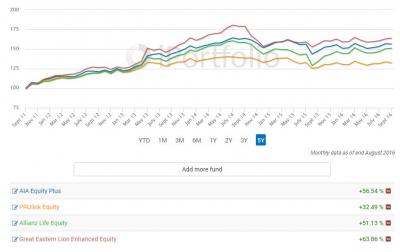
In the past I've raised the importance of considering the investment linked fund returns when selecting insurance company for investment linked policies and it usually get shot down with the standard 'don't mix protection with investment' bla bla. But the investment linked funds will help you grow the capital to sustain the higher insurance cost later on and therefore is an important consideration.

In the past there's no easy way to compare returns of these investment linked funds. Today someone sent me this website that has the info so I'm sharing this with you guys

Attached Image

So clearly not all funds do well and if you are with the lower returns one, you may end up with less cash value, or worse, running out of cash value later on and have to increase premium to maintain the policy

Credits: http://iportfolio.com.my/compare
dasecret
post Oct 30 2016, 11:36 AM

Regular
******
Senior Member
1,498 posts

Joined: Nov 2012
QUOTE(MNet @ Oct 30 2016, 10:41 AM)
After u done the comparison, which company UT is the best?
*
Confused, are you asking about investment linked funds or UTs? UTs we continue in FSM thread la

For investment linked funds, u refer to chart lor. I sked later the agents from the worst performance company come after me

Topic ClosedOptions
 

Change to:
| Lo-Fi Version
0.0818sec    0.09    7 queries    GZIP Disabled
Time is now: 7th December 2025 - 03:32 PM