

QUOTE(azriel @ Oct 31 2015, 11:11 AM)
Nice pic of the Malaysian, Indonesian & Brunei navy ship together.

Credit to the original uploader.

Malay brotherhoodCredit to the original uploader.
 Military Thread V18
|
|
 Oct 31 2015, 11:35 AM Oct 31 2015, 11:35 AM
Return to original view | Post
#21
|
 
Junior Member
41 posts Joined: Sep 2013 
|
QUOTE(azriel @ Oct 31 2015, 11:11 AM) Nice pic of the Malaysian, Indonesian & Brunei navy ship together. Malay brotherhoodCredit to the original uploader. |
|
|
Nov 1 2015, 06:14 AM
Return to original view | Post
#22
|
|
Junior Member
41 posts Joined: Sep 2013
|
QUOTE(Gregyong @ Oct 31 2015, 12:22 PM) last time someone used that phrase, Sukarno tried to invade Malaysia TNI opposed the idea of Indonesia attacking Malaysia, Sukarno was encouraged by the PKI or the communist party.  Once Sukarno was ousted, Indonesia switched to Malaysia's side and eradicated TKNU |
|
|
Nov 6 2015, 07:42 AM
Return to original view | Post
#23
|
|
Junior Member
41 posts Joined: Sep 2013
|
QUOTE(MilitaryMadness @ Nov 5 2015, 01:41 PM) The 1930's war with 300,000 casualties that no one is talking about You write this yourself? It's good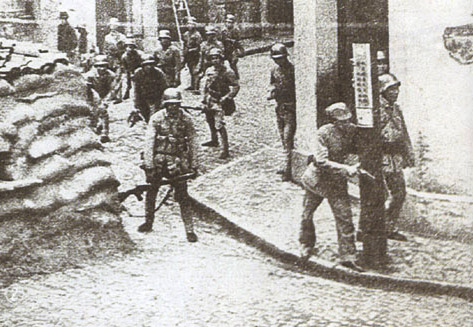 A KMT officer (foreground, with pistol) checks out an adjoining street corner while his troops await his orders during the 1930 Central Plains war In 1930, there was a civil war in china between the main army of the Kuomintang government, led by Chiang Kai-Shek and a coalition of three powerful warlords in the Central Plains region of Henan, China. The war, known as the Central Plains war was shocking in that within the relatively very short span of the war, from May to November 1930, the two sides fielded nearly 1.3 million soldiers (600,000 Kuomintang and 800,000 warlord faction) and ended the war with about 300,000 casualties on both sides ( approx. 100,000 Kuomintang and 200,000 warlord faction). During the 1911 revolution, Dr Sun Yat Sen enlisted the help of regional military leaders in his attempt to overthrow the Ming Dynasty. Due to his strong personality, he succeeded in unifying the leaders of the mostly regional military system practiced under the Ming Dynasty and to turn them over to the revolutionary side. After his death, the various military leaders, resenting that the younger Chiang Kai-Shek was chosen as the leader of Dr Sun's Kuomintang party (KMT) over the more senior members, began to drift away from the KMT central government in Nanjing and started to strengthen their own power base in their respective regions. Over time the regions developed a quasi-independent attitude towards the KMT central government. In reality, vast swathes of China was under the local control of warlords, out of the control and authority of the KMT central government in Nanjing. Although Chiang Kai-Shek briefly reasserted his authority over the entire country during the 1927 'reunification of China' military campaign, in early 1930 powerful warlords began to fall out with Chiang, who has drawn up plans to reorganize the then mainly regional armies (a remnant of the Ming Dynasty military doctrine) into a federal army under the control of the KMT. The regional military leaders were afraid of losing their authority and traditional power base and openly rebelled against the KMT government. Hostilities started on mid-May, concentrating on the Henan and Shandong region. The battles waged were large-scale conventional warfare, in contrast to the mainly insurgent and guerrilla warfare of the 1950 Chinese civil war. Both sides fielded huge amounts of forces, totaling over 1.3 million soldiers. After some early successes, the Warlord factions began to fall back under the attacks of the KMT's better armed and trained armies (trained and supplied by Weimar Germany). After hostilities ceased in November 1930, casualties for both sides were estimated to be around 300,000 soldiers. The war nearly bankrupted the KMT government and effectively broken the KMT military as an effective fighting force. thus it was in no shape to resist the Japanese Army as it started the invasion of Manchuria in 1931 and eventually China. Military historians have commented that the Japanese military probably sensed that the KMT was most likely unable to resist them after the KMT has suffered so many casualties during the Central Plains war and that without the Central Plains war, Japan may have not gone through with the invasion of China, at least during the period of 1930 to 1945. |
|
|
Nov 11 2015, 07:00 AM
Return to original view | Post
#24
|
|
Junior Member
41 posts Joined: Sep 2013
|
QUOTE(Dreadstar @ Nov 11 2015, 03:52 AM) u really think indon got balls to attack msia? your beloved country kan ada ... MY-SG lansi at each other on surface only. Remember lahad datu? Indonesia is very defensive for years.....neighbours who continuously threatening and did territorial intrusions. Never made the first move, so the real question is....When Malaysia will perform the next intrusion...... |
|
|
Dec 3 2015, 09:11 AM
Return to original view | Post
#25
|
|
Junior Member
41 posts Joined: Sep 2013
|
QUOTE(azriel @ Dec 2 2015, 03:32 PM) Looks like the Indonesian Army new Leopard 2RI tanks are equipped with an optic camera (maybe for the driver) on the front armor as seen from this two photos below: It's more similar with Revolution version shown in Eurosatory 2014  Similar optic camera can be seen on the Leopard 2A7:  A bit disappointing that it isn't the same with the one displayed on IndoDefence 2012 |
| Bump Topic Topic ClosedOptions New Topic |
| Change to: |  0.0568sec 0.0568sec
 0.32 0.32
 7 queries 7 queries
 GZIP Disabled GZIP Disabled
Time is now: 2nd December 2025 - 12:53 AM |
 Quote
Quote