

 Aug 14 2015, 03:31 AM


Tried Windows 8, then 8.1. Both OSes only make sense if you have a touchscreen or tablet. Even with tablet, the Metro UI only works if you have Metro/Modern programs. If you have a non-Metro-supported program, you might as well throw your tablet out of your window, because Microsoft didn't think it important to have your keyboard auto-pop up when you need to enter text into a box. This is why I was forced to give up on Firefox and switched to IE on a tablet. Why not Chrome? Well, you can make Chrome work with Metro, but it doesn't integrate well enough, and you end up with a screen that looks like a cheap knockoff of a Chromebook, the bottom bar showing you Google's idea of a UI instead of Windows bar. It feels like Google trying to moon Microsoft. So, you stick to IE, and lose all the bells and whistles of Firefox and Chrome.
To me Windows 10 feels no different from Windows 8.1. There may be added features, but one thing they didn't fix is font rendering. You still have to face the jagged and blocky Chinese font, like this one:

Someone in Redmond finds this pretty.
It doesn't take a magnifying glass to see where Cleartype went wrong compared to Mac font rendering.
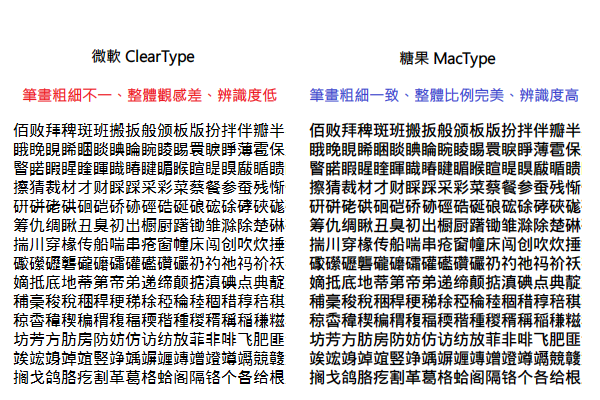
For the longest time, Microsoft's Cleartype team think they got font smoothing down to an art. If that's the case, Google should be implementing Cleartype on their Android, instead of copying Apple/Linux. If Microsoft is right, then iPhone and Android have inferior font rendering than their Cleartype, then Windows phone should have no problem outselling Samsung.
And yet, we're now on Windows 10, and look, it's the same crap.
 Quote
Quote
 0.0180sec
 0.75
0.75
 6 queries
 GZIP Disabled