Welcome Guest ( Log In | Register )

Bump Topic Topic Closed RSS Feed
25 Pages « < 20 21 22 23 24 > » Bottom

Outline · [ Standard ] · Linear+

> Military Thread V17

views
     
BorneoAlliance
post Sep 3 2015, 08:24 PM

New Member
*
Newbie
0 posts

Joined: Dec 2014

China will cut the national military forces by 300,000 troops, country's President Xi Jinping announced on Thursday.

user posted image

BEIJING (Sputnik) – The number of Chinese troops will be cut by 300,000 China’s President Xi Jinping announced on Thursday.

Speaking at the military parade in Beijing, Xi Jinping said that China plans to follow the path of peaceful development and is against hegemony and expansion.

According to various estimates, the Chinese military includes about 2.3 million servicemen.

Read more: http://sputniknews.com/asia/20150903/10265...l#ixzz3kg4ztWzz
BorneoAlliance
post Sep 3 2015, 08:29 PM

New Member
*
Newbie
0 posts

Joined: Dec 2014

Taiwan to launch homegrown submarine plan with initial 60.5 million pound budget

user posted image

TAIPEI: Taiwan has allocated TUS$3 billion (60.51 million pounds) over four years, beginning next year, to launch a long-awaited programme for the island to build its own diesel-electric submarines.

The expected allocation is the first for a plan that has been talked about since the early 2000s, when a deal with the United States for eight diesel-electric submarines got bogged down because of technical and political constraints.

The spending was set out in the defence ministry's budget for 2016 and seen by Reuters.

The plan come as other navies in the regional expand their submarine fleets in part to create a strategic deterrent against China's growing naval assertiveness in Asian waters.

Taiwan has four ageing submarines, including two that date to World War Two, although its military is otherwise considered generally modern.

China has about 70 submarines, along with dozens of surface ships and a refurbished aircraft carrier.

China sees self-ruled Taiwan as a renegade province and has never renounced the use of force to take back the island.

Critical to Taiwan's indigenous submarine programme is the transfer from the United States or other Western countries of submarine-manufacturing technology.

Support from U.S. companies or release of export technology controls would need a nod from the U.S. government.

China opposes any form of military technological transfers or weapons sales to Taiwan.

The spending plan, which is allotted through to 2019, covers only the contract design phase of what should be a decades-long programme.

Taiwan's Ship and Ocean Industries R&D Center (SOIC), a government-backed ship designer and technical consultant, is expected to select a consortium to lead the contract design phase, according to military and industry sources in Taiwan.

Taiwan lacks submarine design skills, the ministry stated in its budget plan.

By carrying out this first phase, Taiwan will be able to deepen its vessel design capabilities, develop its industry and acquire intellectual property, it said.

The defence ministry is planning to spend TUS$321.7 billion in 2016, accounting for 16.1 percent - the biggest share - of the central government's overall expenditures, budget plans show.

The government's 2016 budget was delivered to lawmakers this week and will be reviewed when parliament begins a new session later this month.

The submarine plan has support in parliament which is expected to approve the overall budget.

http://www.channelnewsasia.com/news/asiapa...ch/2097498.html
BorneoAlliance
post Sep 4 2015, 08:24 AM

New Member
*
Newbie
0 posts

Joined: Dec 2014

Malaysia, US in secret talks to ramp up China spying

user posted image

Malaysia and the US are reportedly working together in response to increased Chinese activity in the South China Sea. – Reuters pic, September 4, 2015.Malaysia and the US are reportedly working together in response to increased Chinese activity in the South China Sea. – Reuters pic, September 4, 2015.The US and Malaysia have been secretly discussing expanded use of Malaysian territory for hosting US spy planes to patrol the South China Sea, in response to increased Chinese activity in the disputed territory.

Following a series of incursions into Malaysian waters by Chinese vessels in recent months, talks between the US government and the office of Prime Minister Datuk Seri Najib Razak have intensified, two senior US defence officials said.

The US side has been pressing Najib's government to allow the US Navy to fly both P-8 Poseidon and P-3 Orion maritime surveillance planes from Malaysian airstrips over South China Sea areas where the Chinese government has been rapidly building artificial islands.

There has been no final agreement between the two governments, but the talks themselves represent a shift of Malaysia’s long effort to straddle the fence between the US and China.

On the US side, negotiations are being led by officials from US Pacific Command in Hawaii and David Shear, the assistant secretary of defence for Asian and Pacific security, one senior US defence official said.

While the Pentagon has pushed Malaysia for cooperation before, the talks were newly invigorated following incidents earlier this year when Chinese ships proudly entered the southernmost areas of the South China Sea, inside Malaysia’s exclusive economic zone.

A Pentagon spokesman declined to discuss the bilateral discussions, and the Malaysian Embassy in Washington did not respond to a request for comment.

Last autumn, Admiral Jonathan Greenert, the chief of naval operations, said that "recently the Malaysians have offered us to fly detachments of P-8s out of... East Malaysia." The New York Times stated the plan risked “enraging” China.

The Pentagon and the Malaysian government later clarified that no final agreement had been reached.

Diplomatic sources said the focus of the discussions is now the island of Labuan, off the coast of the semi-autonomous state of Sabah on Borneo. The island is a federally administered territory under the complete control of the Malaysian government that has also been used as a financial hub thanks to its unique tax regulations. It is closer to Chinese military construction in the South China Sea than the locations currently used to launch US spy missions, such as Clark Air Base in the Philippines.

The Malaysian government is very wary about disclosing any of its defence cooperation with the US. “US-Malaysian security cooperation has been very deep and very quiet for a long time. The Malaysians are very much concerned about the Chinese actions,” said Ernest Bower, the chairman of the Southeast Asian Studies department at the Center for Strategic and International Studies.

The US is also working with Malaysia to help it increase its technical capabilities for monitoring and protecting its territory in and around the South China Sea. There’s little chance the US would actually build a military facility in Malaysia, but the use of Malaysian territory is key.

“There’s much more Malaysian interest in allowing US access than there was before. It’s places not bases,” said Bower.

At the same time, however, Malaysia has been increasing its cooperation with China, its top trade partner. The Chinese military announced last week that the two countries will soon hold their largest-ever joint military exercises.

For Najib's government it's a careful balancing act. Patrick Cronin, the director of the Asia-Pacific Security Program at the Center for a New American Security, said that Malaysia rarely calls out China publicly for its aggressive moves in the South China Sea, but has been quietly increasing cooperation with other Southeast Asian nations that have territorial disputes with China.

“P-8 or P-3 maritime patrol fights with the United States and/or Japan would make eminent sense for Malaysia, which cannot enjoy China's changing facts on the ground in the South China Sea,” he said.

The US is finishing plans for a new five-year, US$425 million (RM1.8 billion) Southeast Asian Maritime Security Initiative, and some of that funding is likely to go to exercises and training and information sharing with Malaysia, he said.

Any cooperation between the nations, however, could be complicated by the fact that Najib is facing political and popular upheaval following a string of scandals, including the revelation by The Wall Street Journal in June that Malaysian investigators discovered US$700 million from a government investment fund had ended up in his personal bank account.

Najib, who has supported increased US-Malaysian defence cooperation for over a decade, is now fighting against elements inside his own party and opposition parties. He has also carried out what groups like Human Rights Watch have called a crackdown on freedom of expression and civil society in Malaysia.

Najib and President Barack Obama have been very close, even golfing together during Obama’s last vacation in Hawaii. But the Malaysian leader’s precarious position makes it more difficult for him to pursue a closer relationship with the US, said Michael Auslin, an Asia scholar at the American Enterprise Institute.

“Najib was extremely sophisticated in dealing with Obama and put Malaysia in the sphere of reliable mid-power countries. But the support for what he was doing domestically was always very thin,” he said.

In his moment of crisis, the prime minister has turned for support to Islamist political leaders, who are resistant to cooperation with Washington. And if Najib’s administration falls, there’s no expectation that whatever leadership replaces him will be more willing to work with the US.

“He is struggling for survival domestically. If this comes out, it could force him to back down,” said Auslin. “Who after that in Malaysia is going to take up the cause?”

The US has been cautiously but steadily increasing its rhetoric and activity to confront China’s activities in the South China Sea, and Malaysia was to be an important part of that effort. But in placing all of its chips on Najib, Washington may soon find itself starting from scratch in its plan to enlist Malaysia as a firm ally. – Bloomberg View, September 4, 2015.

http://www.themalaysianinsider.com/malaysi...up-china-spying

BorneoAlliance
post Sep 4 2015, 09:39 AM

New Member
*
Newbie
0 posts

Joined: Dec 2014

Female honor guards appear for first time in V-J Day parade

user posted image

The female honor guards prepare for the military parade marking the 70th anniversary of the end of World War II in Beijing on Sept. 3. (Photo/CNS)

Fifty-one female guards of honor of the People's Liberation Army made their debut in a military parade marking the 70th anniversary of the end of World War II on Thursday morning.

Three lines of female guards of honor, with 17 soldiers in each line, took part. They have an average height of 1.78 meters and an average age of 20. Some 88% of them hold college degrees.

The servicewomen are the first female guards of honor in the 63-year history of the PLA honor guards.

The Beijing Military Area Command selected the first batch of female guards of honor in February 2014. They have been in active service since May last year.

http://www.wantchinatimes.com/news-subclas...=20150903000128
BorneoAlliance
post Sep 4 2015, 06:24 PM

New Member
*
Newbie
0 posts

Joined: Dec 2014

China Building Two Aircraft Carriers, According to Taiwanese Intelligence

user posted image

China Building Two Aircraft Carriers, According to Taiwanese Intelligence

The report on the capabilities of the People's Liberation Army (PLA), a copy of which was obtained by Reuters, says the two new carriers will be the same size as China's only carrier, the Liaoning. China purchased the 60,000-ton Soviet-era vessel from Ukraine in 1998.

China has since refitted the Liaoning, which has participated in military drills, including in the disputed South China Sea, but it is not fully operational. Some military experts believe having an operational Liaoning is the first step to deploying Chinese-built carriers by 2020.

The report did not give an estimated date for when the new carriers would be completed. But as carriers are commissioned for service into China's navy, a command unit would be set up with "the goal to unify power and accelerate combat capabilities," the report added.

Taiwanese intelligence agencies closely monitor Chinese military developments because Beijing has never renounced the use of force to reclaim what it deems a renegade province, Reuters reported.

According to the report, of China's 1.24 million-strong ground forces, 400,000 could be used in combat against the island.

The Taiwanese Defense Ministry's report adds that Beijing is at least preparing for some kind of conflict with Taipei. The PLA and Chinese special forces have held mock battles, featuring full-scale models of a Taiwanese airport, actual roads, government buildings, and even the president's office, the report said.

Ties between the countries have improved under Taiwan's President Ma Ying-jeou. Still, China has threatened to use force to take back Taiwan if the island ever declares its independence.

Taiwan has been self-ruled since 1949 when Chiang Kai-shek fled to Taiwan with his Nationalist forces after losing a civil war with Mao Zedong's Communists.

http://sputniknews.com/asia/20150904/1026571094.html
BorneoAlliance
post Sep 4 2015, 10:38 PM

New Member
*
Newbie
0 posts

Joined: Dec 2014

UAE says 22 Emirati soldiers killed in Yemen

user posted image

Twenty-two soldiers from the United Arab Emirates' military have been killed while taking part in a Saudi-led military campaign against Yemen's Houthi rebels, according to the country's state news agency WAM.

Saudi Arabia and a coalition of other mostly Arab states have been fighting since March to restore Yemen's exiled government and to repel the Houthis, who took control of the capital Sanaa in September last year.

At least five other Emirati soldiers have been killed in Yemen since the offensive began.

There were conflicting reports of the cause of the 22 soldiers' deaths.

The Houthis said they fired a rocket at a weapons cache in a camp used by coalition forces in the central Marib area, killing dozens of Emirati and Yemeni soldiers and destroying a number of Apache helicopters and armed vehicles, according to the Reuters news agency.

In contrast, Yemeni military sources told the AFP news agency that Arab coalition soldiers were among those killed in what they said was an accidental explosion at an ammunition store.

http://www.aljazeera.com/news/2015/09/uae-...4101726433.html
BorneoAlliance
post Sep 4 2015, 10:43 PM

New Member
*
Newbie
0 posts

Joined: Dec 2014

World's Largest Sub Leaves Port for Arctic War Games

user posted imagel

A source in the Russian Northern Fleet said on Friday that the Russian Akula class nuclear ballistic missile submarine Dmitry Donskoy has left its base in the city of Severodvinsk, entering the White Sea, where it will take part in anti-submarine war games, according to the website flot.com.

Taking part in the drills are, among other vehicles, the anti-submarine ships Onega and Naryan-Mar.

Dmitry Donskoy's previous mission in the White Sea lasted three weeks and wrapped up on July 16, 2015.

The vessel, named after the Grand Duke of Moscow Dmitry Donskoy, measures 172 meters in length and has a crew of 160, making it the world's largest submarine.

http://peacekeeper.ru/en/?module=news&action=view&id=27342
BorneoAlliance
post Sep 5 2015, 08:24 AM

New Member
*
Newbie
0 posts

Joined: Dec 2014

China’s Dongfeng-21D ‘Carrier Killer’ To Counter U.S. Warships

user posted image

After years of speculation, China officially showed off its Dongfeng-21D "carrier killer" missile at a massive military parade in Beijing to mark the 70th anniversary of the end of the World War 2. The missile has the capabilities to change the balance of power in favor of China in the western Pacific. Before Dongfeng-21D made its appearance on Thursday, the missile was only briefly mentioned in 2011 that it was in the works.


DF-21D costs a fraction of an aircraft carrier

Western military experts estimate that it has a range of about 1,000 miles. The land-based intermediate-range missile can travel up to 10 times faster than the speed of sound, making it almost impossible to intercept. DF-21D would be launched into orbit, and it manoeuvres on to a target upon re-entering the Earth's atmosphere. That means it could land a large warhead on or near a moving warship.

What gives China a real advantage is that it costs only a fraction of an aircraft carrier. Beijing could build as many as 1,200 DF-21D missiles for the price of a single aircraft carrier. Notably, aircraft carriers form the backbone of the U.S. naval strategy. And missiles like DF-21D threaten to consign aircraft carriers to the dustbin, defense experts told the Financial Times.

China threatens U.S. maritime supremacy

Ashley Townshend, a research fellow at the University of Sydney, said this missile could encroach on Washington's capability "to deploy military power close to Chinese shores." Chinese President Xi Jinping is set to visit the U.S. later this month. Dongfeng-21D is a stern reminder to the U.S. that its undisputed maritime supremacy is under threat.

James Char of the Nanyang University in Singapore said that DF-21D serves as a deterrent that would require enemies to think twice before deploying aircraft carriers against China. However, some still doubt its capabilities as the missile has never been tested under the full range of countermeasures that an advanced aircraft carrier could deploy.

The missile may be almost impossible to intercept and bring down. But it relies on a lot of sensors, satellites, radar, and other equipment to lock on a target. And these systems would be much easier to attack.

http://www.valuewalk.com/2015/09/chinas-do...carrier-killer/
BorneoAlliance
post Sep 5 2015, 09:01 AM

New Member
*
Newbie
0 posts

Joined: Dec 2014

How Russia Is Helping China Develop its Naval Power

user posted image

Russian military technology has significantly contributed to the development of the People’s Liberation Army Navy’s (PLAN) surface warfare capabilities – including long-range precision strike – and has made Chinese naval vessels increasingly capable of defending themselves against U.S. air strikes and long-range missile attacks, according to a new report published by the Washington-based Center for Strategic and International Studies (CSIS).

While the report treads no new ground with this assertion, it nevertheless provides a good overview of Sino-Russian arms and technology transfers to prop up the PLAN’s surface fleet and expand its burgeoning anti-access capability in the Western Pacific. In that respect, Russian air defense technology, long-range sensors, and anti-ship cruise missile (ASCM) systems have played a crucial role.

For example, Russian-made and Russian-derived air defense technologies now enable PLAN surface warfare ships to slip out from underneath the PLA’s land-based air-defense umbrella and to increasingly operate further away from Chinese shores. In addition, new Chinese/Russian-derived ASCM systems along with long-range sensors can now threaten medium-sized naval U.S. surface ships and even strike U.S. military installations as far as Guam and Okinawa (See: “Here’s What You Need to Know About China’s Grand Military Parade”).

Although Russian military exports to China have been slowly declining since 2006, they are still considerable. The decline is partially due the expansions of China’s indigenous defense industry but also due to a reluctance to provide advanced weapon systems due to Beijing’s illicit reverse engineering activities, which makes it hard to assess the quality of indigenously-developed Chinese weapon systems.

“While China has been increasingly manufacturing many of its own weapon systems domestically, real questions remain about the level of innovation in China’s defense industry. Often what is described as ‘innovative’ by the Chinese is actually a relatively incremental improvement on foreign (and in many cases Russian) technology,” the report elaborates.

The report states that China has demonstrated a growing independence from Russia in the development of cruise missile. However, it notes that the most advanced ASCM missiles in the Chinese Navy’s arsenal are still Russian-made or Russian-derived such as the SS-N-22 Sunburn, the SS-N-27B Klub (Sizzler), the Kh-31 Krypton, the Kh-59MK Kingbolt, the YJ-12, and the YJ-18 as well as the CX-1. “Russian ASCMs also exhibit superior speed and penetrating capability when compared with their Chinese counterparts,” according to the study.

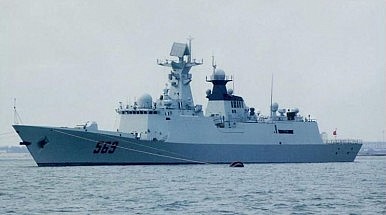
The PLAN’s surface fleet also continues to rely on Russian-made technology for its advanced intelligence, surveillance, and reconnaissance (ISR) capabilities. For example, the PLAN’s Type 054A Jiangkai II-class frigates are equipped with the Russian Band Stand radar system. (China may already have reverse engineered this system). “Without such systems, China would have had to make do with inferior legacy systems, which would have left it at a disadvantage in the battle for situational awareness that dominates today’s naval battlespace,” the report emphasizes.

According to CSIS, other Russian-made or Russian-derived surface surveillance/tracking, air surveillance, air defense, and fire control systems include the SA-N-7 Gadfly, the SA-N-12 Shtil (Grizzly), the SA-N-20 Fort, the HHQ-9, the HHQ-16, the Top Plate (Fregat MAE-3), the Front Dome (Orekh) and the Tomb Stone.

“Recently, however, China appears to have closed the gap with Russia in certain categories of advanced radar technology. New radar systems, such as the Type 346 Dragon Eye installed on the Luyang I– and II–class destroyers, and the Type 382 phased-array radar system installed on the Jiangkai II frigate, are quite advanced in comparison with Russian radar systems,” the CSIS study reads.

While China is rapidly catching up with Russian military technology, there are still many areas where Beijing could benefit from future Sino-Russian technology cooperation, particularly in the field of anti-submarine warfare (ASW), which has historically been a weak spot of the PLAN the report finds. Here, Russia has far greater experience in conducting ASW operations against the U.S. Navy’s fleet of advanced submarines.

http://thediplomat.com/2015/09/how-russia-...ts-naval-power/
BorneoAlliance
post Sep 5 2015, 08:16 PM

New Member
*
Newbie
0 posts

Joined: Dec 2014

Does Malaysia’s military need a Mistral-class ship?

user posted image

tiger-talk-2zOnce again, rumours abound of yet another purchase by the government that aims to augment Malaysia’s defensive capabilities, funded by taxpayers. Right now, the question remains: Does Malaysia need an amphibious assault ship?

For clarity’s sake, Tiger is going to start off with this: the Mistral-class is not an aircraft carrier, at least, not in the traditional sense of the term; it is actually an amphibious assault ship. The Mistral has the ability to serve as a mobile base of operations for helicopters, rather than being one of those great ships with two or four catapults that launch fighter jets and cost a bomb or two to maintain.

And no, the Mistral has no way of launching the Rafale fighter jet. Yes, the Rafale has a variant that is meant for operating from an aircraft carrier, but the Mistral class is unable to support fixed-wing aircraft.

All right, now that Tiger is done being a military geek, Tiger will reiterate a key point: Why does Malaysia need one of these warships?

Of course, it is all well and good to declare that it is “for the defence of the nation!” and all that, but still, there is also the matter of compatibility, is there not?

As far as Tiger knows, the Mistral does not fulfil any specific role in the Malaysian defence forces. In the short term, the most Tiger can see it being used for is as a mobile helicopter base off the coast of Sabah to deter incursions. However, this is, to Tiger, the equivalent of using a high-calibre rifle to shoot the cheat opposite you at the poker table.

Even looking towards the long term, the funds used to procure, maintain, and train up the people to man the Mistral would be better served by building up a defence presence in Sabah and Sarawak.

Not only would this serve as a deterrent against incursions due to the bases or garrisons, but it would show that the government is concerned with the defence of Malaysia as a whole, rather than having everything concentrated in Peninsular Malaysia.

Mistral calss helicopter carrier in-storyWhether or not the funds are enough, well, let’s just put it this way. The procurement cost of the ship was estimated by Pandan member of parliament Rafizi Ramli as RM3 billion. Note that this is just the procurement cost – which is only the cost of buying the vessel – and does not take into account the costs to equip, maintain, and train people to be able to operate the vessel.

Furthermore, it should be noted that it is not possible to just dump helicopters already available on the warship, and expect them to function. Operating from a carrier is very different from operating out of an airfield, with the carrier bringing its own environmental issues that have to be guarded against.

First and foremost in this scenario is the issue of salt water. Salt water is corrosive, and the helicopters assigned to the carrier will have to be able to function properly and reliably over time in an environment where the air is highly humid and exposed to sea spray.

Next, is that these helicopters would then have a quicker “expiry date”, so to speak. While there are definitely steps that can be taken to harden the helicopters against the harsher environment of a carrier, there is only so much that can be done, and the helicopters will eventually succumb to corrosion.

As such, these helicopters would then have to be replaced. Of course, this means further expenditure, either by obtaining helicopters and refitting them for naval aviation purposes, or right out purchasing helicopters meant for naval aviation. And what about the cost of procurement, equipment, and maintenance of the helicopters, as well as the training for pilots?

The cost over time of the amphibious assault ship just seems to keep mounting, does it not? And what would the ship actually contribute in the long term on its own?

Note that the key phrase there is “on its own”. The ship on its own, without the requisite support elements, infantry, and hardware to use it with, would stand useless.

Tiger hopes that the government will look into overall costs and benefits thoroughly when making its choice for defence procurements, rather than acting like a child walking into a toy store. There really is no point having a big fancy ship if there is no money to maintain it, no people who know how to use it, and nothing to use it with.

GRRRRR!!!

http://www.kinibiz.com/story/tigertalk/187...class-ship.html

This post has been edited by BorneoAlliance: Sep 5 2015, 08:16 PM
BorneoAlliance
post Sep 5 2015, 08:32 PM

New Member
*
Newbie
0 posts

Joined: Dec 2014

Army to conduct drills with Indonesia, Malaysia

user posted image

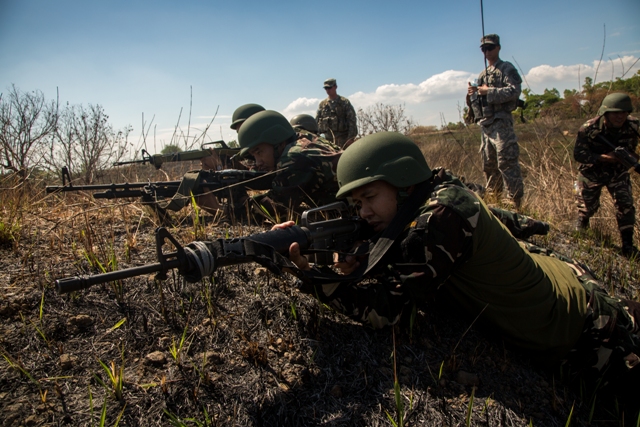
The annual bilateral exercise between the Philippine Army and the Malaysian Army, dubbed the Training Activity Land Malaysia-Philippines (MALPHI), is scheduled from Sept. 9 to 21 at the Peacekeeping Operations Center in Camp O’Donnell in Capas, Tarlac.

“MALPHI aims to enhance the long-standing professional relationship and cooperation between the two armies,” Col. Jose C. Faustino Jr., the Philippine Army’s Assistant Chief of Staff for Training and Education, said in a statement.

“These cross trainings are part of our international agreements that aim to develop and promote cooperative activities in the defense and security of our respective countries,” Mr. Faustino further said.

In the 16th Philippine-Malaysian military exercise, 76 troops of the Philippine Army and another 30 soldiers from the Malaysian Army will be participating.

Meanwhile, a contingent of the Philippine Army is also participating in the Training Activity DOLPHINE with the Indonesian army from August 24 to September 6, at the headquarters of Komando Pasukan Khusus in Bandung, the capital of Indonesia’s West Java province.

An annual bilateral training event, the Training Activity DOLPHINE, focuses on the exchange of information, techniques, tactics and procedures in the conduct of counter-insurgency operations, according to the Philippine Army.

It also involves the discussions and knowledge-sharing regarding other military operations, including humanitarian assistance and disaster response operations.

Twenty personnel from the Philippine Army’s Special Forces Regiment (Airborne) and 20 members of the Indonesian army are participating in the joint military exercise.

The commander of the 80,000-strong Philippine Army, Lt. Gen. Eduardo M. Año, said they will continue with these activities with foreign armies to enhance military relations with other countries and to have a venue to develop the capability of their troops. -- Alden M. Monzon

http://www.bworldonline.com/content.php?se...aysia&id=114742
BorneoAlliance
post Sep 5 2015, 10:54 PM

New Member
*
Newbie
0 posts

Joined: Dec 2014

UAE May Buy French Warship Built for Russia

user posted image

The United Arab Emirates is interested in buying one of two French warships originally intended for Russia, according to multiple news reports.

France built the two Mistral-class helicopter carriers for Russia, but canceled the deal after Russia annexed Crimea from the Ukraine last year. France has since agreed to pay Russia more than $1 billion to settle the transaction.

Now, one of the vessels may go to Egypt and another may go to the UAE, according to a recent article in the Russian newspaper Moskovsky Komsomolets. A UAE official also confirmed the country is interested in buying one of the ships, according to a story in Defense News.

The French navy operates three of the same type of amphibious assault ship, each of which can house more than a dozen helicopters, several dozen combat vehicles, hundreds of troops and a hospital with several dozen beds.

In 2010, a group of U.S. senators, including John McCain, now chairman of the Senate Armed Services Committee, urged France and other NATO allies not to sell military equipment to Russia and then-Defense Secretary Robert Gates said he was concerned about the deal.

It wasn’t until Russia stepped up military activity in Eastern Europe last year with support for pro-Russian separatists in Ukraine and the subsequent international sanctions levied against Russian officials that France decided to reconsider the warship sale.

France’s training last summer of Russian sailors aboard the first Mistral ship in the French port city of Saint-Nazaire angered its Western partners, who claimed the delivery of the ships would undermine their joint efforts to isolate Russia and condemn its annexation of foreign territory, according to an article in Agence France-Presse.

Saudi Arabia has also reportedly expressed an interest in buying one of the ships, according to a story in the French newspaper Le Monde.

http://www.dodbuzz.com/2015/09/04/uae-may-...ilt-for-russia/
BorneoAlliance
post Sep 6 2015, 12:25 PM

New Member
*
Newbie
0 posts

Joined: Dec 2014

600,000 personnel to be cut from PLA Army: retired general

user posted image

Ning Zetao, a swimmer in one of the PLA's sport teams. (Photo/Xinhua)

Beijing is set to cut its military forces and may readjust the ratio between its army, navy and air force from 72:11:17 to 5:2.5:2.5, reports our Chinese-language sister paper China Times.

If the adjustment is made, the number of troops in the navy and air force will be increased while that in the army will be reduced from 1.6 million to 1 million.

Retired major general and China Arms Control and Disarmament Association committee member Xu Guangyu said the military personnel cut is positive for the People's Liberation Army because it suggests the Chinese military is moving towards valuing quality over quantity.

According to a Chinese defense ministry's white paper published in 2013, the PLA has 398,000 personnel in its air force, 235,000 personnel in its navy and over 1.6 million personnel in its army. A stronger navy and air force are needed to win wars in the future which are increasingly relying on information technology, said Xu.

China's Ministry of National Defense said the cut will focus on reducing outdated equipment and non-combat personnel as well as streamlining its structure. Xu said the country's Armed Police Force may be transformed into a National Guard.

Sources claimed the troops that will be cut may be transformed in to ten armed police tactical units and 100 armed police warfare groups and they are both likely to be stationed in the Xinjiang Uyghur autonomous region.

Xu said troops affected in the personnel cut will not have any problem returning to civilian life since China has established a comprehensive mechanism to help soldiers transition from military to civilian life.

The retired official predicted that the personnel cut is most likely to involve the PLA's art troupe and sports teams. He said it is unnecessary for the Chinese military to train their own entertainers and athletes and the two departments should be privatized.

http://www.wantchinatimes.com/news-subclas...=20150906000016
BorneoAlliance
post Sep 6 2015, 12:32 PM

New Member
*
Newbie
0 posts

Joined: Dec 2014
user posted image
BorneoAlliance
post Sep 6 2015, 12:36 PM

New Member
*
Newbie
0 posts

Joined: Dec 2014
user posted image

This post has been edited by BorneoAlliance: Sep 6 2015, 12:36 PM
BorneoAlliance
post Sep 6 2015, 12:38 PM

New Member
*
Newbie
0 posts

Joined: Dec 2014
user posted image
BorneoAlliance
post Sep 6 2015, 05:47 PM

New Member
*
Newbie
0 posts

Joined: Dec 2014
user posted image
BorneoAlliance
post Sep 6 2015, 06:03 PM

New Member
*
Newbie
0 posts

Joined: Dec 2014
user posted image
BorneoAlliance
post Sep 6 2015, 06:07 PM

New Member
*
Newbie
0 posts

Joined: Dec 2014
user posted image
BorneoAlliance
post Sep 6 2015, 06:43 PM

New Member
*
Newbie
0 posts

Joined: Dec 2014

Philippines, Australia set joint military exercises this year

user posted image

MANILA, Philippines – The armies of the Philippines and Australia are scheduled to conduct joint military exercises in both countries this year.

Philippine Army (PA) spokesperson Col. Benjamin Hao said the two joint military exercises, namely the Philippine-Australia Exercise “Dusk” Caracha and the Philippines-Australia Exercise “Dawn” Caracha, will be held separately in Philippines and Australia in line with their existing defense cooperation program.

According to Hao, Exercise “Dusk” Caracha 2015 is a combined training activity between the Special Operations Commands (SOCOM) of both the Philippine and Australian armies which is slated from September 15 to 26 in Perth, Western Australia.

Participants of Exercise “Dusk” Caracha 2015 will utilize the training facilities of the Special Air Service Regiment in Australia.

PA will also send 25 personnel from the Light Reaction Regiment, SOCOM to participate in the said exercise in Australia.

Exercise “Dusk” Caracha seeks to strengthen the counter-terrorist skills and capabilities of PA’s Light Reaction Regiment with its close-quarter battle training, sniper skills, development training and unit collective training.

On the other hand, the Philippines-Australia Exercise “Dawn” Caracha 2015, which will be participated by 102 participants from the PA and 15 soldiers from Australian Army, aims to develop the interoperability between the Special Forces units of both countries.

Exercise “Dawn” Caracha 2015 is an army-to-army exercise between the Special Air Service Regment, SOCOM, Australia and the SOCOM held yearly.

This year, Exercise “Dawn” Caracha will be conducted in Fort Magsaysay, Nueva Ecija from October 19 to 30.

Aside from Australia, Brunei is also eyed to conduct joint exercises and trainings with PA to enhance their cooperation and improve their interoperability.

http://www.philstar.com/headlines/2015/09/...-exercises-year

25 Pages « < 20 21 22 23 24 > » 
Bump Topic Topic ClosedOptions New Topic
 

Change to:
| Lo-Fi Version
0.0256sec    0.62    7 queries    GZIP Disabled
Time is now: 13th December 2025 - 09:42 AM