Welcome Guest ( Log In | Register )

Bump Topic Topic Closed RSS Feed
11 Pages < 1 2 3 4 5 > » Bottom

Outline · [ Standard ] · Linear+

 LYN Catholic Fellowship V01 (Group), For Catholics (Roman or Eastern)

views
     
shioks
post Jun 17 2016, 05:43 PM

On my way
****
Senior Member
627 posts

Joined: Jun 2009
If you have to work your way to salvation, Christ die in vain. bruce.gif

http://www.christiananswers.net/q-sum/sum-r005c.html

Salvation in Christ Alone

The Bible says that Christ is the only way of salvation. Biblical Protestant convictions have always been that no sinner can be saved apart from the saving work of Christ granted to him through faith. Christ's word, "No one comes to the Father except through Me," means that those only who are united to Christ will be saved; all others will die in their sins and suffer the wrath of God in hell forever.

The Catholic church teaches that only through faith in Christ plus Catholic baptism is salvation granted. There are exceptions; e.g., in the cases of martyrs for the faith (Catechism 1258), and infants dying without baptism (Catechism 1261).

The Second Vatican Council's Decree on Ecumenism states:

"For it is through Christ's Catholic Church ALONE, which is the universal help toward salvation, that the fullness of the means of salvation can be obtained" (emphasis added).

shioks
post Jun 17 2016, 05:45 PM

On my way
****
Senior Member
627 posts

Joined: Jun 2009

Furthermore, Catholicism teaches that all mankind, whether they come to faith in Christ or not, if they have a desire to please God and to be right with Him, though ignorant of Jesus Christ, can be saved! Hosts of Protestants and many adherents of all other religions, may be saved because they receive the benefits of Catholic baptism through their ignorance and desire!

Every man who is ignorant of the Gospel of Christ and of his Church, but seeks the truth and does the will of God in accordance with his understanding of it, can be saved. It may be supposed that such persons would have desired Baptism explicitly if they had known its necessity.
—Catechism 1260)

This doctrine called “Rapprochement” makes Catholicism a kind of universal religion, placing all religions to some degree under its umbrella. All people are thus capable of being saved, even in their unbelief (see Catechism 1257-1261).

The Bible says:

Jesus saith unto him, I am the way, the truth, and the life: no man cometh unto the Father, but by me.
—John 14:6 (KJV)

shioks
post Jun 18 2016, 08:27 AM

On my way
****
Senior Member
627 posts

Joined: Jun 2009
QUOTE(khool @ Jun 18 2016, 07:35 AM)
St. Paul talks about images and types in the Old Testament being fulfilled in the new.

St. Paul says the law was a pedagogue of Christ. A pedagogue is a child's teacher. The law teaches us the mysteries of Christ. They are shadows of the true spiritual nature of their heavenly realities.

A reality of a type has to take on the same properties as the type.

Circumcision was a sign of God's covenant that he would be the God of the Israelites and he would be their people. Through the law the parents circumcised their children by the eighth day.

St. Paul relates the pedagogue of circumcision to the heavenly reality of Baptism which expands the covenant family making the family universal, Catholic. You are no longer Jews or Gentiles freeman or slave because you have been baptized in Christ Jesus which makes you an heir to the promise of Abraham.

Christ said I did not come to abolish the law but to fulfill the law.

The types become their heavenly reality. Symbols do not evolve into symbols but into eternal truths.

The Eucharist is prefigured in the Passover Lamb that needed to be consumed, the table of the presence that contained a cereal offering that was a perpetual law to be kept in front of the veil that was in front of the Holy of Holies, in the manna that fell from heaven and was placed in the ark that contained Aarons staff that budded ( the cross the tree of life) and the ten commandments ( the law written on our hearts) the heavenly reality was carried in the womb of Mother Mary.

God put in place another sign in the daily temple sacrifice called the Tamid. The Tamid was a sacrifice of Lamb, bread, and wine. At 9:00 in the morning and 3:00 pm everyday the high priest raised the Lamb before the veil sanctifying the bread and wine on the altar then eating what is sanctified.

As Christ died on the cross saying the Todah prayer ( my God my God why have you forsaken me, through the soul of His spouse) the Lamb was raised, the veil was ripped from heaven to earth and the high priest showed us the Holy Mass by presenting the sacrifice before the Holy of Holies which is a type for heaven itself which contains the presence of the Father and the hosts of heaven. It is finished. The true Tamid is established. I have established my kingdom and covenant memorial of the eternal covenant in my blood ( Do this in remembrance of me ) the memorial covenant sacrifice of the eternal cross in the Holy Mass that will always be before the eyes of the Father before he sees the sins of the world in which the table of the presence and the menorah/cross of tree of life, was a type.

We walk by faith not by sight.

And they dedicated themselves to the doctrine and the breaking of the bread and the prayers.

O you foolish Galatians whom before your very own eyes Christ is portrayed as crucified among you.

Hebrews 12: 22-24

This is fullfilled at every Holy Mass in which our high priest Melchizedek mediates with His priests to offer the memorial of the life giving Cross in the form of bread and wine and we are mystically sprinkled with the blood that cleanses all venial sins so that we can be refined and offer the clean oblation (unbloody) without blemish before the Father with the hosts of heaven.

"Do this in remembrance of me ...",
Anamnesis in Greek which means offer this memorial sacrifice.

Malachi 3: 1-4

Malachi 1: 11

1 Corinthians 11:23-26

Romans 15: 16

Mysteries mysterion sacramentum sacrament.

user posted image
*
yeah...work for your salvation. devil.gif
shioks
post Jun 18 2016, 08:31 AM

On my way
****
Senior Member
627 posts

Joined: Jun 2009
QUOTE(yeeck @ Jun 17 2016, 11:03 PM)
Christ is certainly the only way of salvation. Not by faith alone. God invites, you respond. That's freewill that all human beings have. Else we are nothing but robots. You conveniently ignored Christ and St Peter (why? because he's the first pope?)  like those in Mark 16:16, Acts 10:34-47, Acts 16:30-33, Acts 2:38 and negates the importance of baptism?

The Catholic church teaches that only through faith in Christ plus Catholic baptism is salvation granted. => Not correct, because to a Protestant salvation is equated to the Catholic definition of redemption. For Catholics, salvation is a process that is completed when you are in Heaven. While on this earth, a Christian even those who are baptized and believes in Christ (faith) can still fall from grace.
*
Salvation is through Christ and Peter? Again you are working your way to Salvation. LOL!


shioks
post Jun 18 2016, 08:32 AM

On my way
****
Senior Member
627 posts

Joined: Jun 2009

http://www.christiananswers.net/q-sum/sum-r005e.html

Mary, Jesus' Mother
Statue of Mary

Protestants have historically held Mary in high regard as a godly and highly favored woman of God, a sinner saved by the grace of her divine Son.

Catholic dogma, on the other hand, has exalted her in an irresponsible and idolatrous way. She is declared to have been free from all original sin (the dogma of the Immaculate Conception, first declared in 1854; Catechism 491-492), free from any actual sin during her life (Catechism 411), and perpetually a virgin even after the birth of Jesus (Catechism 499-500).

Mary… was redeemed from the moment of her conception… preserved immune from all stain of original sin.
-Catechism 491

Mary remained free of every personal sin her whole life long.
-Catechism 493

Allegedly, Mary was taken, body and soul, into heaven (Catechism 974). This is the dogma of the “Assumption of Mary,” declared in the year 1950! In heaven, Mary supposedly intercedes for the church as "advocate, helper, benefactress, and mediatrix" (Catechism 969). She is made virtually a co-savior with her Son (Catechism 968). Recently, an increasing number of prominent Catholics have petitioned the church to officially declare that Mary can provide forgiveness of sins!

These doctrines are so far afield from the Scriptures that biblical Protestants are amazed and saddened.

The Bible says:

For there is one God, and one mediator between God and men, the man Christ Jesus.
—1 Timothy 2:5 (KJV)

Jesus Christ of Nazareth… Neither is there salvation in any other: for there is none other name under heaven given among men, whereby we must be saved.
—Acts 4:10-12 (KJV)

shioks
post Jun 18 2016, 08:34 AM

On my way
****
Senior Member
627 posts

Joined: Jun 2009

http://www.christiananswers.net/q-sum/sum-r005g.html

The Papacy and Infallibility

The PopeCatholicism teaches the dogma of the infallibility of the Roman pontiff. This was not declared by the church until the year 1870. Yet through the church's motto of Semper idem (“Always the same”), it is claimed that the church has always held this, going back to the first Pope, the Apostle Peter! (Catechism 80-82, 85).

The pope, as the vicar (deputy, substitute for, representative) of Christ, is considered infallible only when he speaks “ex cathedra” (“from the chair”). But, as the reference below makes very clear, this tradition, along with other traditions of the church, is considered to be as authoritative as the Scriptures.

As a result the Church, to whom the transmission and interpretation of Revelation is entrusted, does not derive her certainty about all revealed truths from the holy Scriptures alone. Both Scripture and Tradition must be accepted and honoured with equal sentiments of devotion and reverence.
—Catechism 82 (emphasis added)

Thus, for the Roman Catholic, submission to the formal teaching of the church's tradition is as important as submission to the Scriptures.

The Protestant Reformation restored to the body of Christ the doctrine of sola scriptura (“Scripture alone”). The Roman Catholic faith has shown a willingness to raise the pope above Jesus Christ and the Bible by giving him the right to nullify Scripture through papal decrees. The conscience of the biblical Protestant (like that of Martin Luther) is bound by the Bible alone. "The Scriptures of the Old and New Testaments are the Word of God, the only infallible rule for faith and life." It cannot be both ways. The traditions of the churches are often of value. But these traditions must always be subordinate to, and constantly corrected by, the Scriptures, which alone are the Word of God.
shioks
post Jun 18 2016, 08:35 AM

On my way
****
Senior Member
627 posts

Joined: Jun 2009

http://www.christiananswers.net/q-sum/sum-r005h.html

The Sacrifice of the Mass

A Catholic mass is by definition the sacrifice of Christ (Catechism 1322, 1338). The Baltimore Catechism (Confraternity Edition of 1949) says,

"Christ gives us His own body and blood in the holy Eucharist first, to be offered as a sacrifice commemorating and renewing for all time the sacrifice of the cross" (Catechism 356).

While the Catholic catechisms quote the passages that speak of Christ dying once, they also teach that the priest miraculously transforms the bread and wine into Christ's real body, and that Jesus is then sacrificed anew. "The blood is real blood (it looks like wine and tastes like wine at Mass, but it is truly the Blood of Christ." [1]

Although there is some variation among Protestants on the meaning of the Lord's supper, without exception biblical Protestants teach that the sacrament is not a renewal or a revisitation of the bodily sacrifice of Christ. Rather it is a remembrance and a memorial use of symbols blessed by God to the benefit of the humbled believer.

This contrast is far more than a controversy of words. It goes to the very heart of the difference between Catholicism and Protestant Christianity. Protestant faith denies that the church has the power to perform the mass's “miracle of transubstantiation,” and it further denies that the Lord's Supper's purpose is to see accomplished the death of Christ all over again.

"Nor did He [Jesus Christ] enter heaven to offer himself again and again…"
—Hebrews 9:25 (NIV) (see Hebrews 9:25-10:18)


shioks
post Jun 18 2016, 08:38 AM

On my way
****
Senior Member
627 posts

Joined: Jun 2009


http://www.christiananswers.net/q-sum/sum-r005i.html

Purgatory

The Roman Catholic Church does not teach its people to have confidence in the full forgiveness of their sins through the death of Christ alone. Nor are they taught that the righteousness of God accomplished by Jesus Christ is their permanent possession. The result is that the faithful Catholic is taught never to come to full assurance of salvation during their Earthly life, for they are still capable of committing “mortal sin.” A Catholic's redemption is always dependent on their maintaining a faithfulness to the Church’s doctrine and practice.

Thus Catholics are taught that when they die, if they have not committed mortal sins (and with the exception of the special class of believers they call “saints”), all go to the place the church calls purgatory. The Catechism states,

“All who die in God's grace and friendship, but still imperfectly purified, are indeed assured of their eternal salvation; but after death they undergo purification, so as to achieve the holiness necessary to enter the joy of heaven…”

“The Church formulated her doctrine of faith on Purgatory especially at the Councils of Florence and Trent” (Catechism 1030-1031). This concept of purgatory led to the unbiblical Catholic doctrine of prayers for the dead (Catechism 1032). Catholic believers are taught that “it is a holy and a wholesome thought to pray for the dead that they may be loosed from their sins” (Catechism 958).

Does God's Word teach about purgatory?

There is no mention of purgatory in the 66 books of the Bible, and since the orthodox biblical view of forgiveness assures redeemed sinners that their sins have all been paid in Christ, the doctrine of purgatory is rejected by Protestants as an erroneous addition to the Bible. Furthermore, we believe that it has been created by the church out of virtual necessity, as its view of the inadequacy of Christ's death demands such a doctrine.

This doctrine simply fits with Catholicism's whole system of justification by faith plus works—a keystone of Catholic theology. There is no possible way to reconcile Catholic teaching with Protestant teaching or the Bible on this point. Purgatory is part of a false gospel.
shioks
post Jun 18 2016, 09:57 AM

On my way
****
Senior Member
627 posts

Joined: Jun 2009
Power crazy system.

http://www.christiananswers.net/q-sum/sum-r005k.html

The Priestly System

The Old Testament clearly established a priesthood (the Levites) to serve Israel. This Earthly priesthood was a symbol of the Messiah's eternal priesthood. The book of Hebrews explains its purpose and fulfillment. Historic Protestantism, because of its study of the Scriptures, proclaimed the “universal priesthood of all believers.” The special office of priest was fulfilled in our Savior, and thus came to an end in Him.

Although Catholicism acknowledges this universal priesthood, it sustains a “weak and beggarly element” of the old covenant and assigns to its priests remarkable power as pastors of the church. This system is essential to the power of the Catholic Church and cannot be justified by the Bible.

One of the finest scholars of Roman Catholic Scripture, Raymond E. Brown, shocked Catholics when he discovered that:

When we move from the Old Testament to the New Testament, it is striking that while there are pagan priests and Jewish priests on the scene, no individual Christian is ever specifically identified as a priest. The Epistle to the Hebrews speaks of the high priesthood of Jesus by comparing his death and entry into heaven with the actions of the Jewish high priest who went into the Holy of Holies in the Tabernacle once a year with a offering for himself and for the sins of his people (Hebrews 9:6-7).

But it is noteworthy that the author of Hebrews does not associate the priesthood of Jesus with the Eucharist or the Last Supper; neither does he suggest that other Christians are priests in the likeness of Jesus. In fact, the once-for-all atmosphere that surrounds the priesthood of Jesus in Hebrews 10:12-14, has been offered as an explanation of why there are no Christian priests in the New Testament period.[1]

Biblical Protestantism repudiates the Catholic priesthood system, and would consider its proposed imposition a radical violation of its conscience before God.
shioks
post Jun 18 2016, 06:13 PM

On my way
****
Senior Member
627 posts

Joined: Jun 2009

Jun 18 2016, 06:28 PM
This post has been deleted by yeeck because: Blasphemy towards Christ on this forum will not be tolerated.

shioks
post Jun 18 2016, 08:39 PM

On my way
****
Senior Member
627 posts

Joined: Jun 2009
http://www.christiananswers.net/q-eden/sol...arlychurch.html


What did the Early Church believe about the authority of Scripture? (sola Scriptura)

The sixteenth century Reformation was responsible for restoring to the Church the principle of sola Scriptura, a principle that had been operative within the Church from the very beginning of the post apostolic age.

Initially the apostles taught orally, but with the close of the apostolic age, all special revelation that God wanted preserved for man was codified in the written Scriptures. Sola Scriptura is the teaching, founded on the Scriptures themselves, that there is only one special revelation from God that man possesses today, the written Scriptures or the Bible.

Consequently the Scriptures are materially sufficient and are by their very nature (as being inspired by God) the ultimate authority for the Church. This means that there is no portion of that revelation which has been preserved in the form of oral tradition independent of Scripture. We do not possess any oral teaching of an Apostle today. Only Scripture therefore records for us the apostolic teaching and the final revelation of God.

[/I]Where things went wrong—The Council of Trent denied the sufficiency of Scripture

The Council of Trent in the 16th century declared that the revelation of God was not contained solely in the Scriptures. It declared that it was contained partly in the written Scriptures and partly in oral tradition and, therefore, the Scriptures were not materially sufficient.

This was the universal view of Roman Catholic theologians for centuries after the Council of Trent. It is interesting to note, however, that in Roman Catholic circles today there is an ongoing debate among theologians on the nature of Tradition. There is no clear understanding of what Tradition is in Roman Catholicism today. Some agree with Trent and some do not.

The Apostolic Fathers and the Apologists held to sola Scriptura

The view promoted by the Council of Trent contradicted the belief and practice of the Early Church. The Early Church held to the principle of sola Scriptura. It believed that all doctrine must be proven from Scripture and if such proof could not be produced, the doctrine was to be rejected.

The Early Church Fathers (Ignatius, Polycarp, Clement, the Didache, and Barnabus) taught doctrine and defended Christianity against heresies. In doing this, their sole appeal for authority was Scripture. Their writings literally breathe with the spirit of the Old and New Testaments. In the writings of the apologists such as Justin martyr and Athenagoras the same thing is found. There is no appeal in any of these writings, to the authority of Tradition as a separate and independent body of revelation.

Irenaeus and Tertullian held to sola Scriptura

It is with the writings of Irenaeus and Tertullian in the mid to late second century that we first encounter the concept of Apostolic Tradition (tradition handed down in the Church from the apostles in oral form). The word tradition simply means teaching. Irenaeus and Tertullian state emphatically that all the teachings of the Bishops that was given orally was rooted in Scripture and could be proven from the written Scriptures.

Both men give the actual doctrinal content of the Apostolic Tradition that was orally preached in the churches. From this, it can be seen clearly that all their doctrine was derived from Scripture. There was no doctrine in what they refer to as apostolic Tradition that is not found in Scripture.

In other words, the apostolic Tradition defined by Irenaeus and Tertullian is simply the teaching of Scripture. It was Irenaeus who stated that while the Apostles at first preached orally, their teaching was later committed to writing (the Scriptures), and the Scriptures had since that day become the pillar and ground of the Churchs faith. His exact statement is as follows:

"We have learned from none others the plan of our salvation, than from those through whom the gospel has come down to us, which they did at one time proclaim in public, and, at a later period, by the will of God, handed down to us in the Scriptures, to be the ground and pillar of our faith." [1]

Tradition, when referring to oral proclamation such as preaching or teaching, was viewed primarily as the oral presentation of Scriptural truth, or the codifying of biblical truth into creedal expression. There is no appeal in the writings of Irenaeus or Tertullian to a Tradition on issues of doctrine that are not found in Scripture.

Rather, these men had to contend with the Gnostics who were the very first to suggest and teach that they possessed an Apostolic oral Tradition that was independent from Scripture. Irenaeus and Tertullian rejected such a notion and appealed to Scripture alone for the proclamation and defense of doctrine. Church historian, Ellen Flessman-van Leer affirms this fact:

"For Tertullian, Scripture is the only means for refuting or validating a doctrine as regards its content… For Irenaeus, the Church doctrine is certainly never purely traditional; on the contrary, the thought that there could be some truth, transmitted exclusively viva voce (orally), is a Gnostic line of thought… If Irenaeus wants to prove the truth of a doctrine materially, he turns to Scripture, because therein the teaching of the apostles is objectively accessible. Proof from tradition and Scripture serve one and the same end: to identify the teaching of the Church as the original apostolic teaching. The first establishes that the teaching of the Church is this apostolic teaching, and the second, what this apostolic teaching is." [2]

The Bible was the ultimate authority for the Church of the Early Church . It was materially sufficient, and the final arbiter in all matters of doctrinal truth. As J.N.D. Kelly has pointed out:

"The clearest token of the prestige enjoyed by Scripture is the fact that almost the entire theological effort of the Fathers, whether their aims were polemical or constructive, was expended upon what amounted to the exposition of the Bible. Further, it was everywhere taken for granted that, for any doctrine to win acceptance, it had first to establish its Scriptural basis". [3]

Heiko Oberman comments about the relationship between Scripture and Tradition in the Early Church:

"Scripture and tradition were for the Early Church in no sense mutually exclusive: kerygma (the message of the gospel), Scripture and Tradition coincided entirely. The Church preached the kerygma, which is found in toto in written form in the canonical books. The tradition was not understood as an addition to the kerygma contained in Scripture but as handing down that same kerygma in living form: in other words everything was to be found in Scripture and at the same time everything was in living Tradition". [4]

Cyril of Jerusalem held to sola Scriptura

The fact that the early Church was faithful to the principle of sola Scriptura is clearly seen from the writings of Cyril of Jerusalem (the bishop of Jerusalem in the mid 4th century). He is the author of what is known as the Catechetical Lectures. This work is an extensive series of lectures given to new believers expounding the principle doctrines of the faith. It is a complete explanation of the faith of the Church of his day. His teaching is thoroughly grounded in Scripture. There is in fact not one appeal in the entirety of the Lectures to an oral apostolic Tradition that is independent of Scripture.

He states in explicit terms that if he were to present any teaching to these catechumens which could not be validated from Scripture, they were to reject it. This fact confirms that his authority as a bishop was subject to his conformity to the written Scriptures in his teaching. The following excerpts are some of his statements on the final authority of Scripture from these lectures.

"This seal have thou ever on thy mind; which now by way of summary has been touched on in its heads, and if the Lord grant, shall hereafter be set forth according to our power, with Scripture proofs. For concerning the divine and sacred Mysteries of the Faith, we ought not to deliver even the most casual remark without the Holy Scriptures: nor be drawn aside by mere probabilities and the artifices of argument. Do not then believe me because I tell thee these things, unless thou receive from the Holy Scriptures the proof of what is set forth: for this salvation, which is of our faith, is not by ingenious reasonings, but by proof from the Holy Scriptures." [5]

"But take thou and hold that faith only as a learner and in profession, which is by the Church delivered to thee, and is established from all Scripture. For since all cannot read the Scripture, but some as being unlearned, others by business, are hindered from the knowledge of them; in order that the soul may not perish for lack of instruction, in the Articles which are few we comprehend the whole doctrine of Faith…And for the present, commit to memory the Faith, merely listening to the words; and expect at the fitting season the proof of each of its parts from the Divine Scriptures. For the Articles of the Faith were not composed at the good pleasure of men: but the most important points chosen from all Scriptures, make up the one teaching of the Faith. And, as the mustard seed in a little grain contains many branches, thus also this Faith, in a few words, hath enfolded in its bosom the whole knowledge of godliness contained both in the Old and New Testaments. Behold, therefore, brethren and hold the traditions which ye now receive, and write them on the table of your hearts". [6]

Notice in the above passage that Cyril states that catechumens are receiving tradition, and he exhorts them to hold to the traditions, which they are now receiving. From what source is this tradition derived? Obviously it is derived from the Scriptures, the teaching or tradition or revelation of God, which was committed to the Apostles and passed on to the Church, and which is now accessible in Scripture alone.

It is significant that Cyril of Jerusalem, who is communicating the entirety of the faith to these new believers, did not make a single appeal to an oral tradition to support his teachings. The entirety of the faith is grounded upon Scripture and Scripture alone.

Gregory of Nyssa held to sola Scriptura

Gregory of Nyssa also enunciated this principle. He stated:

"The generality of men still fluctuate in their opinions about this, which are as erroneous as they are numerous. As for ourselves, if the Gentile philosophy, which deals methodically with all these points, were really adequate for a demonstration, it would certainly be superfluous to add a discussion on the soul to those speculations. But while the latter proceeded, on the subject of the soul, as far in the direction of supposed consequences as the thinker pleased, we are not entitled to such license, I mean that of affirming what we please; we make the Holy Scriptures the rule and the measure of every tenet; we necessarily fix our eyes upon that, and approve that alone which may be made to harmonize with the intention of those writings." [7]

The Early Church operated on basis of sola Scriptura

These above quotations are simply representative of the Church fathers as a whole. Cyprian, Origen, Hippolytus, Athanasius, Firmilian, and Augustine are just a few of these that could be cited as proponents of the principle of sola Scriptura in addition to Tertullian, Irenaeus, Cyril and Gregory of Nyssa. The Early Church operated on the basis of the principle of sola Scriptura. It was this historical principle that the Reformers sought to restore to the Church. The extensive use of Scripture by the fathers of the Early Church from the very beginning are seen in the following facts:

Irenaeus: He knew Polycarp who was a disciple of the apostle John. He lived from c 130 to 202 AD. He quotes from twenty-four of the twenty-seven books of the New Testament, taking over 1,800 quotations from the New Testament alone.

Clement of Alexandria: He lived from 150 to 215 AD. He cites all the New Testament, books except Philemon, James and 2 Peter. He gives 2,400 citations from the New Testament.

Tertullian: He lived from 160 to 220 AD. He makes over 7,200 New Testament citations.

Origen: He lived from 185 to 254 AD. He succeeded Clement of Alexandria at the Catechetical school at Alexandria. He makes nearly 18,000 New Testament citations.

By the end of the 3rd century, virtually the entire New Testament could be reconstructed from the writings of the Church Fathers.

Customs and Practices as Apostolic Oral Tradition

It is true that the Early Church also held to the concept of tradition as referring to ecclesiastical customs and practices. It was often believed that such practices were actually handed down from the Apostles, even though they could not necessarily be validated from the Scriptures. These practices, however, did not involve the doctrines of the faith, and were often contradictory among different segments of the Church.

An example of this is found early on in the 2nd century in the controversy over when to celebrate Easter. Certain Eastern churches celebrated it on a different day from those in the West, but each claimed that their particular practice was handed down to them directly from the apostles. This actually led to conflict with the Bishop of Rome who demanded that the Eastern Bishops submit to the Western practice. This they refused to do, firmly believing that they were adhering to apostolic Tradition.

Which one is correct? There is no way to determine which, if either, was truly of Apostolic origin. It is interesting, however, to note that one of the proponents for the Eastern view was Polycarp, who was a disciple of the apostle John. There are other examples of this sort of claim in Church history. Just because a certain Church Father claims that a particular practice is of apostolic origin does not mean that it necessarily was. All it meant was that he believes that it was. But there was no way to verify if in fact it was a tradition from the Apostles.

There are numerous practices in which the Early Church engaged which it believed were of Apostolic origin (listed by Basil the Great), but which no one practices today. Clearly therefore, such appeals to oral apostolic Tradition that refer to customs and practices are meaningless.

The Roman Catholic Church’s appeal to Tradition as an authority is not valid.

The Roman Catholic Church states that it possesses an oral apostolic Tradition which is independent of Scripture, and which is binding upon men. It appeals to Paul's statement in 2 Thessalonians 2:15: "Therefore, brethren, stand fast and hold the traditions which you were taught, whether by word or our epistle".

Rome asserts that, based on Paul's teaching in this passage, the teaching of sola Scriptura is false, since he handed on teachings to the Thessalonians in both oral and written form. But what is interesting in such an assertion is that Roman apologists never document the specific doctrines to which Paul is referring which they claim they possess, and which they say are binding upon men. From Francis de Sales to the writings of Karl Keating and Robert Sungenis there is a very conspicuous absence of documentation of the specific doctrines to which the Apostle Paul is referring.

Sungenis edited a work recently on a defense of the Roman Catholic teaching of tradition entitled Not By Scripture Alone. It is touted as a definitive refutation of the Protestant teaching of sola Scriptura. His book is 627 pages in length. Not once in the entire book does any author define the doctrinal content of this supposed apostolic Tradition that is binding on all men! Yet, we are told that it exists, that the Roman Catholic Church possesses it, and that we are bound, therefore, to submit to this church which alone possesses the fullness of God's revelation from the Apostles.

What Sungenis and other Roman Catholic authors fail to define, is the contents and precise doctrines of the claimed “apostolic Tradition”. The simple reason that they do not do so is because it does not exist. If such traditions existed and were of such importance why did Cyril of Jerusalem not mention them in his Catechetical Lectures?

We defy anyone to list the doctrines to which Paul is referring in 2 Thessalonians 2:15 which he says he committed orally to the Thessalonians. The only special revelation man possesses today from God that was committed to the Apostles is the written Scriptures.

This was the belief and practice of the early Church . This principle was adhered to by the Reformers. They sought to restore it to the Church after doctrinal corruption had entered through the door of tradition.

The teaching of a separate body of apostolic revelation known as Tradition that is oral in nature originated not with the Christian Church but rather with Gnosticism. This was an attempt by the Gnostics to bolster their authority by asserting that the Scriptures were not sufficient. They stated that they possessed the fullness of Apostolic revelation because they not only had the written revelation of the Apostles in the Scriptures but also their oral tradition, and additionally, the key for interpreting and understanding that revelation.

Just as the Early Church Fathers repudiated that teaching and claim by an exclusive reliance upon and appeal to the written Scriptures, so must we.

"My sheep hear my voice, and I know them, and they follow me" John 10:27.

shioks
post Jun 20 2016, 09:59 AM

On my way
****
Senior Member
627 posts

Joined: Jun 2009
QUOTE(yeeck @ Jun 18 2016, 11:23 PM)
24Then Jesus said to his disciples: If any man will come after me, let him deny himself, and take up his cross, and follow me. 25For he that will save his life, shall lose it: and he that shall lose his life for my sake, shall find it. 26For what doth it profit a man, if he gain the whole world, and suffer the loss of his own soul? Or what exchange shall a man give for his soul? 27For the Son of man shall come in the glory of his Father with his angels: and then will he render to every man according to his works.

To someone like shioks, will he accuse Christ of teaching salvation by works alone? That is what the Apostle St Peter meant when he said "in which are certain things hard to be understood, which the unlearned and unstable wrest, as they do also the other scriptures, to their own destruction. " They pick and choose verses when it pleases their own false teachings.
*
Pick one of the photos you like:

Attached Image

or

Attached Image

rclxs0.gif
shioks
post Jun 20 2016, 10:03 AM

On my way
****
Senior Member
627 posts

Joined: Jun 2009


http://www.christiananswers.net/q-eden/sola-scriptura1.html

Is “Sola Scriptura” a biblical or a man-made concept?

QUESTION: In your answers on the differences between Roman Catholicism and Orthodox Christianity you state "The Protestant Reformation restored to the body of Christ the doctrine of sola Scriptura (Scripture alone)." My question is, if this doctrine of “Sola Scriptura” was “restored” to the body of Christ, where is it found in the Bible? In all documents I have read (I am in no way a Theologian), I have never seen anything say that sola Scriptura is biblical. I do agree that the Scriptures are the inspired word of God, but is this doctrine in the Bible or is it a man-made doctrine? If it is not in the Bible, doesn't that make it contradictory to itself? It is my understanding that the Church did not even have the Bible (especially the New Testament) for around 350 years after Christ's death and resurrection. How then could this doctrine have been “restored”?


Is the concept of “sola Scriptura” biblical? Yes, most definitely. Sola Scriptura is foundational to Christianity, and was given to us by God Himself. It is God made, not man made. (Read what the Bible has to say about it. http://www.christiananswers.net/q-eden/sol...ura-bible.html)

The Early Church clearly understood this and taught it from the beginning of Christianity. (Read the evidence for yourself. http://www.christiananswers.net/q-eden/sol...rlychurch.html)

All the Scriptures were available to the Early Church far earlier than the date you suggest (350 years). It is known, for example, that the Syriac and Latin translations of the New Testament were made around 150 A.D. This brings us within a very close time of the original documents. Based on the latest archaeological findings and textual evidence, there is no reason to doubt that the Early Church had the full Bible. The Church fathers quoted from it so heavily that virtually the entire New Testament can be reconstructed from their writings alone.
shioks
post Jun 20 2016, 10:05 AM

On my way
****
Senior Member
627 posts

Joined: Jun 2009


http://www.gotquestions.org/Peter-first-pope.html

Question: "Was Saint Peter the first pope?"

Answer: The Roman Catholic Church sees Peter as the first pope upon whom God had chosen to build His church (Matthew 16:18). It holds that he had authority (primacy) over the other apostles. The Roman Catholic Church maintains that sometime after the recorded events of the book of Acts, the Apostle Peter became the first bishop of Rome, and that the Roman bishop was accepted by the early church as the central authority among all of the churches. It teaches that God passed Peter’s apostolic authority to those who later filled his seat as bishop of Rome. This teaching that God passed on Peter’s apostolic authority to the subsequent bishops is referred to as “apostolic succession.”

The Roman Catholic Church also holds that Peter and the subsequent popes were and are infallible when addressing issues “ex cathedra,” from their position and authority as pope. It teaches that this infallibility gives the pope the ability to guide the church without error. The Roman Catholic Church claims that it can trace an unbroken line of popes back to St. Peter, citing this as evidence that it is the true church, since, according to their interpretation of Matthew 16:18, Christ built His church upon Peter.

But while Peter was central in the early spread of the gospel (part of the meaning behind Matthew 16:18-19), the teaching of Scripture, taken in context, nowhere declares that he was in authority over the other apostles, or over the church (having primacy). See Acts 15:1-23; Galatians 2:1-14; and 1 Peter 5:1-5. Nor is it ever taught in Scripture that the bishop of Rome, or any other bishop, was to have primacy over the church. Scripture does not even explicitly record Peter even being in Rome. Rather there is only one reference in Scripture of Peter writing from “Babylon,” a name sometimes applied to Rome (1 Peter 5:13). Primarily upon this and the historical rise of the influence of the Bishop of Rome come the Roman Catholic Church’s teaching of the primacy of the bishop of Rome. However, Scripture shows that Peter’s authority was shared by the other apostles (Ephesians 2:19-20), and the “loosing and binding” authority attributed to him was likewise shared by the local churches, not just their church leaders (see Matthew 18:15-19; 1 Corinthians 5:1-13; 2 Corinthians 13:10; Titus 2:15; 3:10-11).

Also, nowhere does Scripture state that, in order to keep the church from error, the authority of the apostles was passed on to those they ordained (the idea behind apostolic succession). Apostolic succession is “read into” those verses that the Roman Catholic Church uses to support this doctrine (2 Timothy 2:2; 4:2-5; Titus 1:5; 2:1; 2:15; 1 Timothy 5:19-22). Paul does NOT call on believers in various churches to receive Titus, Timothy, and other church leaders based on their authority as bishops or their having apostolic authority, but rather based upon their being fellow laborers with him (1 Corinthians 16:10; 16:16; 2 Corinthians 8:23).

What Scripture DOES teach is that false teachings would arise even from among church leaders, and that Christians were to compare the teachings of these later church leaders with Scripture, which alone is infallible (Matthew 5:18; Psalm 19:7-8; 119:160; Proverbs 30:5; John 17:17; 2 Peter 1:19-21). The Bible does not teach that the apostles were infallible, apart from what was written by them and incorporated into Scripture. Paul, in talking to the church leaders in the large city of Ephesus, makes note of coming false teachers. To fight against their error does NOT commend them to “the apostles and those who would carry on their authority”; rather, Paul commends them to “God and to the word of His grace” (Acts 20:28-32). It is Scripture that was to be the infallible measuring stick for teaching and practice (2 Timothy 3:16-17), not apostolic successors. It is by examining the Scriptures that teachings are shown to be true or false (Acts 17:10-12).

Was Peter the first pope? The answer, according to Scripture, is a clear and emphatic “no.” Peter nowhere claims supremacy over the other apostles. Nowhere in his writings (1 and 2 Peter) did the Apostle Peter claim any special role, authority, or power over the church. Nowhere in Scripture does Peter, or any other apostle, state that their apostolic authority would be passed on to successors. Yes, the Apostle Peter had a leadership role among the disciples. Yes, Peter played a crucial role in the early spread of the gospel (Acts chapters 1-10). Yes, Peter was the “rock” that Christ predicted he would be (Matthew 16:18). However, these truths about Peter in no way give support to the concept that Peter was the first pope, or that he was the “supreme leader” over the apostles, or that his authority would be passed on to the bishops of Rome. Peter himself points us all to the true Shepherd and Overseer of the church, the Lord Jesus Christ (1 Peter 2:25).

shioks
post Jun 20 2016, 01:46 PM

On my way
****
Senior Member
627 posts

Joined: Jun 2009

The work of the Holy Spirit must always be grounded in biblical revelation. This does not mean that the church must be bound to religious traditionalism. Jaroslav Pelikan has said, "Tradition is the living faith of those now dead while traditionalism is the dead faith of those now living." Tradition says, "Worship on the Lord's day!" Traditionalism says, "It must be at 11:00 a.m. in a building with a steeple and pews."

We must differentiate between human customs and real biblical truth. Also, we must be careful not to press human, denominational, or other parameters into Scripture.

So, biblical truth vs traditionalism. Pick one.
shioks
post Jun 20 2016, 01:47 PM

On my way
****
Senior Member
627 posts

Joined: Jun 2009
QUOTE(yeeck @ Jun 20 2016, 01:39 PM)
Thank you for acknowledging something which other Protestants might not agree with you.  rclxs0.gif Many Prots say that Christ is "the rock", not Peter.  rclxs0.gif

Let me ask you something. Christ have the authority to Peter and His apostles to govern, but what happens after their death, since you said the authority will not be passed on? Back to Christ?   laugh.gif Sound like the case of the disciple handing back something to the Master. LOL.
*
English ed couldn't read comparing to cinapek like me. Always live in denial. doh.gif

This post has been edited by shioks: Jun 20 2016, 01:48 PM
shioks
post Jun 20 2016, 02:10 PM

On my way
****
Senior Member
627 posts

Joined: Jun 2009
QUOTE(khool @ Jun 20 2016, 01:55 PM)
user posted image
*
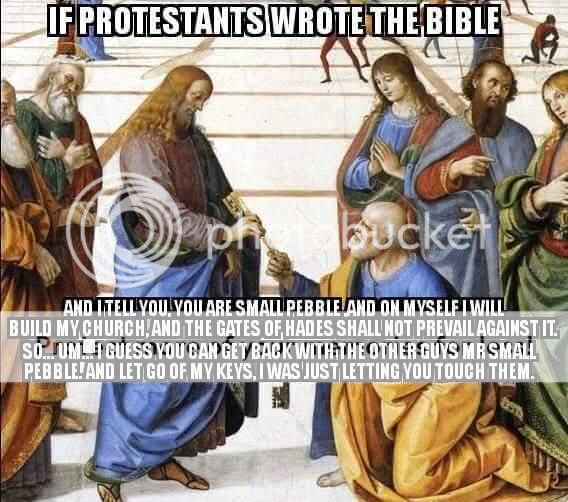
Good that you believe Bible is written by Protestants. devil.gif brows.gif rclxs0.gif
shioks
post Jun 20 2016, 02:12 PM

On my way
****
Senior Member
627 posts

Joined: Jun 2009
QUOTE(yeeck @ Jun 20 2016, 02:01 PM)
Thank you for acknowledging Tradition. We know what is Tradition vs tradition. But to some of you, it is the same.
*
Uncle Yeeck, what is the meaning of Matthew 5:39 "But I tell you, do not resist an evil person. If anyone slaps you on the right cheek, turn to them the other cheek also."

Take your time to do your homework and ask your bishops or others before replying.

This post has been edited by shioks: Jun 20 2016, 06:11 PM
shioks
post Jun 20 2016, 02:14 PM

On my way
****
Senior Member
627 posts

Joined: Jun 2009
QUOTE(khool @ Jun 20 2016, 02:12 PM)
Would some even know what is Tradition? Some are stuck with noses inside our Catholic book called the Bible, and taking it as their own.
*
Bible is Catholic book?!!!


Attached image(s)
Attached Image
shioks
post Jun 20 2016, 02:24 PM

On my way
****
Senior Member
627 posts

Joined: Jun 2009
QUOTE(khool @ Jun 20 2016, 12:18 PM)
According to ancient Greek legend, the great warrior, Achilles, was invulnerable against attack, except for one area of weakness—his heel. That weakness would be exploited near the end of the Trojan War by Paris. As the story goes, he shot Achilles in the heel with an arrow, killing his seemingly undefeatable foe.

Okay, so referring to Sola Scriptura as the Protestant Achilles's Heel is not a perfect analogy. There are many weak spots in Protestant theology. But the use of the image of "Achilles's Heel" in prose today is employed not only to accentuate a singular weakness in an otherwise impenetrable person or institution, but a particularly acute weakness. It is in that sense that I think the analogy fits.

Sola Scriptura was the central doctrine and foundation for all I believed when I was Protestant. On a popular level, it simply meant, “If a teaching isn’t explicit in the Bible, then we don’t accept it as doctrine!” And it seemed so simple. Unassailable. And yet, I do not recall ever hearing a detailed teaching explicating it. It was always a given. Unchallenged. Diving deeper into its meaning, especially when I was challenged to defend my Protestant faith against Catholicism, I found there to be no book specifically on the topic and no uniform understanding of this teaching among Protestant pastors.

Once I got past the superficial, I had to try to answer real questions like, what role does tradition play? How explicit does a doctrine have to be in Scripture before it can be called doctrine? How many times does it have to be mentioned in Scripture before it would be dogmatic? Where does Scripture tell us what is absolutely essential for us to believe as Christians? How do we know what the canon of Scripture is using the principle of sola scriptura? Who is authorized to write Scripture in the first place? When was the canon closed? Or, the best question of all: where is sola scriptura taught in the Bible? These questions and more were left virtually unanswered or left to the varying opinions of various Bible teachers.

The Protestant Response

In answer to this last question, “Where is sola scriptura taught in the Bible?” most Protestants will immediately respond as I did, by simply citing II Tm. 3:16:

All scripture is inspired by God and profitable for teaching, for reproof, for correction, and for training in righteousness, that the man of God may be complete, equipped for every good work.

“How can it get any plainer than that? Doesn’t that say the Bible is all we need?” Question answered.

The fact is: II Timothy 3—or any other text of Scripture—does not even hint at sola scriptura. It says Scripture is inspired and necessary to equip “the man of God,” but never does it say Scripture alone is all anyone needs. We’ll come back to this text in particular later. But in my experience as a Protestant, it was my attempt to defend this bedrock teaching of Protestantism that led me to conclude: sola scriptura is 1) unreasonable 2) unbiblical and 3) unworkable.

Sola Scriptura is Unreasonable

When defending sola scriptura, the Protestant will predictably appeal to his sole authority—Scripture. This is a textbook example of the logical fallacy of circular reasoning which betrays an essential problem with the doctrine itself. One cannot prove the inspiration of a text from the text itself. The Book of Mormon, the Hindu Vedas, writings of Mary Baker Eddy, the Koran, and other books claim inspiration. This does not make them inspired. One must prove the point outside of the text itself to avoid the fallacy of circular reasoning.

Thus, the question remains: how do we know the various books of the Bible are inspired and therefore canonical? And remember: the Protestant must use the principle of sola scriptura in the process.

II Tim. 3:16 is not a valid response to the question. The problems are manifold. Beyond the fact of circular reasoning, for example, I would point out the fact that this verse says all Scripture is inspired tells us nothing of what the canon consists. Just recently, I was speaking with a Protestant inquirer about this issue and he saw my point. He then said words to the effect of, “I believe the Holy Spirit guides us into all truth as Jesus said in Jn. 16:13. The Holy Spirit guided the early Christians and helped them to gather the canon of Scripture and declare it to be the inspired word of God. God would not leave us without his word to guide us.”

That answer is much more Catholic than Protestant! Yes, Jn. 16:13 does say the Spirit will lead the apostles—and by allusion, the Church—into all truth. But this verse has nothing to say about sola scriptura. Nor does it say a word about the nature or number of books in the canon. Catholics certainly agree that the Holy Spirit guided the early Christians to canonize the Scriptures because the Catholic Church teaches that there is an authoritative Church guided by the Holy Spirit. The obvious problem is my Protestant friend did not use sola scriptura as his guiding principle to arrive at his conclusion. How does, for example, Jn. 16:13 tell us that Hebrews was written by an apostolic writer and that it is inspired of God? We would ultimately have to rely on the infallibility of whoever “the Holy Spirit” is guiding to canonize the Bible so that they could not mishear what the Spirit was saying about which books of the Bible are truly inspired.

In order to put this argument of my friend into perspective, can you imagine if a Catholic made a similar claim to demonstrate, say, Mary to be the Mother of God? “We believe the Holy Spirit guides us into all truth and guided the early Christians to declare this truth.” I can almost hear the response. “Show me in the Bible where Mary is the Mother of God! I don’t want to hear about God guiding the Church!” Wouldn’t the same question remain for the Protestant concerning the canon? “Show me in the Bible where the canon of Scripture is, what the criterion for the canon is, who can and cannot write Scripture, etc.”

Will the Circle be Unbroken?

The Protestant response at this point is often an attempt to use the same argument against the Catholic. “How do you know the Scriptures are inspired? Your reasoning is just as circular because you say the Church is infallible because the inspired Scriptures say so and then say the Scriptures are inspired and infallible because the Church says so!”

The Catholic Church’s position on inspiration is not circular. We do not say “the Church is infallible because the inspired Scriptures say so, and the Scriptures are inspired because the infallible Church says so.” That would be a kind of circular reasoning. The Church was established historically and functioned as the infallible spokesperson for the Lord decades before the New Testament was written. The Church is infallible because Jesus said so.

Having said that, it is true that we know the Scriptures to be inspired because the Church has told us so. That is also an historical fact. However, this is not circular reasoning. When the Catholic approaches Scripture, he or she begins with the Bible as an historical document, not as inspired. As any reputable historian will tell you, the New Testament is the most accurate and verifiable historical document in all of ancient history. To deny the substance of the historical documents recorded therein would be absurd. However, one cannot deduce from this that they are inspired. There are many accurate historical documents that are not inspired. However, the Scriptures do give us accurate historical information whether one holds to their inspiration or not. Further, this testimony of the Bible is backed up by hundreds of works by early Christians and non-Christian writers like Suetonius, Tacitus, Pliny the Younger, Josephus, and more. It is on this basis that we can say it is an historical fact that Jesus lived, died, and was reported to be resurrected from the dead by over 500 eyewitnesses. Many of these eyewitnesses went to their deaths testifying to the veracity of the Christ-event (see Lk. 1:1-4, Jn. 21:18-19, 24-25, Acts 1:1-11, I Cr. 15:1-8).

Now, what do we find when we examine the historical record? Jesus Christ—as a matter of history–established a Church, not a book, to be the foundation of the Christian Faith (see Mt. 16:15-18; 18:15-18. Cf. Eph. 2:20; 3:10,20-21; 4:11-15; I Tm. 3:15; Hb. 13:7,17, etc.). He said of his Church, “He who hears you hears me and he who rejects you rejects me, and he who rejects me rejects him who sent me” (Lk. 10:16). The many books that comprise what we call the Bible never tell us crucial truths such as the fact that they are inspired, who can and cannot be the human authors of them, who authored them at all, or, as I said before, what the canon of Scripture is in the first place. And this is just to name a few examples. What is very clear historically is that Jesus established a kingdom with a hierarchy and authority to speak for him (see Lk. 20:29-32, Mt. 10:40, 28:18-20). It was members of this Kingdom—the Church—that would write the Scripture, preserve its many texts and eventually canonize it. The Scriptures cannot write or canonize themselves. To put it simply, reason clearly rejects sola scriptura as a self-refuting principle because one cannot determine what the “scriptura” is using the principle of sola scriptura.

Sola Scriptura is Unbiblical

Let us now consider the most common text used by Protestants to “prove” sola scriptura, II Tm. 3:16, which I quoted above:

All scripture is inspired by God and profitable for teaching, for reproof, for correction, and for training in righteousness, that the man of God may be complete, equipped for every good work.

The problem with using this text as such is threefold: 1. Strictly speaking, it does not speak of the New Testament at all. 2. It does not claim Scripture to be the sole rule of faith for Christians. 3. The Bible teaches oral Tradition to be on a par with and just as necessary as the written Tradition, or Scripture.

1. What’s Old is Not New

Let us examine the context of the passage by reading the two preceding verses:

But as for you, continue in what you have learned and have firmly believed, knowing from whom you learned it and how from childhood (italics added) you have been acquainted with the sacred writings which are able to instruct you for salvation through faith in Jesus Christ.

In context, this passage does not refer to the New Testament at all. None of the New Testament books had been written when St. Timothy was a child! To claim this verse in order to authenticate a book, say, the book of Revelation, when it had most likely not even been written yet, is more than a stretch. That is going far beyond what the text actually claims.

2. The Trouble With Sola

As a Protestant, I was guilty of seeing more than one sola in Scripture that simply did not exist. The Bible clearly teaches justification by faith. And we Catholics believe it. However, we do not believe in justification by faith alone because, among many other reasons, the Bible says, we are “justified by works and not by faith alone” (James 2:24, emphasis added). Analogously, when the Bible says Scripture is inspired and profitable for “the man of God,” to be “equipped for every good work,” we Catholics believe it. However, the text of II Tim. 3:16 never says Scripture alone. There is no sola to be found here either! Even if we granted II Tm. 3:16 was talking about all of Scripture, it never claims Scripture to be the sole rule of faith. A rule of faith, to be sure! But not the sole rule of faith.

James 1:4 illustrates clearly the problem with Protestant exegesis of II Tim. 3:16:

And let steadfastness (patience) have its full effect, that you may be perfect and complete, lacking in nothing.

If we apply the same principle of exegesis to this text that the Protestant does to II Tm. 3:16 we would have to say that all we need is patience to be perfected. We don’t need faith, hope, charity, the Church, baptism, etc.

Of course, any Christian would immediately say this is absurd. And of course it is. But James’s emphasis on the central importance of patience is even stronger than St. Paul’s emphasis on Scripture. The key is to see that there is not a sola to be found in either text. Sola patientia would be just as much an error as is sola scriptura.

3. The Tradition of God is the Word of God

Not only is the Bible silent when it comes to sola scriptura, but Scripture is remarkably plain in teaching oral Tradition to be just as much the word of God as is Scripture. In what most scholars believe was the first book written in the New Testament, St. Paul said:

And we also thank God… that when you received the word of God which you heard from us, you accepted it not as the word of men but as what it really is, the word of God… (I Thess. 2:13)

II Thess. 2:15 adds:

So then, brethren, stand firm and hold to the traditions you have been taught by us, either by word of mouth or by letter.

According to St. Paul, the spoken word from the apostles was just as much the word of God as was the later written word.

Sola Scriptura is Unworkable

When it comes to the tradition of Protestantism—sola scriptura—the silence of the text of Scripture is deafening. When it comes to the true authority of Scripture and Tradition, the Scriptures are clear. And when it comes to the teaching and governing authority of the Church, the biblical text is equally as clear:

If your brother sins against you go and tell him his fault, between you and him alone … But if he does not listen, take one or two others with you … If he refuses to listen … tell it to the church; and if he refuses to listen even to the church, let him be to you as a Gentile and a tax collector. (Mt. 18:15-17)

According to Scripture, the Church—not the Bible alone—is the final court of appeal for the people of God in matters of faith and discipline. But isn’t it also telling that since the Reformation of just ca. 480 years ago—a reformation claiming sola scriptura as its formal principle—there are now over 33,000 denominations that have derived from it?

For 1,500 years, Christianity saw just a few enduring schisms (the Monophysites, Nestorians, the Orthodox, and a very few others). Now in just 480 years we have this? I hardly think that when Jesus prophesied there would be “one shepherd and one fold” in Jn. 10:16, this is what he had in mind. It seems quite clear to me that not only is sola scriptura unreasonable and unbiblical, but it is unworkable. The proof is in the puddin’!

Source: http://www.catholic.com/blog/tim-staples/t...t-achilles-heel
*
Were you once Protestant or born into a Catholic family?

11 Pages < 1 2 3 4 5 > » Top
Topic ClosedOptions
 

Change to:
| Lo-Fi Version
0.1346sec    0.48    7 queries    GZIP Disabled
Time is now: 3rd December 2025 - 07:26 PM