Monday of the Fifth Week of Easter
Lectionary: 285 Reading 1 (Acts 14:5-18)
There was an attempt in Iconium
by both the Gentiles and the Jews,
together with their leaders,
to attack and stone Paul and Barnabas.
They realized it,
and fled to the Lycaonian cities of Lystra and Derbe
and to the surrounding countryside,
where they continued to proclaim the Good News.
At Lystra there was a crippled man, lame from birth,
who had never walked.
He listened to Paul speaking, who looked intently at him,
saw that he had the faith to be healed,
and called out in a loud voice, "Stand up straight on your feet."
He jumped up and began to walk about.
When the crowds saw what Paul had done,
they cried out in Lycaonian,
"The gods have come down to us in human form."
They called Barnabas "Zeus" and Paul "Hermes,"
because he was the chief speaker.
And the priest of Zeus, whose temple was at the entrance to the city,
brought oxen and garlands to the gates,
for he together with the people intended to offer sacrifice.
The Apostles Barnabas and Paul tore their garments
when they heard this and rushed out into the crowd, shouting,
"Men, why are you doing this?
We are of the same nature as you, human beings.
We proclaim to you good news
that you should turn from these idols to the living God,
who made heaven and earth and sea and all that is in them.
In past generations he allowed all Gentiles to go their own ways;
yet, in bestowing his goodness,
he did not leave himself without witness,
for he gave you rains from heaven and fruitful seasons,
and filled you with nourishment and gladness for your hearts."
Even with these words, they scarcely restrained the crowds
from offering sacrifice to them.
Responsorial Psalm (Ps 115:1-2, 3-4, 15-16)R. Not to us, O Lord, but to your name give the glory.
(Non nobis domine ... domine, tua da gloriam!)
or:
R. Alleluia.Not to us, O LORD, not to us
but to your name give glory
because of your mercy, because of your truth.
Why should the pagans say,
"Where is their God?"
R. Not to us, O Lord, but to your name give the glory.
(Non nobis domine ... domine, tua da gloriam!)
or:
R. Alleluia.Our God is in heaven;
whatever he wills, he does.
Their idols are silver and gold,
the handiwork of men.
R. Not to us, O Lord, but to your name give the glory.
(Non nobis domine ... domine, tua da gloriam!)
or:
R. Alleluia.May you be blessed by the LORD,
who made heaven and earth.
Heaven is the heaven of the LORD,
but the earth he has given to the children of men.
R. Not to us, O Lord, but to your name give the glory.
(Non nobis domine ... domine, tua da gloriam!)
or:
R. Alleluia.Alleluia (Jn 14:26)R. Alleluia, alleluia.The Holy Spirit will teach you everything
and remind you of all I told you.
R. Alleluia, alleluia.Gospel (Jn 14:21-26)Jesus said to his disciples:
"Whoever has my commandments and observes them
is the one who loves me.
Whoever loves me will be loved by my Father,
and I will love him and reveal myself to him."
Judas, not the Iscariot, said to him,
"Master, then what happened that you will reveal yourself to us
and not to the world?"
Jesus answered and said to him,
"Whoever loves me will keep my word,
and my Father will love him,
and we will come to him and make our dwelling with him.
Whoever does not love me does not keep my words;
yet the word you hear is not mine
but that of the Father who sent me.
"I have told you this while I am with you.
The Advocate, the Holy Spirit
whom the Father will send in my name—
he will teach you everything
and remind you of all that I told you."
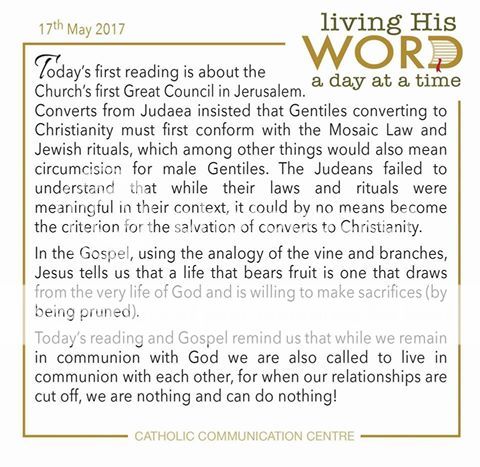
[IMGhttp://i790.photobucket.com/albums/yy184/khool/18491602_10207008118640824_7702520656460061707_o_zpssajyk8di.jpg[/IMG]
REFLECTIONWhoever loves me will keep my word. Discipleship is a union of intimate love with Jesus, but love is not to be interpreted merely as emotion. Love is also a matter of human decision and action. One who truly loves Jesus proves it by keeping His commandments or, better, the “new commandment” of love. And this is to love one another as Jesus loves His disciples (cf Jn. 13:34).
Unlike love that usually means a one-to-one relationship, the love of Jesus takes the form of a triad: Jesus-I-brother/sister. To love Jesus is not to be thoroughly focused on Him only, but to welcome the brother and sister in that relationship. It is not “you and me against the world,” an exclusive love, but rather an inclusive one that welcomes others. John writes: “If anyone says, ‘I love God,’ but hates his brother, he is a liar; for whoever does not love a brother whom he has seen cannot love God whom he has not seen” (1 Jn. 4:20).
It is certainly easier to love Jesus because He is all good and loving than a fellow human being with all his or her weaknesses, shortcomings, and sins. But this is how we prove to the Lord that we really love Him.
“[Lord,] lead me in the path of Your commandments, for that is my delight” (Ps. 119:35).
SOURCE: “365 Days with the Lord 2017,” ST. PAULS Philippines, 7708 St. Paul Rd., SAV, Makati City (Phils.)
http://www.ssp.ph/ 

 May 15 2017, 02:15 AM


 Quote
Quote














 0.0664sec
 0.61
0.61
 6 queries
 GZIP Disabled