

LYN Catholic Fellowship V01 (Group), For Catholics (Roman or Eastern)
|
|
 Feb 28 2017, 11:07 PM Feb 28 2017, 11:07 PM
|
 
Senior Member
3,573 posts Joined: Apr 2006  
|
|
 Quote
Quote|
|
|
|
|
Feb 28 2017, 11:48 PM
|
|
Senior Member
3,573 posts Joined: Apr 2006
|
"To those who repent, God permits return,
and he encourages those who were losing hope. Return to the Lord and leave sin behind, plead before his face and lessen your offence. Come back to the Most High and turn away from iniquity, and hold in abhorrence all that is foul. Who will praise the Most High in Sheol, if the living do not do so by giving glory to him? To the dead, as to those who do not exist, praise is unknown, only those with life and health can praise the Lord. How great is the mercy of the Lord, his pardon on all those who turn towards him!" – Ecclesiasticus 17:20-28 |
|
|
Mar 1 2017, 07:20 AM
|

Junior Member
225 posts Joined: Mar 2008
|
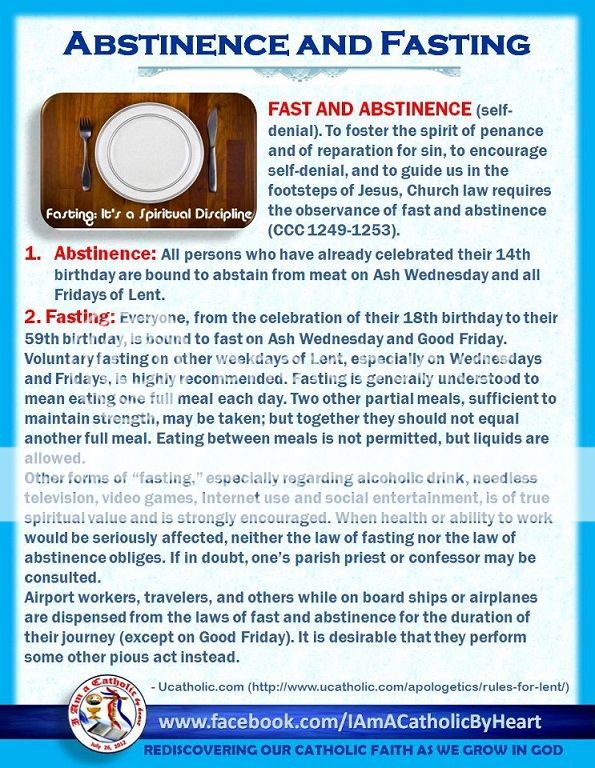 |
|
|
Mar 1 2017, 10:09 AM
|
|
Junior Member
225 posts Joined: Mar 2008
|
Ash Wednesday
Lectionary: 219 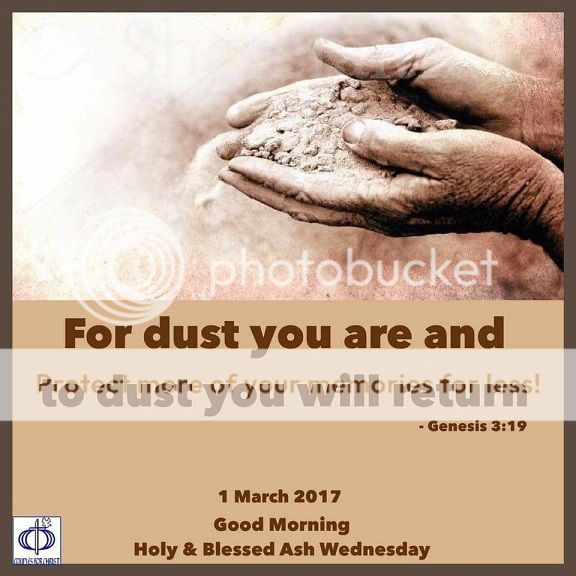 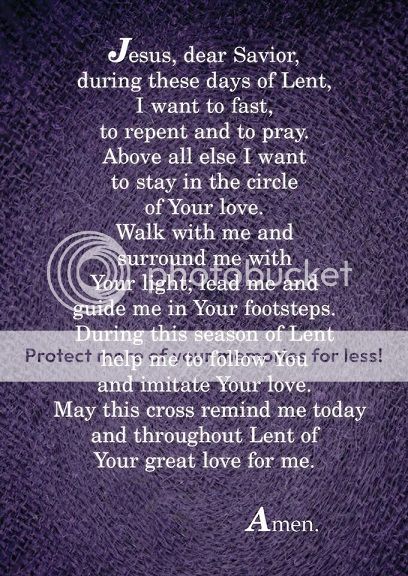 Reading 1 (JL 2:12-18) Even now, says the LORD, return to me with your whole heart, with fasting, and weeping, and mourning; Rend your hearts, not your garments, and return to the LORD, your God. For gracious and merciful is he, slow to anger, rich in kindness, and relenting in punishment. Perhaps he will again relent and leave behind him a blessing, Offerings and libations for the LORD, your God. Blow the trumpet in Zion! proclaim a fast, call an assembly; Gather the people, notify the congregation; Assemble the elders, gather the children and the infants at the breast; Let the bridegroom quit his room and the bride her chamber. Between the porch and the altar let the priests, the ministers of the LORD, weep, And say, "Spare, O LORD, your people, and make not your heritage a reproach, with the nations ruling over them! Why should they say among the peoples, 'Where is their God?'" Then the LORD was stirred to concern for his land and took pity on his people. Responsorial (Psalm PS 51:3-4, 5-6AB, 12-13, 14 AND 17) R. Be merciful, O Lord, for we have sinned. Have mercy on me, O God, in your goodness; in the greatness of your compassion wipe out my offense. Thoroughly wash me from my guilt and of my sin cleanse me. R. Be merciful, O Lord, for we have sinned. For I acknowledge my offense, and my sin is before me always: "Against you only have I sinned, and done what is evil in your sight." R. Be merciful, O Lord, for we have sinned. A clean heart create for me, O God, and a steadfast spirit renew within me. Cast me not out from your presence, and your Holy Spirit take not from me. R. Be merciful, O Lord, for we have sinned. Give me back the joy of your salvation, and a willing spirit sustain in me. O Lord, open my lips, and my mouth shall proclaim your praise. R. Be merciful, O Lord, for we have sinned. Reading 2 (2 COR 5:20—6:2) Brothers and sisters: We are ambassadors for Christ, as if God were appealing through us. We implore you on behalf of Christ, be reconciled to God. For our sake he made him to be sin who did not know sin, so that we might become the righteousness of God in him. Working together, then, we appeal to you not to receive the grace of God in vain. For he says: In an acceptable time I heard you, and on the day of salvation I helped you. Behold, now is a very acceptable time; behold, now is the day of salvation. Verse Before The Gospel (PS 95:8) If today you hear his voice, harden not your hearts. Gospel (MT 6:1-6, 16-18) Jesus said to his disciples: "Take care not to perform righteous deeds in order that people may see them; otherwise, you will have no recompense from your heavenly Father. When you give alms, do not blow a trumpet before you, as the hypocrites do in the synagogues and in the streets to win the praise of others. Amen, I say to you, they have received their reward. But when you give alms, do not let your left hand know what your right is doing, so that your almsgiving may be secret. And your Father who sees in secret will repay you. "When you pray, do not be like the hypocrites, who love to stand and pray in the synagogues and on street corners so that others may see them. Amen, I say to you, they have received their reward. But when you pray, go to your inner room, close the door, and pray to your Father in secret. And your Father who sees in secret will repay you. "When you fast, do not look gloomy like the hypocrites. They neglect their appearance, so that they may appear to others to be fasting. Amen, I say to you, they have received their reward. But when you fast, anoint your head and wash your face, so that you may not appear to be fasting, except to your Father who is hidden. And your Father who sees what is hidden will repay you."  REFLECTION Your father who sees in secret will repay you. This statement is like a refrain for every pillar of Jewish piety (almsgiving, v 4; prayer, v 6; fasting, v 18). Jesus corrects the attitude of practicing these acts just to give a good impression on people. He insists on the right motivation, that is, to please the heavenly Father alone. Only the Father, in fact, can give the reward that lasts. To give alms, pray, and fast for show has its reward on earth, but not in heaven. The Lenten season, which begins today, is an opportunity for us to purify our motives and intensify our desire to please the heavenly Father, not others or ourselves, in everything we do. SOURCE: “365 Days with the Lord 2016,” ST. PAULS Philippines, 7708 St. Paul Rd., SAV, Makati City (Phils.) http://www.ssp.ph/ |
|
|
Mar 1 2017, 03:03 PM
|
|
Junior Member
225 posts Joined: Mar 2008
|
|
|
|
Mar 2 2017, 09:27 AM
|
|
Junior Member
225 posts Joined: Mar 2008
|
Thursday after Ash Wednesday
Lectionary: 220 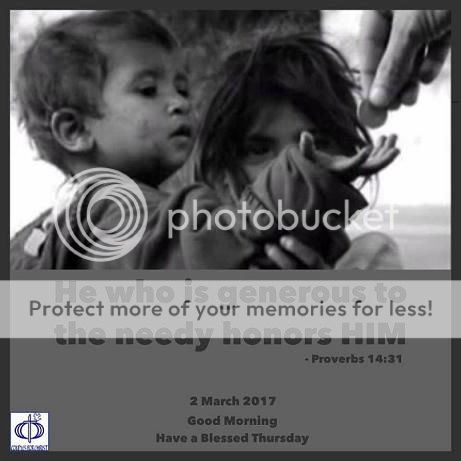  Reading 1 (Dt 30:15-20) Moses said to the people: "Today I have set before you life and prosperity, death and doom. If you obey the commandments of the LORD, your God, which I enjoin on you today, loving him, and walking in his ways, and keeping his commandments, statutes and decrees, you will live and grow numerous, and the LORD, your God, will bless you in the land you are entering to occupy. If, however, you turn away your hearts and will not listen, but are led astray and adore and serve other gods, I tell you now that you will certainly perish; you will not have a long life on the land that you are crossing the Jordan to enter and occupy. I call heaven and earth today to witness against you: I have set before you life and death, the blessing and the curse. Choose life, then, that you and your descendants may live, by loving the LORD, your God, heeding his voice, and holding fast to him. For that will mean life for you, a long life for you to live on the land that the LORD swore he would give to your fathers Abraham, Isaac and Jacob." Responsorial Psalm (Ps 1:1-2, 3, 4 and 6) R. Blessed are they who hope in the Lord. Blessed the man who follows not the counsel of the wicked Nor walks in the way of sinners, nor sits in the company of the insolent, But delights in the law of the LORD and meditates on his law day and night. R. Blessed are they who hope in the Lord. He is like a tree planted near running water, That yields its fruit in due season, and whose leaves never fade. Whatever he does, prospers. R. Blessed are they who hope in the Lord. Not so the wicked, not so; they are like chaff which the wind drives away. For the LORD watches over the way of the just, but the way of the wicked vanishes. R. Blessed are they who hope in the Lord. Verse Before the Gospel (Mt 4:17) Repent, says the Lord; the Kingdom of heaven is at hand. Gospel (Lk 9:22-25) Jesus said to his disciples: "The Son of Man must suffer greatly and be rejected by the elders, the chief priests, and the scribes, and be killed and on the third day be raised." Then he said to all, "If anyone wishes to come after me, he must deny himself and take up his cross daily and follow me. For whoever wishes to save his life will lose it, but whoever loses his life for my sake will save it. What profit is there for one to gain the whole world yet lose or forfeit himself?" 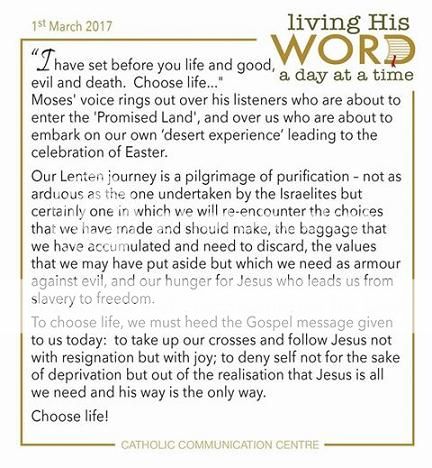 *Errata: Date should be 2nd. March 2017 REFLECTION The son of man must suffer greatly. “Son of Man” is the title often used in the gospels of Mark, Matthew, and Luke to refer to Jesus. (It is used once in Jn 1:51.) The title encompasses Jesus’ divinity (cf Dn 7:13ff) and humanity (e.g., the prophet in the book of Ezekiel is addressed as son of man). The humanity of Jesus is described in the first part of v 22: He “must suffer greatly and be rejected by the elders, the chief priests, and the scribes, and be killed,” while the second part of the same verse describes His divinity: He will “on the third day be raised.” Jesus must undergo great suffering and death, but on the third day, He will be gloriously raised from the dead. “Must” underlines the necessity of suffering to attain his salvific mission. Jesus’ disciples must follow the same path of suffering, which starts with self-denial. Taking up our cross daily means living responsibly as Christians, reaching out to those in need. We can be of service to others only if we divest ourselves of selfish motives and interests. “A clean heart create for me, God; renew within me a steadfast spirit” (Ps 51:12) SOURCE: “365 Days with the Lord 2016,” ST. PAULS Philippines, 7708 St. Paul Rd., SAV, Makati City (Phils.) http://www.ssp.ph/ |
|
|
|
|
|
Mar 2 2017, 09:29 AM
|
|
Junior Member
225 posts Joined: Mar 2008
|
 |
|
|
Mar 2 2017, 03:27 PM
|
|
Junior Member
225 posts Joined: Mar 2008
|
  |
|
|
Mar 4 2017, 11:11 AM
|
|
Junior Member
225 posts Joined: Mar 2008
|
Saturday after Ash Wednesday
Lectionary: 222   Reading 1 (Is 58:9b-14) Thus says the LORD: If you remove from your midst oppression, false accusation and malicious speech; If you bestow your bread on the hungry and satisfy the afflicted; Then light shall rise for you in the darkness, and the gloom shall become for you like midday; Then the LORD will guide you always and give you plenty even on the parched land. He will renew your strength, and you shall be like a watered garden, like a spring whose water never fails. The ancient ruins shall be rebuilt for your sake, and the foundations from ages past you shall raise up; "Repairer of the breach," they shall call you, "Restorer of ruined homesteads." If you hold back your foot on the sabbath from following your own pursuits on my holy day; If you call the sabbath a delight, and the LORD's holy day honorable; If you honor it by not following your ways, seeking your own interests, or speaking with malice— Then you shall delight in the LORD, and I will make you ride on the heights of the earth; I will nourish you with the heritage of Jacob, your father, for the mouth of the LORD has spoken. Responsorial Psalm (Ps 86:1-2, 3-4, 5-6) R. Teach me your way, O Lord, that I may walk in your truth. Incline your ear, O LORD; answer me, for I am afflicted and poor. Keep my life, for I am devoted to you; save your servant who trusts in you. You are my God. R. Teach me your way, O Lord, that I may walk in your truth. Have mercy on me, O Lord, for to you I call all the day. Gladden the soul of your servant, for to you, O Lord, I lift up my soul. R. Teach me your way, O Lord, that I may walk in your truth. For you, O Lord, are good and forgiving, abounding in kindness to all who call upon you. Hearken, O LORD, to my prayer and attend to the sound of my pleading. R. Teach me your way, O Lord, that I may walk in your truth. Verse Before the Gospel (Ez 33:11) I take no pleasure in the death of the wicked man, says the Lord, but rather in his conversion, that he may live. Gospel (Lk 5:27-32) Jesus saw a tax collector named Levi sitting at the customs post. He said to him, "Follow me." And leaving everything behind, he got up and followed him. Then Levi gave a great banquet for him in his house, and a large crowd of tax collectors and others were at table with them. The Pharisees and their scribes complained to his disciples, saying, "Why do you eat and drink with tax collectors and sinners?" Jesus said to them in reply, "Those who are healthy do not need a physician, but the sick do. I have not come to call the righteous to repentance but sinners." 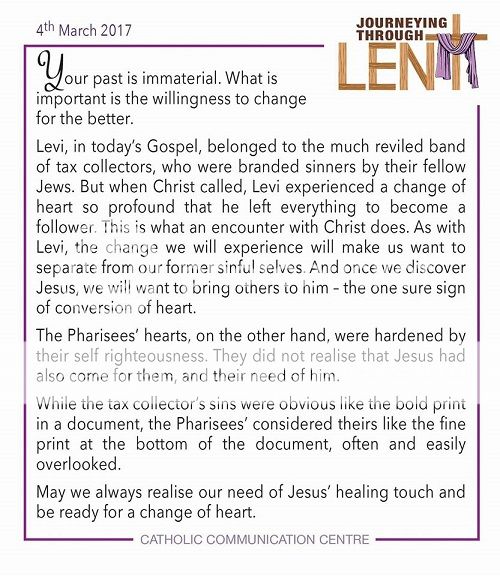 REFLECTION  Why do you eat and drink with tax collectors? During the Roman occupation of Palestine, tax collectors are hated by their fellow Jews because they collect taxes for the foreign conquerors and enrich themselves in the process. They belong to the category of “sinners,” who are marginalized in Jewish society. Jesus compares sinners to sick people who need a physician. And he has come to bring not only physical healing but also, above all, spiritual well-being. The first stage of spiritual healing is repentance, a word translated from the Greek word metanoia. Paul explains metanoia as a “renewal of… mind” (Rom 12:2). The Hebrew word for metanoia is shub, which means to make a 180-degree turn. Repentance then means to turn away from sin and go to God. Levi exemplifies true repentance: he leaves everything behind (his means of livelihood), gets up, and follows Jesus. Getting up signifies a new way of life. Levi is transformed from a tax collector to a disciple of Jesus. The Lenten season invites us to get rid of our prejudice and self-righteous attitude and imbibe Jesus’ spirit of openness to the marginalized in society. SOURCE: “365 Days with the Lord 2016,” ST. PAULS Philippines, 7708 St. Paul Rd., SAV, Makati City (Phils.) http://www.ssp.ph/ This post has been edited by khool: Mar 4 2017, 11:13 AM |
|
|
Mar 4 2017, 11:28 AM
|
|
Junior Member
225 posts Joined: Mar 2008
|
BE RECONCILED THIS EASTER 2017
06 Mar (Mon) : 7.30 pm :St. Ignatius Church, P.J.. 07 Mar (Tues) : 7.30 pm: St.John Vianney, Tampin 08 Mar (Wed): 8.00 pm : Holy Rosary, K.L. 09 Mar (Thurs) : 8.00 pm : Sacred Heart, K.L. 13 Mar (Mon) : 6.00 pm: Visitation, Seremban 16 Mar (Thur) : 7.00 pm : St. Francis Xavier, P.J. 23 Mar (Thur): 7.30 pm:- St. Aloysius, Mantin 27 Mar (Mon): 7.30 pm : Immaculate Conception, P.D. 28 Mar (Tues): 7.30 pm : Gemencheh  |
|
|
Mar 4 2017, 11:33 AM
|
|
Junior Member
225 posts Joined: Mar 2008
|
Stations of the Cross
|
|
|
Mar 5 2017, 03:48 PM
|
|
Junior Member
225 posts Joined: Mar 2008
|
First Sunday of Lent
Lectionary: 22 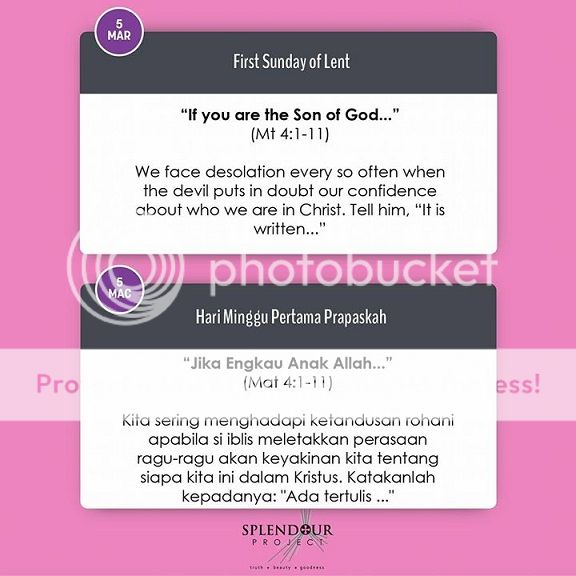 Reading 1 (Gn 2:7-9; 3:1-7) The LORD God formed man out of the clay of the ground and blew into his nostrils the breath of life, and so man became a living being. Then the LORD God planted a garden in Eden, in the east, and placed there the man whom he had formed. Out of the ground the LORD God made various trees grow that were delightful to look at and good for food, with the tree of life in the middle of the garden and the tree of the knowledge of good and evil. Now the serpent was the most cunning of all the animals that the LORD God had made. The serpent asked the woman, "Did God really tell you not to eat from any of the trees in the garden?" The woman answered the serpent: "We may eat of the fruit of the trees in the garden; it is only about the fruit of the tree in the middle of the garden that God said, 'You shall not eat it or even touch it, lest you die.'" But the serpent said to the woman: "You certainly will not die! No, God knows well that the moment you eat of it your eyes will be opened and you will be like gods who know what is good and what is evil." The woman saw that the tree was good for food, pleasing to the eyes, and desirable for gaining wisdom. So she took some of its fruit and ate it; and she also gave some to her husband, who was with her, and he ate it. Then the eyes of both of them were opened, and they realized that they were naked; so they sewed fig leaves together and made loincloths for themselves. Responsorial Psalm (Ps 51:3-4, 5-6, 12-13, 17) R. Be merciful, O Lord, for we have sinned. Have mercy on me, O God, in your goodness; in the greatness of your compassion wipe out my offense. Thoroughly wash me from my guilt and of my sin cleanse me. R. Be merciful, O Lord, for we have sinned. For I acknowledge my offense, and my sin is before me always: "Against you only have I sinned, and done what is evil in your sight." R. Be merciful, O Lord, for we have sinned. A clean heart create for me, O God, and a steadfast spirit renew within me. Cast me not out from your presence, and your Holy Spirit take not from me. R. Be merciful, O Lord, for we have sinned. Give me back the joy of your salvation, and a willing spirit sustain in me. O Lord, open my lips, and my mouth shall proclaim your praise. R. Be merciful, O Lord, for we have sinned. Reading 2 (Rom 5:12-19) Brothers and sisters: Through one man sin entered the world, and through sin, death, and thus death came to all men, inasmuch as all sinned— for up to the time of the law, sin was in the world, though sin is not accounted when there is no law. But death reigned from Adam to Moses, even over those who did not sin after the pattern of the trespass of Adam, who is the type of the one who was to come. But the gift is not like the transgression. For if by the transgression of the one, the many died, how much more did the grace of God and the gracious gift of the one man Jesus Christ overflow for the many. And the gift is not like the result of the one who sinned. For after one sin there was the judgment that brought condemnation; but the gift, after many transgressions, brought acquittal. For if, by the transgression of the one, death came to reign through that one, how much more will those who receive the abundance of grace and of the gift of justification come to reign in life through the one Jesus Christ. In conclusion, just as through one transgression condemnation came upon all, so, through one righteous act, acquittal and life came to all. For just as through the disobedience of the one man the many were made sinners, so, through the obedience of the one, the many will be made righteous. Verse Before the Gospel (Mt 4:4b) One does not live on bread alone, but on every word that comes forth from the mouth of God. Gospel (Mt 4:1-11) At that time Jesus was led by the Spirit into the desert to be tempted by the devil. He fasted for forty days and forty nights, and afterwards he was hungry. The tempter approached and said to him, "If you are the Son of God, command that these stones become loaves of bread." He said in reply, "It is written: One does not live on bread alone, but on every word that comes forth from the mouth of God." Then the devil took him to the holy city, and made him stand on the parapet of the temple, and said to him, "If you are the Son of God, throw yourself down. For it is written: He will command his angels concerning you and with their hands they will support you, lest you dash your foot against a stone." Jesus answered him, "Again it is written, You shall not put the Lord, your God, to the test." Then the devil took him up to a very high mountain, and showed him all the kingdoms of the world in their magnificence, and he said to him, "All these I shall give to you, if you will prostrate yourself and worship me." At this, Jesus said to him, "Get away, Satan! It is written: The Lord, your God, shall you worship and him alone shall you serve." Then the devil left him and, behold, angels came and ministered to him. 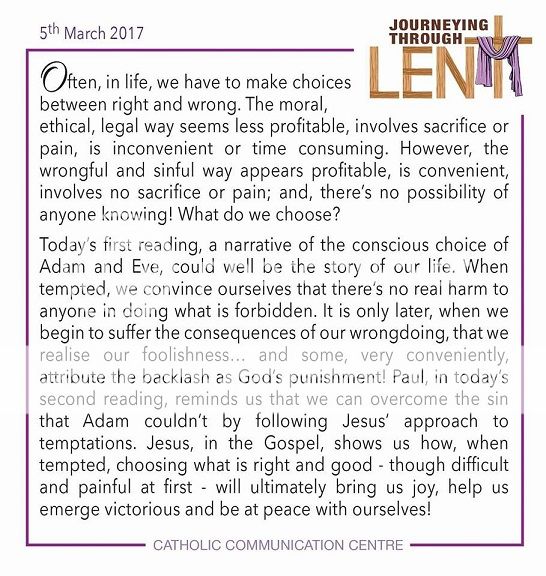 REFLECTION Life is like a cup of coffee. We are often more concerned with what makes us live than with what makes our life worth living. We are so taken up by work that we no longer know what is happening to our spouse and children. We do not have time to enjoy our family. We hold a cup of coffee but focus on the cup rather than savor the drink. In the Gospel, Jesus shows us that life is not about satisfying our lust for power and material wealth or replacing God with “loaves of bread” or “the kingdoms of the world.” What matters is not what we acquire but whom we worship. Life is always about God. In Lent, let us spend time with the Lord, speak with him, reflect on our priorities, and confront our craving for the passing pleasures of the world. Let us allow God’s mercy to wash away our sins. Let us enjoy the coffee, not complain about the cup. The happiest people may not have the best, but they make the best of everything. Let us live simply, love generously, forgive until it hurts, care deeply, speak kindly, and live uprightly. SOURCE: “365 Days with the Lord 2016,” ST. PAULS Philippines, 7708 St. Paul Rd., SAV, Makati City (Phils.) http://www.ssp.ph/ Meditation: Are you ready to follow the Lord Jesus wherever he wishes to lead you? After Jesus' was baptized by John the Baptist at the River Jordan, he withdrew into the wilderness of Judea - a vast and mostly uninhabitable wilderness full of danger. Danger from scorching heat by day and extreme cold at night, danger from wild animals and scorpions, plus the deprivation of food and the scarcity of water. Why did Jesus choose such a barren, lonely place for an intense and long period of sustained prayer and fasting? Matthew, Mark, and Luke tell us in their Gospel accounts that Jesus was led by the Holy Spirit into the wilderness. Mark states it most emphatically: "The Spirit immediately drove him out into the wilderness" (Mark 1:12). What compelled Jesus to seek solitude, away from his family and friends, for such a lengthy period? Was it simply a test to prepare him for his mission? Or did Satan want to lure him into a trap? The word tempt in English usually means to entice someone to do what is wrong or forbidden. The scriptural word used here also means test in the sense of proving and purifying someone to see if there are ready for the task at hand. We test flight pilots to see if they are fit to fly under all conditions, including times of adverse turbulence, storms, and poor visibility. In like manner God tests his people to see if they are ready to follow and serve him without reservation or compromise. Encountering God face to face On many occasions God tested Abraham to prove his faith and to strengthen his hope in the promises that God made to him. Abraham obeyed willingly even when God asked him to sacrifice his only son Isaac, the son of promise. When the Israelites were sorely tested in Egypt for more than 400 years, they did not forget God. They kept God's word and remembered his promise to save them. When God called Moses to free the Israelites from captivity in Egypt, God led them into the wilderness to his holy mountain at Sinai. There Moses ascended the mountain and met with God face to face for 40 days in prayer and fasting (Exodus 24:18). The prophet Elijah was also led on a 40 day journey to the holy mountain at Sinai to seek the face of God. God sustained Elijah with bread from heaven (1 Kings 19:8). Jesus was no exception to this pattern of testing and preparation with prayer and fasting. He was led into the wilderness for 40 days without food or shelter to seek the face of his heavenly Father. When God put Adam and Eve in the Garden of Paradise, he supplied them with everything they needed for abundant life and happiness with him. But when they listened to the voice of evil and followed the counsel of the serpent, who is the devil, they doubted God's word and disobeyed his command They fell because they trusted in themselves rather than in God (Genesis 2:16-17; 3:1-6). They were cast out of Paradise and driven into the wilderness. Jesus now freely enters the wilderness in order to regain Paradise for the lost children of God. Jesus refuses food to show his dependence on the bread of heaven, the word of God, that would sustain him not only in his physical hunger, but in his hour of temptation as well. When Satan tempts Jesus to turn stones into bread, Jesus replies with the words of Scripture, "Man shall not live by bread alone, but by every word that proceeds from the mouth of God" (quote from Deuteronomy 8:3; Matthew 4:4). Where did Jesus find the strength to survive the desert's harsh conditions and the tempter's seduction? He fed on God's word and found strength in doing his Father's will. Satan will surely tempt us and he will try his best to get us to choose our will over God's will. If he can't make us renounce our faith or sin mortally, he will then try to get us to make choices that will lead us, little by little, away from what God wants for us. Strength from God in resisting temptation Jesus was tempted like us and he overcame sin not by his own human effort but by the grace and strength which his Father gave to him. He had to renounce his will for the will of his Father. He succeeded because he wanted to please his Father and he trusted that his Father would give him the strength to overcome the obstacles that stood in the way. Luke says that Jesus was "full of the Holy Spirit" (Luke 4:1). When tempted by the devil Jesus did not try to fight his adversary on his own human strength. He relied on the power which the Spirit gave him. Jesus came to overthrow the evil one who held us captive to sin and fear of death (Hebrews 2:14). His obedience to his Father's will and his willingness to embrace the cross reversed the curse of Adam's disobedience. His victory over sin and death won for us not only pardon for our sins but adoption as sons and daughters of God. How can we overcome sin and gain freedom over our unruly desires and the lies of Satan and the world? The Lord Jesus gives us his Holy Spirit to help us in our weakness (Romans 8:26) and to be our guide and consoler in temptation and testing (1 Corinthians 10:13). The Lord gives grace to the humble who acknowledge their dependence on him (James 4:6) and he helps us to stand against the lies and attacks of our enemy, Satan, who seeks to destroy us (1 Peter 5:8-10; Ephesians 6:10-18). The Lord Jesus is ever ready to pour out his Spirit upon us that we may have the strength and courage we need to resist sin and to reject the lies and deceits of Satan. God wants us to "fight the good fight of the faith" (1 Timothy 6:12) with the power and strength which comes from the Holy Spirit. Do you rely on the Lord for your strength and help? "Lord Jesus, your word is life and joy for me. Fill me with your Holy Spirit that I may have the strength and courage to embrace your will in all things and to renounce whatever is contrary to it." A Daily Quote for Lent: On the Snare of the Devil, by Ambrose, 339-397 A.D. "The devil said to Jesus: 'If you are the son of God, command that these stones become bread' (Luke 4:3). Here we learn that there are three principal weapons that the devil likes to carry in order to wound our souls. They are gluttony, arrogance and ambition. Here begins the weapon with which he has already been victorious. We likewise should begin to be victorious in Christ in the very same area in which we have been defeated in Adam - we should be wary of gluttony. The devious trap is set for us when the table is laid for a royal banquet - it is bound to weaken our defences. "See what weapons Christ uses to defeat the power of the devil. He does not use the almighty power he has as God - what help would that be to us? In his humanity he summons the help common to all - overlooking bodily hunger and seeking the word of God for nourishment. "Whoever follows the Word is no longer attached to earthly bread, because he receives the bread of heaven and knows the divine is better than the human, the spiritual is better than the physical. Therefore, because such a person desires the true life, he looks for that which fortifies the heart by means of its invisible substance." (excerpt from On the Gospel of St. Luke, 4, 17) copyright and original source at … http://www.dailyscripture.net … |
|
|
Mar 7 2017, 11:17 PM
|
|
Senior Member
3,573 posts Joined: Apr 2006
|
|
|
|
|
|
|
Mar 8 2017, 12:10 AM
|
|
Senior Member
3,573 posts Joined: Apr 2006
|
“Fasting is the soul of prayer, mercy is the lifeblood of fasting. So if you pray, fast; if you fast, show mercy; if you want your petition to be heard, hear the petition of others. If you do not close your ear to others, you open God’s ear to yourself.” — St. Peter Chrysologus
 |
|
|
Mar 8 2017, 12:43 AM
|
|
Senior Member
3,573 posts Joined: Apr 2006
|
The Transitory Nature of the Mosaic Law
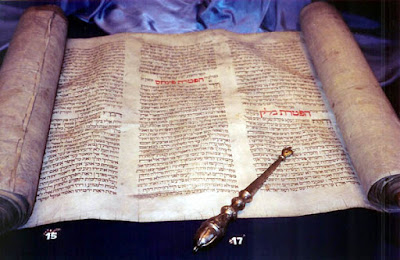 Two years ago I did a post entitled "Not to Abolish, but to Fulfill" (July, 2015) addressing the question of what Jesus meant when He said he did not come to abolish the Law of Moses, but to fulfill, it. The post can be summed up in the following excerpt: Jesus did not come to destroy the Law. He came to fulfill its precepts, obligations and prophecies to the last letter. He fulfills the function of all the sacrifices, He lives a perfect life and keeps the essence of its commandments flawlessly, and brings to fulfillment all its prophecies - the greatest being His atoning death on the cross, which ushers in the New Covenant...and brings the Old Law to its natural conclusion.Yes, the Old Law is obsolete and has passed away. No, our Lord did not "destroy" it or "abolish" it; rather, like so much else of the Old Testament, He took it up, transfigured it, ennobled it, and fulfilled it. Recently I received this inquiry from a reader on the question of the Law of Moses: How do we refute the Jews' assertion that the Law of Moses is permanent...interpreted by the rabbis and those in the Sanhedrin leading up to the Talmud? And also how do we demonstrate that Jesus is the Messiah when they have a doctrine that the Messiah must be a political leader? Traditional Catholicism may claim to have unbroken tradition, but the Jews will respond that we broke from their tradition, therefore making us heretics in their view. I know this is an old blog post, but these thoughts keep bugging me. The fulfillment of the Old Covenant by the coming of Christ is one of the most important teachings of the Christian faith. Understanding the relationship between the New Testament and the Old is essential for grasping how the claim of the Old Testament are fulfilled in Jesus Christ. The question of the impermanence of the Mosaic Law is a very broad question that cannot be exhaustively answered in a single post. This question was of pressing concern to the Church Fathers, however. Judaism was a powerful rival of Christianity in the late Roman Empire; Christians felt an urgent need to answer Jewish attacks on the claims of the Church to be the fulfillment of Old Testament Israel. We refer the reader to two important patristic works on the subject: Dialogue with Trypho the Jew by St. Justin Martyr, and Three Books of Testimonies Against the Jews by St. Cyprian of Carthage. These lengthy works give a very systematic exposition of the early Church's understanding of the transitory nature of the Mosaic Law and the Law's fulfillment in Christ. These works a very dense, but essential reading. That being said, I think there are a few points we can make to help address the question. Part I: The New Covenant is Distinctively Different from the Old Testament Law of Moses One first must realize there is nothing you can say to the Jews that will suddenly convince them. There is no "gotcha" verse or argument that will make them stop and think "Whoa...he's correct. Our thousands of years of tradition is wrong." That should not be the aim here. It sometimes happens that over time the accumulated weight of many arguments, coupled with a charitable example and the grace of the Holy Spirit, can win someone over. But in presenting the following points we are aiming more towards edifying Christians rather than building a case against the Jews. Second, it seems the question is making the assumption that an unbroken tradition is inherently good. To the Jews, we are the heretics because we broke with their tradition. That may be true from the Jewish viewpoint. But remember, Christ taught that the Jewish traditions had actually obscured the revelation of God: "For leaving the commandment of God, you hold the tradition of men, the washing of pots and of cups: and many other things you do like to these. And he said to them: Well do you make void the commandment of God, that you may keep your own tradition" (Mark 7:8-9). The tradition of Judaism actually is a hindrance to understanding the truth about God. St. Paul teaches that the Jews interpret the revelation of God in a "fleshly" manner, thinking sanctity consists in washings, keeping of certain feasts, ceremonial purity, dietary rules, circumcisions, etc. He says their reading of the Old Testament is skewered, and he draws a parallel between this and the veil that Moses put over his face. Just as Moses wore a veil to hide the glory of God that came off his face, so the Jewish traditions constitute a sort of "veil" over a right understanding of the Scriptures: "Their senses were made dull. For, until this present day, the selfsame veil, in the reading of the old testament, remains not taken away (because in Christ it is made void). But even until this day, when Moses is read, the veil is upon their heart. But when they shall be converted to the Lord, the veil shall be taken away" (2 Cor. 3:14-16). So we ought not be given pause by the fact that Christianity is viewed as a Jewish "heresy" by the Jews. The Jews have ever rejected the truth when it is given to them. They wanted to stone Moses for bringing them out of Egypt. They killed the prophets and persecuted the righteous. Christ laments over their hardness of heart when He cries for Jerusalem: "O Jerusalem, Jerusalem, killing the prophets and stoning those who are sent to you! How often would I have gathered your children together as a hen gathers her brood under her wings, and you would not! Behold, your house is forsaken. And I tell you, you will not see me until you say, ‘Blessed is he who comes in the name of the Lord!’” (Luke 13:34-35) Of course, ultimately, they killed the Messiah Himself because their tradition had blinded them to the truth about who the Christ would be. The Jews' own law testified that the dictates of Moses' law would one day give way to something more perfect. Moses himself testifies to this when he says: "The Lord your God will raise up for you a prophet like me from among you, from your brethren—him you shall heed— just as you desired of the Lord your God at Horeb on the day of the assembly, when you said, ‘Let me not hear again the voice of the Lord my God, or see this great fire any more, lest I die.’ And the Lord said to me, ‘They have rightly said all that they have spoken. I will raise up for them a prophet like you from among their brethren; and I will put my words in his mouth, and he shall speak to them all that I command him" (Deut. 18:15-18). God had spoken to the Israelites at Mount Horeb, but they had begged him not to speak anymore to them because they were terrified of His presence. Moses, His messenger, they rebelled against when they sinned and made the golden calf, as well as at other times. Thus Moses promises them that in the future God will raise up a prophet whom they will listen to. Thus the Israelites were awaiting the coming of a new prophet from among their brethren who would speak with the power and authority of Moses and whom they would heed. This prophet would reveal God to them in a way they could draw close to, not like the fiery cloud on Horeb. That the law would be impermanent, we see in the book of the prophet Jeremiah, where God says: “Behold, the days are coming, says the Lord, when I will make a new covenant with the house of Israel and the house of Judah, not like the covenant which I made with their fathers when I took them by the hand to bring them out of the land of Egypt, my covenant which they broke, though I was their husband, says the Lord. But this is the covenant which I will make with the house of Israel after those days, says the Lord: I will put my law within them, and I will write it upon their hearts; and I will be their God, and they shall be my people. And no longer shall each man teach his neighbor and each his brother, saying, ‘Know the Lord,’ for they shall all know me, from the least of them to the greatest, says the Lord; for I will forgive their iniquity, and I will remember their sin no more" (Jer. 31:31-34) In this passage, God says He will make a new covenant with Israel. Note that this new covenant is "not like the covenant" He made with them through Moses - i.e., it is not just a rehash of the Mosaic Law. It is of an essentially different character altogether. The law will be written on their hearts, not on tablets of stone. It is a kind of interiorization of the Mosaic Law. In Ezekiel too, God promises that a new kind of covenant will come where it is not the hands but the heart that is washed, and that this washing will come from God Himself: “Therefore say to the house of Israel, Thus says the Lord God: It is not for your sake, O house of Israel, that I am about to act, but for the sake of my holy name, which you have profaned among the nations to which you came. And I will vindicate the holiness of my great name, which has been profaned among the nations, and which you have profaned among them; and the nations will know that I am the Lord, says the Lord God, when through you I vindicate my holiness before their eyes. For I will take you from the nations, and gather you from all the countries, and bring you into your own land. I will sprinkle clean water upon you, and you shall be clean from all your uncleannesses, and from all your idols I will cleanse you. A new heart I will give you, and a new spirit I will put within you; and I will take out of your flesh the heart of stone and give you a heart of flesh. And I will put my spirit within you, and cause you to walk in my statutes and be careful to observe my ordinances. You shall dwell in the land which I gave to your fathers; and you shall be my people, and I will be your God" (Ezk. 36:22-28). This washing is essentially unlike the ritual washings proscribed by Moses. It consists of giving a "new heart" and a "new spirit." The washing is not a fleshly washing, but an interior renewal, such that the law of God will be able to be kept in a new manner, not like the Old Law. These passages show us that God will indeed inaugurate a New Covenant that will be fundamentally different in nature from the Old Covenant. Besides being different in nature, it will also be geographically universal - this is found in the prophets as well. This is beyond the scope of this article, but I recommend the essay "Epiphany in the Prophets" (USC, 2013), as well as "Old Testament Typology: Epiphany" (USC, 2015) for the biblical background of the universality of the New Covenant. Thus the New Covenant is prophesied in the Old Testament, it is markedly different than the Old Testament Law of Moses, and will be geographically universal. Part II. The Messianic Age This is all well and good, and Jews would acknowledge that all these things will come to pass in the Messianic age. The real difference between Jews and Christians is in when the Messianic age will come. For Jews, the Messianic age has not happened yet and the Law of Moses is still in effect. For Christians, the coming of Christ has definitively ended the Old Testament and we are now in the Messianic era, though before the definitive realization of His kingdom at the end of the age. It is well-known that the Jewish conception of the Messiah was fundamentally political, and that they expected with his reign the overthrow of Roman and Gentile dominion in the political order. This was not entirely unreasonable. Many Old Testament Messianic prophecies speak of the Messiah as destroying or ruling over the nations, notably Psalm 2, Psalm 110, Daniel 2 (as well as other prophecies of Daniel), Isaiah 9, Isaiah 11, and many other passages. 2 Samuel 7 says that the Messiah will be of the line of David and Solomon and will rule over a kingdom whose duration is eternal. It stands to reason that the nature of this kingdom would be like the Davidic kingdom. The problem is not misinterpreting Old Testament passages that make the Messiah a kingly figure; it is clear that this is taught. The problem is in traditional Jewish understanding of passages that show another side to the Messiah. For example, Isaiah 53 which speaks of how the Messiah will suffer and be humiliated, Zechariah 13 which states that the Messiah will be struck and his sheep scattered; Psalm 22, which prophesies the details of the crucifixion minutely, and Wisdom 2, which also foretells the suffering of the righteous Servant of God at the hands of the wicked. The Jews did not have a clear way to reconcile these passages. They tended to attributed the glorious passages to the Messiah and the suffering passages to some other character (this is the so-called "Two Messiah" theory). One will note upon reading the New Testament that the Jews were not only awaiting the coming of the Messiah, but another character called "the prophet": "And this is the testimony of John, when the Jews sent priests and Levites from Jerusalem to ask him, “Who are you?” He confessed, he did not deny, but confessed, “I am not the Christ.” And they asked him, “What then? Are you Elijah?” He said, “I am not.” “Are you the prophet?” And he answered, “No.” They said to him then, “Who are you? Let us have an answer for those who sent us. What do you say about yourself?” (John 1:19-22) The "prophet" is probably the prophet referred to in Deuteronomy 18. Notice that according to the Scriptural exegesis of the Pharisees, this prophet is distinct from the Messiah (as well as the Prophet Elijah, whose return the Jews were also expecting). This is an example of the division of Scriptural prophecies about the Messiah into two distinct classes, whereas Christian revelation as always seen the suffering/meek and glorious/reigning prophecies about the Messiah all reconciled in the person of Christ. Jews, however, did not make this reconciliation. It was quite impossible in their understanding that the Messiah should suffer. This is why St. Paul says "we preach Christ crucified: a stumbling block to Jews" (1 Cor. 1:23); the idea that the Messiah could suffer the death of crucifixion at the hands of Gentiles was as abhorrent to the Jews as the idea of a resurrection of the flesh was to the Greeks (cf. Acts 17:32). The crucifixion of the Messiah was the fundamental issue Jews took with the Gospel. Of course, the suffering of the Messiah is not in opposition to His glory. The entire paradox of the mission of Christ is that in His suffering He has His triumph. He finds His glory through meekness and submission to the will of God. This was not the only stumbling block, though. Anyone who has attentively read the Book of Acts, or the Epistles to the Romans, Galatians, and Hebrews knows that the Jews - even Jewish Christians - were deeply scandalized by the inclusion of the Gentiles into the Church without imposing upon them the necessity of keeping the Mosaic Law. In the eyes of many Jews, Gentiles were second-class humans, to be excluded from the commonwealth of God. The glory of the Messiah would be that He would destroy the nations, not that He would include them in a transfigured, reconstituted Israel. But reviewing Old Testament prophecy (we refer the reader above to the links about Epiphany) we see that the full inclusion of the Gentiles was always part of God's saving plan. Those who were not God's people would become God's people (Hos. 2:23); and they do not become God's people because the Messiah will destroy them in a military sense and reduce them to subservience, but because "the knowledge of God will fill the earth as water fills the seas" (Hab. 2:14). God will give the Gentiles to the Messiah as a gift, as a token of His favor towards the Messiah and His will to save all men: "It is too small a thing for you to be my servant to restore the tribes of Jacob and bring back those of Israel I have kept. I will also make you a light for the Gentiles, that my salvation may reach to the ends of the earth"(Isa. 49:6). Traditional Jewish understanding of the Old Testament did not seem to grasp that God did not will for the Gentiles to be destroyed and brought prostrate to the Jews; rather, He wanted to elevate them and make them brothers with the Jews in a single family of God that would be a kind of reconstituted Israel, the "Israel of God" (Gal. 6:16) composed of Jews and Gentiles both following the teaching revealed by the Messiah. And we can see this Jewish misunderstanding in the way the Jews react to the full inclusion of Gentiles into the Church throughout the New Testament. By the way, it should be pointed out that some Jews, notably of the Reformed or more moderate branches, do away with the concept of a Messiah altogether and interpret the suffering Messianic passages as referencing Israel itself. Thus, for example, when Isaiah 53:4 says "Surely he has borne our griefs and carried our sorrows; yet we esteemed him stricken, smitten by God and afflicted", they apply the passage to Israel allegorically, such that it is Israel as a people who are suffering - and that Israel's suffering is somehow redemptive of the human race. This concept illustrates the trouble Jews have traditionally had with the suffering Messiah passages. Part III. His Coming in Glory What are we to do with the passages that do predict a glorious triumph of the Messiah over the nations, such as Psalm 2? God wills to establish the universal dominion of the Messiah, but He does not wish to do it without the cooperation of mankind. Therefore He has left a period - whose duration is known only to God - where mankind will come to know and love God through the work of grace, not through force, for "the son of man did not come to destroy men's lives but to save them" (Luke 9:56). But though God is patient, He has appointed an hour when He will judge the living and the dead through the Christ, at which time all the glorious prophecies about the Messiah will be fulfilled in the triumphant everlasting reign of the Son of God. Thus, the Jewish confusion about the nature of the Messiah's reign has to do with (a) their reluctance to attribute the suffering passages and the triumphant passages to the same individual, and (b) historical failure to see that the plan of God was the full inclusion of the Gentiles into His family; it is this full, voluntary inclusion which makes the "Church age" necessary and accounts for the gap between Christ's first and second advents. Part IV. Impossibility of Keeping the Old Law One last point to emphasize: God not only sent the Messiah to establish the New Covenant, but in establishing the New, He allowed the Old to pass away. St. Paul discusses this in the Letter to the Hebrews, where he notes that the New Covenant has made the Old obsolete: "Christ has obtained a ministry which is as much more excellent than the old as the covenant he mediates is better, since it is enacted on better promises. For if that first covenant had been faultless, there would have been no occasion for a second...In speaking of a new covenant he treats the first as obsolete. And what is becoming obsolete and growing old is ready to vanish away" (Heb. 8:6-7, 13). With the coming of the perfect, the imperfect passes. The Mosaic Law was like a teacher that God's family needed in its youth; but with the coming of Christ, God's people reaches maturity and no longer needs a teacher (cf. Gal. 3:24). The fascinating thing about the Old Law is that since the coming of the New Covenant, it is actually impossible to keep the Mosaic Law. I will not pretend this is my observation; others have commented upon it before, including Fr. Ripperger, among others. The Mosaic Law requires animal sacrifices. No animal sacrifices are currently being carried out. The Law - at least since the time of Solomon - required a centralized worship in the Temple of Jerusalem. This is no longer possible. The keeping of the Mosaic Law requires a High Priest and Levites, who cannot merely possess the title but must be biological descendants of Aaron and Levi respectively. The genealogical trees of the Jews have long been lost. Thus, as Fr. Ripperger states, there is no such thing as a practicing Jew. To be sure, the Jews have invented justifications and exceptions to why the current Synagogue system of Jewish worship is acceptable, but these are circumlocutions to get around the problem that the actual keeping of the Mosaic Law today is impossible and that the Synagogue system exists as a kind of "replacement" Judaism due to the fact that actual Judaism died out in the year 70 AD with the destruction of the Temple and the priesthood. Conclusion None of this will convince a Jew. But it should give certainty to a Christian. Yes, we are "heretics" from the Jewish point of view. But that is ultimately irrelevant. How do we know the Mosaic Law is not permanent? The Old Testament itself tells us that one day a New Covenant will come that will be fundamentally different than the Old. Thus, the Mosaic Law itself attests to its impermanence. It comes to an end with the advent of the Messiah, who will be both meek and glorious - in His meekness He will draw all the Gentiles to Himself, and in His triumph He will crush those who refuse to submit. Jews have not understood this; indeed, as St. Paul says, a "veil" is over their interpretation of the Law. The fundamental disagreement with the Jews is on when the Messianic age begins; Jews historically have not valued the full inclusion of the Gentiles into God's family and hence see no reason for a "Church age", which explains the distance between Christ's first and second advents, a distance which exists to "make disciples of all nations" (Matt. 28:19). With the advent of the Messiah, the Old Covenant passed away, not only in its obligations, but in the very possibility of its observance. Thus, in the New Covenant, both Jew and Gentile are all called to obey the Messiah, as Moses prophesied (Deut. 18:15); it is this family of those who believe in Christ that is called the true "Israel of God" (Gal. 6:16). +AMDG+ |
|
|
Mar 10 2017, 01:51 AM
|
|
Senior Member
3,573 posts Joined: Apr 2006
|
 |
|
|
Mar 21 2017, 01:47 AM
|
|
Senior Member
3,573 posts Joined: Apr 2006
|
ON THE VENERATION OF THE CROSS
St. John of Damascus  The word “Cross” is foolishness to those that perish, but to us who are saved it is the power of God (1 Corinthians 1:23). For he that is spiritual judges all things, but the natural man receives not the things of the Spirit. For it is foolishness to those who do not receive in faith and who do not consider God's goodness and omnipotence, but search out divine things with human and natural reasonings. For all the things that are of God are above nature and reason and conception. For should any one consider how and for what purpose God brought all things out of nothing and into being, and aim at arriving at that by natural reasonings, he fails to comprehend it. For knowledge of this kind belongs to spirits and demons. But if any one, under the guidance of faith, should consider the divine goodness and omnipotence and truth and wisdom and justice, he will find all things smooth and even, and the way straight. But without faith it is impossible to be saved (Hebrews 11:6). For it is by faith that all things, both human and spiritual, are sustained. For without faith neither does the farmer cut his furrow, nor does the merchant commit his life to the raging waves of the sea on a small piece of wood, nor are marriages contracted nor any other step in life taken. By faith we consider that all things were brought out of nothing into being by God's power. And we direct all things, both divine and human, by faith. Further, faith is assent free from all meddlesome inquisitiveness. Every action, therefore, and performance of miracles by Christ are most great and divine and marvelous: but the most marvelous of all is His precious Cross. For no other thing has subdued death, expiated the sin of the first parent, despoiled Hades, bestowed the resurrection, granted the power to us of contemning the present and even death itself, prepared the return to our former blessedness, opened the gates of Paradise, given our nature a seat at the right hand of God, and made us the children and heirs of God, save the Cross of our Lord Jesus Christ. For by the Cross all things have been made right. So many of us, the apostle says, as were baptized into Christ, were baptized into His death Romans 6:3, and as many of you as have been baptized into Christ, have put on Christ. Galatians 3:27 Further, Christ is the power of God and the wisdom of God (1 Corinthians 1:24). Lo! The death of Christ, that is, the Cross, clothed us with the enhypostatic wisdom and power of God. And the power of God is the Word of the Cross, either because God's might, that is, the victory over death, has been revealed to us by it, or because, just as the four extremities of the Cross are held fast and bound together by the bolt in the middle, so also by God's power the height and the depth, the length and the breadth, that is, every creature visible and invisible, is maintained. This was given to us as a sign on our forehead, just as the circumcision was given to Israel: for by it we believers are separated and distinguished from unbelievers. This is the shield and weapon against, and trophy over, the devil. This is the seal that the destroyer may not touch you (Exodus 12:23), as says the Scripture. This is the resurrection of those lying in death, the support of the standing, the staff of the weak, the rod of the flock, the safe conduct of the earnest, the perfection of those that press forwards, the salvation of soul and body, the aversion of all things evil, the patron of all things good, the taking away of sin, the plant of resurrection, the tree of eternal life. So, then, this same truly precious and august tree, on which Christ has offered Himself as a sacrifice for our sakes, is to be worshipped as sanctified by contact with His holy body and blood; likewise the nails, the spear, the clothes, His sacred tabernacles which are the manger, the cave, Golgotha, which brings salvation, the tomb which gives life, Sion, the chief stronghold of the churches and the like, are to be worshipped. In the words of David, the father of God, We shall go into His tabernacles, we shall worship at the place where His feet stood. And that it is the Cross that is meant is made clear by what follows, Arise, O Lord, into Your Rest. For the resurrection comes after the Cross. For if of those things which we love, house and couch and garment, are to be longed after, how much the rather should we long after that which belonged to God, our Savior, by means of which we are in truth saved. Moreover we worship even the image of the precious and life-giving Cross, although made of another tree, not honoring the tree (God forbid) but the image as a symbol of Christ. For He said to His disciples, admonishing them, Then shall appear the sign of the Son of Man in Heaven Matthew 24:30, meaning the Cross. And so also the angel of the resurrection said to the woman, You seek Jesus of Nazareth which was crucified (Mark 16:6). And the Apostle said, We preach Christ crucified (1 Corinthians 1:23). For there are many Christs and many Jesuses, but One crucified. He does not say speared but crucified. It behooves us, then, to worship the sign of Christ. For wherever the sign may be, there also will He be. But it does not behoove us to worship the material of which the image of the Cross is composed, even though it be gold or precious stones, after it is destroyed, if that should happen. Everything, therefore, that is dedicated to God we worship, conferring the adoration on Him. The tree of life which was planted by God in Paradise pre-figured this precious Cross. For since death was by a tree, it was fitting that life and resurrection should be bestowed by a tree. Jacob, when He worshipped the top of Joseph's staff, was the first to image the Cross, and when he blessed his sons with crossed hands (Hebrews 11:21) he made most clearly the sign of the cross. Likewise also did Moses' rod, when it smote the sea in the figure of the cross and saved Israel, while it overwhelmed Pharaoh in the depths; likewise also the hands stretched out crosswise and routing Amalek; and the bitter water made sweet by a tree, and the rock rent and pouring forth streams of water (Numbers 20), and the rod that meant for Aaron the dignity of the high priesthood (Exodus 4): and the serpent lifted in triumph on a tree as though it were dead, the tree bringing salvation to those who in faith saw their enemy dead, just as Christ was nailed to the tree in the flesh of sin which yet knew no sin. The mighty Moses cried, You will see your life hanging on the tree before your eyes, and Isaiah likewise, I have spread out my hands all the day unto a faithless and rebellious people (Isaiah 65:2). But may we who worship this obtain a part in Christ the crucified. Amen. |
|
|
Mar 24 2017, 03:19 AM
|
|
Senior Member
3,573 posts Joined: Apr 2006
|
The Tomb of Christ Reopened in Jerusalem
|
|
|
Mar 28 2017, 02:44 PM
|
|
Senior Member
3,573 posts Joined: Apr 2006
|
Paganism, Prophecies, and Propaganda
Fr. Dwight Longenecker October 27, 2011 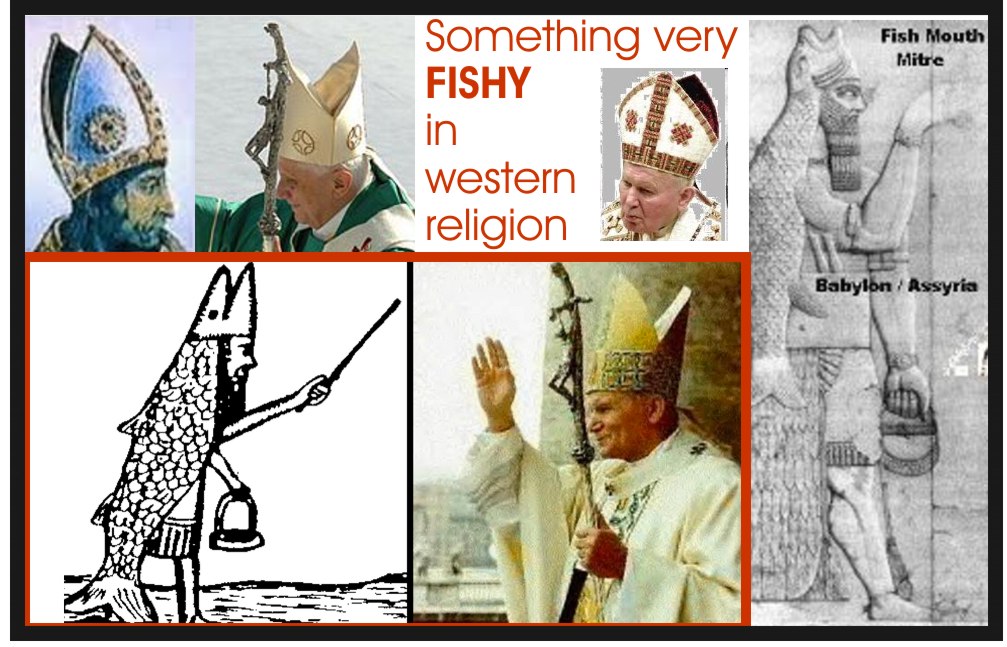 Did you know that Catholic bishops are actually high priests of Dagon, the ancient fish deity of the Philistines? You see, the miter the bishop wears is a replica of the costumes worn by the priests of Dagon. That’s right, the priests of Dagon wore a head dress that looked like the head of a fish with an open mouth, and down their back they wore a long cape that looked like the skin of a big fish. When you look at a Catholic bishop sideways you can see the open-mouthed fish head, and his cope looks just like that fish skin they wore! This proves that Catholicism is really just old-fashioned devil-worshipping paganism, right? Wrong. The bishop’s miter developed from the camelaucum, a form of crown worn in the imperial court in Byzantium. There are no pictures of a Catholic bishop wearing what we would recognize as a miter until the 11th century—and then it was a shorter, softer hat which only developed into its present form in the late middle ages, long after the worshippers of Dagon were dead and gone. Three Forms of Anti-Catholicism The true history of the bishop’s miter can be found with a simple Internet search, but explain it to the kind of Protestant who believes everything Catholic is simply warmed-up paganism, and he will think you have been brainwashed, that you are a naive dupe of a sinister regime, and the source of your information is part of a cover-up by the vast Catholic disinformation machine deep within the bowels of the secret walled city of the Vatican. A second Protestant friend may not be quite so extreme in his “Catholice-equals-pagan” beliefs, and he eschews the wild-eyed fundamentalism of the Chick Tracts. Nevertheless, he shakes his head sadly and informs you that Catholic doctrine is not Scriptural. It is a mishmash of pagan philosophy and religious customs. He tells you how veneration of the Virgin Mary and prayers to the saints have their roots in pagan goddess religions and ancestor worship. He will tell you how the doctrines of purgatory and the sacraments (which we call “mysteries”) have come from Gnosticism, how transubstantiation is imported from Aristotelianism, and how your beliefs about heaven and hell and the afterlife are infected with the pagan philosophies of neo-Platonism. Finally, there is your secular friend with his own brand of “Catholic-equalspagan” anti-Catholicism. He does not fear Catholicism because it is pagan; he dismisses it because it is pagan. Secularists don’t realize how influenced they are by old-fashioned Protestant anti- Catholicism. They have uncritically imbibed “Catholic-equals-pagan,” and they ridicule or dismiss Catholicism because “all religions are merely different versions of primitive pagan superstition.” Protestant Propaganda The idea that the Catholic Church is the pagan anti-Christ has been around since the Protestant Reformation. If your sect had been persecuted by Catholics, it was easy enough to see the corrupt Roman hierarchy in the ominous warnings from the Book of Revelation: I saw a woman sitting on a scarlet beast that was covered with blasphemous names and had seven heads and ten horns. The woman was dressed in purple and scarlet, and was glittering with gold, precious stones and pearls. She held a golden cup in her hand, filled with abominable things and the filth of her adulteries. The name written on her forehead was a mystery: Babylon the Great, the mother of prostitutes, and of the abominations of the earth. I saw that the woman was drunk with the blood of God’s holy people, the blood of those who bore testimony to Jesus. (Rv 17:3-6) As a Protestant reading those words, you couldn’t help but think of the opulence of the Roman prelates in their palaces. You see the cardinals and canons in their robes of purple and scarlet celebrating Mass at an altar glittering with jewels and holding up a golden cup. Then when you read that the “seven heads” were the seven hills on which the harlot sat, and you knew that Rome was the city of seven hills: The Roman Catholic Church was that great whore, and she had sold her soul to the disgusting, devil-worshipping pagan religions of ancient Rome. Never mind that the writer of Revelation was actually referring to the decadent court of the Roman emperors; it is only a short hop from there to see in every manner of Catholic beliefs and practices a reenactment of the pagan religions. With only a little bit of imagination, you see that Christmas and Easter are versions of the pagan spring and winter celebrations, that the “worship” of the Blessed Virgin Mary is derived from the ancient cult of Diana, that the Eucharist is taken from Egyptian fertility rites, that the cross was the ancient Egyptian tau symbol, that baptism and the idea of the sacraments were lifted from Mithraism, and that not only was the bishop’s miter part of the secret worship of Dagon the fish god of the Philistines, but the icthus fish sign of the early Christians was part of the pagan conspiracy too! The list could go on and on. In fact, it is only limited by the imagination of those who wish to discover pagan connections to Catholicism. It’s simple. As with any conspiracy theory, look hard enough, and you will find what you seek. Begin with your theory and then find the “facts” to support it. All of these “historical” connections of paganism with Catholicism can be easily refuted with a bit of research and explanation, but instead of tackling the different particular theories, I would like to unlock the thinking behind the fable that Catholicism is rehashed paganism and show how best to counter it. The Missing Link First, you have to do your homework: There are connecting points between early Christianity and the pagan culture in which it was born, but what are they? Are the connections real or just coincidental? Just because two things happened at the same time does not demand a link between them, and it certainly does not demand a causal link. So, for example, the decline of the number of Catholic priests and nuns in the United States coincided with the popularity of Elvis Presley and the decline in popularity of Bing Crosby. This does not mean that the two phenomena were linked (even though Bing Crosby played the part of a Catholic priest), and it certainly doesn’t mean that the popularity of Elvis Presley caused the decline in the number of priests. Likewise, to see the similarity between two things and their coincidence in history does not require that they be linked in any way, and it certainly does not prove a causal link between the two. Even if a cultural link can be proved, a causal link must also be proved. If a causal link is proved, then it must also be proved which way the causal link flows. Does the existence of a winter-solstice celebration in oth Christianity and Roman paganism demand that one caused the other? If so, which influenced the other? It used to be a commonplace that the Christians borrowed the pagan winter Saturnalia and replaced it with Christmas. It now seems that the celebration of the Nativity of Christ was established first, and the pagans invented the Saturnalia to compete with the increasingly popular Christian celebrations. These are interesting questions, but they are complex and cannot be truly answered without solid historical research and scholarship. We’re All Pagan Second, all the major doctrines of the Christian faith can be seen to have pagan antecedents. A Protestant may say that veneration of the Blessed Virgin Mary hearkens back to pagan goddess worship, but the Virgin Birth (which he will affirm) also has multiple echoes in the myths of the pagan religions. He sees as pagan belief in purgatory or prayers for the dead, but he believes in the Incarnation—and pagan religions abound in stories of god-men coming down to be born on earth. Does he believe in the Resurrection? Does he celebrate it at Easter? How does he fit that in with all the pagan myths of the dying and rising god who was worshiped annually at the springtime of the year? Does he believe in the inspiration of the Holy Spirit? The Ascension? Does he practice baptism? The Lord’s Supper? All of these beliefs and practices have parallels in paganism. You can’t blame Catholics for being pagan in some beliefs and practices while happily endorsing beliefs that might just as readily have their origins in paganism. If Catholic doctrine and devotions are pagan, then Protestantism’s must be too. This is the crunch of the argument. There are links between paganism and Christianity. That is natural because the Church was born in a particular culture, and that culture was bound to have some influence on it. Furthermore, there is nothing wrong with this interaction. From the very beginning it was considered to be good missionary method: Find what connects with the Christian story in the culture you are preaching to and make the connection. Build on that and use it to share the Christian gospel through images and concepts with which they are familiar. This is precisely what we see taking place in the New Testament. In Acts 17, St. Paul preaches in Athens and sees an altar to an “unknown god.” He picks up on this idea and uses it to preach the gospel. Infected by Philosophy? Now, let’s address the less-extreme Protestant, who thinks Catholic doctrines are non-scriptural and infected by pagan philosophy. He needs to see that borrowing concepts from the philosophers of the time is exactly what the writers of the New Testament did. John used the existing Greek philosophical concept of the logos (the Word) to articulate the doctrine of the pre-existing Son of God and the Incarnation of the Son of Man. In doing so he was borrowing a concept from Greek philosophy. Throughout his writings, Paul uses the concept of “the mystery of godliness,” and in doing so he connects with his pagan audience’s awareness of the mystery religions. Likewise, the Epistle to the Hebrews talks of an “earthly temple.” The image of the “heavenly temple” is steeped in a Platonic metaphysical understanding. In both these cases, as in the borrowings in early Church theology, the writers take a concept and change it from the inside out. So for John, the vague philosophical concept of the logos is clarified and fulfilled in the incarnate Christ. For Paul, the “mystery” is a mystery no longer, for that hidden wisdom is now revealed clearly in Christ Jesus. For the writer of the letter to the Hebrews, the earthly temple and the heavenly temple are united in the body of Christ on earth. The early Christians did use the philosophical concepts of their culture, but as theydid so, they transformed those ideas and fulfilled them with a new and radiant expression of the truth, and this transaction indicates the real answer to the riddle of the relationship between paganism and Catholicism. The Riddle and the Revelation The secular critic also argues that Catholicism is simply a rehash of paganism, but for him it is a reason to reject Christianity altogether. “Ha!” he cries, “I’ve seen through it all. Christianity was nothing new. The myth of the virgin-born God-man saving mankind by his death and rising was around for centuries! Don’t you see” he continues, “all religions developed when human beings were primitive. They looked at the sun, moon, and stars and were awed by them. They gave them personalities and made up stories about them. These became the gods and goddesses of ancient myths. They told stories of how the gods sent one of their own to earth to save the human race. Then some Hebrews wanted people to believe their teacher was also a god, so they spliced all these myths into the story of his life, and then they had a top-notch product: Once the emperor bought into this newfangled hodgepodge of myths and mysteries, Christianity never looked back.” Having worked out a seemingly credible alternative history, the secularist sits back and smugly dismisses its claims. The problem is that his version of anti-Catholicism is just as leaky and insubstantial as the various forms of Protestant anti-Catholicism. In his version, the early Christians enthusiastically graft paganism into their new religion; in reality, the early Christians were Jews and as such were thoroughly opposed to paganism. Nor does his version account for the persecution of Christians. The early Christians died to defend Christianity from compromise with paganism. The idea that they heartily adopted pagan myths to boost their popularity is ridiculous. Finally, if early Christianity was a cleverly concocted amalgamation of paganism and the stories of a wandering rabbi, why would anyone be tortured and die for such a fraud? The links between paganism and Catholicism require another answer. They require an explanation of just how and why there are connections and links between Christianity and other religions, and the answer is riddle and revelation: Paganism in all its forms was the riddle, and Christ was the revelation. Hints and Glimpses C.S. Lewis said that it didn’t bother him that Christianity has links with earlier religions: What would have bothered him was if it didn’t have links with earlier religions. The fact is, you can find echoes and connecting points between Christianity and all the other religions both ancient and modern, and it is this fact which validates rather than invalidates Christianity. If a religion is not only true but more true than all the other religions, then it should connect with all those other religions at the points where they are true. The Catholic understanding is that there are echoes, connections, and similarities among Catholicism and all the other religions because Catholicism fulfills them and transforms them from within. The other religions are partial truths. They are hints and guesses at the truth. They are the riddles and Christ is the revelation which completes them and answers their questions. The Hebrew religion was the one which most perfectly pointed to the coming Christ, but each of the pagan religions and philosophies in their own way—some better than others—point to and prophesy the coming of Christ. The Church Fathers saw that every aspect of the ancient world (not just the religions) were imperfect but definite pointers to Christ. In the myths and philosophies, in both the horrors and the glories of the ancient world, they heard echoes of the Word of God and saw glimpses of glory. So the Fathers loved to use quotes from the ancient philosophers which hinted at the fullness of revelation that would come in Christ. The most famous is from Virgil’s fourth Eclogue, written the century before the coming of Christ. It expresses the longing of the pagan heart for a coming Redeemer. The virgin is returning . . . A new human race is descending from the heights of heaven . . . The birth of a child, with whom the iron age of humanity will end and the golden age begin . . . Catholicism is not the practice of paganism, but the fulfillment of the hints and glimpses of revelation that are given in every ancient religion, philosophy, and prophecy. Truth, wherever it appears, is Catholic truth, and once we see the beautiful and true relationship between other religions and philosophiesand the Catholic faith, the sooner we will see their beautiful fulfillment in one faith, one baptism, one flock, one Shepherd, and one Lord. |
|
|
Mar 29 2017, 04:19 PM
|
|
Senior Member
3,573 posts Joined: Apr 2006
|
In the case of John 10:28, Jesus says that no one will be able to take us away from God. The language is similar to Paul’s in Romans 8:39 when he says that nothing in creation will be able to separate us from the love of God in Christ Jesus. Both of these passages address the same fact that no one is capable of removing you from the grace of God. No one is capable of nullifying your salvation. It would be like saying that no one is capable of pulling you out of a car driving at eighty miles per hour. This does not mean that you are incapable of opening the door and jumping out. In the same way, John 10:28 does not mean that we are incapable of severing our relationship with God. Read on in John, and you’ll see why.
Five chapters later in John’s Gospel, Christ tells the apostles at the Last Supper to remain in his love. He adds that if we keep his commandments we will remain in his love. But he who does not remain in his love is "cast forth as a branch and withers; and the branches are gathered, thrown into the fire, and burned" (John 15:6). Now, if salvation were a done deal, why would Jesus feel the need to tell anyone to remain in his love? It would be like locking a person in a closet and telling them to remain there. If they are unable to leave, it is senseless to ask them to remain. Jesus told his disciples to remain in his love because just as we enter freely into a relationship with Christ, we are free to leave him. Scripture is overflowing with examples of this. In Romans 11:22, Paul says, "Note then the kindness and the severity of God: severity toward those who have fallen, but God’s kindness to you, provided you continue in his kindness; otherwise you too will be cut off." In Galatians 5:4, Paul says, "You are severed from Christ, you who would be justified by the law; you have fallen away from grace." This verse implies that they were united with Christ and in grace before they fell. In 1 Corinthians 9:27, Paul again warns the Christians against being overconfident: "I pummel my body and subdue it, lest after preaching to others I myself should be disqualified." This is not the language of "once saved always saved." 3. If you can lose your salvation by sin, doesn’t that imply that you are earning your salvation? Ephesians 2:8–9, says, "for by grace you have been saved through faith; and this is not your own doing, it is the gift of God—not because of works, lest any man should boast." Perhaps the best place to begin when dealing with this verse is to turn to the Council of Trent. In chapter eight of the Decree on Justification, the Church said that "none of those things which precede justification—whether faith or works—merit the grace itself of justification." This means that no man can work himself into a state of justification. The New Covenant is not a system of works righteousness whereby a person can please God and earn heaven by doing a number of good deeds. This is what Paul is driving at in Ephesians 2. He is not saying that sin cannot separate us from Christ. When he gave a litany of created things that can not separate us from the love of God in Romans 8:39, notice that he did not say, "neither fornication nor adultery nor drunkenness nor murder will separate us from the love of God." He was well aware that if we choose sin, we renounce Christ. In 1 Corinthians 15:1–2, Paul says, "Now I would remind you, brethren, in what terms I preached to you the gospel, which you received, in which you stand, by which you are saved, if you hold it fast—unless you believed in vain." So, you could believe, but fail to hold fast to the gospel, and not be saved (cf. 2 Pet. 2:20). This is why Paul spoke in the book of Romans about the "obedience of faith" (Rom. 1:5, 16:26). It is not enough that one call Jesus Lord, for, as he said, "Not every one who says to me, ‘Lord, Lord’ shall enter the kingdom of heaven, but he who does the will of my Father who is in heaven" (Matt. 7:21; cf. Matt. 10:33, 18:35). If we are disobedient, God will "take away his share in the tree of life and in the holy city" (Rev 22:19). Just because you may choose to no longer hold fast to what was freely given to you does not mean that you were ever capable of earning what was given to you in the first place. The same is true of earthly sonship—it cannot be earned. But if you were adopted, you would be free to run away as a prodigal son and lose your inheritance. 4. What’s the history behind the teaching that you could lose your salvation? The first person to espouse the idea of "once saved, always saved" was John Calvin in the mid-sixteenth century. Even Martin Luther didn’t subscribe to the theory. Prior to Calvin, the unanimous consent of the early Christians was that a person is capable of losing his salvation by committing mortal sin, as John spoke about in 1 John 5:16–17. In the first century, the Didache, commonly known as the Teaching of the Twelve Apostles, said "Watch for your life’s sake. Let not your lamps be quenched, nor your loins unloosed; but be ready, for you know not the hour in which our Lord comes. But you shall assemble together often, seeking the things which are befitting to your souls: for the whole time of your faith will not profit you, if you be not made complete in the last time" (Didache 16 [A.D. 70]). In the second century, Irenaeus wrote, "To Christ Jesus, our Lord, and God, and Savior, and King, according to the will of the invisible Father, ‘every knee should bow, of things in heaven, and things in earth, and things under the earth, and that every tongue should confess’ [Phil. 2:10–11] to him, and that he should execute just judgment towards all. . . . The ungodly and unrighteous and wicked and profane among men [shall go] into everlasting fire; but [he] may, in the exercise of his grace, confer immortality on the righteous, and holy, and those who have kept his commandments, and have persevered in his love, some from the beginning [of their Christian course], and others from [the date of] their penance, and may surround them with everlasting glory" (Against Heresies 1:10:1 [A.D. 189]). Such consistent testimony could be given from the dawn of Christianity until today, and no suggestion of "once saved, always saved" can be found on the lips of any Christian before Calvin. https://www.catholic.com/magazine/print-edi...ed-always-saved |
|
Topic ClosedOptions
|

| Change to: |  0.0582sec 0.0582sec
 0.14 0.14
 6 queries 6 queries
 GZIP Disabled GZIP Disabled
Time is now: 3rd December 2025 - 01:52 AM |
All Rights Reserved © 2002- 2025 Vijandren Ramadass (~unite against racism~)
Powered by Invision Power Board © 2025 IPS, Inc.