

QUOTE(yeeck @ Jan 23 2017, 02:11 PM)
Statues are not idols. When Jesus was a Baby, He is indeed God, but the statue of the baby Jesus is not God. That's the difference that you cannot seem to see.

i almost chocked on my sandwich! LOL! LOL! LOL!LYN Catholic Fellowship V01 (Group), For Catholics (Roman or Eastern)
|
|
 Jan 23 2017, 02:22 PM Jan 23 2017, 02:22 PM
Show posts by this member only | IPv6 | Post
#2501
|
 
Senior Member
627 posts Joined: Jun 2009 
|
QUOTE(yeeck @ Jan 23 2017, 02:11 PM) Statues are not idols. When Jesus was a Baby, He is indeed God, but the statue of the baby Jesus is not God. That's the difference that you cannot seem to see. i almost chocked on my sandwich! LOL! LOL! LOL! |
|
|
|
|
|
Jan 23 2017, 08:24 PM
Show posts by this member only | IPv6 | Post
#2502
|
|
Senior Member
627 posts Joined: Jun 2009
|
Uncle Yeeck, probably you should get scriptures support on masses for the dead, seeking the intercession of the dead saints, and building up a treasury of merits from Apocrypha books of Tobit and 2 Maccabees. This way, at least, you can say these practices are supported by scriptures. Scriptures that only used by non-protestants.
 This post has been edited by shioks: Jan 23 2017, 08:25 PM |
|
|
Jan 23 2017, 09:09 PM
|

Senior Member
3,573 posts Joined: Apr 2006 
|
QUOTE(shioks @ Jan 23 2017, 08:24 PM) Uncle Yeeck, probably you should get scriptures support on masses for the dead, seeking the intercession of the dead saints, and building up a treasury of merits from Apocrypha books of Tobit and 2 Maccabees. This way, at least, you can say these practices are supported by scriptures. Scriptures that only used by non-protestants. Right. Only rejected by the protestants that started in the 16th century, but accepted by the more ancient Eastern Orthodox and Oriental Orthodox. Pretty telling, eh? |
|
|
Jan 23 2017, 09:19 PM
Show posts by this member only | IPv6 | Post
#2504
|
|
Senior Member
627 posts Joined: Jun 2009
|
QUOTE(yeeck @ Jan 23 2017, 09:09 PM) Right. Only rejected by the protestants that started in the 16th century, but accepted by the more ancient Eastern Orthodox and Oriental Orthodox. Pretty telling, eh? And, what's the meaning of Apocrypha?How do you interpret Revelation 22:18–19? This post has been edited by shioks: Jan 23 2017, 09:26 PM |
|
|
Jan 24 2017, 12:19 PM
|
|
Senior Member
3,573 posts Joined: Apr 2006
|
QUOTE(shioks @ Jan 23 2017, 09:19 PM) And, what's the meaning of Apocrypha? Apocrypha is the term used by Protestants. The deuterocanonical books are considered canonical by Catholics, Eastern Orthodox, Oriental Orthodox, and the Church of the East, but are considered non-canonical by most Protestants. Revelation 22:18-19? As it is said. What about you?How do you interpret Revelation 22:18–19? This post has been edited by yeeck: Jan 24 2017, 12:22 PM |
|
|
Jan 24 2017, 01:57 PM
|
|
Senior Member
3,573 posts Joined: Apr 2006
|
Truth and Forgiveness
If the best of all possible results from recent political developments were to occur — a big if — the real problems that beset society will yet remain unfixed. The reason is that those real problems involve an order that lies well beyond political solutions. They are problems related to the family, to “relationships” (in the broadest sense), to morals, and to truth. If the modern State has only a limited jurisdiction in the first three, it seems to be positively allergic to the fourth. Ultimately, it is a matter of people actually perceiving reality (the conformity of our mind to which is the very definition of truth), accepting it, and living accordingly in their private, family, and social lives. In using the term “reality” here, I include both natural reality and what has been revealed to us of supernatural reality. To live according to the truth demands, among other things, the acquisition of virtue by carrying out acts proper to those virtues. Here, I would like to consider the quintessentially Christian act of forgiveness. It is worth our attention for several reasons, the most pressing of which is, in my opinion, what appears to be a terrible hardening of hearts in the world. We who strive to be counterrevolutionary, anti-Modernist, and in every way contrary to the spirit and maxims of the world need to keep in mind that the great saints practiced not only the virtues most immediately associated with Christian militancy, like fortitude, fidelity, and fearlessness, but they also practiced the “little” virtues — like mercy, meekness, humility, and kindness. No, there is no contradiction. As Father Garrigou Lagrange reminds us more than once, the mark of the saint is the simultaneous practice of seemingly contrary virtues, like meekness and fortitude. The subject of forgiveness immediately elicits some familiar biblical passages. Pride of place here must go to the words of Our Lord when He taught His disciples how to pray: “And forgive us our debts, as we also forgive our debtors” (Matt. 6:12). And Our Lord goes on to append an inspired “footnote” to this verse after He completes the prayer: “For if you will forgive men their offences, your heavenly Father will forgive you also your offences. But if you will not forgive men, neither will your Father forgive you your offences” (vs. 14-15). Over and above its being a fantastic apologetical proof of the necessity of good works for salvation (withhold forgiveness and you’re not forgiven: i.e., you’re damned), this passage clearly obliges each one of us to practice forgiveness. Saint Luke records another passage where Jesus makes our forgiveness by God contingent on our forgiving others: “Judge not, and you shall not be judged. Condemn not, and you shall not be condemned. Forgive, and you shall be forgiven” (Luke 6:37). In at least two places in his epistles, Saint Paul commands us to forgive others as God has forgiven us. To the Ephesians, he writes, “And be ye kind one to another; merciful, forgiving one another, even as God hath forgiven you in Christ” (Eph. 4:32). A similar passage is found in the Epistle to the Colossians. Significantly, this particular verse is part of the Epistle reading for the Feast of the Holy Family, which means that if we read it with the mind of the Church as manifested in the liturgy, we will know that the Apostle’s directives here are a guide for a holy family life: “Bearing with one another, and forgiving one another, if any have a complaint against another: even as the Lord hath forgiven you, so do you also” (Col. 3:13). Married folk, take heed! Is forgiveness a virtue? No, according to Saint Thomas, it is an act of the virtue of mercy, which virtue inclines us to have pity on our neighbor. In his Commentary on the Our Father, Saint Thomas says that we are all bound to forgive those who seek our forgiveness. He cites Ecclesiasticus 28:2: “Forgive thy neighbor if he hath hurt thee: and then shall thy sins be forgiven to thee when thou prayest.” Showing the connection to mercy, he adds, “And from this follows that other beatitude: ‘Blessed are the merciful.’ For mercy causes us to have pity on our neighbor.” While all are bound to forgive those who ask our forgiveness, the perfect (i.e., those well advanced in the spiritual life) actively seek out their neighbor to forgive him, says the Angelic Doctor. Perhaps we can consider the greatness of forgiveness in light of the sublimity of the virtue of which it is an act. Saint Thomas argues that charity is greater than mercy because charity has God as its object, but “of all the virtues which relate to our neighbor, mercy is the greatest, even as its act surpasses all others, since it belongs to one who is higher and better to supply the defect of another, in so far as the latter is deficient.” (The quoted passages in this and the next paragraph come from Saint Thomas’ Summa Theologiae.) Now, forgiving others is not the only act of mercy, which is, in general, a “grief for another’s distress,” by which a man “supplies the defects of his neighbor.” Such a description gives mercy a fairly broad scope. According to Saint Thomas, who quotes Saint Augustine on the point, mercy “obeys the reason when mercy is vouchsafed in such a way that justice is safeguarded, whether we give to the needy or forgive the repentant.” If sin, with its consequent physical death and suffering, had not entered the world, there would be no need for mercy — not, at least, as a human virtue. It would still exist as a divine perfection in the Trinity. Moreover, charity — from which mercy results, according to Saint Thomas — would still exist as a virtue among the unfallen children of Adam. Now, if we review the fourteen works of mercy, we will see in them a litany of so many of the corporal and spiritual defects of our neighbor that each work is intended to help remedy. And one of these (the fifth of the spiritual works of mercy) is “to forgive offenses willingly.” The question is sometimes asked: Do we have to forgive those who do not ask for forgiveness? To the best of my knowledge, Saint Thomas has not addressed the point directly. Tim Staples makes, I believe, a very cogent argument for the negative response to this question. In summary, the argument is that we are not obliged to be more forgiving than God, and He demands contrition and repentance in order to forgive, as we know from such passages as “the sorrow that is according to God worketh penance, steadfast unto salvation” (II Cor. 7:10), and, “If we confess our sins, he is faithful and just, to forgive us our sins, and to cleanse us from all iniquity” (I John 1:9). The validity of the sacrament of Penance depends upon contrition, so clearly God does not forgive unconditionally. Further, when Christ commands us to forgive a brother who has wronged us, He conditions the command on the brother’s repentance: “Take heed to yourselves. If thy brother sin against thee, reprove him: and if he do penance, forgive him. And if he sin against thee seven times in a day, and seven times in a day be converted unto thee, saying, I repent; forgive him” (Luke 17:3-4). Such a withholding of forgiveness is not to be confused with bearing a grudge, which is a sort of petty resentment not at all compatible with any Christian virtue. As Mr. Staples points out, while we are not obliged to forgive those who are not sorry, we are obliged to love them with theological charity — which is to wish their good, ultimately, their salvation. We are to love our enemies even if, for some good reason, we have not forgiven them a particular wrong for which they are not sorry. Further, we should recall that forgiveness is an act of the virtue of mercy. We can exercise mercy toward such a person in other ways than forgiveness, for instance, by praying for him to be contrite for his sins. Certainly, we must be disposed to forgive our impenitent brother, else how will we forgive him if he becomes penitent? We cultivate such a disposition by the practice of the virtues of mercy and charity. Humility also, which makes us cognizant of our own sinfulness and need for forgiveness, certainly helps. In fact, it is indispensable, because the proud man cannot easily overcome the affront to his personal majesty! When Saint Thomas says, as we mentioned above, that the perfect man seeks out the brother who wronged him in order to forgive, he probably has in mind a charitable conversation by which that perfect man’s kind words enkindle a desire for forgiveness on the part of the wrongdoer. Such a person would be a peacemaker, which requires not only the virtues, but also the working of the Gifts of the Holy Ghost — especially Wisdom, which, according to Saint Thomas, is the gift proper to peacemakers. And we can use a few more of those. In the Immaculate Heart of Mary, Brother André Marie, M.I.C.M. |
|
|
|
|
|
Jan 24 2017, 04:03 PM
|
|
Senior Member
627 posts Joined: Jun 2009
|
QUOTE(yeeck @ Jan 24 2017, 12:19 PM) Apocrypha is the term used by Protestants. The deuterocanonical books are considered canonical by Catholics, Eastern Orthodox, Oriental Orthodox, and the Church of the East, but are considered non-canonical by most Protestants. Revelation 22:18-19? As it is said. What about you? These are some of the quotes from Wikipedia.org:Apocrypha usually is used by Protestants to refer to a set of texts included in the Septuagint and therefore included in the Catholic canon, but not in the Hebrew Bible. The Roman Catholic church provided its first dogmatic definition of her entire canon in 1546, which put a stop to doubts and disagreements about the status of the Apocrypha, as well as certain other books, which had continued from the beginning of the NT church. The leader of the Protestant Reformation, Martin Luther, like the Catholic church father Jerome (and certain others), favored the Masoretic canon for the Old Testament, excluding apocryphal books in his non-binding canon as being worthy to properly be called Scripture, but included most of them in a separate section, as per Jerome. Apocrypha was canon but was later canon just to support the non-scriptures practices of Roman Catholics after Martin Luther and father Jerome the likes disagreed with the practices. Wikipedia.org also has comments on Revelation 22:18-19: "Apocrypha" was also applied to writings that were hidden not because of their divinity but because of their questionable value to the church. Many in Protestant traditions cite Revelation 22:18–19 as a potential curse for those who attach any canonical authority to extra-biblical writings such as the Apocrypha. However, a strict explanation of this text would indicate it was meant for only the Book of Revelation. Rv.22:18–19f. (KJV) states: "For I testify unto every man that heareth the words of the prophecy of this book, If any man shall add unto these things, God shall add unto him the plagues that are written in this book: And if any man shall take away from the words of the book of this prophecy, God shall take away his part out of the book of life, and out of the holy city, and from the things which are written in this book." In this case, if one holds to a strict hermeneutic, the "words of the prophecy" do not refer to the Bible as a whole but to Jesus' Revelation to John. The early Christian theologian Origen, in his Commentaries on Matthew, distinguishes between writings which were read by the churches and apocryphal writings: γραφὴ μὴ φερομένη μέν ἒν τοῖς κοινοῖς καὶ δεδημοσιευμένοις βιβλίοις εἰκὸς δ' ὅτι ἒν ἀποκρύφοις φερομένη (writing not found on the common and published books in one hand, actually found on the secret ones on the other).[8] The meaning of αποκρυφος is here practically equivalent to "excluded from the public use of the church", and prepares the way for an even less favourable use of the word.[6] Can I say your interpretation of the two verses is meant for the entire Bible? If this is so, would it also mean you agree that the Apocrypha was additions and was canon for the sake of providing support to so called Roman Catholic traditions or malpractice? I am more favored towards the two verses are meant for only the Book of Revelation. This warning is given to those who might purposely distort the message in this book. Moses gave a similar warning in Deuteronomy 4:1-4. |
|
|
Jan 24 2017, 04:38 PM
|
|
Senior Member
627 posts Joined: Jun 2009
|
Is this link the same as catechism of Catholic? If it is so, the ten commandments looks really different to cater for idol worships:
http://www.vatican.va/archive/ccc_css/arch...ism/command.htm |
|
|
Jan 24 2017, 05:47 PM
|
|
Senior Member
3,573 posts Joined: Apr 2006
|
QUOTE(shioks @ Jan 24 2017, 04:03 PM) These are some of the quotes from Wikipedia.org: The second bolded part above was not part of the Wiki article but from your false understanding. St Jerome certainly is a Catholic and submitted to the authority of the Church.Apocrypha usually is used by Protestants to refer to a set of texts included in the Septuagint and therefore included in the Catholic canon, but not in the Hebrew Bible. The Roman Catholic church provided its first dogmatic definition of her entire canon in 1546, which put a stop to doubts and disagreements about the status of the Apocrypha, as well as certain other books, which had continued from the beginning of the NT church. The leader of the Protestant Reformation, Martin Luther, like the Catholic church father Jerome (and certain others), favored the Masoretic canon for the Old Testament, excluding apocryphal books in his non-binding canon as being worthy to properly be called Scripture, but included most of them in a separate section, as per Jerome. Apocrypha was canon but was later canon just to support the non-scriptures practices of Roman Catholics after Martin Luther and father Jerome the likes disagreed with the practices. Wikipedia.org also has comments on Revelation 22:18-19: "Apocrypha" was also applied to writings that were hidden not because of their divinity but because of their questionable value to the church. Many in Protestant traditions cite Revelation 22:18–19 as a potential curse for those who attach any canonical authority to extra-biblical writings such as the Apocrypha. However, a strict explanation of this text would indicate it was meant for only the Book of Revelation. Rv.22:18–19f. (KJV) states: "For I testify unto every man that heareth the words of the prophecy of this book, If any man shall add unto these things, God shall add unto him the plagues that are written in this book: And if any man shall take away from the words of the book of this prophecy, God shall take away his part out of the book of life, and out of the holy city, and from the things which are written in this book." In this case, if one holds to a strict hermeneutic, the "words of the prophecy" do not refer to the Bible as a whole but to Jesus' Revelation to John. The early Christian theologian Origen, in his Commentaries on Matthew, distinguishes between writings which were read by the churches and apocryphal writings: γραφὴ μὴ φερομένη μέν ἒν τοῖς κοινοῖς καὶ δεδημοσιευμένοις βιβλίοις εἰκὸς δ' ὅτι ἒν ἀποκρύφοις φερομένη (writing not found on the common and published books in one hand, actually found on the secret ones on the other).[8] The meaning of αποκρυφος is here practically equivalent to "excluded from the public use of the church", and prepares the way for an even less favourable use of the word.[6] Can I say your interpretation of the two verses is meant for the entire Bible? If this is so, would it also mean you agree that the Apocrypha was additions and was canon for the sake of providing support to so called Roman Catholic traditions or malpractice? I am more favored towards the two verses are meant for only the Book of Revelation. This warning is given to those who might purposely distort the message in this book. Moses gave a similar warning in Deuteronomy 4:1-4. St. Jerome who lived from 347 A.D. - 419 A.D. Mini-bio: Dalmatian; priest, hermit, abbot, biblical scholar and translator, Doctor of the Church In a letter to Pammachius (Epistle 66) says: "Other husbands decorate the graves of their wives with violets, roses, lilies, and purple-colored flowers. By such tokens of love they relieve the grief of their hearts. Our Pammachius bedews the sacred ashes and the venerable remains with the balsam of alms; for he knows what is written: 'As fire is extinguished by water, so is sin effaced by almsdeeds.' " I see that you also conveniently left out the later portion regarding St Jerome: Other uses of apocrypha developed over the history of Western Christianity. The Gelasian Decree (generally held now as being the work of an anonymous scholar between 519 and 553) refers to religious works by church fathers Eusebius, Tertullian and Clement of Alexandria as apocrypha. Augustine defined the word as meaning simply "obscurity of origin," implying that any book of unknown authorship or questionable authenticity would be considered apocryphal. On the other hand, Jerome (in Protogus Galeatus) declared that all books outside the Hebrew canon were apocryphal.[6] In practice, Jerome treated some books outside the Hebrew canon as if they were canonical, and the Western Church did not accept Jerome's definition of apocrypha, instead retaining the word's prior meaning (see: Deuterocanon). As a result, various church authorities labeled different books as apocrypha, treating them with varying levels of regard. This post has been edited by yeeck: Jan 24 2017, 05:51 PM |
|
|
 Jan 24 2017, 07:40 PM Jan 24 2017, 07:40 PM
|
|
Senior Member
627 posts Joined: Jun 2009
|
QUOTE(yeeck @ Jan 24 2017, 05:47 PM) The second bolded part above was not part of the Wiki article but from your false understanding. St Jerome certainly is a Catholic and submitted to the authority of the Church. I believe you have searched on wikipedia.org for you to conclude my false understanding. So, I reproduce the full section with links to wikipedia to prove my "false understanding":St. Jerome who lived from 347 A.D. - 419 A.D. Mini-bio: Dalmatian; priest, hermit, abbot, biblical scholar and translator, Doctor of the Church In a letter to Pammachius (Epistle 66) says: "Other husbands decorate the graves of their wives with violets, roses, lilies, and purple-colored flowers. By such tokens of love they relieve the grief of their hearts. Our Pammachius bedews the sacred ashes and the venerable remains with the balsam of alms; for he knows what is written: 'As fire is extinguished by water, so is sin effaced by almsdeeds.' " I see that you also conveniently left out the later portion regarding St Jerome: Other uses of apocrypha developed over the history of Western Christianity. The Gelasian Decree (generally held now as being the work of an anonymous scholar between 519 and 553) refers to religious works by church fathers Eusebius, Tertullian and Clement of Alexandria as apocrypha. Augustine defined the word as meaning simply "obscurity of origin," implying that any book of unknown authorship or questionable authenticity would be considered apocryphal. On the other hand, Jerome (in Protogus Galeatus) declared that all books outside the Hebrew canon were apocryphal.[6] In practice, Jerome treated some books outside the Hebrew canon as if they were canonical, and the Western Church did not accept Jerome's definition of apocrypha, instead retaining the word's prior meaning (see: Deuterocanon). As a result, various church authorities labeled different books as apocrypha, treating them with varying levels of regard. https://en.wikipedia.org/wiki/Apocrypha Introduction Apocrypha is commonly applied in Christian religious contexts involving certain disagreements about biblical canonicity. Apocryphal writings are a class of documents rejected by some as being worthy to properly be called Scripture, though, as with other writings, they may sometimes be referenced for support, such as the Book of Jasher. While writings that are now accepted by Christians as Scripture were recognized as being such by various believers early on, the establishment of a largely settled uniform canon was a process of centuries, and what the term "canon" (as well as "apocrypha") precisely meant also saw development. The canonical process took place with believers recognizing writings as being of God, subsequently being followed by official affirmation of what had become largely established.[3] The Roman Catholic church provided its first dogmatic definition of her entire canon in 1546, which put a stop to doubts and disagreements about the status of the Apocrypha, as well as certain other books, which had continued from the beginning of the NT church.[4] The leader of the Protestant Reformation, Martin Luther, like the Catholic church father Jerome (and certain others), favored the Masoretic canon for the Old Testament, excluding apocryphal books in his non-binding canon as being worthy to properly be called Scripture, but included most of them in a separate section, as per Jerome.[5] Luther also doubted the canonicity of four New Testament books (Hebrews, James and Jude, and Revelation), which judgment Protestantism did not follow, but he did not title them Apocrypha. Explaining the Eastern Orthodox Church's canon is made difficult because of differences of perspective with the Roman Catholic church in the interpretation of how it was done. Today Orthodox accept a few more books than appear in the Catholic canon. Perhaps, my version of wikipedia is totally different than Catholic version of wikipedia; otherwise, please file a report and request my version of wikipedia to delete the section that is not in line with Catholic belief. |
|
|
Jan 24 2017, 10:27 PM
|
|
Senior Member
3,573 posts Joined: Apr 2006
|
QUOTE(shioks @ Jan 24 2017, 07:40 PM) I believe you have searched on wikipedia.org for you to conclude my false understanding. So, I reproduce the full section with links to wikipedia to prove my "false understanding": LOL, you just confirmed it yourself... https://en.wikipedia.org/wiki/Apocrypha Introduction Apocrypha is commonly applied in Christian religious contexts involving certain disagreements about biblical canonicity. Apocryphal writings are a class of documents rejected by some as being worthy to properly be called Scripture, though, as with other writings, they may sometimes be referenced for support, such as the Book of Jasher. While writings that are now accepted by Christians as Scripture were recognized as being such by various believers early on, the establishment of a largely settled uniform canon was a process of centuries, and what the term "canon" (as well as "apocrypha") precisely meant also saw development. The canonical process took place with believers recognizing writings as being of God, subsequently being followed by official affirmation of what had become largely established.[3] The Roman Catholic church provided its first dogmatic definition of her entire canon in 1546, which put a stop to doubts and disagreements about the status of the Apocrypha, as well as certain other books, which had continued from the beginning of the NT church.[4] The leader of the Protestant Reformation, Martin Luther, like the Catholic church father Jerome (and certain others), favored the Masoretic canon for the Old Testament, excluding apocryphal books in his non-binding canon as being worthy to properly be called Scripture, but included most of them in a separate section, as per Jerome.[5] Luther also doubted the canonicity of four New Testament books (Hebrews, James and Jude, and Revelation), which judgment Protestantism did not follow, but he did not title them Apocrypha. Explaining the Eastern Orthodox Church's canon is made difficult because of differences of perspective with the Roman Catholic church in the interpretation of how it was done. Today Orthodox accept a few more books than appear in the Catholic canon. Perhaps, my version of wikipedia is totally different than Catholic version of wikipedia; otherwise, please file a report and request my version of wikipedia to delete the section that is not in line with Catholic belief.  |
|
|
Jan 24 2017, 11:39 PM
|
|
Senior Member
3,573 posts Joined: Apr 2006
|
From the so-called 'Dark Ages':
 |
|
|
Jan 25 2017, 01:32 AM
|
|
Senior Member
3,573 posts Joined: Apr 2006
|
The “Apocrypha” and the Liturgy
GREGORY DIPIPPO At yesterday’s presidential inauguration, Timothy Cardinal Dolan, Archbishop of New York, read as a prayer a selection of verses from the ninth chapter of the Book of Wisdom. In the original, this passage is a prayer delivered as if from the mouth of King Solomon, and all of the first person plurals spoken by His Eminence (“God of our ancestors…”) are in the singular in the Biblical text. (Accommodations of this sort in the context of prayer are a well-established tradition of the Church.) I say “as if” because it is well-known, of course, that the Book of Wisdom was written hundreds of years after Solomon’s lifetime, and its attribution to him (which is strongly implied, but not explicitly stated, within the book itself) was known at the time it was written to be a literary device. A writer on the website of Christianity Today, Daniel de Silva, published an article explaining to their (I assume mostly non-Catholic) readership why a Biblical reading at the ceremony “Isn’t in Your Bible,” namely, because it is from the group of books which Protestants generally call “the Apocrypha,” and Catholics the “Deuterocanonical books.” Both of these terms are really rather unfortunate, but we are now stuck with them after centuries of use. “Apocrypha” is a Greek word for “hidden”, and would be better reserved for things like the Gnostic so-called Gospels, rather than a group of works whose canonicity was almost undisputed in the Church for 15 centuries. (I say “almost” advisedly, as I will explain shortly.) The term “deuterocanonical” was coined in 1566 by a scholar called Sixtus of Siena, a Jewish convert to Catholicism, at a point when the Protestant reformation had been going on for almost half a century, and the “disputed” nature of the books had become a fixed feature of Catholic-Protestant debate. I consider it unfortunate because it seems to imply (though this was certainly not Sixtus’ intention) either that there are degrees of canonicity within Scripture, which is heretical, or, as one Biblical commentary states, that their canonicity was recognized later, which is historically false. The Catholic Encyclopedia rightly states, in its article on the Canon of the Old Testament, that “The terms protocanonical and deuterocanonical … require a word of caution. They are not felicitous, and it would be wrong to infer from them that the Church successively possessed two distinct Biblical Canons.” At a public debate held at Leipzig in 1519, Johann Eck, a very prominent theologian of the era, objected to Luther’s rejection of the doctrine of Purgatory, and therefore of praying for the dead, by citing a well-known passage from Second Maccabees (12, 46), which has been read at Masses for the Dead from time immemorial: “It is therefore a holy and wholesome thought to pray for the dead, that they may be loosed from sins.” To this Luther replied that Second Maccabees was not a part of Scripture, and hence constituted no valid proof; the Catholic Encyclopedia is equally right to term this, in the article cited above, “a radical departure.” Certain other passages, such Tobit 4, 11, “For alms deliver from all sin, and from death, and will not suffer the soul to go into darkness,” became focal points of the controversy as well. Subsequently, the debate over the place of the “Deuterocanonicals” in the Church has been very largely framed in terms of what the Fathers have to say about them in their writings. St Jerome is a crucial figure in this regard, because he is the only one who ever rejected them on the same grounds as the Protestants, namely, their absence from the Hebrew Bible; he is cited to this effect in the sixth “Article of Religion” of the Church of England. And thus de Silva writes “Jerome …was the loudest voice in this regard.” 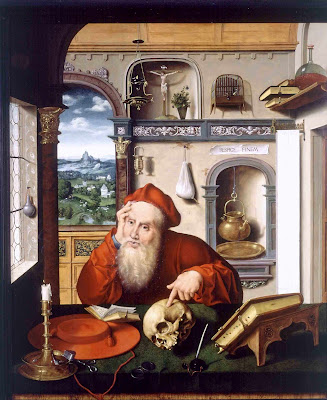 St Jerome in His Study, by Joos van Cleve, 1521 Three things call for note here. One is that not even Jerome was consistent on this point; he included Tobit, Judith, and the Deuterocanonical additions to both Esther and Daniel in his great project of Biblical translations, and in some of his later writings, cites some of them without distinction from the rest of Scripture. (The versions of Wisdom, Sirach, Baruch and the two books of the Maccabees included in the Vulgate are not his.) The second is that the other Church Fathers are similarly inconsistent; St Athanasius, for example, in an epistle of the year 367, includes Baruch in the canonical list, and omits Esther. The third is that citations in the New Testament cannot serve as a definitive yardstick for canonicity, since it contains none from certain books whose canonicity was disputed even among the Jews (Ecclesiastes and the Song of Songs), two from the book of Wisdom (2, 13 in Matthew 27, 43 and 7, 26 in Hebrews 1, 3), and an explicit citation from the indisputably apocryphal Book of Enoch. (Jude, 14-15) The opinion of the vast majority of the Fathers is best explained by referring to the great Biblical scholar Origen. (ca. 185-255). A friend of his named Africanus, one of his sponsors in the decades-long production of a massive corpus of Biblical exegesis, claimed that the Greek puns in the story of Susanna proved that it could not be part of the original text of the book of Daniel. Origen’s defense of the story, and of the other deuterocanonical books, repeatedly refers to the “use” of the book in the churches, i.e., in the liturgy. He also cites in its defense a saying of the book of Proverbs, “Thou shalt not remove the ancient landmarks which thy fathers have set,” (22:28), a passage long understood by Jewish commentators as a command to preserve the ancient traditions of religious practice. This opinion is confirmed by St Augustine, and several early synods whose acts have come down to us. As I have written before, the story of Susanna occupies a particularly prominent place in the liturgy of Lent in the West, and in the art of the primitive Church. Readings from almost all of the other Deuterocanonical books are attributed in the ancient Roman lectionaries, most of which carry through right into the Missal of St Pius V. The books of Wisdom and Sirach are particularly prominent, especially on the feasts of Confessors; this is especially significant precisely because St Jerome did not produce either a revised or freshly translated version of either of them. The canticle known from its first word as the Benedicite, Daniel 3, 57-88 and 56, was sung in the Roman Divine Office on every single Sunday and feast until 1913. (It is still, of course, said very often in both Form of the Office to this day.) One might cite innumerable examples from other ancient rites of the Church, but I will here confine myself to a few particularly interesting ones. The 7th century Lectionary of Luxeuil, the most ancient lectionary of the Gallican Rite, prescribes that the entire book of Tobias be read on Rogation Monday after None, that of Judith on Tuesday, and that of Esther (with the additions) on Wednesday. (It is no wonder that the clergy of Gaul enthusiastically embraced Charlemagne’s forced transition to the Roman Rite.) The Ambrosian Liturgy makes the same use of the Benedicite as the Roman, and places Susanna in an even more prominent position, on Holy Thursday. A passage from Baruch 3 is read on the Third Sunday of October, the feast of Milan cathedral’s dedication; a longer excerpt from the same chapter was read at the Roman vigils of Easter and Pentecost until 1954. 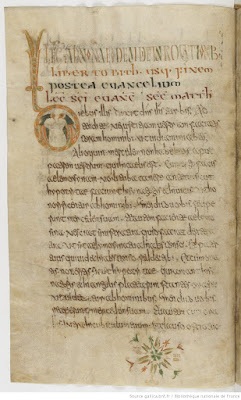 Folio 165v of the Lectionary of Luxeuil, with the rubric for Rogation Monday, “Liber Tobith usque ad finem, postea Evangelium - the Book of Tobit, until the end, and afterwards the Gospel.” (Bibliothèque nationale de France, Département des Manuscrits, Latin 9427) In the Byzantine Rite, a prayer said every single day at Vespers cites the Song of the Three Children, which also figures among the group of canticles at Orthros called the Odes. The entire third chapter of Daniel, including the additions, is read at the Easter Vigil, with the choir singing “Sing to the Lord and exalt him above all forever” as a refrain. (Video below; Exodus 13, 20 - 15, 19 is also read in a similar fashion.) Many of the more important feasts have three Scriptural readings at Vespers; among those assigned to the feasts of Confessors, there are two which are titled liturgically as “from the Wisdom of Solomon”, but are actually very complicated centos, composite readings from more than one book, mixing the words of the protocanonical books of Proverbs and Ecclesiastes quite indiscriminately with those of Wisdom and Sirach. (You can read them at the following link, where they are the first two readings on the feast of St Nicholas: http://www.antiochianladiocese.org/files/s...ec-05-VESP.pdf) |
|
|
|
|
|
Jan 26 2017, 02:21 PM
|
|
Senior Member
627 posts Joined: Jun 2009
|
QUOTE(yeeck @ Jan 24 2017, 10:27 PM) LOL, you just confirmed it yourself... LOL! You really is one kind.This link not from vatican also, right? must be false Francis also. QUOTE(shioks @ Jan 24 2017, 04:38 PM) Is this link the same as catechism of Catholic? If it is so, the ten commandments looks really different to cater for idol worships: http://www.vatican.va/archive/ccc_css/arch...ism/command.htm |
|
|
Jan 27 2017, 11:40 AM
|
|
Senior Member
3,573 posts Joined: Apr 2006
|
QUOTE(shioks @ Jan 26 2017, 02:21 PM) LOL! You really is one kind. There's nothing wrong with that link.This link not from vatican also, right? must be false Francis also. If what you are hinting is that Catholics number the 10 Commandments differently from Protestants, have a read at this: http://catholicbridge.com/catholic/10_commandments.php |
|
|
Jan 27 2017, 11:57 AM
|
|
Senior Member
3,573 posts Joined: Apr 2006
|
Abortion is the Antichrist’s demonic parody of the Eucharist. That is why it uses the same holy words, “This is my body,” with the blasphemously opposite meaning. - Dr. Peter Kreeft
|
|
|
Jan 27 2017, 12:02 PM
|
|
Senior Member
3,573 posts Joined: Apr 2006
|
|
|
|
Jan 28 2017, 05:58 PM
|
|
Senior Member
3,573 posts Joined: Apr 2006
|
Wishing all Chinese Catholics a Blessed Lunar New Year ahead showered with God's many special graces. In your charity remember the suffering of the persecuted Catholics in China of the underground Church:
 |
|
|
Jan 28 2017, 06:19 PM
|
|
Senior Member
3,573 posts Joined: Apr 2006
|
|
|
|
Jan 30 2017, 12:41 PM
|

Junior Member
225 posts Joined: Mar 2008
|
The Sunday Mass - 4th Sunday in Ordinary Time (January 29, 2017)
|
|
Topic ClosedOptions
|
| Change to: |  0.0377sec 0.0377sec
 0.34 0.34
 6 queries 6 queries
 GZIP Disabled GZIP Disabled
Time is now: 2nd December 2025 - 10:07 PM |
 Quote
Quote