Catholicism 101:
A Brief Primer The Trinity
We believe the dogma expressed in the Nicene Creed, which states that God the Father, God, the Son, and the Holy Spirit are Three Persons of the One Almighty God. [Read more about the Trinity]. The Three Persons of the Trinity are equally eternal, equally God, equally uncreated. They are the One God in the One Being Who is Being itself, Who is "I AM."
Creation and FallWe believe that God created the universe ex nihilo (out of nothing), starting with the creatures of the praeternatural order (the angels), one of whom -- Satan, the Evil One -- rebelled, taking a legion of angels with him; these evil ones are known as demons.
Then God created the Heavens, earth and light on the first day; the firmament on the second day; grass, herbs, and fruit trees on the third day; the sun, moon and stars on the fourth day; the creatures of the water and air on the fifth day; and, on the sixth day, the creatures of the land, and a man named Adam. From Adam, He formed Eve.
God created man in His image -- whole, free, and filled with sanctifying grace -- in a paradise known as Eden. But the Evil One tempted Eve to do what God commanded them not to do, and Adam sinned by following suit. Because of the sin of the first man, humankind lost its sanctifying grace and became condemned not only to concupiscence (a propensity to fulfill carnal desires), work, sickness, and death, etc., but to a loss of his likeness to God, and to separateness from God -- a separateness from which we cannot be saved except by the grace of God Himself. This loss of sanctifying grace is known as "original sin." Original sin isn't personal sin (that is, sin resulting from one's choices), but a lack of grace that we cannot overcome on our own. Through Adam and Eve and "the Fall of Man," we are broken and in need of redemption. Man cannot save himself and man-made utopia is not an option (Genesis 11).
We believe that the Old Testament tells the story of God's entrusting the Israelites, through Abraham, to be His People, and that the Prophets of this Old Covenant predicted the coming of the Messiah who would be able to reconcile man with God.
IncarnationWe believe that Second Person of the Trinity took on Flesh, by the Holy Ghost, through the ever-Virgin Mary. Mary is the Ark of the New Covenant, the Theotokos -- the God-Bearer -- in that she brought forth, through the Holy Spirit and her Grace-inspired "YES," the Son of the Living God Whose Name is Jesus and Who is the Messiah Whom the prophets foretold. Mary is not the mother of God the Father or of God the Holy Spirit. She is the Mother of the Divine Person Jesus, Who is God. The Christ's divine and human natures are in complete hypostasis and cannot be separated, and mothers are the mothers of persons, not "natures"; she is the Mother of the Person of Jesus, Who is God. She is, therefore, the mother of God. Though veneration of Mary is only because of her Son's grace, though she is not a "godess" in any way, and though she is not to be worshiped as God, she is to be emulated, loved and admired because she points the way to her Son. All generations will call her blessed! (Luke 1:26-48)
We believe that Jesus was crucified for our salvation and that all salvation comes from His sacrifice and only through His sacrifice. This Sacrifice was necessary because God is holy, loving, jealous, and just, but our sins are great and they offend Him. In order for God's honor -- offended by our sins -- to be preserved and for His wrath at our sins to be assuaged, there had to be atonement. In order for His holiness to not be offended and for us to see Heaven (nothing unholy can enter Heaven!), the Second Person of the Trinity Himself took on flesh and was crucified to satisfy the Father for our sins. As Aquinas wrote in his Summa Theologia, III, 49:
...Christ's Passion is in two ways the cause of our reconciliation to God. In the first way, inasmuch as it takes away sin by which men became God's enemies, according to Wisdom 14:9: "To God the wicked and his wickedness are hateful alike"; and Psalm. 5:7: "Thou hatest all the workers of iniquity." In another way, inasmuch as it is a most acceptable sacrifice to God. Now it is the proper effect of sacrifice to appease God: just as man likewise overlooks an offense committed against him on account of some pleasing act of homage shown him. Hence it is written (1 Kings. 26:19): "If the Lord stir thee up against me, let Him accept of sacrifice." And in like fashion Christ's voluntary suffering was such a good act that, because of its being found in human nature, God was appeased for every offense of the human race with regard to those who are made one with the crucified Christ in the aforesaid manner...
The Father sent the Son to suffer and die because He loves us and wants us to be with Him, to share in His divine nature -- something we can't do or earn on our own. So holy is He and so poor are we! It is by the Passion and Blood of Jesus that the Father is appeased, that we may be saved, and that the gates of Heaven are opened up to us. By no other Name than Jesus can any man see the Father.
We believe that Jesus bodily rose again after His Crucifixion and ascended into Heaven, sending the Holy Ghost after Him to sanctify, guide, and protect His Church. His Resurrection is a sign of His promise to us for our own lives if we believe, repent, are baptized, and obey the will of God as revealed to us in His Sacred Scripture and through the infallible teachings of His Church (i.e., the teachings handed down to us by Christ and the Apostles or explicitly and solemnly defined by the Pope or Church Councils).
The Four Last Things:
Death, Judgment, Heaven, and Hell
We believe that when a person dies, he faces a "particular judgement": he immediately goes to Heaven, to Hell (including the possibility of Limbo for the unbaptized who are innocent of personal sins), or to Purgatory. Purgatory is where those who, by the Blood of Christ, are already saved from the eternal effects of sin but who still have the temporal effects of sins on their souls go to be cleansed ("purged") before they are allowed to see the face of God when they enter Heaven (1 Corinthians 3:13-15, Hebrews 12:14, Hebrews 12:22-23, 1 Peter 4:6, Revelation 21:10-27). [Read more about Purgatory]
We believe that at the end of time, there will be a Last Judgement, when the King of Kings, Christ Jesus, will come in glory, to judge the entire world. This will happen after a Great Apostasy (which many traditional Catholics believe we are very possibly seeing now given the state of our hierarchy), a great Tribulation (from which the Church will not be spared via a "Rapture"), and a final Antichrist who will deceive many into believing he is a man of peace and justice. At this Last Judgement, the bodies of the dead will be resurrected and reunited with their souls. The Evil One and his demons will be thrown into the pit of Hell. Those bound for Hell will go to Hell; those who are in Hell will remain in Hell. Those who are bound for Heaven will go to Heaven, and those in Heaven will remain in Heaven, their bodies glorified, to endure in the Presence of Love forever and ever, world without end. [see End Times]
The ChurchWe believe that the Mystical Body of Christ -- the nation of priests and kings, Israel, the Church -- is of three parts:
the Church Militant: Christians on earth, the "Historical Church";
the Church Suffering: Christians in Purgatory where they are being cleansed before standing before God (also called the "Church Purificatory"); and
the Church Triumphant: Christians in Heaven
We believe that death does not separate the members of His Church and that we are exhorted to pray for one another and ask others to pray for us. [read more about the Saints and Purgatory]
We believe that Jesus Christ is the spiritual Foundation Stone, the High Priest and Head of the Church and that He authorized Peter, as the earthly rock of the Church, to shepherd His sheep (Matthew 16:18-19). The Christ-given authority entrusted to Peter and the other Apostles, with Peter as the Chief Apostle, is passed on by "apostolic succession" through the Bishops, with the Bishop of Rome as their source of unity and earthly king, and Christ Jesus as King of Kings (Acts 1:21-26, 1 Timothy 1:6, 1 Timothy 4:14, 1 Timothy 5:22, and the unanimous agreement of early Christian writings). [read more about Peter]
We believe that the gates of Hell will not prevail against the Church, that while scandal may sometimes ensue, while Satan makes his efforts (as he is doing now with great success), the Church's dogma will be kept pure in that nothing against the Faith will be presented as infallible. We believe that the Apostles and their successors were given authority by Christ to teach, to interpret Sacred Scripture, to bind and loose, to exorcise demons, to ordain, to baptize, annoint the sick, and administer the other Sacraments. [read more about the Marks of the Church].
The Church Militant is made of the ritual Churches that are in communion with the Petrine Ministry (the office held by the successors of Peter). The particular churches in the full Catholic Communion use 6 different rites, or traditions concerning how the Sacraments (see below) are to be offered. These ritual churches of the One, True Church are dogmatically the same though their points of theological emphasis (and language for their expression), liturgical and devotional styles, canonical disciplines, martyrology (Saints and martyrs that they honor), sacred art, etc., differ. Members of these particular churches belong to the One, True, Holy, Catholic and Apostolic Church, which is the Catholic Church, the Mystical Body of Christ.
The 6 main rites and the ritual Catholic churches of the One Catholic Church are:
The Roman Rite (The Mass of St. Gregory the Great): the Latin Church (or the "Roman Church" -- the ritual Church most Westerners think of when they think of "the Catholic Church" and whose Patriarch, the Bishop of Rome, is the Pope, who has primacy over all the particular Churches that make up the Catholic Church).
The Byzantine Rite (Liturgy of St. James, St. Basil and Others): Albanian Church; Belarussian/Byelorussian Church; Bulgarian Church; Croatian (Krizevci) Church; Georgian Church; Greek Church; Hungarian Church; Italo-Greek (or Italo-Albanian) Church; Melkite Church; Romanian Church; Russian Church; Ruthenian Church; Serbian Church; Slovak Church; and the Ukrainian Church
The Alexandrian Rite (Liturgy of St. Mark): Coptic Church; and the Ethiopian/Abyssinian Church. The languages of these Churches are Coptic (Egyptian) and Ge'ez, respectively.
The Antiochian Rite (Liturgy of St. James): Maronite Church; Syrian Church; and the Syro-Malankar Church. The language of these Churches is Aramaic (ancient Syriac).
The Chaldean Rite (Derived from Antiochene Rite): Chaldean Church; and the Syro-Malabarese Church. The language of these Churches is Syriac.
Armenian Rite (Greek Liturgy of St. Basil)
Each Catholic ritual church (known as a Church sui iuris) has its own Patriarch (sometimes called a "Metropolitan" or "pope" -- i.e., "papa") who is in communion with the Roman Pope, the man who holds the office of Peter. The (Roman) Pope has a triple role as Bishop of Rome, Patriarch of the West, and Supreme Pontiff of the entire Catholic Church.
Every Catholic, no matter his ritual church 1, believes the same dogma and may receive the Sacraments of the Eucharist, Penance, and Unction from any other ritual Catholic Church; in our union through the Petrine ministry, we are all one as Christ desires [Matthew 12:25, 16:18, John 10:16, John 17:20-23, Acts 4:32, Romans 12:5, Romans 16:17, 1 Corinthians 1:10-13, Corinthians 3:3-4, Corinthians 10:17, Corinthians 11:18-19, Corinthians 12:12-27, Corinthians 14:33, 2 Corinthians 12:20, Ephesians 4:3-6, Philippians 1:27, 2:2-3, 1 Timothy 6:3-5, Titus 3:9-10, James 3:16, 2 Peter 2:1].
The Church has two types of members: living members (those in a state of grace, whether they be in the Church Militant, Suffering or Triumphant) and dead members (those not in a state of grace, i.e., those in mortal sin (I John 5:16-17), who are necessarily of the Church Militant). Dead members cannot be saved unless they are reconciled and returned to a state of grace through the Sacrament of Penance (or a perfect act of contrition if the Sacrament is unavailable).
No Salvation Outside of the Church :
"Extra Ecclesiam Nulla Salus"There is no salvation outside of Christ, and the Church is the Bride of Christ -- become His Body, one Flesh in marriage. Therefore, there is no salvation outside of the Church and not belonging formally to the Catholic Church is objectively sinful:
Matthew 18:17
"If he will not hear the Church, let him be to thee as a heathen and a publican"
Luke 10:16
"He that heareth you heareth Me, and he that despiseth you despiseth Me, and he that despiseth Me, despiseth Him that sent Me"
Mark 16:16
"He that believeth not will be condemned"
John 3:18
"He that believeth not is already judged"
Luke 11:23
"He that is not with Me is against Me and he that gathereth not with Me, scattereth"
This does not mean, however, that if one is necessarily damned if one is not a formal member of the visible society of God's Kingdom on earth -- the One, Holy, Catholic and Apostolic Church. What it means is that: Christ founded one Church with Peter as His Vicar; that this Church was given the powers of binding and loosing, that this Church exists today; that it is the source of the Gospel and the earthly source of the Sacraments without which, normatively, one cannot be saved. Those who are not formal members might be saved and become associated with the soul of the Church if they:
are validly baptized by water and spirit, in the Name of the Father, and of the Son, and of the Holy Ghost (all who are baptized are subject to the Church even if they are not formal members because Baptism belongs to the Church), and have not committed a mortal sin (or who, if they have committed a mortal sin, have made a perfect act of contrition), which means a sin concerning a grave matter committed with full knowledge and consent of the will, and are animated by charity and a supernatural Faith in God's existence, and seek Him, and firmly believe that their religion is the true religion such that there is no conflict or doubt about such in their ill-formed conscience, and are not formally outside of the Church in spite of doubts about the possibility that the Catholic Church is the true Church of Christ (if one believes it is possible that the Catholic Church is the true Church of Christ, one is duty-bound to investigate)
In addition, those individuals who, through no fault of their own, have no means to hear of Christ-given Baptism and are invincibly ignorant -- who've never heard the Name Jesus, know nothing of the Church, or misunderstand Church teachings -- but who obey the Natural Law written in all men's hearts and who truly seek God are left to the mercy of Christ Who may save them as He desires. Christ will judge our wills, hearts, intellects, and deeds, and shall have mercy and compassion on whom He will have mercy and compassion (Romans 9:15); those whom He deigns to save He can well give the grace of the Sacraments to in a manner beyond our ken -- perhaps even in their final breath, by illuminating their souls in a supernatural way such that they desire Baptism, even if implicitly, and therefore become associated with the Soul of the Catholic Church, outside of which there is no salvation. This is something we can never presume -- but we can pray for.
I note here, too, that there is also the possibility of Limbo -- a state of perfect natural happiness -- for those who die unregenerated (unbaptized) and with the stain of original sin, but who've committed no personal sin. While these people would not enter Heaven as they are not born again of water and Spirit (or the desire for it), they would also experience no subjective sufferings. This teaching is not a part of revelation and is, therefore, not a matter of dogma. There is no consensus among the Church Fathers on the matter; some believed in the existence of Limbo (e.g., most of the Greek Fathers, St. Augustine in his early writings, St. Gregory Nanzianus, St. Ambrose, St. Thomas Aquinas) while others didn't (e.g., St. Augustine in his later writings, St. Anselm). But it is a most definite possibility that can be piously believed given the truths that God is not only merciful but just and, therefore, will not punish someone for that which involves no personal guilt. While believing this proposition, which is the prevalent belief among traditional Catholics, one must never forget how easy it is to sin -- and that most everyone who's reached the age of reason has (in fact, because of the rarity of those who've reached the age of reason and have not committed personal sins, "Limbo" is often referred to as "Children's Limbo.")
These possibilities are left to the mercy of God, however, and the presumption of salvation in any sense on the part of anyone who is not a formal member of the the visible Church is a sin against the Holy Spirit. We can pray for such, but we cannot presume such. We cannot presume this association with the Soul of the Church on the part of any particular individual who is not a manifest member the Church; in fact, we are to presume the opposite because they are objectively in sin, even if not culpably so, and we must do all we can to bring them to the Sacraments, which are true media of grace. We are to preach the fullness of the Truth, pray for God's mercy on all who are apart from the Sacraments, and always remember that material heresy is still heresy, no matter the level of culpability a material heretic might possess. While some who are not formal members of the Church might be illumined before death such that they desire Baptism and are then allowed to see Heaven by the Grace of Christ and become, therefore, associated with the Soul of the Church, the non-Catholic elements of other religions do not mediate grace in and of themselves, and it is always God's will that all formally become part of the eternally unified Mystical Body of Christ. The salvation of these souls would be in spite of, not because of, their religion.
In this regard, any "ecumenism" that is not false will have as its goal the bringing of all into the Church as formal members, be they Protestant, Jewish, Buddhist, Muslim, Hindu, pagan, or secular. The goal of any true "ecumenism" isn't "unity" because the Church is already unified; His Body is already unified. The return of heretics, schismatics, and apostates to the bosom of the One, Holy, Catholic and Apostolic Catholic Church is the only goal of true ecumenism.
The proper attitude to take toward the Truth that those who are not formal members of the Church might be saved if they meet the above criteria is expressed well in this analogy by Harold E. Welitz:
Let's say that a father kept a loaded gun in the house. Now, certainly it has occurred since the invention of the revolver that a bullet has failed to fire when the trigger was pulled. Therefore, based on this possibility should the father continually remind his children that if they play with a gun and shoot at each other, it may not go off? Would that be a wise and prudent father, one who truly cares for his children? If the father continually discussed the possibility that the gun may not go off if the trigger were pulled, would he be misleading his children? Yes! Although what he is saying is not false, it is deceptive because it implies that something that is rare is actually likely. The result will be that the children will become more negligent in playing with loaded guns, which most likely will kill one of them. Should the father not say: "Do not play with a loaded gun, whatever you do! If you play with a loaded gun, someone will get killed." A wise and prudent father may realize there are a very slight percentage of bullets that are defective, but he knows it is not wise to continually remind his children of this, lest they become forgetful of the dangers of playing with loaded guns.
To carry the metaphor further: Catholics don't let non-Catholics play with guns. When others do play with guns, we can pray and have human hope that they don't get shot, but we can't expect or have a "good hope" that they won't. If, in fact, they are not "shot," we know that they are a part of the Church outside of which there is no salvation.
Bottom line: We can't know the subjective states of the souls of manifest heretics, and we can't know how God might or might not illumine the the souls of the invincibly ignorant. But we can and do know what He has revealed about Himself, and we must tell others this Gospel. We can and do know what He told us about His Church, and we must bring people to it. We can and do know what He told us to do, and we must do it. And we must do these things with firmness, boldness, prudence, and great charity, all while begging mercy for sinners, including ourselves.
AuthorityThe authority of the Church rests on three pillars:
Scripture: The Bible is the inerrant word of God and is to be read as the earliest Christians read it: in the light of Tradition and under the guidance of those ordained to teach. The Books of the Old Testament were put together by the Hebrews in the Septuagint (ca 300 B.C.), which includes the seven Books called "Deuterocanonical" by Catholics and "Apocryphal" by Protestants, and was the Old Testament used by the Apostles. The Books of the New Testament were made canonical over time and were first listed over 300 years after the Resurrection. [see more on the Canon of the Bible and the Septuagint and on Sola Scriptura: The Fallacy of the Bible alone as the Rule of Faith]
Tradition: the teachings which the Church has preserved and passed down from Christ, His Apostles, and the unanimous teachings of the early Church Fathers (1 Corinthians 11:2, 2 Thessalonians 2:15, 2 Thessalonians 3:6).
(The above two pillars are referred to as "The Deposit of Faith")
Magisterium: the teaching authority of the Church under the guidance of the Holy Spirit. The teachings of Catholic hierarchs have three different levels of fallibility:
Extraordinary Magisterium:
Extraordinary infallible teaching given in the very rare exercise of the Pope alone, only when, in his capacity as Pastor and Doctor of all Christians and by virtue of his supreme Apostolic authority, he defines a dogma concerning faith and morals so as to be held by the whole Church and does so ex cathedra -- i.e., "from the chair" of Peter. Also called the "Solemn Magisterium."
Ordinary Magisterium:
Ordinary infallible teaching by Pope, Bishop, or anyone with the proper authority to teach which illumines doctrine that has always been believed and accepted by the universal Church. Also called the "Universal Magisterium" or the "Constant Magisterium" and its exercise can be recognized when a teaching is one that is has been held "always and everywhere" by the Church. [Note: some Catholics forget this category of teaching and believe that only if a teaching is solemnly defined ex cathedra is it infallible. These "Catholics," forgetting Tradition, are the "liberals" and "modernists" one always sees on TV]
Authentic Magisterium:
Teaching by Pope, Bishop, or anyone with the proper authority to teach, that does not fit into the above two categories. All authorized teaching is owed proper, intelligent, prayerful religious assent, but must be resisted if it leads to sin, compromises the Faith and the salvation of souls, or contradicts the above two levels of Magisterium, the Sacred Deposit of Faith, Scripture, and Tradition. [Note: some otherwise wonderful Catholics forget this category of teaching and think everything the Pope does and says is "infallible," an attitude that borders on papolatry. These Catholics are the "neo-conservatives" or "neo-Catholics" who defend the novelties since Vatican II and some of the scandalous behaviors of Bishops and the Holy Father -- e.g., Qu'ran-kissing, ecumenism that leads to indifferentism, etc. -- but while still truly trying to be orthodox.]
The Pope is supreme pastor, the "King of Bishops," and he outranks all Bishops, individually or collectively. "The Roman Pontiff has power over the entire Church, can exercise power over all, whether over the whole or over one; he can exercise power without being limited by anyone, neither Pastor nor faithful" (G. Siri, La giovimzza della Chiesa).
However, of course, neither the Pope as Pontiff nor any Bishop can lawfully or morally contradict Scripture or Tradition as interpreted and passed down by the universal Church. Any teaching of Pope, Bishop, or Council that attempts to nullify what has always been taught is null and void in se. In other words, magisterium that contradicts former magisterium is not infallible magisterium. From Pastor Aeternus, section De Romani Pontificis Infallibili Magisterio of Vatican I:
For the Holy Spirit was promised to the successors of Peter not so that they might, by His revelation, make known some new doctrine, but that, by His assistance, they might religiously guard and faithfully expound the revelation or Deposit of Faith transmitted by the Apostles.
Doctrine and dogma may be clarified, explained more fully, and be more explicitly defined, but they cannot be contradicted by anyone, by neither Pope nor Council.
The Seven Sacraments or "Holy Mysteries"The Church has 7 Sacraments -- "outward signs of invisible grace" and media of sanctifying grace. The Sacraments were given to us by Christ so that we may receive His grace and become more like Him. The Seven Sacraments are:
Baptism: with immersion in water, sprinkling of water, or the pouring of water over the skin of the forehead while the words "I baptize thee in the Name of the Father, and of the Son, and of the Holy Ghost" (or "Holy Spirit") are said by one who intends to initiate the baptized into the Christian life, one is baptized for the remission of all sins, both original sin and personal sins, and their effects.
Through Baptism in the Name of the Father, the Son, and the Holy Ghost (Matthew 28:19), we are born again (John 3) of water and of the Spirit and enter into the New Covenant. This is the initial rite of Christian initiation (Acts 2:38-39, Acts 16:32-35, Ephesians 4:3-5, Colossians 2:11-12, Didache ch. 7), and all who are baptized with water and Spirit, using these words, by anyone (layman or priest) who intends to do what the Church does, is validly baptized -- whether they are baptized by Pentecostals, Baptists, Orthodox, etc. -- and cannot be re-baptized. If one desires to formally join the Catholic Church but is unsure about the validity of his baptism, he is conditionally baptized with water and the words, "If thou art not baptized, I baptize thee in the Name of the Father, and of the Son, and of the Holy Ghost."
Baptism replaces circumcision (Colossians 2:11–12), and just as children were circumcized at the age of 8 days in the Old Covenant, children, even infants, are welcome in God's Kingdom and are baptized as soon as possible (Matthew 19:14, Luke 18:15–16, Acts 2:39). This is the early practice of the Church, as evident by St. Paul's baptizing of entire households (Acts 16:15, 1 Corinthians 1:16) and the words of Christ and His Apostles (Mark 10:14, Acts 2:38-39). [Read more about Baptism]
Aside from the Baptism by water and Spirit, without the graces of which one can't be saved, there are the analogically-named "Baptism of Blood" and the "Baptism of Desire." Baptism of Blood is martyrdom -- that is, dying for the sake of the Faith. Baptism of desire is the vow to receive Baptism by one who has a a living faith and the desire to do all the Lord commands, but who doesn't have the earthly possibility of water baptism (or who dies before receiving it). Baptism of Blood and Baptism of Desire both have the saving effects of water Baptism, by the mercy of Christ.
Confirmation ("Chrismation" or the "Sacrament of the Seal"): Confirmation is the laying on of hands by a Bishop or authorized priest and becoming sealed to the Holy Ghost, becoming annointed spiritually and, literally, with sacred oil -- a consecrated olive oil called "chrism" or "oil of gladness." Confirmation is becoming infused with the Holy Ghost, sealed to Him by grace and fortified in becoming true soldiers of Christ (Acts 8:14-17, Acts 19:5-6, 2 Corinthians 1:21-22, Ephesians 1:13, Hebrews 1:9, Hebrews 6:1-6).
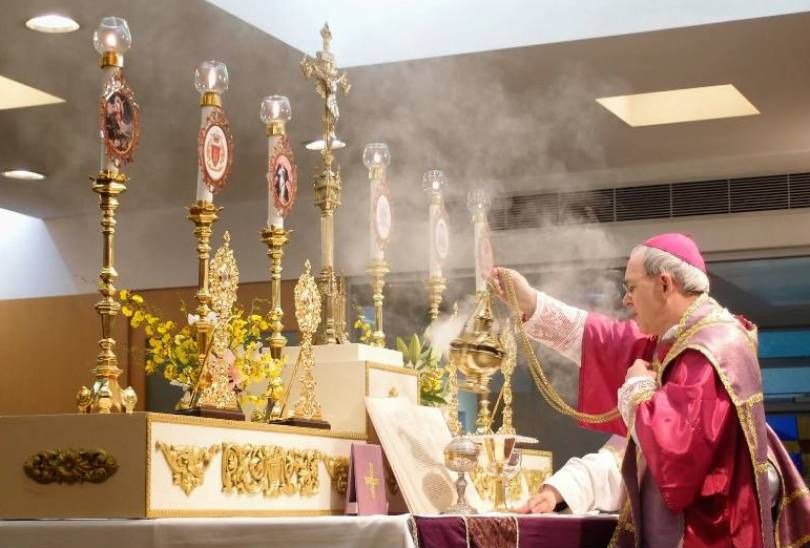
Eucharist ("Communion"): We believe that at Mass (the "Divine Liturgy") the bread and wine truly become the Body, Blood, Soul and Divinity of Christ glorified and that no one should eat of it unworthily (John 6, Luke 22:19, John 6:52-58, Acts 2:42, 1 Corinthians 10, 1 Cor. 11:27-29, Ignatius of Antioch's Letter to the Smyraeans, Didache ch. 9 ). The Eucharist should only be received by the baptized who are in a state of grace (who have no unconfessed mortal sins on their soul), and after prayer and fasting. The bread used must be made only of wheat and water (nothing else may be added, though leaven is used in Eastern Churches); the wine must be true grape wine. The one offering the Mass at which the bread and wine become Christ must be a validly ordained priest using the proper form. See "Mass/Divine Liturgy" below.
(In the Eastern Catholic Churches, the above
three Sacraments are received at the same time, even infants.)
Penance ("Confession" or "Reconciliation"): We confess our sins to God, in the presence of his priests (through his priests), so that we can be freed from their eternal effects and reconcile with Him and with His Church (Matthew 9:5-8, Matthew 16:18-19, 1 Corinthians 11:27-29, 2 Corinthians 5:18, James 5:14-16, Didache 4:14, 14:1). For there to be a valid confession, one must confess his sins, with a contrite heart and the desire for pardon, to a priest with jurisdiction (ordinary or supplied) who uses the proper form of absolution, which is the words "Ego te absolvo" ("I absolve you"). If no priest is available, one may make an act of perfect contrition, confessing to God directly and begging forgiveness (one must resolve to go to a priest when one is available for a perfect act of contrition to be valid). Confession of sins to other Christians is a sacramental which remits venial sins and is encouraged, but it is not a Sacrament.
Holy Matrimony: See Matthew 5:31-33, Matthew 19:8-10, Mark 10:10-12, Luke 16:17-19, 1 Corinthians 7:10-11. The Sacrament of Matrimony is the covenental joining of the validly baptized Bride and Groom as head of their own little domestic "church" and the source of their spirit of self-sacrifice that allows them to put their children first. A valid Sacramental marriage has as its primary purpose the begetting and raising of children; the unitive aspects of marriage are secondary. Marriage, therefore, is open to life if the marital right (the right of each spouse to the other's body, 1 Corinthians 7:4) is exercised. In the rare instance that both spouses mutually consent to not exercise their marital rights and decide to remain sexually continent in imitation of Joseph and Mary and for the sake of the Kingdom, the marriage is termed a "Josephite marriage."
"What therefore God hath joined together, let not man put asunder": marriage lasts until the death of one of the spouses (Mark 10:11-12). "Re-marriage" after separation (as in physical separation due to threats of physical danger) in a valid, Sacramental and consummated marriage is impermissible.
A declaration of nullity ("annulment") is not a "Catholic divorce" (though, sadly, it is too-often treated as such by many modern hierarchs); it is a Church tribunal's finding that a valid Sacramental marriage never existed in the first place (i.e., God did not join the two in the first place) because, at the time the vows were exchanged, certain conditions were present indicating that one of the couple did not intend for a valid, Sacramental marriage to take place. Some of these conditions are impotence, unwillingness to be open to procreation if the marital right is exercised, unwillingness to commit to fidelity, etc..
For there to be a valid Sacramental marriage, there must be none of the impediments listed above, the two must be validly baptized, and both must mutually consent to marriage. The man and woman act as minister (the priest presides, but does not marry them; they marry each other).
Holy Orders ("Ordination"): the integration of men into the order of bishops, presbyters, or deacons which confers a gift of the Holy Ghost that permits the exercise of a sacred power (sacra potestas) which can come only from Christ Himself, through his Church, by the laying on of hands by a true Bishop in the line of Apostolic Succession (Mark 6:7, Luke 10:16, John 13:20, John 15:5, John 20:21, Acts 14:23, Romans 10:15, 2 Corinthians 5:20, 1 Timothy 4:14, 1 Timothy 5:23, the Book of Hebrews).
In the Latin Church's discipline, only unmarried men can become ordained. In many of the Eastern Churches, married men can become ordained, though they may not marry after ordination and may not become Bishops. In the early Church, married priests were sexually continent (abstinent); it is this Tradition that lives on only in the sexually continent and celibate (unmarried) priesthood of the Latin Church and in those Eastern Catholic priests who are sexually continent, whether celibate or not. See Canon 33 of the Council of Elvira (A.D. 300-306); Canon 1 of the Council of Neocæsarea (A.D. 315); Canon 3 of the Council of Carthage (A.D. 390); Canon III of the Quinisext Council of Trullo (A.D. 691) which speaks of the Eastern Churches changing their chastity rules while "they of the most holy Roman Church purpose to keep the rule of exact perfection," etc.
Women cannot and will never be ordained into the priesthood, though a female diaconate of sorts is part of our Tradition insofar as women, referred to as "deaconesses," sometimes helped minister to other women in the early Church (moreso in the East) when it came to such things as the Baptism of other women by immersion, where modesty was an issue, and caring for the sick. They were not, however, priests, they did not receive the Sacrament of Holy Orders, etc. (see Canon 19 of the First Council of Nicaea, 325 A.D.).
Extreme Unction ("Sacrament of the Sick"): See Matthew 10:1, Luke 9:1-2, Luke 9:6, and James 5:13-15. the annointing before death with consecrated olive oil is known as "Last Rites" or "Extreme Unction," and the Eucharist itself that is given at that time is known as "Viaticum" ("food for the journey" from the Latin viaticus meaning "journey". Unction purifies the soul by remitting sins, and heals the body if it is God's will.
Sacraments are not magic: while they impart sanctifying grace, in order for those who've reached the age of reason to benefit from them, he must receive them with the proper intention; in other words, they require faith! If one has attained the age of reason, for ex., and does not believe in Christ but is baptized, objectively, true grace is given, but, subjectively, he will receive the fruits of his Baptism only when/if he later believes. The Sacrament of Confession, as an other example, requires true contrition (e.g., one can't knowingly commit a sin, go to Confession without true repentance and while planning on committing that same sin again, and expect to receive Sacramental effects), etc.
The Sacraments are also normatively required: for example, if one is in the middle of a desert and no water is available to conduct the rite of Baptism in the proper way, as Christ desires we be baptised, one is still "baptised" by desire if he would be baptized in the proper way if the means were available to him. This does not make the rites less important; it only demonstrates the power of Christ's mercy. One who has no priest available may make a spiritual Communion and receive the fruits of the Eucharist. A perfect act of contrition can give one the fruits of Confession even though no priest is available. And so on. The point: God is not bound by the Sacraments; we are bound by the Sacraments!
The Sacraments also are not human works; they are the work of Christ operating through the priest (or other minister, as in some cases of Baptism and in Matrimony), and their effectiveness does not depend on the personal holiness of the minister. The necessary elements are that the priest have proper power and authorization, the proper intention, and that he uses the prescribed matter (e.g. water, oil, bread made of wheat and water, etc.) and form (i.e., the rite must be properly performed). In other words, if these things are followed, the Sacraments give sanctifying grace in a manner known as ex opere operato, or "by the deed done" -- by the very fact of the action. The grace is fruitful depending on the faith of the one who receives the Sacrament (or the faith of his parents, in the case of infant baptism).
The Most Sacred Mystery of the EucharistChrist is our High Priest after the order of Melchizedek -- and in order for a priesthood of any kind to exist, there must be a sacrifice. When we go to Mass (the Divine Liturgy), the Sacrifice of Christ's once and for all, historical Passion and Crucifixion is re-presented; it is not repeated in any sense of Christ "dying again." While the Crucifixion was a specific, finite historical event from our physics-bound point of view, God is transcendent and outside of time, and Christ's offering of Himself is eternal. As one apologist puts it, "One can't 'repeat' what has never ended!"
At the Mass, the bread and wine become the sacramental Presence of Jesus Christ. It is not only "symbolic"; it is the real, true bringing-forth of the glorified Body and Blood of our Lord, Who is then offered to appease the Father as a perfect Sacrifice -- a re-presentation of Christ's Historical and perfect, once and for all Sacrifice at Calvary. This offering was predicted (see Malachi 1:10–11) and was believed to be sacrificial and propitiatory in nature by the very earliest Christians (I challenge all who call themselves Christian to research this! Read Ignatius, John Chrystostom, Pope Clement I, Justin Martyr, the Didache -- any of the very earliest Christians' writings!).
The reality of the Presence of God in the Eucharist is made clear in the 6th chapter of John, and Luke 22:19-20 minces no words when it says "This IS my Body... This IS my Blood." The Jews in John 6, even some of His followers, walked away from Him out of disgust over this teaching, but Jesus didn't backtrack at all; He maintained that we must eat His Flesh and drink His Blood. The Temple walls fell as Jesus said they would, and those "last days" of the Old Covenant have ended. But the Sacrifice continues with Christ's eternal offering to us the gift of Himself. The New Covenant is here, and we are all invited to enter into it! The tabernacle lamps still burn brightly in Catholic churches... (at least the ones that follow pre-Vatican II rubrics).
In our liturgy, Christ's ordained priests offer Christ under the appearances of bread and wine (Genesis 14:18, Psalm 110:1-4, Malachi 1:10–11, John 6:53–58) as a pure sacrificial offering to the Father in order to appease Him; Christ offers Himself to us by His Real Presence in the Eucharist after the Holy Ghost changes these gifts from "bread and wine" into Sacrament; and we, members of the royal priesthood (what Protestants call "the priesthood of believers"), offer ourselves to God, worshipping Him with the angels in Heaven who sing "Holy, Holy, Holy!" without ceasing. (Listen to Real Audio lessons about the Eucharist at the bottom of the Scott Hahn Apologetics page of this site, and listen to how the Book of Revelation (Apocalypse) describes, in part, the Heavenly liturgy)
SalvationIn the Old Testament, the Israelites upheld their Covenant with God by keeping Moses' Law and, of course, the great Commandments. Christians are freed from The Law (later twisted into Talmudism by the Pharisees) and enter into the New Covenant by Baptism. We are saved by the grace of His Passion and Blood alone, a grace we have to actively cooperate with through metanoia (repentance and a turning of the heart toward Christ), submitting our wills to our Father's, and obedience. When we enter into this Covenant, we literally become His children, His family. God the Father becomes for us Abba and Christ seals us to Him with His own Blood. Our task -- and our reward -- is to "become divinized" (to undergo "theosis"), to "put on Christ" and share in the Divine Energies of God and Christ's Sonship. We become the heirs of God Himself. In this divinization, this theosis, His Chosen will share in God's divine nature (2 Peter 1:4) -- but still as creatures of God and not as God Himself or in any way apart from God. We will forever and always be creatures, "becoming God" by sharing in His divine nature, but never in His divine essence -- and never, ever apart from God, which is the lie Satan first told to Eve. The created can never become Uncreated.
We agree entirely with the many Protestants who say one has to "have a personal relationship with Jesus" or "let Jesus into one's heart" if, by that, they mean that we are to pray earnestly, walk the walk, make His Will manifest in our lives, preach the Gospel, etc. We are to turn our hearts toward Christ! We must experience true conversion! We believe, too, that no aspect of our relationsip with Christ can be more intimate and awesome than by prayerfully and humbly receiving Him through the Eucharist and receiving His graces through His other Sacraments!
We refute the idea that all one needs to do in order to be saved is to say "The Sinner's Prayer" (though it is a nice prayer, as far as it goes); we believe that we are to work out our salvation in fear and trembling (Philippians 2:12) lest we be cast away (I Corinthians 9:27) -- but always with the knowledge of God's Fatherly Love and Mercy for us, His adopted children. Likewise, we reject the idea that one can work his way into Heaven or that any Christian's works have salvific merit outside of Christ's grace. Neither faith alone, nor works alone, nor faith and works together saves us or puts God into debt to us; He owes us nothing! Neither getting on your knees once and saying the "Sinner's Prayer," no matter how sincerely, nor a lifetime working at soup kitchens, but without faith and the Sacraments, will save you. It is His grace alone that saves -- a grace we accept in faith and by doing His will!
Though we believe in predestination (Ephesians 1:11), we see it as an inscrutable Mystery, and we reject any ideas of predestination that deny the free will of man or which make God the Author of sin by seeing Him as also predestining some souls to go to Hell (i.e., as in any idea of "double predestination"). We assert that we are created by God in His image, that He created us freely able to choose Him or to choose sin, and that predestination beyond recognizing His omniscience, would render His divine plan meaningless. We believe that free will exists both before and after justification. In other words, a person who enters the Covenant may freely leave it and lose his salvation (2 Peter 2:20-21). While we do believe that whom God elects, He will save, we don't presume to know who the elect are (I Corinthians 4:4)! This is a Mystery of God that we can't presume to know, let alone base an entire theology and soteriology on.
Summary: We are saved by grace alone, through a saving faith (i.e., a faith that works in love, Galatians 5:6), and as a fruit of Christ's having suffered and shed His blood for us. Christianity is both a "head religion" and a "heart religion"; we intellectually assent to the Truths given to us by the Church through Her Scripture and Sacred Tradition, and these Truths affirm that we must give our hearts to Jesus. In other words, we are to love God with all our heart, soul, mind, and strength (Mark 12:30). To focus only on the heart without including the mind (i.e., to forget doctrine and rely on "experience" and "feelings") is to lapse into heresy and subjectivism; to focus on the intellect without including the heart (i.e., to forget humility, repentance, and, above all, charity) is to lapse into a legalistic Pharisaism.
To be saved: believe and trust in Jesus, repent of your sins, be baptized, receive the Eucharist, and obey the will of God as taught to us in the Bible and the constant teachings of the Church. Love God with all your heart and mind and soul and strength, and love your neighbor as yourself.
Source: Fisheaters
This post has been edited by yeeck: Mar 16 2015, 04:23 PM 

 Mar 13 2015, 07:32 PM


 Quote
Quote



 0.0278sec
 0.45
0.45
 6 queries
 GZIP Disabled