

 Brunei economy crumbling? Oil exports down 25.7%!, currency peg with Singapore traps Brunei
  May 2 2014, 12:07 PM, updated 12y ago


Data shows that something is wrong with Brunei starting September 2013
International trade plummeted 12% on the same period. This is again more severe than the January figure (-8.9%). Merchandise imports however, rose by 6.9% from B$219 million in January to B$234.2 million in February 2014. As Brunei's own industrial output declines, it is buying more mineral fuels, miscellaneous transactions and crude materials from other countries, of whose imports all witnessed a sharp rise. About 20% of Brunei's imports came from Singapore, followed by Malaysia at 17% and the United States at 8.5%.
In 2013, Brunei recorded a -1.8% full year GDP growth, the only country in Asia to experience an economic decline. GDP has been falling since Q3 2013, where it dropped 9.7% and Q4 2013, where it again fell 5.3%. The last time Brunei registered a GDP increase was in Q2 2013, a rise of 1.5%. Its currency, the Brunei dollar (BND), remains stable however, gaining 0.67% so far this year against the U.S. dollar. This is because of the currency interchangeable agreement between Brunei and Singapore where both peg their currency on a 1:1 basis. As Singapore is a more prominent economy of the two, Brunei's monetary policies are basically dictated by the Monetary Authority of Singapore (MAS).

Statistics again reveal something is wrong since September 2013, one month later, in October 2013, the Sultan of Brunei announced the implementation of Sharia
This is quite a problem for Brunei. The economy of Singapore is robust, as shown by a 4.1% growth in GDP last year, an impressive rate for developed economy. To fight inflation Singapore allows a gradual appreciation of its currency, so to make imports cheaper. The island-city has been shifting towards high-tech and R&D industries, which mean that an eventual stronger currency would only have a limited impact on its export competitiveness, as long as the technological leads remain. That isn't much of an issue because Singapore is the most high tech nation in Southeast Asia. It spent US$8.6 billion on R&D last year, as compared to Malaysia US$3.3 billion and Indonesia US$2.4 billion - ASEAN second and third biggest spenders.
Brunei's economy however, is faltering, having been in a state of stagnation since the 1997-98 Asian financial crisis. While it may be true that by forcing into the Singaporean policy of currency appreciation, imports become cheaper, but inflation is not an utmost concern for Brunei, since there hasn't been much economic growth for years. The latest stats from JPKE shows that Brunei actually had deflation, with CPI being -0.1% on March. This is where Brunei and Singapore's monetary goal conflicted. Singapore is fighting inflation, while Brunei is not. Following Singapore's currency appreciation policy may not be in Brunei's economic interest.

Singapore-Brunei currency peg: damned if hold on, damned if delink
An unnecessary currency appreciation may be catastrophic to Brunei. It doesn't possess the technological advantage, and whatever non-oil industries Brunei has left could be devastated by the expensive currency. This was proven in Brunei's latest trade statistics, where machinery and transport equipment exports was down 29.8%, miscellaneous manufactures down 24%, chemicals down 16.5%, and miscellaneous transactions down 86.7%. A stronger currency is apparently hurting Brunei's export competitiveness.
That said, Brunei couldn't risk delinking or terminating its currency agreement with Singapore either. The Asian Development Bank (ADB) warns that Brunei's dwindling oil reserves may pose a severe threat to its economy. The country's oil and gas exports will decrease by 3.5 million tons of oil equivalent (Mtoe) between now and 2035 due to the maturing of its main fields, ADB said in a report. That is a 45% drop. Without adequate oil and gas revenues, Brunei's economy may not be sustainable. Therefore the country is basically trapped. Based on its current economic performance, if it ever try to depeg from the Singapore dollar, Brunei's currency would plunge sharply to the extent of destabilizing its economy. It is apparently aware of that, two weeks ago, Singapore and Brunei signed an agreement reaffirming their monetary peg.
SOS:
http://bt.com.bn/business/2014/05/02/brune...ports-down-15-1
http://brudirect.com/0-national/national/n...s-this-february
 Quote
Quote
















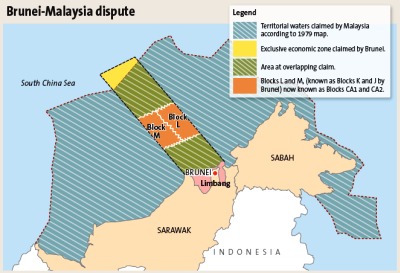
 but even so petronas will share some profit ratio as agreed in 2009.
























 0.0602sec
 0.29
0.29
 5 queries
 GZIP Disabled