Welcome Guest ( Log In | Register )

9 Pages « < 3 4 5 6 7 > » Bottom

Outline · [ Standard ] · Linear+

 Lightning protection, Lightning proctection in house

views
     
paskal
post Jun 1 2014, 06:50 PM

armchair commando couch potato
*******
Senior Member
2,801 posts

Joined: Jan 2003
From: Darul Aman
QUOTE(westom @ Jun 1 2014, 05:19 AM)
Learn what an effective SPD does?  This was first demonstrated by Franklin in 1752.

Lightning (and other surges) seeks earth ground.  A best connection to earth is via a wooden church steeple.  Because wood is a better electrical conductor than air.  Unfortunately, wood is a poor conductor.  So a 20,000 amp lightning strike would create a high voltage.  20,000 amps times a high voltage is high energy.  Church steeple damaged.

Franklin connected lightning to earth via a better conductor - often called a lightning rod.  That conductor is a better conductor.  So a 20,000 amp lightning strike creates a near zero voltage.  20,000 amps times a near zero voltage is near zero energy.  No damage.

That is protection of a structure.  We do same to protect appliances.

Lightning seeks earth ground.  A best connection to earth is via appliances. Unfortunately appliances are poor conductors.  So a massive current would create a high voltage inside the appliance.  That high current times a resulting high voltage is high energy.  Appliance damaged.

For over 100 years, informed consumers connected lightning to earth via a better conductor.  Usually a direct hardwire connection.  Otherwise a next best solution is implements: a 'whole house' protector. Then 20,000 amps connected low impedance (ie 'less than 3 meters') to earth creates a near zero voltage.  The resulting near zero voltage means no energy dissipates destructively in appliances.  No appliance damaged.

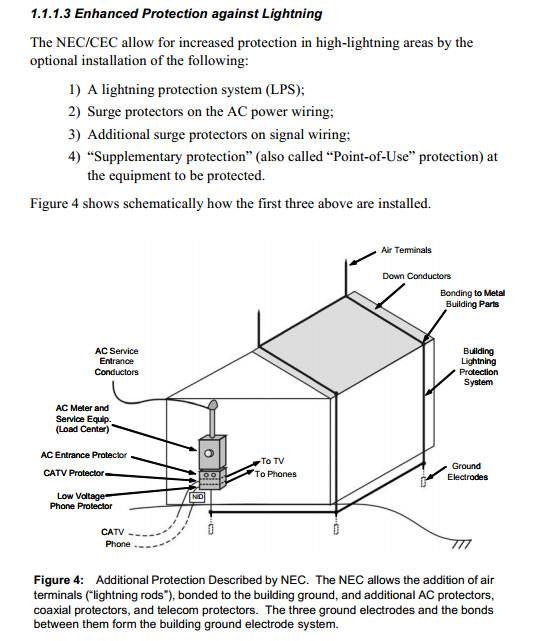
A protector adjacent to the appliance does not do this.  The protector at the service entrance must be sized to connect even direct lightning strikes to earth.  And not fail.  So a minimal 'whole house' protector is 50,000 amps.  If a surge damaged that protector, then a 100,000 amp protector is needed in that venue.

Described is what effective protectors work, why they work, and relevant numbers such as 50,000 amps.  Because any protector that fails did not provide effective protection.  Protectors must not fail even after many direct lightning strikes.

What should also be obvious is what is more important than a protector.  Protection is defined by the quality and connection to earth ground. Both for structure protection and for appliance protection.  Most of your attention should focus on THE most important component in every protection 'system': earth ground.  Since that is always where hundreds of thousands of joules harmlessly dissipate.
*
yes westom. you're more knowledgeable than IEEE.
say westom, are you familiar with the local wiring scheme? do you know that us over here is required BY LAW to implement earth grounding into the structural wiring?

and we here are indeed talking about diversion and dissipation of the lightning energy safely to the earth grounding THROUGH SURGE PROTECTION DEVICES. and while i could argue with your whole voltage this, voltage that, no energy no current zero voltage crap, i'm gonna let it slide.

enough with your endeavour to discredit the use of SPD and electronics surge protectors.
westom
post Jun 1 2014, 10:05 PM

Getting Started
**
Junior Member
228 posts

Joined: Mar 2009
QUOTE(paskal @ Jun 1 2014, 02:50 PM)
do you know that us over here is required BY LAW to implement earth grounding into the structural wiring?

Apparently important numbers were ignored. That ground in a wall receptacle is not earth ground. Codes require a safety ground. Electrical characteristics such as 'less than 3 meters', no sharp wire bends, no splices, and ground wire separated from other non-grounding wires are critically important. Please grasp important references to low impedance to appreciate a difference between 'safety' ground and 'earth' ground.

Lightning is best connected to earth via a direct hardwire connection. A next best solution implements the same low impedance, earth ground connection via a 'whole house' protector. Then 20,000 amps connects low impedance (ie 'less than 3 meters') to earth; creates a near zero voltage. A resulting near zero voltage means no energy dissipates destructively in appliances. No appliance damaged.

Protectors adjacent to appliances cannot earth that energy. Too close to appliances and too far from earth ground electrodes. These devices must somehow block or absorb energy. This different device, also called a surge protector, does not claim to protect from destructive surges. Instead, it only claims to protect from surges typically so small as to be made irrelevant by protection already inside appliances.

Sometimes a surge too tiny to harm an appliance will destroy a grossly undersized and adjacent protector. A failed protector did not do protection. The appliance protected itself.

Concepts such as wire bends and wire length can subvert an earth ground connection. For example, connect a 200 watt transmitter to a long wire antenna. Touch one part of that long wire to feel near zero volts. Touch another part to be shocked by over 100 volts. Why two voltages on the same wire? These electrical characteristics explain why a wall receptacle's safety ground is not earth ground.

Effective protector must be located adjacent (ie 'less than 3 meters') to a single point earth ground. Last four words also have electrical significance. A protector too far from single point earth ground (ie connected to a wall receptacle) is not earthed. And does not even claim to do what an effective 'whole house' protector does.

Rather than ignore relevant numbers, appreciate these electrical concepts even defined in IEEE standards. What many mistake as an earth ground is really only a safety ground. This difference explains why best protectors are distant from appliances (ie up to 50 meters) and as close to earth ground as practicable. Please do not ignore the expression 'low impedance'. Protectors without that 'low impedance' connection do not claim to protect appliances from destructive surges. Ignoring that voltage discuss implies you did not understand an important concept: impedance.

This post has been edited by westom: Jun 1 2014, 10:08 PM
tengster
post Jun 2 2014, 11:03 AM

Look at all my stars!!
*******
Senior Member
5,612 posts

Joined: Jan 2009
QUOTE(westom @ Jun 1 2014, 10:05 PM)
Apparently important numbers were ignored.  That ground in a wall receptacle is not earth ground.  Codes require a safety ground.  Electrical characteristics such as 'less than 3 meters', no sharp wire bends, no splices, and ground wire separated from other non-grounding wires are critically important.  Please grasp important references to low impedance to appreciate a difference between 'safety' ground and 'earth' ground.

Lightning is best connected to earth via a direct hardwire connection.  A next best solution implements the same low impedance, earth ground connection via a 'whole house' protector. Then 20,000 amps connects low impedance (ie 'less than 3 meters') to earth; creates a near zero voltage.  A resulting near zero voltage means no energy dissipates destructively in appliances.  No appliance damaged.

Protectors adjacent to appliances cannot earth that energy.  Too close to appliances and too far from earth ground electrodes.  These devices must somehow block or absorb energy.  This different device, also called a surge protector, does not claim to protect from destructive surges.  Instead, it only claims to protect from surges typically so small as to be made irrelevant by protection already inside appliances.

Sometimes a surge too tiny to harm an appliance will destroy a grossly undersized and adjacent protector.  A failed protector did not do protection.  The appliance protected itself.

Concepts such as wire bends and wire length can subvert an earth ground connection.  For example, connect a 200 watt transmitter to a long wire antenna.  Touch one part of that long wire to feel near zero volts.  Touch another part to be shocked by over 100 volts.  Why two voltages on the same wire?  These electrical characteristics explain why a wall receptacle's safety ground is not earth ground.

Effective protector must be located adjacent (ie 'less than 3 meters') to a single point earth ground.  Last four words also have electrical significance.  A protector too far from single point earth ground (ie connected to a wall receptacle) is not earthed.  And does not even claim to do what an effective 'whole house' protector does.

Rather than ignore relevant numbers, appreciate these electrical concepts even defined in IEEE standards. What many mistake as an earth ground is really only a safety ground.  This difference explains why best protectors are distant from appliances (ie up to 50 meters) and as close to earth ground as practicable.  Please do not ignore the expression 'low impedance'.  Protectors without that 'low impedance' connection do not claim to protect appliances from destructive surges.  Ignoring that voltage discuss implies you did not understand an important concept: impedance.
*
notworthy.gif good sharing...

Can share with you how to size SPD accordingly? Let say for a bungalow nod.gif
westom
post Jun 2 2014, 06:55 PM

Getting Started
**
Junior Member
228 posts

Joined: Mar 2009
QUOTE(tengster @ Jun 2 2014, 07:03 AM)
Can share with you how to size SPD accordingly?

A protector must not fail. So what will be a typically largest surge? Lightning is typically 20,000 amps. So a minimal SPD should be rated at least 50,000 amps.

SPDs have an indicator light that only reports one type of failure. If its indicator light reports any failure, then the SPD was grossly undersized. Then a 100,000 amp protector is probably necessary.

SPD is only one part of a 'system'. SPD must be sized to not fail over many decades. The 'system's effectiveness during each surge is defined by the other and more important component - earth ground. 'System' effectiveness for each surge is defined by the quality of and connecton to single point earth ground.

Protectors are simple science. Earthing is an 'srt'.

tengster
post Jun 2 2014, 07:00 PM

Look at all my stars!!
*******
Senior Member
5,612 posts

Joined: Jan 2009
QUOTE(westom @ Jun 2 2014, 06:55 PM)
A protector must not fail.  So what will be a typically largest surge?  Lightning is typically 20,000 amps.  So a minimal SPD should be rated at least 50,000 amps.

SPDs have an indicator light that only reports one type of failure.  If its indicator light reports any failure, then the SPD was grossly undersized.  Then a 100,000 amp protector is probably necessary.

SPD is only one part of a 'system'.  SPD must be sized to not fail over many decades.  The 'system's effectiveness during each surge is defined by the other and more important component - earth ground.  'System' effectiveness for each surge is defined by the quality of and connecton to single point earth ground.

Protectors are simple science.  Earthing is an 'srt'.
*
Why are we using SPD to protect our appliances from direct lightning exposure? Arent deviate from the intention? Lightning Protection System such as Faraday cage is protect our appliances from direct lightning. I seriously think there are no SPD that can protect one from direct hit...

SPD is normally used to protect more sensitive equipment from lightning-induced surved or other form of surges.

note - SPD = surge protection device
westom
post Jun 2 2014, 07:18 PM

Getting Started
**
Junior Member
228 posts

Joined: Mar 2009
QUOTE(tengster @ Jun 2 2014, 03:00 PM)
I seriously think there are no SPD that can protect one from direct hit...

So how often is your town without phone service for four days after each storm? A typical bulding may suffer a major surge every seven years. But the telco's computer is connected all over town. Thefore it suffers about 100 surges per storm. And without damage. Because protection from direct lightning strikes has been that routine for that long.

If protection from direct strikes could not exist, then telephone operators would remove headsets and leave the room with each storm. Reality. Even 100 years ago, that was unnecessary. Because protection from direct strikes was that well understood that long ago.

Protection uses a proven concept similar to a Faraday cage. But a Faraday cage is compromised if even one wire in any cable does not first connect to what performs a Faraday cage effect - single point earth ground. That is what a protector does. Protection is compromised if a protector does not make that low impedance (ie 'less than 3 meters') connection to single point earth ground.

A 'more sensitive' equipment is virtually every household appliance. That includes the dishwasher, air conditioner, dimmer switches, CFL bulbs, and clocks. Most every appliance now contains electronics. And all appliances are now as or more robust than that appliance was 40 years ago. Homeowners are only just learning about what was standard 50 years ago in facilities that could never have damage.


This post has been edited by westom: Jun 2 2014, 07:25 PM
tengster
post Jun 2 2014, 07:25 PM

Look at all my stars!!
*******
Senior Member
5,612 posts

Joined: Jan 2009
QUOTE(westom @ Jun 2 2014, 07:18 PM)
So how often is your town without phone service for four days after each storm?  A typical bulding may suffer a major surge every seven years.  But the telco's computer is connected all over town.  Thefore it suffers about 100 surges per storm.  And without damage.  Because protection from direct lightning strikes has been that routine for that long.

If protection from direct strikes could not exist, then telephone operators would remove headsets and leave the room with each storm.  Reality.  Even 100 years ago, that was unnecessary.  Because protection from direct strikes was that well understood that long ago.

Protection uses a proven concept similar to a Faraday cage.  But a Faraday cage is compromised if even one wire in any cable does not first connect to what performs a Faraday cage effect - single point earth ground.  That is what a protector does.  Protection is compromised if a protector does not make that low impedance (ie 'less than 3 meters') connection to single point earth ground.
*
Afaik, KL has not experienced 4 days downtime on phone service.

I am getting more confused with your post. Just now, you are talking about SPD sizing and now you talking about my town, building, protection...Faraday cage that is compromised.....Faraday Cage mostly used copper tape from top to bottom.....only very limited occassion, they use cable.

I think I have to stop reading your post to avoid confusion. Pemikiran berserabut, payah pembaca. icon_rolleyes.gif
paskal
post Jun 2 2014, 07:26 PM

armchair commando couch potato
*******
Senior Member
2,801 posts

Joined: Jan 2003
From: Darul Aman
whole house protector like what?
any wiring diagram? anything to show? any example?

you could place your trust in this westom over here. zero voltage here, zero voltage there, boom no lightning strike.
or you could follow the recommendation from IEEE here.
or if that's too much to read, there's a simpler one over here.

yeah i'll use SPD. whatever westom might say about it.
westom
post Jun 2 2014, 07:34 PM

Getting Started
**
Junior Member
228 posts

Joined: Mar 2009
QUOTE(tengster @ Jun 2 2014, 03:25 PM)
Afaik, KL has not experienced 4 days downtime on phone service.
Of course not - as I said. KL must have long used a 'whole house' solution. Their switching computer is threatened by about 100 surges with each storm - without damage. Because surge protection routinely makes direct lightning strikes irrelevant.

If you read something the first time and understand it, then it did not introduce anything new. If a concept is this new, then it should be reread at least three times. You misunderstand (misread) an example of direct lightning strikes without damage.

I never said KL suffered 4 days of downtime. Please read what was posted. I said KL never experiences 4 days of downtime because protection from direct lightning strikes is routine. So routine that damage is traceable to a human mistake.

This post has been edited by westom: Jun 2 2014, 07:37 PM
tengster
post Jun 2 2014, 07:37 PM

Look at all my stars!!
*******
Senior Member
5,612 posts

Joined: Jan 2009
QUOTE(westom @ Jun 2 2014, 07:34 PM)
Of course not - as I said.  KL must have long used a 'whole house' solution.  Their switching computer is threatened by about 100 surges with each storm - without damage.  Because surge protection routinely makes direct lightning strikes irrelevant.

If you read something the first time and understand it, then it did not introduce anything new.  If a concept is this new, then it should be reread at least three times. You did not understand a simple example of direct lightning strikes without damage.

I never said KL suffered 4 days of downtime.  Please read what was posted.  I said KL never experiences 4 days of downtime because protection from direct lightning strikes is routine.  So routine that damage is traceable to a human mistake.
*
my apology.
westom
post Jun 2 2014, 08:00 PM

Getting Started
**
Junior Member
228 posts

Joined: Mar 2009
QUOTE(paskal @ Jun 2 2014, 03:26 PM)
you could place your trust in this westom over here. zero voltage here, zero voltage there, boom no lightning strike.
IEEE is a source of what I have summarized. For example, IEEE Std 142 is entitled 'Static and Lightning Protection Grounding:
QUOTE
Lightning cannot be prevented; it can only be intercepted or diverted to a path which will, if well designed and constructed, not result in damage.  Even this means is not positive, providing only 99.5-99.9% protection.  ...
Still, a 99.5% protection level will reduce the incidence of direct strokes from one stroke per 30 years ... to one stroke per 6000 years ...  Protection at 99.5% is the practical choice.

Suitable protection is nearly always provided by the installation of air terminals, down conductors, and grounding electrodes.

Standard 1100 says:
QUOTE
It is important to ensure that low-impedance grounding and bonding connections exist among the telephone and data equipment, the ac power system's electrical safety-grounding system, and the building grounding electrode system.  ...
Failure to observe any part of this grounding requirement may result in hazardous potential being developed between the telephone (data) equipment and other grounded items that personnel may be near or might simultaneously contact.

Summarized here are the principles that all industry professionals discuss for protection. A protector is only as effective as its earth ground.

Another IEEE Standard says
QUOTE
In actual practice, lightning protection is achieve by the process of interception of lightning produced surges, diverting them to ground, and by altering their associated wave shapes.


IEEE Standard 80 says:
QUOTE
Secondary arresters will be used only for low-voltage services at munitions areas and buildings which house computer and sensitive electronics equipment. Arresters will be located as close to the electrical service entrance as possible and a separate ground conductor from the secondary service entrance will be bonded to the building ground ring. Range of voltage ratings is 0.175 kV to 0.650 kV.
What is that secondary arrester? The 'whole house' protector. Secondary protection is located at the service entrance. A primary protection layer is installed by the utility.

One can criticize. Or one can first comprehend their technical sources. IEEE and I say same. Another forget to read what the IEEE says.

paskal
post Jun 3 2014, 10:06 AM

armchair commando couch potato
*******
Senior Member
2,801 posts

Joined: Jan 2003
From: Darul Aman
QUOTE(westom @ Jun 2 2014, 08:00 PM)
Summarized here are the principles that all industry professionals discuss for protection.  A protector is only as effective as its earth ground.
*
so now the protector is highly dependent on earth ground? you said the ground inside the receptacle is not earth ground?
and i quote:
QUOTE
Apparently important numbers were ignored. That ground in a wall receptacle is not earth ground. Codes require a safety ground. Electrical characteristics such as 'less than 3 meters', no sharp wire bends, no splices, and ground wire separated from other non-grounding wires are critically important. Please grasp important references to low impedance to appreciate a difference between 'safety' ground and 'earth' ground.

is that cable going from the distribution box to the earth? the large copper cable?

oh yes we already have those in our distribution box. how is that different from your suggestion? your 3 meter rule? move the service entrance/distribution box? so you're suggesting that we move our DB to somewhere where it doesn't breach your 3 meter rule? how about if i live in a condo?

QUOTE(westom @ Jun 2 2014, 08:00 PM)
IEEE Standard 80 says:  What is that secondary arrester?  The 'whole house' protector.  Secondary protection is located at the service entrance.  A primary protection layer is installed by the utility.
*
primary protection = installed by utility, correct?
secondary protection = lightning arrestor, correct?
westom
post Jun 3 2014, 12:47 PM

Getting Started
**
Junior Member
228 posts

Joined: Mar 2009
QUOTE(paskal @ Jun 3 2014, 06:06 AM)
so now the protector is highly dependent on earth ground? you said the ground inside the receptacle is not earth ground?

Correct. So why the confusion? This was explained repeatedly because it is new and therefore difficult to grasp.

Or maybe another fundamental fact, posted previously, was misunderstood. Electricity is never same at both ends of a wire. Earth ground and safety ground are electrically different. I don't understand why this fundamental fact was not read. Was that long wire antenna example unread?

Receptacle safety ground is not earth ground. Why is that confusing?

A ballpark three meter rule comes from basic circuit theory. One protector is best because it has no earth ground connection. Instead, that protector mounts ON earth ground. Zero meters to earth means better protection.

Correct. Primary protection is provided by the utility. A picture demonstates what does that protection:
http://www.tvtower.com/fpl.html

Secondary protection is not a lightning arrestor (lightning rod or protector). Those are only connecting devices. Each layer of protection is defined by what absorbs hundreds of thousands of joules. A protector only connects to that other 'system' component: earth ground. Earth ground (not an arrestor) is the protection. Due to advertising myths and hearsay, this concept is extremely hard to grasp.

A protector is only as effective as its earth ground. Same is also true for lightning rods. Lightning rod is for protection of a structure. 'Whole house' protector is for protection of appliances. In every case and in every layer of protection: the only component that must always exist and that does the protection is earth ground.

This post has been edited by westom: Jun 3 2014, 12:48 PM
liawei
post Jun 3 2014, 01:10 PM

New Member
*
Junior Member
16 posts

Joined: Jan 2006
QUOTE(paskal @ Jun 3 2014, 10:06 AM)
so now the protector is highly dependent on earth ground? you said the ground inside the receptacle is not earth ground?
and i quote:

is that cable going from the distribution box to the earth? the large copper cable?

oh yes we already have those in our distribution box. how is that different from your suggestion? your 3 meter rule? move the service entrance/distribution box? so you're suggesting that we move our DB to somewhere where it doesn't breach your 3 meter rule? how about if i live in a condo?
primary protection = installed by utility, correct?
secondary protection = lightning arrestor, correct?
*
Utility companies never installed any so called "primary protection" for you.

Primary protection is the SPD installed at the 1st entry point, that is in the DB. In Malaysia, 99% buildings do not have it. Don't mistakenly assume the ELCB as SPD. In advanced countries, ELCB+SPD must be installef in order to get CF. Too bad in Malaysia and other SEA countries, SPD has been omitted due to poor awareness.

Secondary protection is the additional protection installed at the point of use.

Both primary and secondary protections are heavily relying on good earthing. "3 meter rule" is just a layman term guideline. In reality you can hardly see the earth path that is less than 3 meters.What important is the soil resistivity. You may have > 3 meters earth wire but as long as it is thick enough and connected to a earth rod with <5 ohm earth resistance, it is perfectly fine.
paskal
post Jun 3 2014, 08:49 PM

armchair commando couch potato
*******
Senior Member
2,801 posts

Joined: Jan 2003
From: Darul Aman
QUOTE(liawei @ Jun 3 2014, 01:10 PM)
Utility companies never installed any so called "primary protection" for you.

Primary protection is the SPD installed at the 1st entry point, that is in the DB. In Malaysia, 99% buildings do not have it. Don't mistakenly assume the ELCB as SPD. In advanced countries, ELCB+SPD must be installef in order to get CF. Too bad in Malaysia and other SEA countries, SPD has been omitted due to poor awareness.

Secondary protection is the additional protection installed at the point of use.

Both primary and secondary protections are heavily relying on good earthing.  "3 meter rule" is just a layman term guideline. In reality you can hardly see the earth path that is less than 3 meters.What important is the soil resistivity.  You may have > 3 meters earth wire but as long as it is thick enough and connected to a earth rod with <5 ohm earth resistance, it is perfectly fine.
*
didn't you read? westom already said the primary protection is already installed by the utility.
and i quote:
QUOTE
Correct. Primary protection is provided by the utility. A picture demonstates what does that protection:
http://www.tvtower.com/fpl.html

and i quote another one:
QUOTE
IEEE Standard 80 says:  What is that secondary arrester?  The 'whole house' protector.  Secondary protection is located at the service entrance.  A primary protection layer is installed by the utility.

he's right. so you must be wrong.


paskal
post Jun 3 2014, 09:03 PM

armchair commando couch potato
*******
Senior Member
2,801 posts

Joined: Jan 2003
From: Darul Aman
i'm quite tired of this whole debacle.
search on the net about westom and his entire plight against surge protectors.
http://lmgtfy.com/?q=westom+surge+protector

he went on this mission to discredit the use of surge protectors. he registers himself at various forums and post all the technical jargon suggesting his whole house protection without giving any clear advice on how to actually implement this protection of his. got into the nerves of quite some people.
he previously came inside the discussion about belkin and cal-lab in home theatre and discredited their use.

the problem is, even IEEE recommends the use SPD and any other form of surge protectors. even appliance level SPD is explained inside IEEE guide.
» Click to show Spoiler - click again to hide... «

but sure, you guys could place your trust to some random guy posting in some random internet forum.
westom
post Jun 3 2014, 09:53 PM

Getting Started
**
Junior Member
228 posts

Joined: Mar 2009
QUOTE(paskal @ Jun 3 2014, 05:03 PM)
i'm quite tired of this whole debacle.
No debate exists. Provided was the science. You openly deny using wild speculation, hearsay, and by ignoring 100 years of proven science. If it was a debate, then your beliefs are supported by facts and numbers. You have yet to post even one manufacturer specification number that defines effective protection. Honesty also provides facts with numbers. Lies and myths are quickly identified by subjective (qualitative) denials.

Look. I did this stuff for decades. And you clearly did not. Direct lightning strikes without damage. Others are warning about the naive who make recommendations only because advertising taught them. Provided are basic concepts and numbers that define protection. You tire only because you cannot dispute over 100 years of well proven science. And refuse to admit hearsay easily manipulated you. So now you would attack the messenger rather than admit to being a victim.

IEEE recommend tiny additional protectors only with the 'whole house' solution. IEEE and other professionals are bluntly clear about that. One brochure even shows a protector earthing a surge 8000 volts destructively through an adjacent TV. Becase the 'whole house' solution was not implemented and earthed. Please stop reading IEEE material selectively. IEEE says what works by also saying where hundreds of thousands of joules harmelessly dissipate.

Why, in every reply, do you ignore that reality? It is not a debate. It is science exposing parables and fables. If you know this stuff, then quote the specific electrical concepts and numbers from your own citations. You cannot. An honest reply quotes the relevant point. But you really do not understand what is relevant. You you throw mud on the wall hoping that something might stick. Please stop denying over 100 years of well proven science.

A protector is only a connecting device to what does protection. What does protection is what harmlessly absorbs hundreds of thousands of joules. That simple science could not be easier. Only solution in facilities that cannot have damage has always been a "low impedance" connection to earth ground. For over 100 years, the proven solution has always said where hundreds of thousands of joules harmlessly dissipate. Rather than vent emotions, why not answer the fundamental question? Where do hundreds of thousands of joules harmlessly dissipate?

There is no debate. The question, that you refuse to answer, is asked repeatedly. Where does that energy dissipate?

A plug-in protector has a purpose. It may provide an additional 0.2% protection. But only when used in conjunction with the 'whole house' solution. It does what its spec numbers says it will do. It does not claim and cannot protect from typically destructive surges that occur maybe once every seven years. Those are realities provided with numbers.

Protection is always about earth ground - where hundreds of thousands of joules are harmlessly absorbed. Each protection layer is defined by what harmlessly absorbs energy - earth ground. Some protection systems have no protectors. But every protection layer always has the one item that defines protection - earth ground. Always. Advertising will not discuss earth ground. No profit in it. Over 100 years of science and experience is why every facility that cannot have damage upgrades and inspects THE most important component in the protection system - earth ground. They inspect, learn of, and fix potential problems. And do not tire by remaining attached to lies and myths.

Where do hundreds of thousands of joules harmlessly dissipate? A protector is only as effective as its earth ground. Each protection layer is only defined by what absorbs the energy - earth ground. Reality does not change because you remain in denial.

This post has been edited by westom: Jun 3 2014, 10:05 PM
paskal
post Jun 3 2014, 11:01 PM

armchair commando couch potato
*******
Senior Member
2,801 posts

Joined: Jan 2003
From: Darul Aman
QUOTE(westom @ Jun 3 2014, 09:53 PM)
» Click to show Spoiler - click again to hide... «

There is no debate.  The question, that you refuse to answer, is asked repeatedly.  Where does that energy dissipate? 
» Click to show Spoiler - click again to hide... «

*
to the earth ground, where else?
that's the sole reason why the earth ground exist in your distribution box. that's why it's wired through a copper clamp, to a copper pole right into the ground. why it exist near the distribution box, not wired 200 meters away to the other edge of the house.

should i take a picture of the distribution box to you and label where is the earth connection?

QUOTE(westom @ Jun 3 2014, 12:47 PM)
Receptacle safety ground is not earth ground. Why is that confusing?
*
QUOTE(westom @ Jun 3 2014, 12:47 PM)
Earth ground and safety ground are electrically different.  I don't understand why this fundamental fact was not read.  Was that long wire antenna example unread?
*
so westom, explain to us, how is the earth ground and safety ground different?
user posted imageuser posted image
assuming i didn't read your whole long wire antenna analogy, copy paste it here so i can finally understand the difference between the earth ground and the safety ground that we have in the 3 pin receptacle.

please westom, please elaborate how it's different?
silent_killer
post Jun 3 2014, 11:05 PM

Getting Started
**
Junior Member
123 posts

Joined: Jul 2008
QUOTE(GaryLBV @ May 29 2014, 08:51 AM)
Take note that the SPD is max at 40ka
Would recommend at least 80 ka
*
care to elaborate why 80 ka is the minimum?
liawei
post Jun 4 2014, 12:09 AM

New Member
*
Junior Member
16 posts

Joined: Jan 2006
QUOTE(paskal @ Jun 3 2014, 08:49 PM)
didn't you read? westom already said the primary protection is already installed by the utility.
and i quote:

and i quote another one:

he's right. so you must be wrong.
*
Ok, I'm so wrong. smile.gif
Go ask TNB what kind of primary protection they have put in for you.

9 Pages « < 3 4 5 6 7 > » Top
 

Change to:
| Lo-Fi Version
0.0306sec    0.43    6 queries    GZIP Disabled
Time is now: 2nd December 2025 - 10:21 PM