kebetulan free lak hari ni..tgh gugel gugel..jumpa reseearch paper ni..maybe a bit TLDR for some..
» Click to show Spoiler - click again to hide... «
Final Research Paper
Malaysia’s Government Policy on Football (Soccer)
Infrastructure and Institution:
Afdal Izal Md. Hashim
Korean Economic and Social Transformation
Professor Lim Young-Jae
December 2, 2012
KOREAN ECONOMIC AND SOCIAL TRANSFORMATION COURSE
MALAYSIA’S POLICY ON FOOTBALL (SOCCER) ON INFRASTUCTURE AND INSTITUTION:
1.0 INTRODUCTION
The outcome of the mid-term paper was on the question of number of players in Malaysia and the governmental policies to generate and create high quality players. Another question posed was: Why was Malaysia successful in the 1960s up to the 1980s even when it was relatively low in terms of infrastructure to create a solid foundation of quality players compared to Asian football powerhouses in the 21st century? Namely nations of South Korea and Japan who once regarded Malaysia as a strong team but now are much professional and skillful than the latter country. This final research paper will further define the social upheaval and problems faced by the Malaysian Government after having spent millions of dollars on infrastructure and talent building measures but have not received the results projected. Malaysia is still lacking in terms of FIFA football rankings and continues to struggle in the region of Asia (Asia Football Confederation Cup (AFC) and international tournaments) and still does not have a complete strategy for qualifying for the World Cup. This research will propose measures and suggestions for at least a qualification in the next AFC Football Cup in 2019.
1.1 FOOTBALL IN MALAYSIA
It would be fair to note that Malaysia’s football scene started to deteriorate in mid 1980s and worsened in 1990s. That was the lowest point for Malaysia’s football when match-fixing, corruption and scandals rose at an alarming rate due to tight salary control by State Football Associations (FA) under the purview of the governing body of the Football Association of Malaysia (FAM). Why did in the earlier stages of a new nation the country performed well in qualifying for the 1980 Olympics and then went down to football abyss? Even when arguments were aimed on the causes of Malaysia’s lesser infrastructures or a systematic national football management compared to South Korea or Japan – Malaysia did not have the infrastructure compared to now, but it was able to do so in challenges of yesteryears. Did the countries Malaysia competed were ill prepared and later developed their football management over stages? Or Malaysia’s talent program diminished when other nations started to build their youth programs? These are questions being asked by sports science scholars and everyday fans or supporters. In 1990, Malaysia was scrutinized by the world football governing body FIFA over match-fixing scandals when it turned from semi-professional to fully professional football team. It was thought that the upgrade would empower Malaysia’s quality of football, but salary cap and regulations proved otherwise. Two national players in the Malaysian squad were found guilty of accepting bribes to influence and change the result of games whilst being dictated by Hong Kong bookies or gambling institution to influence the outcome of the game. A recent study by Kris Helge published in the Northern Kentucky Law Review on the success and failures of national football team had a similar impact on the performance of national football due to corruption that is explained as below.
1.1.1 Case I: Corruption
Nigeria’s Dilapidated Football Infrastructure
A good case was Nigeria Football Association (NFA) where as mentioned in the mid term paper; a nation with a larger GDP, large human populations, and adequate experience in playing the game of football can produce national teams that can win the World Cup (Kuper & Szymanski, 2009). In the study, GDP and populations are more closely analyzed and Nigeria’s GDP is US$357.2 billion, which ranks 32nd in the world. Nigeria’s population is approximately 152.2 million which ranks eighth in the world. Nigeria is a nation with an abundance of money to invest in hiring the most experienced and intelligent managers and football administrators in the world, and has a large population to select and train genetically gifted players. However, these money luxuries that should have been used to develop and produce robust football infrastructure are down the drain when the governing body in charge of the football workforce and regulating it are complicit in committing corrupt acts hence the unfortunate result is an impossible feat to develop a national team that is competitive in the World Cup. Malaysia’s FAM was quick to dismiss corrupt players and reconstruct tighter anti-corruption regulations but the damage has been done and spectators and Malaysian football enthusiast were declining in mid 1990s. It did not help that the introduction of international football through television from Italy’s Serie A and British Premier League (BPL) were right at their door steps through satellite television and Malaysian were sick and tired of corruption allegations and poor football skill performance due to this incident. During that era, FAM had a huge task of restructuring the domestic football scene but it failed to attract good players and quality coaches. People were comparing Malaysia to South Korea and Japan in terms of their domestic league and international recognition in the late 1990s where it was emerging a world class team. In the end, the Malaysian domestic football scene had to suffer silently and had time as a healing process for the people to become interested again.
1.1.2 Case II: Strict Control of the State Football Association
South Korea and Japan Soccer Regulations
Malaysia have admired and tried to emulate South Korea and Japan’s football success since the 2002 World Cup in South Korea-Japan which the former performed really well to advance to the semi-finals as co-hosts. One of the things Malaysia learned was to strengthen its foreign talents and invite them to play in Malaysia’s domestic league. But it was a flip-flop experiment when foreign players were seen as taking over the local talents rather than cultivating them. For a good number of years, foreign players contributed to the improvement of the game added with international managers and coaches that made Malaysian football interesting again. However in early 2000s, the governing football FAM ceased State FAs to import foreign talents. There were mixed feelings over the decision but as the national football team did not win any major championships in the regional tournaments, it was deemed a good move to nurture more local talents. But this was a big mistake as the local players had no chance to assess their capabilities and would only know it through international friendly matches. As the case for South Korea and Japan, both countries were able to move far ahead against their Asian counterparts – this is seen because their respective football associations generated logical regulations, where the South Korea’s government relinquished control over the countries FA. Prior to that in 1980s, South Korea and Japan FAs were tightly governed by highly centralized and bureaucratized federal government agencies. For example, the two nation’s FAs promulgated regulations that mandated national players to receive bare minimum salaries, and that domestic teams were only marketed to citizens when it would benefit the government’s political purposes (Manzenreiter, 2004). South Korea and Japan’s FAs took off when they convinced their respective governments to allow private corporate investment in both domestic leagues and the national teams. This commercialization allowed for intelligent and determined young individuals from South Korea and Japan’s advertising agencies to market sport domestically and also abroad. This marketing increased the interest in the sport and made Coca-Cola, Canon, Fuji Film, JVC and others to invest millions of dollars into these countries’ domestic and national teams (Helge, 2012).
The government’s release from repressive government control also rewarded these FAs with lucrative television contracts with organizations such as ESPN and further solidified the nation’s progress with the opportunity to host the World Cup in 2002. The encouragement of private capital investment is a primary reason that South Korea and Japan have been able to produce great players and coaching talents, able to win international tournaments, and increase their rankings and ratings on the football per capita index. Malaysia did open up its private capital investment and had private institutions sponsoring the domestic leagues and national teams such as Nike, Astro and 100plus. While local sponsors includes Telekom Malaysia, AirAsia, Malaysia Airlines, Sime Darby, Resorts World Genting and SHARP. However these investments are mainly sponsorship on advertisements and they do not have any say in improving the level of quality in domestic leagues. The governing body of FAM is tightly controlled and regulated with the Ministry of Sports, Youth and Culture being the core agency to overview its budget and expenditure. FAM has been headed by a Malaysian royalty – a Sultan (similar to a King) of the State of Pahang (a northeast central state in Malaysia). He has been challenged to vacate his post as its president for over 20 years when Malaysia’s football scene was poor and dismissal. But due to political affiliations and monarch influence nobody dared to challenge him out of respect and status quo. The Vice Presidency of FAM has been contested democratically and there were a few effective Vice Presidents who dared to challenged the status quo but were not successful to do so. The thing that has been always argued is the change of mindset or mentality of the FAM. Only with a change in the regulations through effective leadership should the level of Malaysian football improved as to South Korea and Japan’s experience. Less regulations and control by the government and more business and marketing environment would be a turning point for Malaysia’s Harimau Malaya (nickname) to be a strong contender in Asia and ultimately the world.
1.1.3 Case III: Creating Economic Viable Teams
The United States and the Netherlands Pro-Business Infrastructure
The US and the Netherlands comparatively are sky high in terms of comparison with Malaysia and indeed Asia’s football infrastructure, but it would be a good platform to emulate in 10-15 years time if Malaysia were to improve its current standings. The US Major League Soccer (MLS) was established just after the 1994 World Cup in USA. The MLS has experienced huge public and private investments league to building an infrastructure of football specific stadiums and develops youth academies for each of the 19 teams competing in MLS. While the Netherlands league known as the Eredivise has a successful business plan that reinvests it lucrative profits and provides each club to attract highly skilled players and brilliant coaches. This would result in developing players that will play for the Dutch national team in international competitions. The Netherlands have a population of 16.7 million – much less than Malaysia’s 28 million and its GDP is ranked 22nd in the world with around US$680.4 billion. Such economic stability in the US and the Netherlands is a result of pro-business regulations implemented by both nations. Both Netherlands Football Association and the US Soccer Federation adhere to FIFA’s statutes and have their own implementation of bylaws to regulate malfeasance. This pro-business implementation should start with Malaysia in a five year developmental program to create an ecosystem of attracting the best players, managers and coaches, and administrators. For the time being, Malaysia does not have a plan for being pro-business other than attracting sponsorships, and that’s about where it contributes. If Malaysia were to begin a free managerial statute that encourages investments from private with public partnership, it should be able to produce clear and effective results by creating a franchise environment of club ownership instead of government-inclination.
2.0 STRATEGIES FOR FOOTBALL ASSOCIATION OF MALAYSIA (FAM)
This paper has defined the three core areas that Malaysia needs to address in order for a viable solution in 5-10 years time. The FAM needs to see that football as a place branding platform for emerging, transition and newly industrialized country – even if Malaysia has been industrialized beginning in 1980s and Malaysians believe we should transformed towards service industry to create a high-income nation. Some proposals maybe unrealistic given the resources required to invest in sports particularly in Malaysian football such as the question of resources should be better channeled towards education, transportation or healthcare. Malaysia’s government may also have the anticipation that it may appear to be a losing game when considering that many strongest nations program are from first-world countries that have the financial ability and historical capital to invest heavily (Rein and Shields, 2006). Another aspect to consider is that sports can provide tangible and intangible benefits. Football receive wide spread free media coverage that can attract tourists, residents and investors at a low cost. Football can also stimulate an emotional heat between participants and the audiences that symbolizes energy, vigour and strength of an emerging nation in ways that eco-branding, museum and cultural attractions have certain limitations to reach the masses. Football and sports may be seen as a strategy to promote Malaysia and its brands. For example, in the US, Indianapolis transformed from an industrial city into a tourist and business attraction by building sports facilities and hosting sporting events. In Australia, the town of Bargo became a ‘cycling town’ to reverse its historically negative image (Kerr and Johnson, 2005).
Football Investments
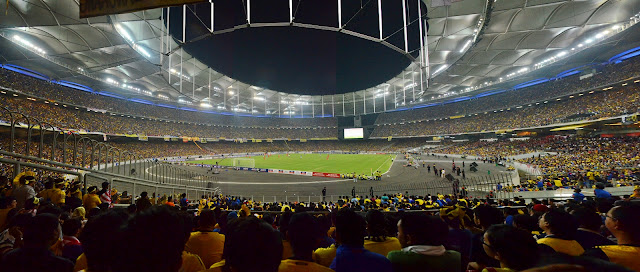
Sport Industry Research Center (UK Sport, 2004) entitled Measuring Success2: The Economic Impact of Major Sports Events synthesized data from 16 studies on economic impact of sporting events in the United Kingdom. The finding was that cities received substantial increase in economic activity as a result of hosting events and Malaysia has not fall far in hosting domestic and international events with the current host of the ASEAN Football Federation – Suzuki Cup (AFF-Suzuki) from November 24 – December 22 2012. In domestic leagues, the attendance has been below average to only about 10,000 for a capacity stadium of 40,000 – 80,000, but for matches of quarterfinal levels would exceed 70% of attendance when their clubs enter the final eight teams. This portrays that domestic football local interest have not reduced, they increase with number of tickets bought with high quality football. Co-host of the AFF-Suzuki Cup; Malaysia and Thailand have seen low turn-out audiences due to geographic location and having only the country-host matches being attended by the local population. In relation to the UK research, while Malaysia-Thailand co-hosts the AFF-Suzuki Cup with the ASEAN population of 596 million, this tournament is a good example of branding Malaysian and its regional football scene. Economic studies examining the financial implication of public funding for facilities of professional sports concluded that cities and their taxpayers do not consistently receive benefits that owners and governments promise (Quirk and Fort, 1992) – which means that why should public funding or even private investment have an interest to participate in Malaysia’s football program? This could be emulated with the financial risks to build or renovate stadiums with public money not only to cater to professional teams but also to university and college football programs. This can be extended to competitive sports school which Malaysia has only two at the moment. Though the school has produced many of the nation’s top athletes which were copied from Australia’s Sport School, it has yet to achieve world class athletes competing international platforms and winning Olympic medals. As Albert Einstein quoted: “Insanity: doing the same thing over and over again and expecting different results” – it is high time that Malaysia starts its own specific football academy to cater to the growing sports interest and talents it needs to nurture.
Strategic Platform
According to Rein and Shields there are two different types of platforms for a team: privately owned teams named after a place and a state or national teams that are controlled by the place itself. In both cases, it is often the case of the place to cooperate in helping build facilities, participate in joint-marketing campaigns, and facilitating the relationship so that teams have friendly environments. In cases such as the British Premier League, where teams such as Manchester United-Old Trafford, Chelsea-Stamford Bridge or Liverpool-Anfield stadiums, these teams have transcended private ownership and became magnets for tourism, business attractions, and resident retention. Malaysia can follow similar paths not by private investments but through other aspects of football attractions it can evaluate. Even though the short history of football compared to the British League, it would be a good strategy to begin partnership with the regional players in ASEAN. To build sound football-based supporters not only to see respective countries to grow in terms of quality players and coaches but the level of regional cooperation in building a competitive environment for football players.
Youth Programs
Another element to strategic platforms is an understanding to facilitate its infrastructure – not only the facilities, but the ability to provide the structure and organization to produce talent at all levels. Historically, the most successive countries have very strong youth programs. Many of them begin at early stages of school with systematic coaching, strong parental and community involvement, and facilities that are age-based and consistent with building a strong team. Countries that have this approach are Canada and Japan that built extensive infrastructure for their sports. But countries that lack ideal facilities and equipment such as Ghanaian kids play football in spaces that barely resemble football fields and with balls from gum tree juice (Duodo, 2005). One good example to discuss on the infrastructure that has fully developed against the setting of an infrastructure that is lacking is South Korea’s women’s professional golf. Though it may be different from football where it can be played with just a simple field and ball, golf is an exclusive sport – but South Korea is not capitalizing successful golfers by building and supporting a golf infrastructure. Yes, playing golf in South Korea is expensive and has forced talented golfers to learn the game on a driving range or move to another country. As a result, South Korea is not maximizing the advantages of its valuable asset. Differs from Malaysian football, we do have the field, we do have the infrastructure but when we have talented players we send them overseas. Their full potential perhaps could be grown in European football setting, but when they come home to play for local football or could not adapt to the environment, most players with talents get frustrated and just hung their football boots or missed the opportunity to shine. An example close to this case is Titus James Palani, a young Malaysian talent discovered by a German coach who is currently playing in the French League after attending a football academy there. Even though he did not make a big break in Europe (currently playing in France’s Division Three League), what he did, should inspire young Malaysians to go overseas with good support from not only the government, but the community, the football associations and also football supporters. But then, do we have the basic infrastructure to mould overseas talents for a Malaysian setting? South Korea had football talents playing overseas but when they come home to play for the national team, the level of high quality domestic football with international clubs do not differ too greatly hence the chemistry and good team spirit gives the national coach a luxury to select good players.
CONCLUSION
For Malaysia to produce high quality players and world class level of football games, the government should loosen its grip on regulating body of the nation’s FAM. The current leadership needs to be changed with a more business focus and market-friendly environment where big dollars should attract first mid-level quality foreign players to play in domestic leagues. The basic infrastructure that has been laid should be reinvigorated to accommodate to young talent programs starting from early stages right towards university and college levels. The five year development program should begin with players in their pre-teens, exposing them to play with foreign players, cultivating and nurturing talented local players and let private investments have a say of their own stake. It would take a mammoth task to straighten out the leadership issues of FAM but a top down approach is the best solution to rejuvenate and re-energize the local football scene in Malaysia
References
Barros, Carlos and Stephanie Leach. Analyzing the Performance of the English F.A. Premier League With an Economietric Frontier Model. Journal of Sports Economics 7:391. 2006. Sage Publications.
Duodo, C. World Cup, Here We Come. 2006. New African. Expended Academic.
Helge, Kris. The Success of a Nation's Soccer Team: A Bellwether Regarding a Nation's Electronic Information Infrastructure, the Legal Regulations that Govern the Infrastructure, the Resulting Citizen-Trust in its Government and its E-Readiness in Nigeria, the DPRK, China, Japan, South Korea, the Netherlands and the United States. 2012. General Law Article Issue. Northern Kentucky Law Review.
Kerr, G and Johnson S. A Review of Brand Management Strategy for a Small Town – Lessons Learnt”. Place Branding 1:4. 2005.
Leeds, Michael and Eva Leeds. International Soccer Success and National Institutions. Journal of Sports Economics 10:4. 2009. Sage Publications.
Manzenreiter, Wolfram Japanese Football and World Sports: Raising the Global Game in a Local
Setting. Institute of East Asian Studies, University of Vienna Japan Forum 2004 Routledge, Ltd.
Manzenreiter Wolfram and John Horne. Playing the Post-Fordist Game into the Far East: The Footballisation of China, Japan and South Korea. Soccer and Society 8:4. 2007. Routledge.
Quirk, J and Fort, R.D. Pay Dirt: The Business of Professional Team Sports. 1992. Princeton University Press. Princeton, New Jersey.
Rein, Irving & Ben Shields. Place Branding Sports: Strategies for Differentiating Emerging, Transitional, Negatively Viewed and Newly Industrialized Nations. 2006. Place Branding and Public Diplomacy. 3:1 Palgrave Macmillan Ltd.
Simon Kuper & Stefan Szymanski, Soccernomics: Why England Loses, Why Germany and Brazil Win, and Why the U.S., Japan, Australia, Turkey - and even Iraq - are Destined to become the Kings of the World’s Most Popular Sport 2009. Nation Books.


 Dec 19 2013, 09:50 PM, updated 12y ago





 Quote
Quote














 tak naik...










 .
.








 " Tetapi agak menyedihkan kerana usaha gigih skuad negara untuk ke Beijing tidak menerima sokongan peminat tempatan. Hanya sejumlah kecil yang hadir ke stadium, malah bilangan mereka lebih rendah drpd penyokong Myanmar ketika menundukkan negara jiran itu 4-0 Rabu lepas"..





 0.1767sec
 0.74
0.74
 6 queries
 GZIP Disabled