Welcome Guest ( Log In | Register )

Outline · [ Standard ] · Linear+

 Personal Financial Management V3, It's all about managing your $$$

views
     
SUSTOS
post May 15 2021, 10:50 PM

Look at all my stars!!
*******
Senior Member
8,667 posts

Joined: Aug 2019
From: Penang <-> Singapore


QUOTE(zenwell @ May 15 2021, 10:25 PM)
Not sure if anyone have asked this question before, but I'm really curious how this is actually done in real life:

we have been told again and again, start investing early, so that you can enjoy the compounding effect. I know it means you keep reinvesting your profit and watch it grow. many gurus keep saying if you watch the compounding effect at X% for N years, you will reach certain amount. My question is, let's say I buy a stock or invest into some funds at fundsupermart/stashaway/etc, how do i take the profit and reinvest? I have to sell the stok/fund and then buy again at the current price?then this is not compounding effect right?

Please enlighten me, even though my question is a dumb one. Thank you all sifus!
*
Nope, you just sit back, relax and watch the price goes up. No need to sell and buy back again. When you are done, goals accomplished, you sell it at a very high price, inclusive of all compounding interests/profits earned over the years.

So say compounding rate is 5%. Starting amount is 100 dollars. One year after investment, it is worth 105. The year after it's 100*(1.05)^2 = 110.25. After N years, assume no top-up, you get 100*(1.05)^N. You don't sell, it keeps compounding; you sell, that means you realize your profits. And that's the final amount.

In reality it's far more complicated, you have dividends, unit splits etc. And not to forget the ups and downs which tend to invite speculations and lure people away from "investing" into "trading".

This post has been edited by TOS: May 15 2021, 10:52 PM
SUSTOS
post May 18 2021, 10:38 PM

Look at all my stars!!
*******
Senior Member
8,667 posts

Joined: Aug 2019
From: Penang <-> Singapore


QUOTE(zenwell @ May 18 2021, 09:44 PM)
this is not every type of investment right? where the take into account your 'profit' part as the capital. let's say if i buy stock, unless there's dividend and i reinvest the dividend, otherwise there's no way of achieving so called compounding interest right?

sorry I'm still confused as in like i understand the theory of compounding interest but in actual case, how does it happen? I currently have some funds on hand but i can only see the price of the fund i hold whether it is green/red against the price i buy in. I don't see how it can compound. please teach me sifu  notworthy.gif
*
Compounding interest should be more appropriately called "compounding return".

Returns come in two form: capital gain and current income. Capital gain is the price appreciation of the asset you own, current income is the dividend/rent etc, you collect in a certain period of time "explicitly".

If shares are rather abstract, think of buying property, a house for example. You buy today at 500k. 10 years later when you sell it, it won't be 500k. Maybe a few millions. The difference between the selling price of a few millions and your initial purchase price (and minus tax and other transaction cost) is your return over the 10 years.

Apart from buying and owning that house, you can rent it out too. You still own it, but by renting it out, you get some monthly cashflow. This is your rental income. The income is still a "profit" to you. So after 10 years, if you rent out your house, you get returns in the form of capital gain (price appreciation of your house), and rental income over the 10-year period.

Same goes to stock, you buy Microsoft's or Apple's shares, their prices go up over the long run, like your house. Microsoft and Apple pay dividends. That is also part of the profit (like your rental income). But Microsoft and Apple don't distribute all their profits as dividends (they retain some for capital working and investment purposes). So a portion of the profits are retained with the companies. The rest distributed as dividends.

As the years go by, profits grow, and some goes into dividends to you, and some is retained by the company for further investment, and even more profit is generated from those investment, and thus the stock price rises. Thus compounding arises because the profits earned by the company is used to generate future revenue stream/profits on top of the profits earned early. The share price rises automatically as the market (the buyers and sellers) will factor in the rise in profits.

Simple example. You invest 100 dollars in company A at the beginning of year 1. Company A earns 5% per annum (p.a.). Your capital now becomes 105 dollars. Company A does not plan to declare any dividend at the end of year 1 but instead use your money to invest in some projects that generate 5% return p.a. So after another year, (end of years 2) your money is 105*1.05 = 110.25. I can rewrite this as (100+5)*(1.05) = 110.25.

So 2 components of return, your capital of 100 dollars is generating 5% p.a. in the second year 100*1.05 = 105, but so is the 5 dollars you earn in year 1, that gives you 5*1.05 = 5.25. The 5.25 dollars is the compounded return earned from reinvestment of profits a year earlier. (Imagine doing this for 10 years. This is how compounding arises) In this case, the company does it for you, internally.

Alternatively, the company could also distribute the profit of 5 dollars at the end of year 1 to you, but then to let compounding interest to work, you will need to reinvest the 5 dollars into the company yourself. In this case you reinvest the dividends by say, buying more shares of the same company. Both cases lead to compounding via reinvestment of profits, just different methodologies.

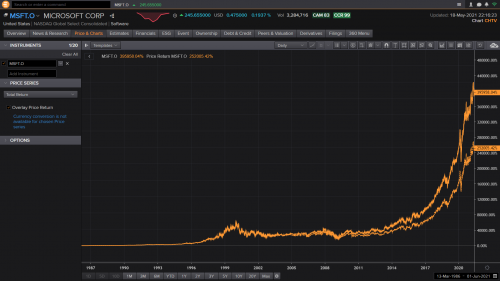
You asked for actual case, so here you go: compounding at work for Microsoft shares since inception in the late 80s.
user posted image

2 lines appear in the graphs. The upper one which gives 395958.04% as the terminal value is the total return, while the bottom one whose terminal value is 252005.42% is the price return. The difference between the two is the dividend return (current income) over time. The astronomical numbers should demonstrate compounding at work, I hope.

An important point to note is compounding is generally a long term process, prices might go up and down because market sentiment changes every second. News, good or bad, appear every now and then. Profits fluctuate throughout the business cycle, but in the long run the trend is up, especially for blue-chip companies. Same applies for funds too, in general.

This post has been edited by TOS: May 18 2021, 10:54 PM

SUSTOS
post May 18 2021, 11:16 PM

Look at all my stars!!
*******
Senior Member
8,667 posts

Joined: Aug 2019
From: Penang <-> Singapore


QUOTE(zenwell @ May 18 2021, 11:08 PM)
yup got it! Thanks!
So in a case where there's no dividend, there's only capital gain/loss right? there's no compounding effect right? i don't think every type of investment got compounding effect like this perfect example you gave above. So unless we are able to identify all the types of assets that have compounding effect, then only the estimation of invest X amount, compound at Y % over N years will give you Z amount. Am I right?
*
1. When there is no dividend, then only capital gain/loss. This is correct. No current income.

Like if you purchase a house but don't rent it out. After say 10 years, you decide to sell your house, your only returns will be the price appreciation of the house. Hence only capital gain. Same applies to stock.

2. No, There is still compounding effect from the rise in stock price. Notice the case for Microsoft's chart. The price return is still going up in the long-run. If companies elect not to declare dividends then the profits from the company will stay with the company. The money is still there. Companies will use the profits earned to invest further to generate even more revenue and profits.

So the profits still compound and grow every year. This is reflected in the stock price. Just because no dividends go to your pocket does not mean no compounding is at work. Otherwise, ask yourself, what will happen to the profits? It must go somewhere, right?

Some, and quite many companies declare little or no dividend at all. These companies are generally companies that are at their growth phase and need intensive capital investment, so the company's management choose to reinvest all the earnings/profits to further boost their profits in years to come. But compounding is still there, as profits grow exponentially. So share price rises. That is compounding at work.

This post has been edited by TOS: May 18 2021, 11:16 PM
SUSTOS
post May 18 2021, 11:26 PM

Look at all my stars!!
*******
Senior Member
8,667 posts

Joined: Aug 2019
From: Penang <-> Singapore


QUOTE(zenwell @ May 18 2021, 11:23 PM)
got it! so number 2 is still compounding but not a direct compounding on your capital, right?
*
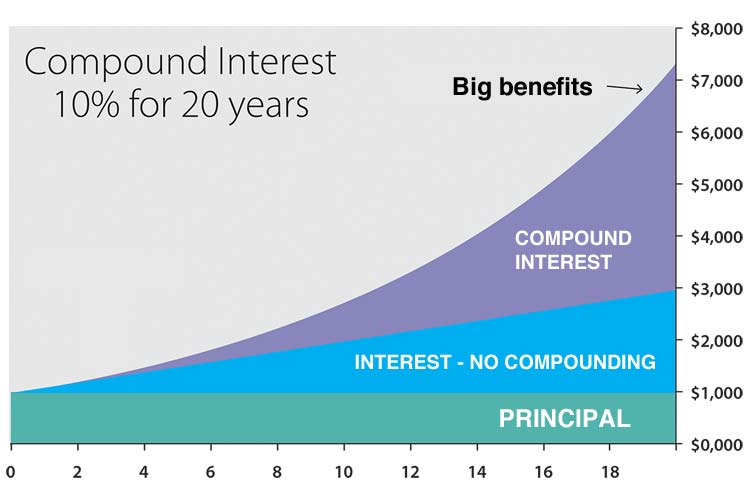
Exactly. Compounding refers to interest on (previous) interest, returns on (previous) returns.

user posted image

This post has been edited by TOS: May 18 2021, 11:34 PM
SUSTOS
post May 26 2021, 05:23 PM

Look at all my stars!!
*******
Senior Member
8,667 posts

Joined: Aug 2019
From: Penang <-> Singapore


QUOTE(taiping... @ May 26 2021, 05:04 PM)
But i cant collect interest
*
In theory you do.

The appreciation of SGD against MYR (currency), the fact that your feel safer parking your money there (credit risk), is the "interest" that the market prices in.

The lower interest rates of SGD deposits against that of MYR is the price one has to pay to compensate for the lower credit risk and other factor in SG (relative to MY).

Once again, the old adage: There is no free lunch in this world. There might be one occasionally, but arbitrage will ensure things remain balanced. Risk-return tradeoff is always true.
SUSTOS
post May 26 2021, 08:11 PM

Look at all my stars!!
*******
Senior Member
8,667 posts

Joined: Aug 2019
From: Penang <-> Singapore


QUOTE(taiping... @ May 26 2021, 06:49 PM)
Thanks for the info

I hav not put my money in IBKR yet

Tho, wit this little push of yours, i will buy into something now 😆
*
I would also suggest you to read up some academic finance and economics book, uni textbooks preferably. Have a good understanding of finance and economics will be of great help to you in understanding how the financial markets function.

At least you can think independently and not follow the herd. Investing is one thing to practice, but without understanding the underlying theory your portfolio won't go anywhere. For example, why S&P 500 is recommended instead of stock/portfolio picking etc. There are reasons behind these.

SUSTOS
post May 27 2021, 09:39 AM

Look at all my stars!!
*******
Senior Member
8,667 posts

Joined: Aug 2019
From: Penang <-> Singapore


QUOTE(Ramjade @ May 27 2021, 09:15 AM)
I don't think you can read finish the links I gave. If you do, you have a rough idea.
Go buy the intelligent investor book (not very nice to read cause the person speaks in third person)
One up with wall Street
Common stocks and uncommon profit
The little book that beat the market
The five rules for successful investing
Howard marks memo and books.

To be truth I haven't read finished but read some of it halfway.

You can use better world books to buy them secondhand and they have free shipping. Use bigpay to buy.

But then again, I don't know if you should read more. hmm.gif
Well your account will be closed by 3rd month I think if you didn't buy anything yet and if I think if you have less than USD2k inside. Better check back

Opening account should only be done when you are ready to start buying.
*
taiping...

The books proposed by Ram are also fine. Maybe read them first to have a rough idea then followed by the academic books I mentioned earlier, for starters this may be a better way of learning financial management. At least the slope won't be that steep.


Change to:
| Lo-Fi Version
0.0923sec    0.86    7 queries    GZIP Disabled
Time is now: 4th December 2025 - 07:12 AM