Welcome Guest ( Log In | Register )

117 Pages « < 112 113 114 115 116 > » Bottom

Outline · [ Standard ] · Linear+

 Personal Financial Management V3, It's all about managing your $$$

views
     
MUM
post Sep 28 2020, 11:37 PM

10k Club
********
All Stars
14,857 posts

Joined: Mar 2015

QUOTE(silverwave @ Sep 28 2020, 11:23 PM)
Probably about 1/3 of the income when i was working and I usually pay more to clear the loan faster. I'm not working now (on a short break) but the loan has been paid in advance for 2 years.

At least 40%-50% can be saved after deducting all.
*
wow at 40~50% is very good
will you be able to get back to your past income level once you had decided you wanted to stop your current break and restart your working life?
can you be able to get back into working life easily?
how is your "luck" on stock picking (gain/loss) experience in your 12% investment on KLSE (growth and dividend stocks) & 9% on US stocks?

if the luck is not that great and if the expected investment return is not of high...may i suggest that you seek an investment planner to help chart a more holistic investment route and vehicle that suit your risk and expectation.
as i think your monthly saving amount is larger than many of the people here.

This post has been edited by MUM: Sep 28 2020, 11:44 PM
silverwave
post Sep 28 2020, 11:50 PM

Look at all my stars!!
*******
Senior Member
4,082 posts

Joined: Apr 2006


QUOTE(MUM @ Sep 28 2020, 11:37 PM)
wow at 40~50% is very good
will you be able to get back to your past income level once you had decided you wanted to stop your current break and restart your working life?
can you be able to get back into working life easily?
how is your "luck" on stock picking (gain/loss) experience in your 12% investment on KLSE (growth and dividend stocks) & 9% on US stocks?

if the luck is not that great and if the expected investment return is not of high...may i suggest that you seek an investment planner to help chart a more holistic investment route and vehicle that suit your risk and expectation.
as i think your monthly saving amount is larger than many of the people here.
*
Yes, because i'm still living with my parents and i do not want to splurge on a new car, hence the savings. If i'm on my own and i get a new car, i think the most i can save will be 15-20%.

Yes, should be able to get back to the same income level but i can't tell how soon with all the unemployment rates now. I am already applying for jobs and going for interviews though. This investment plan will only resume only i start working.

Last year it was all about dividends for the stocks, this year i took some risks with glove stocks. Some are gains, some are losses but i hope to sell some once it reaches my profit margin.

US stocks were employee share option from my previous company and i just let it accumulate. The dividends are reinvested back into the shares even after i've left the company, so it's still ok. Probably once it touches a good price in a few years to come, i will sell it.

You're probably right, an investment planner can provide a better direction.

This post has been edited by silverwave: Sep 29 2020, 12:00 AM
wongmunkeong
post Jan 14 2021, 11:26 PM

Barista FIRE
Group Icon
Elite
5,608 posts

Joined: May 2011
From: Here, There, Everywhere


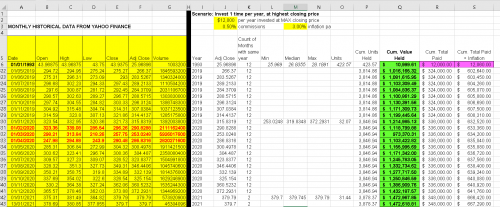
I've just updated data to share a simplified view with my nieces, nephew & kids + friends to ally their fears & FOMOs. Thus, thought it'll be useful for fellow forumers here who are new to investing and having such fears & FOMOs too.

Summary of the Excel in the ZIP file:
Shows xx years of investing yearly, if bought at each year's HIGHEST/COSTLIEST price and just stupidly held
SPY = S&P500 - US large leading 500 companies
EEM = Emerging Marking large leading companies
VT = Vanguard World Stocks - all developed and emerging markets' leading companies

Data from Yahoo Finance - copied & pasted to the left (yellow cells) and i just use the date & adjusted closing to avoid calculation issues with dividend, splits & rights issue values

Look at Column Q - value held which is stock units *current value
VS
Column R - cost paid to get the stock units
VS
Column S - cost paid if inflation of 3% pa factored in
user posted image


Bottom line - if just bought stupidly, regularly and held long term (MUST BE ABLE TO HOLD - thus emergency buffer $ must always be built first),
even THE MOST CURSED INVESTOR (always buying at the highest of the year) can still generally get ahead.
No need to trade, analyze-paralyzed, etc - all another job.
Might as well focus on making career or business, then invest the extras too smile.gif

Attached File  SPY_if_invested_at_highest_price_every_year_25yrs.zip ( 280.96k ) Number of downloads: 22

Feel free to monkey around with the worksheet - no macros, all using built-in functions in Excel - can be imported into Google Sheet too if U wish.
Just focus on changing the cells in YELLOW first
and the data from Yahoo Finance must be monthly data & use the beginning of the year (ie. Jan) ya.

This post has been edited by wongmunkeong: Jan 14 2021, 11:27 PM
TSzenwell
post Jan 14 2021, 11:28 PM

Regular
******
Senior Member
1,749 posts

Joined: Oct 2007
how do you buy S&P500 stocks and invest in vanguard from Malaysia?
hhsmax
post Jan 14 2021, 11:43 PM

Getting Started
**
Junior Member
60 posts

Joined: Jan 2021
QUOTE(zenwell @ Jan 14 2021, 11:28 PM)
how do you buy S&P500 stocks and invest in vanguard from Malaysia?
*
If I'm not mistaken you can invest in both on eToro
ky33li
post Jan 15 2021, 12:56 PM

Casual
***
Junior Member
313 posts

Joined: Mar 2010
From: Kuala Lumpur


QUOTE(zenwell @ Jan 14 2021, 11:28 PM)
how do you buy S&P500 stocks and invest in vanguard from Malaysia?
*
try using the local robo advisor. the portfolio jas vanguard etfs inside.
mmweric
post Jan 16 2021, 12:35 PM

Getting Started
**
Junior Member
156 posts

Joined: Jan 2020
QUOTE(zenwell @ Jan 14 2021, 11:28 PM)
how do you buy S&P500 stocks and invest in vanguard from Malaysia?
*
You can just open an account with any stock broker in Malaysia which allows you to buy US stocks
adele123
post Jan 16 2021, 01:28 PM

Look at all my stars!!
*******
Senior Member
4,724 posts

Joined: Jul 2013


QUOTE(zenwell @ Jan 14 2021, 11:28 PM)
how do you buy S&P500 stocks and invest in vanguard from Malaysia?
*
Someone shared a more cost efficient way.
My Webpage

Want cheap, do abit more work. Want convenient, may cost more.

Those charges can be expensive if you arent careful.

TSzenwell
post Jan 16 2021, 06:01 PM

Regular
******
Senior Member
1,749 posts

Joined: Oct 2007
QUOTE(hhsmax @ Jan 14 2021, 11:43 PM)
If I'm not mistaken you can invest in both on eToro
*
QUOTE(ky33li @ Jan 15 2021, 12:56 PM)
try using the local robo advisor. the portfolio jas vanguard etfs inside.
*
QUOTE(mmweric @ Jan 16 2021, 12:35 PM)
You can just open an account with any stock broker in Malaysia which allows you to buy US stocks
*
QUOTE(adele123 @ Jan 16 2021, 01:28 PM)
Someone shared a more cost efficient way.
My Webpage

Want cheap, do abit more work. Want convenient, may cost more.

Those charges can be expensive if you arent careful.
*
Thanks for the tips! notworthy.gif
hhsmax
post Jan 18 2021, 09:01 AM

Getting Started
**
Junior Member
60 posts

Joined: Jan 2021
QUOTE(adele123 @ Jan 16 2021, 01:28 PM)
Someone shared a more cost efficient way.
My Webpage

Want cheap, do abit more work. Want convenient, may cost more.

Those charges can be expensive if you arent careful.
*
Good resource, likey thumbsup.gif
TSzenwell
post May 15 2021, 10:25 PM

Regular
******
Senior Member
1,749 posts

Joined: Oct 2007
Not sure if anyone have asked this question before, but I'm really curious how this is actually done in real life:

we have been told again and again, start investing early, so that you can enjoy the compounding effect. I know it means you keep reinvesting your profit and watch it grow. many gurus keep saying if you watch the compounding effect at X% for N years, you will reach certain amount. My question is, let's say I buy a stock or invest into some funds at fundsupermart/stashaway/etc, how do i take the profit and reinvest? I have to sell the stok/fund and then buy again at the current price?then this is not compounding effect right?

Please enlighten me, even though my question is a dumb one. Thank you all sifus!
SUSTOS
post May 15 2021, 10:50 PM

Look at all my stars!!
*******
Senior Member
8,667 posts

Joined: Aug 2019
From: Penang <-> Singapore


QUOTE(zenwell @ May 15 2021, 10:25 PM)
Not sure if anyone have asked this question before, but I'm really curious how this is actually done in real life:

we have been told again and again, start investing early, so that you can enjoy the compounding effect. I know it means you keep reinvesting your profit and watch it grow. many gurus keep saying if you watch the compounding effect at X% for N years, you will reach certain amount. My question is, let's say I buy a stock or invest into some funds at fundsupermart/stashaway/etc, how do i take the profit and reinvest? I have to sell the stok/fund and then buy again at the current price?then this is not compounding effect right?

Please enlighten me, even though my question is a dumb one. Thank you all sifus!
*
Nope, you just sit back, relax and watch the price goes up. No need to sell and buy back again. When you are done, goals accomplished, you sell it at a very high price, inclusive of all compounding interests/profits earned over the years.

So say compounding rate is 5%. Starting amount is 100 dollars. One year after investment, it is worth 105. The year after it's 100*(1.05)^2 = 110.25. After N years, assume no top-up, you get 100*(1.05)^N. You don't sell, it keeps compounding; you sell, that means you realize your profits. And that's the final amount.

In reality it's far more complicated, you have dividends, unit splits etc. And not to forget the ups and downs which tend to invite speculations and lure people away from "investing" into "trading".

This post has been edited by TOS: May 15 2021, 10:52 PM
Ramjade
post May 16 2021, 08:48 AM

20k VIP Club
*********
All Stars
24,334 posts

Joined: Feb 2011


QUOTE(zenwell @ May 15 2021, 10:25 PM)
Not sure if anyone have asked this question before, but I'm really curious how this is actually done in real life:

we have been told again and again, start investing early, so that you can enjoy the compounding effect. I know it means you keep reinvesting your profit and watch it grow. many gurus keep saying if you watch the compounding effect at X% for N years, you will reach certain amount. My question is, let's say I buy a stock or invest into some funds at fundsupermart/stashaway/etc, how do i take the profit and reinvest? I have to sell the stok/fund and then buy again at the current price?then this is not compounding effect right?

Please enlighten me, even though my question is a dumb one. Thank you all sifus!
*
For me I never sell and find it more effective. I add in every dip. Buy the F dip regardless if how painful it is.

By just holding on to my stocks I just 2-4x my money. No buying and selling involve. Buy once and hold it long term. Don't think of taking profits as it's a trader mentally.

If you really want to take profit, wait for your stocks to 2x take out original capital and leave the profit inside there to continue running.

I sell options on the side to generate extra 15-20%p.a
TSzenwell
post May 18 2021, 09:44 PM

Regular
******
Senior Member
1,749 posts

Joined: Oct 2007
QUOTE(TOS @ May 15 2021, 10:50 PM)
Nope, you just sit back, relax and watch the price goes up. No need to sell and buy back again. When you are done, goals accomplished, you sell it at a very high price, inclusive of all compounding interests/profits earned over the years.

So say compounding rate is 5%. Starting amount is 100 dollars. One year after investment, it is worth 105. The year after it's 100*(1.05)^2 = 110.25. After N years, assume no top-up, you get 100*(1.05)^N. You don't sell, it keeps compounding; you sell, that means you realize your profits. And that's the final amount.

In reality it's far more complicated, you have dividends, unit splits etc. And not to forget the ups and downs which tend to invite speculations and lure people away from "investing" into "trading".
*
this is not every type of investment right? where the take into account your 'profit' part as the capital. let's say if i buy stock, unless there's dividend and i reinvest the dividend, otherwise there's no way of achieving so called compounding interest right?

sorry I'm still confused as in like i understand the theory of compounding interest but in actual case, how does it happen? I currently have some funds on hand but i can only see the price of the fund i hold whether it is green/red against the price i buy in. I don't see how it can compound. please teach me sifu notworthy.gif
MUM
post May 18 2021, 09:50 PM

10k Club
********
All Stars
14,857 posts

Joined: Mar 2015

googled and found this,...

effect of compounding effect in share market
https://www.amgfunds.com/research_and_insig...ompounding.html
Suppose you invest $10,000 into Cory’s Truck Company. The first year, the shares rise 10%. Your investment is now worth $11,000. Based on good performance, you hold the stock. In the second year, the shares appreciate another 10%. Therefore, your $11,000 grows to $12,100. Rather than your shares appreciating an additional $1,000 (10%) like they did in the first year, they appreciate an additional $1,100, because the $1,000 you gained in the first year grew by 10% too.

If you extrapolate the process out, the numbers have the potential to grow as your previous earnings start to provide returns. In fact, $10,000 that returns 10% annually for 25 years would grow to nearly $110,000— and that’s without investing additional money. Keep in mind that the examples presented throughout this paper are hypothetical, and actual returns will be different, much less predictable and potentially negative.

more and some youtube too...
https://www.google.com/search?q=compounding...sclient=gws-wiz
SUSTOS
post May 18 2021, 10:38 PM

Look at all my stars!!
*******
Senior Member
8,667 posts

Joined: Aug 2019
From: Penang <-> Singapore


QUOTE(zenwell @ May 18 2021, 09:44 PM)
this is not every type of investment right? where the take into account your 'profit' part as the capital. let's say if i buy stock, unless there's dividend and i reinvest the dividend, otherwise there's no way of achieving so called compounding interest right?

sorry I'm still confused as in like i understand the theory of compounding interest but in actual case, how does it happen? I currently have some funds on hand but i can only see the price of the fund i hold whether it is green/red against the price i buy in. I don't see how it can compound. please teach me sifu  notworthy.gif
*
Compounding interest should be more appropriately called "compounding return".

Returns come in two form: capital gain and current income. Capital gain is the price appreciation of the asset you own, current income is the dividend/rent etc, you collect in a certain period of time "explicitly".

If shares are rather abstract, think of buying property, a house for example. You buy today at 500k. 10 years later when you sell it, it won't be 500k. Maybe a few millions. The difference between the selling price of a few millions and your initial purchase price (and minus tax and other transaction cost) is your return over the 10 years.

Apart from buying and owning that house, you can rent it out too. You still own it, but by renting it out, you get some monthly cashflow. This is your rental income. The income is still a "profit" to you. So after 10 years, if you rent out your house, you get returns in the form of capital gain (price appreciation of your house), and rental income over the 10-year period.

Same goes to stock, you buy Microsoft's or Apple's shares, their prices go up over the long run, like your house. Microsoft and Apple pay dividends. That is also part of the profit (like your rental income). But Microsoft and Apple don't distribute all their profits as dividends (they retain some for capital working and investment purposes). So a portion of the profits are retained with the companies. The rest distributed as dividends.

As the years go by, profits grow, and some goes into dividends to you, and some is retained by the company for further investment, and even more profit is generated from those investment, and thus the stock price rises. Thus compounding arises because the profits earned by the company is used to generate future revenue stream/profits on top of the profits earned early. The share price rises automatically as the market (the buyers and sellers) will factor in the rise in profits.

Simple example. You invest 100 dollars in company A at the beginning of year 1. Company A earns 5% per annum (p.a.). Your capital now becomes 105 dollars. Company A does not plan to declare any dividend at the end of year 1 but instead use your money to invest in some projects that generate 5% return p.a. So after another year, (end of years 2) your money is 105*1.05 = 110.25. I can rewrite this as (100+5)*(1.05) = 110.25.

So 2 components of return, your capital of 100 dollars is generating 5% p.a. in the second year 100*1.05 = 105, but so is the 5 dollars you earn in year 1, that gives you 5*1.05 = 5.25. The 5.25 dollars is the compounded return earned from reinvestment of profits a year earlier. (Imagine doing this for 10 years. This is how compounding arises) In this case, the company does it for you, internally.

Alternatively, the company could also distribute the profit of 5 dollars at the end of year 1 to you, but then to let compounding interest to work, you will need to reinvest the 5 dollars into the company yourself. In this case you reinvest the dividends by say, buying more shares of the same company. Both cases lead to compounding via reinvestment of profits, just different methodologies.

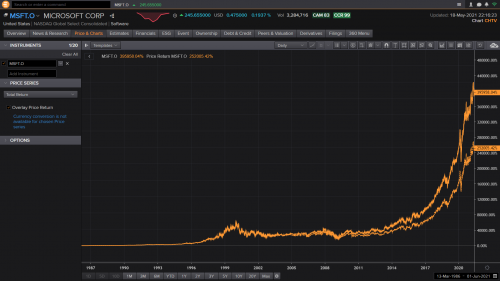
You asked for actual case, so here you go: compounding at work for Microsoft shares since inception in the late 80s.
user posted image

2 lines appear in the graphs. The upper one which gives 395958.04% as the terminal value is the total return, while the bottom one whose terminal value is 252005.42% is the price return. The difference between the two is the dividend return (current income) over time. The astronomical numbers should demonstrate compounding at work, I hope.

An important point to note is compounding is generally a long term process, prices might go up and down because market sentiment changes every second. News, good or bad, appear every now and then. Profits fluctuate throughout the business cycle, but in the long run the trend is up, especially for blue-chip companies. Same applies for funds too, in general.

This post has been edited by TOS: May 18 2021, 10:54 PM

TSzenwell
post May 18 2021, 11:08 PM

Regular
******
Senior Member
1,749 posts

Joined: Oct 2007
QUOTE(TOS @ May 18 2021, 10:38 PM)
Compounding interest should be more appropriately called "compounding return".

Returns come in two form: capital gain and current income. Capital gain is the price appreciation of the asset you own, current income is the dividend/rent etc, you collect in a certain period of time "explicitly".

If shares are rather abstract, think of buying property, a house for example. You buy today at 500k. 10 years later when you sell it, it won't be 500k. Maybe a few millions. The difference between the selling price of a few millions and your initial purchase price (and minus tax and other transaction cost) is your return over the 10 years.

Apart from buying and owning that house, you can rent it out too. You still own it, but by renting it out, you get some monthly cashflow. This is your rental income. The income is still a "profit" to you. So after 10 years, if you rent out your house, you get returns in the form of capital gain (price appreciation of your house), and rental income over the 10-year period.

Same goes to stock, you buy Microsoft's or Apple's shares, their prices go up over the long run, like your house. Microsoft and Apple pay dividends. That is also part of the profit (like your rental income). But Microsoft and Apple don't distribute all their profits as dividends (they retain some for capital working and investment purposes). So a portion of the profits are retained with the companies. The rest distributed as dividends.

As the years go by, profits grow, and some goes into dividends to you, and some is retained by the company for further investment, and even more profit is generated from those investment, and thus the stock price rises. Thus compounding arises because the profits earned by the company is used to generate future revenue stream/profits on top of the profits earned early. The share price rises automatically as the market (the buyers and sellers) will factor in the rise in profits.

Simple example. You invest 100 dollars in company A at the beginning of year 1. Company A earns 5% per annum (p.a.). Your capital now becomes 105 dollars. Company A does not plan to declare any dividend at the end of year 1 but instead use your money to invest in some projects that generate 5% return p.a. So after another year, (end of years 2) your money is 105*1.05 = 110.25. I can rewrite this as (100+5)*(1.05) = 110.25.

So 2 components of return, your capital of 100 dollars is generating 5% p.a. in the second year 100*1.05 = 105, but so is the 5 dollars you earn in year 1, that gives you 5*1.05 = 5.25. The 5.25 dollars is the compounded return earned from reinvestment of profits a year earlier. (Imagine doing this for 10 years. This is how compounding arises) In this case, the company does it for you, internally.

Alternatively, the company could also distribute the profit of 5 dollars at the end of year 1 to you, but then to let compounding interest to work, you will need to reinvest the 5 dollars into the company yourself. In this case you reinvest the dividends by say, buying more shares of the same company. Both cases lead to compounding via reinvestment of profits, just different methodologies.

You asked for actual case, so here you go: compounding at work for Microsoft shares since inception in the late 80s.

user posted image

2 lines appear in the graphs. The upper one which gives 395958.04% as the terminal value is the total return, while the bottom one whose terminal value is 252005.42% is the price return. The difference between the two is the dividend return (current income) over time. The astronomical numbers should demonstrate compounding at work, I hope.

An important point to note is compounding is generally a long term process, prices might go up and down because market sentiment changes every second. News, good or bad, appear every now and then. Profits fluctuate throughout the business cycle, but in the long run the trend is up, especially for blue-chip companies. Same applies for funds too, in general.
*
yup got it! Thanks!
So in a case where there's no dividend, there's only capital gain/loss right? there's no compounding effect right? i don't think every type of investment got compounding effect like this perfect example you gave above. So unless we are able to identify all the types of assets that have compounding effect, then only the estimation of invest X amount, compound at Y % over N years will give you Z amount. Am I right?
TSzenwell
post May 18 2021, 11:12 PM

Regular
******
Senior Member
1,749 posts

Joined: Oct 2007
QUOTE(MUM @ May 18 2021, 09:50 PM)
googled and found this,...

effect of compounding effect in share market
https://www.amgfunds.com/research_and_insig...ompounding.html
Suppose you invest $10,000 into Cory’s Truck Company. The first year, the shares rise 10%. Your investment is now worth $11,000. Based on good performance, you hold the stock. In the second year, the shares appreciate another 10%. Therefore, your $11,000 grows to $12,100. Rather than your shares appreciating an additional $1,000 (10%) like they did in the first year, they appreciate an additional $1,100, because the $1,000 you gained in the first year grew by 10% too.

If you extrapolate the process out, the numbers have the potential to grow as your previous earnings start to provide returns. In fact, $10,000 that returns 10% annually for 25 years would grow to nearly $110,000— and that’s without investing additional money. Keep in mind that the examples presented throughout this paper are hypothetical, and actual returns will be different, much less predictable and potentially negative.

more and some youtube too...
https://www.google.com/search?q=compounding...sclient=gws-wiz
*
Thanks for this! is it only buying shares can have compounding effect? what about mutual funds, equity funds etc?
SUSTOS
post May 18 2021, 11:16 PM

Look at all my stars!!
*******
Senior Member
8,667 posts

Joined: Aug 2019
From: Penang <-> Singapore


QUOTE(zenwell @ May 18 2021, 11:08 PM)
yup got it! Thanks!
So in a case where there's no dividend, there's only capital gain/loss right? there's no compounding effect right? i don't think every type of investment got compounding effect like this perfect example you gave above. So unless we are able to identify all the types of assets that have compounding effect, then only the estimation of invest X amount, compound at Y % over N years will give you Z amount. Am I right?
*
1. When there is no dividend, then only capital gain/loss. This is correct. No current income.

Like if you purchase a house but don't rent it out. After say 10 years, you decide to sell your house, your only returns will be the price appreciation of the house. Hence only capital gain. Same applies to stock.

2. No, There is still compounding effect from the rise in stock price. Notice the case for Microsoft's chart. The price return is still going up in the long-run. If companies elect not to declare dividends then the profits from the company will stay with the company. The money is still there. Companies will use the profits earned to invest further to generate even more revenue and profits.

So the profits still compound and grow every year. This is reflected in the stock price. Just because no dividends go to your pocket does not mean no compounding is at work. Otherwise, ask yourself, what will happen to the profits? It must go somewhere, right?

Some, and quite many companies declare little or no dividend at all. These companies are generally companies that are at their growth phase and need intensive capital investment, so the company's management choose to reinvest all the earnings/profits to further boost their profits in years to come. But compounding is still there, as profits grow exponentially. So share price rises. That is compounding at work.

This post has been edited by TOS: May 18 2021, 11:16 PM
TSzenwell
post May 18 2021, 11:23 PM

Regular
******
Senior Member
1,749 posts

Joined: Oct 2007
QUOTE(TOS @ May 18 2021, 11:16 PM)
1. When there is no dividend, then only capital gain/loss. This is correct. No current income.

Like if you purchase a house but don't rent it out. After say 10 years, you decide to sell your house, your only returns will be the price appreciation of the house. Hence only capital gain. Same applies to stock.

2. No, There is still compounding effect from the rise in stock price. Notice the case for Microsoft's chart. The price return is still going up in the long-run. If companies elect not to declare dividends then the profits from the company will stay with the company. The money is still there. Companies will use the profits earned to invest further to generate even more revenue and profits.

So the profits still compound and grow every year. This is reflected in the stock price. Just because no dividends go to your pocket does not mean no compounding is at work. Otherwise, ask yourself, what will happen to the profits? It must go somewhere, right?

Some, and quite many companies declare little or no dividend at all. These companies are generally companies that are at their growth phase and need intensive capital investment, so the company's management choose to reinvest all the earnings/profits to further boost their profits in years to come. But compounding is still there, as profits grow exponentially. So share price rises. That is compounding at work.
*
got it! so number 2 is still compounding but not a direct compounding on your capital, right?

117 Pages « < 112 113 114 115 116 > » Top
 

Change to:
| Lo-Fi Version
0.0270sec    0.25    6 queries    GZIP Disabled
Time is now: 2nd December 2025 - 08:43 PM