

 Sep 8 2013, 11:40 AM, updated 13y ago


REVIEW OF A VOLTAGE STABILIZER CAR FUEL SAVER
The following review is made after a face to face dialogue with the importer of a car fuel saving device that works on stabilizing the 12V voltage of cars, trucks and buses.
Appearance
The device is a cigarette box size black plastic box with a label sticker (instead of silk-screen printed). The black box is joined via a thick cable to a cigarette lighter type plug. It contains capacitor(s) and electronic circuit. The appearance and quality appear to be similar to those car fuel savers that are openly sold in Chinese Alibaba website.
http://www.alibaba.com/showroom/car-fuel-saver.html
Manufacturer’s name and address
The manufacturer’s name and address are not listed in the label and packaging box. Similarly, there is no serial number printed on the product or the packaging. There is only a warranty sticker with month/year of purchase similar to those cheap computer gadgets. One Year Warranty Card is inside the packaging box, though.
Approvals/Certifications
SIRIM and PUSPAKOM logos are printed on the packaging indicating the product is approved or certified by SIRIM and PUSPAKOM . These certifications, if true, indicate the product achieved the quality demanded by SIRIM and the product is safe to be used on cars (will not cause any adverse effect on car safety).
Efficiency claim
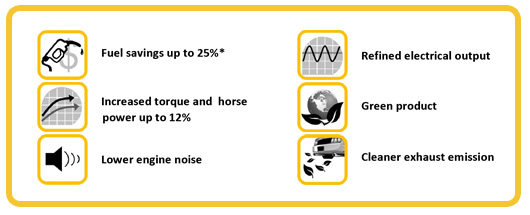
The packaging box also states the product is a multi-purpose car voltage stabilizer, power booster, fuel saver controller and best of all, the product “saves fuel up to 40%” ! When the importer was questioned on the bizarre efficiency claim, the answer was “it was a printing error”. The deliberate printing error, may be, is to catch the eyes of unwary consumers. A pure marketing tactic used to lure customers. The real efficiency, according to importer, varies from 10 – 25%. In marketing sense, the product will not sell if the “real” efficiency is printed on the packaging box as all the competitors are claiming up to 30% fuel saving efficiency. Claiming slightly higher efficiency of 40% now make sense, don’t you think so? Do you think it will save your car fuel by 10 – 25%? Please continue to read.
Country of origin and technology
The country of origin of the product is not stated in the packaging. However, judging from the appearance and finishing of the product, and abundance cheap supply from China, it can safely be assumed to be from China. But, the product is claimed to be of “Japanese Technology”. The importer claimed that the car voltage stabilizer technology originated from Germany many years ago and “perfected” by the Japanese in recent years. This cannot be verified. The overseas (or local) manufacturer of this product may have acquired this “latest Japanese technology”.
Patent application
Any innovative invention and improvement in invention will need to be patented to protect the interest of the inventor. The importer claimed that the device is patented in Japan only and not worldwide. The Japanese patent claim cannot be verified. Even if there is such a Japanese patent, whether this device design is that of the Japanese patent cannot be verified too. The importer claimed that they are going to apply for the Malaysian patent.
Performance tests by independent bodies
In order for the consumers to acknowledge the usefulness of these devices, most suppliers and importers are resorting to consumer testimonials. Consumer testimonials, as often used by water filter salesmen for miraculous health benefit claims, are not accepted as proof of performance or benefits of using such products. These are because consumer testimonials are often very biased and the evaluations are often carried out not in controlled conditions (thus subjects to errors and deviations). According to Wikipedia–Fuel saving device, ( http://en.wikipedia.org/wiki/Fuel_saving_device ) “One reason that ineffective fuel saving gadgets are popular is the difficulty of accurately measuring small changes in the fuel economy of a vehicle. This is because of the high level of variance in the fuel consumption of a vehicle under normal driving conditions. Due to selective perception and confirmation bias, the buyer of a device can perceive an improvement where none actually exists.”
Instead of consumer testimonials, the results of performance tests by independent bodies such as consumer associations, automobile associations are more trustworthy. Unbiased performance tests under controlled conditions such as that performed by MythBusters ( http://en.wikipedia.org/wiki/MythBusters ) are the most accurate and trustworthy. You may view their tests at Gas Saving Devices Busted 1 ( https://www.youtube.com/watch?v=90szKQAjhfo ) and Gas Saving Devices Busted 2 . ( https://www.youtube.com/watch?v=Pb7vhHKaGYw )
Unfortunately, all the independent tests stated in Wikipedia–Fuel saving device indicated that these fuel saving devices are not working to expectation. Among these, the independent tests by United States Environmental Protection Agency EPA Gas Saving and Emission Reduction Devices Evaluation ( http://www.epa.gov/otaq/consumer/reports.htm ) is the most comprehensive and reliable. The full reports of the test results of 92 fuel saving devices can be downloaded from the website. Out of these, only 7 showed improved results of only max 6% only.
The importer of the voltage stabilizers argued that the tests were carried before year 2005 and is thus out-dated. The importer also claimed that latest developments and improvements in automotive stabilizer technology have improved since then to make his voltage stabilizer different from others and thus functional.
The report dated 30th August 2011 by online automotive magazine website Car and Driver titled Fuel Doctor Finale: No, It Really Doesn’t Work. At All ( http://blog.caranddriver.com/fuel-doctor-f...nt-work-at-all/ ) proved that Fuel Doctor FD-47 working on the same principle of voltage stabilizing does not work at all. Similarly, Consumer Reports too reported the same in May 2011 ( http://www.consumerreports.org/cro/news/20...magic/index.htm ).
It appears that the importer’s voltage stabilizer devices are only being evaluated by consumers (consumer testimonials).
You may find the full details in Wikipedia–Fuel saving device article. The statements in the article have links to the original reports/articles and thus are trustworthy.
Online magazine Popular Mechanic carried out a series of independent tests on car fuel savers. Worth to take a look. ( http://www.popularmechanics.com/cars/alter...mileage/1802932 )
Acceptance by major auto-makers
If a car fuel saving device is so effective in saving car fuel, major auto makers would have installed in the cars they manufacture. These car fuel savers have been around for so many years and yet none of the auto makers installed these devices, be it voltage stabilizers, cyclones, hydrogen generators, fuel line magnets, etc. Auto makers would be most pleased if the car they manufactured are fuel saving. They would not mind even to pay for the patented devices, if available. Anyhow, the additional cost is always passed to the consumers.
Our national car makers, PROTON and PERODUA are famous for including the most gadgets or features in the national cars. They too would be most likely to include the fuel saving devices and advertised them. But none so far.
It would be absurd to claim that the major oil companies such as PETRONAS, PETRON, SHELL or certain political parties are against these fuel saving devices and have been pressuring auto makers not to accept these devices.
The technology of car fuel saving devices
The importer claimed that the device stabilizes the car voltage and thus improves the power and fuel efficiency. Then modern cars may already installed with voltage stabilizers (if voltage stabilizing works) and thus will not show vast improvement in new cars. Then the importer claimed it works particularly well in older cars as these cars do not have voltage stabilizers.
However in Consumer Reports dated May 2011 ( http://www.consumerreports.org/cro/news/20...magic/index.htm ) proved that voltage stabilizer did not improve the fuel efficiency of a 2002 Subaru Forester. The car is more than 10 years old.
Auto makers employ highly qualified research scientists, R & D engineers and spend millions of dollars to develop a particular model of car. The same applies to auto component manufacturers such as Valeo and TRW/Lucas. They would definitely not miss out in making the car more fuel efficient through the usage of the “simple” devices comprises of electronic circuits and capacitors. In fact, the most modern cars have highly sophisticated gadgetry such electronic control systems that monitor and control the fuel combustion efficiently. These devices are tailored made for each particular model of car. A simple device would not efficiently reduce fuel consumption for a wide range of cars, trucks and buses.
Modern high power (high c.c.) luxury cars of AUDI, MERCEDES are extremely fuel efficient due to highly sophisticated computer controlled fuel combustion systems unique to a particular model of the car. Fuel saving is not impossible but not with simple devices.
You have read the above detailed write-up on car voltage stabilizer fuel saver. It is up to your common sense whether to believe if it works on your car.
Have a safe drive!
This post has been edited by tango123: Sep 9 2013, 12:56 PM
Review of A Voltage Stabilizer Car Fuel Saver
 Quote
Quote









 0.0259sec
 0.60
0.60
 5 queries
 GZIP Disabled