


Cat Thread
Cat Thread
|
|
 Jul 17 2006, 11:31 AM Jul 17 2006, 11:31 AM
|
 
Senior Member
2,599 posts Joined: Oct 2005   
|
still young.. the ear haven't stand yet
|
|
|
|
|
|
Jul 17 2006, 11:36 AM
|

Senior Member
656 posts Joined: Mar 2006 From: Penang  
|
ic..
hehe.. kinda cute tho.. maybe i could post here their pics.. |
|
|
Jul 17 2006, 11:42 AM
|
|
Senior Member
656 posts Joined: Mar 2006 From: Penang
|
   |
|
|
Jul 17 2006, 11:43 AM
|
|
Senior Member
656 posts Joined: Mar 2006 From: Penang
|
if u see pic no 2..
u see the orange's tail.. kinda funny too.. my moms said its like puppy tail.. the hair soo thick.. |
|
|
Jul 17 2006, 11:55 AM
|
|
Senior Member
2,599 posts Joined: Oct 2005
|
lol. u have normal very very cute kitties
 |
|
|
Jul 17 2006, 12:12 PM
|
|
Senior Member
656 posts Joined: Mar 2006 From: Penang
|
thanks..
i just askin this bcoz, if there any probs with the kitten, i want to go to vet asap.. if u said its normal, then no need ar.. the mom hate me when i hold her babies.. haha.. cannot tahan loo.. very cute.. |
|
|
|
|
|
Jul 17 2006, 12:37 PM
|

Senior Member
520 posts Joined: Apr 2006 From: KL
|
sorcerer: adorable kittens! and like smelly said, they look normal and healthy..
 |
|
|
Jul 17 2006, 12:40 PM
|
|
Senior Member
656 posts Joined: Mar 2006 From: Penang
|
QUOTE(heidityj @ Jul 17 2006, 12:37 PM) sorcerer: adorable kittens! and like smelly said, they look normal and healthy.. thanks heidityj..  |
|
|
Jul 17 2006, 03:21 PM
|

Junior Member
14 posts Joined: Jul 2006
|
ur kittens r adorable especially the black one. since their still young, and mummy cat doesnt quite like the idea, then rather leave the babies alone for now. as long as they r healthy n nursing well, then they'll be fine. good luck
|
|
|
Jul 17 2006, 03:25 PM
|
|
Senior Member
656 posts Joined: Mar 2006 From: Penang
|
yep..
actually the cats are at my mums.. my mum had to lock the cage as the mother cat always wanted to transfer her kitten.. maybe bcoz ppl looking at them.. last week we found her and 1 of kitten under my sis bed.. now only morning and eve can let the mother out(she pee and poo outside her cage) then, get her in, and lock the cage back.. u like the black eh, same here.. my mom said the black is a she and the orange is a he.. |
|
|
Jul 17 2006, 03:40 PM
|
|
Junior Member
14 posts Joined: Jul 2006
|
QUOTE(|sorcerer| @ Jul 17 2006, 03:25 PM) yep.. i love black cats....just that im so unlucky that i never am able to get a blacky all my life actually the cats are at my mums.. my mum had to lock the cage as the mother cat always wanted to transfer her kitten.. maybe bcoz ppl looking at them.. last week we found her and 1 of kitten under my sis bed.. now only morning and eve can let the mother out(she pee and poo outside her cage) then, get her in, and lock the cage back.. u like the black eh, same here.. my mom said the black is a she and the orange is a he..  |
|
|
Jul 17 2006, 03:53 PM
|
|
Senior Member
656 posts Joined: Mar 2006 From: Penang
|
QUOTE(rozitahalim @ Jul 17 2006, 03:40 PM) i love black cats....just that im so unlucky that i never am able to get a blacky all my life ever look at spca?i think u will get blackie if u patience enuf.. hehe.. |
|
|
Jul 18 2006, 05:03 PM
|
|
Senior Member
656 posts Joined: Mar 2006 From: Penang
|
hey, guess what..
tday when i peek thru their cages, both kitten has open wide their eyes.. haha.. thanks for all the advise.. here they are..  the blackie are hard to see his eyes, its REALLY black.. haha even his nose and lip are black..   |
|
|
|
|
|
Jul 18 2006, 05:52 PM
|

Senior Member
7,485 posts Joined: Jun 2005 From: Kuala Lumpur 
|
Nobody post pics of the Cat Fair last week? Anyway just to share some pics from a link a friend sent me from Kitten.com...
http://www.kitten.com.my/forum/threadnav4332-1-10.html MAINE COON 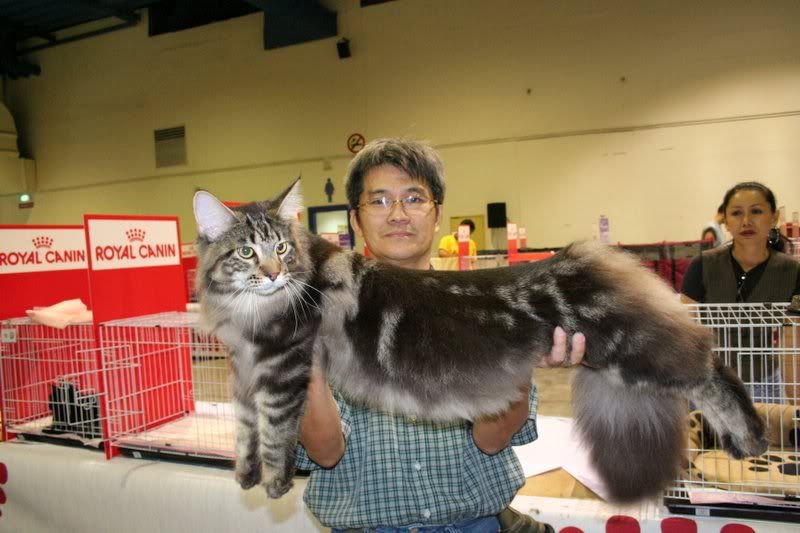 |
|
|
Jul 18 2006, 05:52 PM
|
|
Senior Member
2,599 posts Joined: Oct 2005
|
ish. so cute. geram!!!!! I miss my kitty kat....
Tremmie!!!!!!!!!!!!!!!!!!!!!!! |
|
|
Jul 18 2006, 05:53 PM
|
|
Senior Member
2,599 posts Joined: Oct 2005
|
QUOTE(julchin_09 @ Jul 18 2006, 05:52 PM) Nobody post pics of the Cat Fair last week? Anyway just to share some pics from a link a friend sent me from Kitten.com... lol. maine coon. bloody big kitty. Alicia has one and already so heavy! got more to grow.http://www.kitten.com.my/forum/threadnav4332-1-10.html MAINE COON |
|
|
Jul 18 2006, 08:23 PM
|

Senior Member
842 posts Joined: Jan 2003 From: ~around da world~
|
thats a freakin huge cat.. size like a dog
 still cute, wonder when it'll grow fat |
|
|
Jul 19 2006, 02:27 AM
|
|
Senior Member
7,485 posts Joined: Jun 2005 From: Kuala Lumpur
|
Sorry but a bit lost. Whos Alicia?
Anyway that Maine Coon won best of breed in the fair if Im not mistaken. And the Owner holding it is one of the famous Maine Coon breeders in Malaysia. I adore that cat.... |
|
|
Jul 19 2006, 10:44 AM
|
|
Senior Member
2,599 posts Joined: Oct 2005
|
QUOTE(julchin_09 @ Jul 19 2006, 02:27 AM) Sorry but a bit lost. Whos Alicia? aliciahorsley. a friend to a few of us here. I adopted my Tremmie from her Anyway that Maine Coon won best of breed in the fair if Im not mistaken. And the Owner holding it is one of the famous Maine Coon breeders in Malaysia. I adore that cat.... she was at the cat show. Won quite a bunch of medals but oddly enough are being hung on the rabbit's pen |
|
|
Jul 19 2006, 11:43 AM
|

Senior Member
2,503 posts Joined: Jan 2003 From: http://davis-online-store.com
|
Belilah barangan buatan Malaysia
 QUOTE MALAY CAT 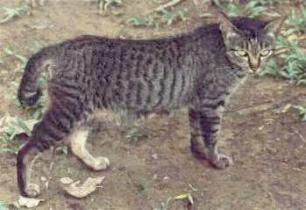 In 1783, Willian Marsden, Fellow of the Royal Society and late Secretary to the President and Council of Fort Marlborough wrote in "The History of Sumatra" of the Malay Cat: "All their tails imperfect and knobbed at the end." In 'The Variation of Animals and Plants under Domestication", Darwin wrote "throughout an immense area, namely, the Malayan Archipelago, Siam, Pequan, and Burmah, all the cats have truncated tails about half the proper length, often with a sort of knob at the end. [...] The Madagascar cat is said to have a twisted tail." (The latter comment may be due to the use of "Madagascar Cat" to mean the Ringtailed Lemur) Mivart had corroborated the statement regarding the Malay cat, of which he said the tail "is only half the ordinary length, and often contorted into a sort of knot, so that it cannot be straightened [...] Its contortion is due to deformity of the bones of the tail," and added that there was a tailless breed of cats in the Crimea. Miss Lowndes, daughter of writer Mrs Belloc Lowndes, described a Malay kitten recently acquired, along with its mother, from the Straits Settlements. "It has a triple-kinked tail. It is, unfortunately, not of the spotted kind, but these seem to be very rare nowadays." More information was provided by the Director of the Raffles Museum and Library at Singapore "The tail which distinguishes these cats may be clubbed or kinked, very short or of medium length, and the animals themselves of many colours - plain, piebald, or patterned." The cat fancier and prolific author, H C Brooke, wrote a widely published paper called "The Malay Cat" in 1927. He wrote that the peculiar variety of domestic cat was very little known in Britain and was becoming scarcer in its native habitats, probably due to crossing with long-tailed cats. He noted the possibility that Manx cats were descended from it, citing the Spanish Rock (shipwreck) theory and the prevalence of spotted tabby Manx. Both the Malay cat and the Manx were companionable and "doggy" and a resident in Sumatra had reported to Brooke that it was quite common to see the natives going about their business followed by their cats. "About a quarter of a century ago [1880s] I saw in Holland three beautiful Malay cats, of a sort of drab colour, spotted all over with very clear cut dark brown spots, much resembling those found in some of the Palm Civets. At about the same period, too, some very similar specimens were at the Jardin d'Acclimatation in Paris. The tails of these cats, about three or four inches long, were tightly screwed, or at least the tail formed three complete revolutions. The 'screw' tail, as also the spotted type of colouration, appear to be becoming very rare." A photograph of a young Malay cat was supplied to Brooke by Mr Boden Kloss, Director of the Raffles Museum in Singapore. Brooke noted that it resembled the Australian cat he had once owned, except that the Malay cat's tail was kinked upwards, while the Australia cat's triple-kinked tail was carried downwards. Mr Boden Kloss was familiar with this type of cat and wrote "A fair proportion of the cats of Singapore seen in native villages are short-tailed animals with a kinked tail. There would [be], I should say, three or four kinks. In colour they may be tabby, or boldly black and white. As a point of interest it may be noted that Felis planiceps [Flat-Headed Cat], one of the wild species of the peninsula, tends to resemble the domestic Malay cat in the matter of tail." Brooke commented that F planiceps was unlikely to be inter-fertile with domestic cats. He reported other sources as commenting that pure Malay cats (that had not been allowed to interbreed with ordinary cats) were said to have a "wild animal odour" most unlike the ordinary domestic cat. R Shelford, former Curator of the Sarawak Museum wrote in his book "A Naturalist in Borneo" "It may be mentioned here that the domestic cat of the Malays is quite a distinct variety [...] it is a very small tabby with large ears and a body and hindlegs so long that it lacks all grace. The tail is either an absurd twisted knot or else very short and terminating in a knob; this knotting of the tail is caused by a natural dislocation of the vertebrae so that they join onto each other at all sorts of angles." Brooke added that the length of hindleg was a trait shared by the Manx. Mr H O Forbes had exhibited a Malay cat to the Liverpool Biological Society and showed the cause of the knotting to be the development of wedge-shaped cartilages between the tail vertebrae. Forbes wrote "My remarks referred to the interest I had in exhibiting the creature's skin from the occurrence in the East of what I had noted as extremely common in the cats of Portugal when I lived there about 1876. The kink, I was told was then believed to have become hereditary, from a custom long practised by the Portuguese of pinching or breaking the tails of the new-born kittens, and it would be of special interest if it could be established that the kink in the Malayan cats' tails had been communicated to them through those imported by the early Portuguese into the East. If I can trust my memory the tail of this cat, though short and kinked had the full number of vertebrae, some of them reduced and wedge shaped." Brooke commented that no amount of tail-pinching would cause the trait to become hereditary and that the trait had been present in the Malay cat since at least 1783. The general type of the Malay Cat reported in the Malaysian peninsula between 1881 and the 1930s, described by HC Brooke and others, and found throughout Malaysia is represented on today's show-bench by the Japanese Bobtail. The colour photo here is of a cat at Lake Chini, near Kuantan, Malaysia. Bobtailed cats in all colours, and with varying degrees of tail-kink, can be found throughout Malaysia and Singapore. QUOTE BOBTAILED CATS The bobtailed mutation is not related to the Manx mutation. It has occurred independently in various geographic areas. It is widespread in Asia and parts of Russia. An Abyssinian Bobtail has been reported in non-pedigree Abyssinian-type cats (location not specified). A Spanish bobtail has also been reported. Cats with knotted, shortened, kinked and pom-pom tails are relatively common in Tenerife and the Canary Islands, the mutation apparently having become established due to the isolation of the gene pool (tourists frequently mistake the trait for breakage). Similar mutation have occurred spontaneously in the USA. There are also bobcat hybrids (and purported Bobcat hybrids) which have inherited the short tail from the wild parent. According to leading feline geneticists, the genes governing tail conformation are located on a mutation hotspot. According to an earlir anatomist, Sir Richard Owen, and to Professor H N Moseley, the kink in the Siamese's tail (a mild form of the bobtailed trait) was the relic of a prehensile tail, possibly inherited from civet ancestors (though neither civets nor genets had prehensile tails)! Others asserted that the kink was due to intercrossing the Siamese with the "common strain" however Lilian J Veley wrote in 1926 that this could be discounted since there was no other cat known in Siam, "common" or otherwise that had ever possessed an original kink, making it a folly to try to eradicate the trait. Presumably Ms Veley had not encountered the numerous bobtailed and kink-tailed street cats in Thailand. In "Our Cats" of May 1901 there was information on the Siamese's tail from interviews with the King of Siam and his Private Secretary. While the cats in the Royal Palace apparently had no kinks in their tails, occasionally a "tramp cat of Malay origin" strayed in and the resultant crossbred cats had kinked tails. In 1783, Willian Marsden, Fellow of the Royal Society and late Secretary to the President and Council of Fort Marlborough wrote in "The History of Sumatra" of the Malay Cat: "All their tails imperfect and knobbed at the end." In 'The Variation of Animals and Plants under Domestication", Darwin wrote "throughout an immense area, namely, the Malayan Archipelago, Siam, Pequan, and Burmah, all the cats have truncated tails about half the proper length, often with a sort of knob at the end. [...] The Madagascar cat is said to have a twisted tail." Another writer and traveller, Mivart, had corroborated the statement regarding the Malay cat, of which he said the tail "is only half the ordinary length, and often contorted into a sort of knot, so that it cannot be straightened [...] Its contortion is due to deformity of the bones of the tail". Joseph Train had also mentioned th Malayan cats, comparing them with the Manx: "The Manks rumpy resembles some what in appearance the cats said by Sir Stamford Raffles to be peculiar to the Malayan Archipelago." Sir Stamford Raffles' name is closely associated with Singapore. HC Brooke reported seeing three spotted tabby Malay cats in Holland in the 1880s and some very similar specimens at the Jardin d'Acclimatation in Paris around the same time. "The tails of these [Paris] cats, about three or four inches long, were tightly screwed, or at least the tail formed three complete revolutions. The 'screw' tail, as also the spotted type of colouration, appear to be becoming very rare." In 1889, Mr O Gould had apparently taken four Siamese to Ceylon and soon Ceylon was "overspread" with their progeny, known as "Gould's Cats" and many had kinked tails in spite of there being no Malay cats for them to interbreed with. Lilian J Veley wondered if the Malay cat's kink had come from the Siamese rather than the other way round (she considered the Siamese to be the older type). She also implicated the Korat "a blue variant of the Siamese, to which our 'blue-pointed' freaks are due." R Shelford, former Curator of the Sarawak Museum wrote in his book "A Naturalist in Borneo" "It may be mentioned here that the domestic cat of the Malays is quite a distinct variety [...] it is a very small tabby with large ears and a body and hind-legs so long that it lacks all grace. The tail is either an absurd twisted knot or else very short and terminating in a knob; this knotting of the tail is caused by a natural dislocation of the vertebrae so that they join onto each other at all sorts of angles." The length of hind-leg was a trait shared by the Manx, leading some cat-fanciers to believe that the two were related. Miss Lowndes, daughter of the novelist Mrs Belloc Lowndes described a Malay kitten that she had acquired. It had recently arrived, along with its mother, from the Straits Settlements. "It has a triple-kinked tail. It is, unfortunately, not of the spotted kind, but these seem to be very rare nowadays." More information was provided by Mr Boden Kloss, Director of the Raffles Museum and Library at Singapore "The tail which distinguishes these cats may be clubbed or kinked, very short or of medium length, and the animals themselves of many colours - plain, piebald, or patterned." He also wrote "A fair proportion of the cats of Singapore seen in native villages are short-tailed animals with a kinked tail. There would [be], I should say, three or four kinks. In colour they may be tabby, or boldly black and white. As a point of interest it may be noted that Felis planiceps [Flat-Headed Cat], one of the wild species of the peninsula, tends to resemble the domestic Malay cat in the matter of tail." The cat writer HC Brooke, who had an interest in the Malay cat, wrote that F planiceps and the domestic cat were unlikely to be inter-fertile. Mr H O Forbes had exhibited a bobtailed Malay cat to the Liverpool Biological Society and shown the cause of the knotting to be the development of wedge-shaped cartilages between the tail vertebrae. Forbes attempted to link the Malay bobtails to the bobtailed cats found in part of Portugal. In the 1920s, Forbes wrote "My remarks referred to the interest I had in exhibiting the creature's skin from the occurrence in the East of what I had noted as extremely common in the cats of Portugal when I lived there about 1876. The kink, I was told was then believed to have become hereditary, from a custom long practised by the Portuguese of pinching or breaking the tails of the new-born kittens, and it would be of special interest if it could be established that the kink in the Malayan cats' tails had been communicated to them through those imported by the early Portuguese into the East. If I can trust my memory the tail of this cat, though short and kinked had the full number of vertebrae, some of them reduced and wedge shaped." Others disputed his theory as the trait had been reported in the Malay cat since at least 1783 and no amount of tail-pinching would cause the trait to become hereditary! 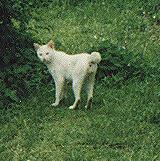 Kuantan, Malaysia. Feral male with perfect pom-pom tail. Kuantan, Malaysia. Feral male with perfect pom-pom tail.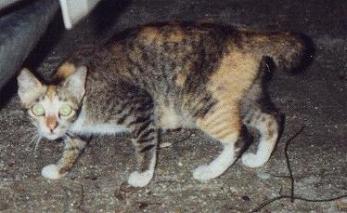 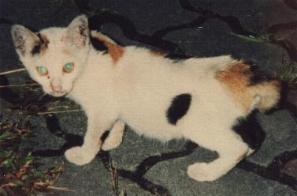 Street cats from Singapore and Johor Bahru (the town at Malaysian end of causeway to Singapore) showing the typical bobbed or kinked tail of local felines. The bobtail trait ranges from a normal-length tail with a distinct kink, through to a short twisted pom-pom and just about anything between those two extremes. The degree of kink is variable and the vertebrae are affected so that the tail cannot be straightened. It is often possible to feel a bony knot inside the kink where vertebrae have fused. The bobtail mutation is widespread throughout Asia, extending as far as Russia. It is well know that early Siamese cats had kinked full-length tails and this is still seen in Siamese-type cats in Thailand, but has been bred out of pedigree Siamese cats. Colourpointed cats were kept by Thai royalty and legend has it that a princess entrusted her rings to a palace cat while she bathed. She threaded them on the cat's tail and the cat knotted its tail so the rings did not fall off. The kink therefore marks where it knotted its tail. Unlike the Manx mutation, there appear to be no detrimental effects. There are tales associated with the Asian bobtailed cats. One (Malaysia) is that if a kittens tail is cut off and buried under the doorstep, the cat will not stray from home. Another is that monks cut the tails off of cats so that the cats do not go to heaven. A cat with a stumpy tail is not perfect and imperfect creatures cannot go to heaven. I examined a tabby cat brought back from Japan whose owner claimed that its tail had been cut off by monks during kittenhood. I found evidence of knots and kinks in the remnant of tail which told me it was a natural bobtail. Also, the tail ended quite normally in a black tip. This was a perfectly normal genetic bobtail, though the owner preferred to think she had rescued an abused cat. In 1988, the Cat Association of Britain finalised the standard for the "Oriental Bobtail"; a cat of oriental (or foreign) conformation and coat, but with a bobbed tail. Since then, little or nothing has been heard of this breed. The most famous bobtailed breed is the Japanese Bobtail found in both shorthair and semi-longhair varieties. This is due to a recessive gene. It has appeared in ancient Japanese art and has evidently existed back as far as the 6th. It is claimed that it was introduced into Japan from China at that time, which corresponds to Ida Mellen's account of curly tailed cats in China. Once the pet of Japanese nobles, it eventually spread to the general population but was not considered anything more than a common moggy. It attracted the interest of American breeders in 1968 and was recognised in the US in 1978. The longhaired version had always existed (longhair is due to a recessive gene) but was not given breed status until 1991. Distinguished by its bobtail and high-cheekboned triangular face. Close-lying, silky short hair. The tail is 10-13 cm in length if fully extended, but due to the kinked structure it appears only 4-7 cm long. The tail hair often grows straight out in all directions, giving it a rabbit-like fluff-ball or pom-pom appearance. In Japan it is found in all colours including agouti (Abyssinian pattern) and colourpoint though these are not accepted in the Western fancy. In 2001 a Singapura Bobtail was reported in a breeding programme. The bobtail kitten appeared in a Singapura litter, tracing back to a part-tailed foundation cat. Inbreeding can cause recessive genes to reappear. The kitten initially appeared to be tailless, but proved to have a stumpy tail similar to that of the Japanese Bobtail. This is not surprising since there are numerous bobtails in Singapore. The bobtail trait is also widespread in parts of Russia (probably the same recessive gene mutation as the Japanese Bobtail though this is unconfirmed) and following the break with communism, a cat fancy developed in Russia and several bobtailed breeds are under development. The Karel Bobtail (Karellian) is a shorthaired/semi-longhaired breed which occurs naturally along the coasts and islands of Lake Ladoga. The mutation is claimed to be identical to the Japanese Bobtail. These are elegant, svelte cats with lifted rumps and short pompom tails (4-13 cm). The Kuril Bobtail (Curilsk) is smallish, compact and cobby with a short (5-13 cm) "bob" or "pompon" tail . It has shorthair and semi-longhair forms. The Thai-Bob (Thai Bobtail) is a medium-sized Russian breed resembling the Traditional style (Apple- or Round-head) Siamese in all non-mitted colorpoint varieties. The tail is short (3-11 cm), bobbed and its outline is smoothed by the coat. The Toy-Bob or Toy Bobtail (1986) is a Russian miniature breed, no larger than a normal 3-4 month kitten. Toybobs have short, solid bodies and excellent muscles, with short straight or curved tail-remnant (3-7 cm), straight or corkscrewed, covered with fur in a "pompon" or "brush" effect. All of these were recognised in the 1990s, but apart from the Toy-Bob have existed for far longer. Confusingly, there is another variety known as a Thai Bobtail. It is a naturally occurring bobtailed variety of Oriental/Burmese type. These are mostly, but not exclusively, colourpointed and are found in Thailand and Malaysia. The Malay Cat reported in the Malaysian peninsula in 1881 and found throughout Malaysia is similar to Japanese Bobtail, but has not been adopted as a formal breed. The second officially recognised bobtail breed is the American Bobtail bred from a foundation cat discovered in the 1960s in Arizona. This is a dominant gene mutation. It occurs in shorthair and semi-longhair varieties and has a powder puff tail up to one third normal length. It was reputed to have bobcat blood (based on purely circumstantial evidence), but it may be a Manx-type mutation since some lines produce a range of tailless, rumpy, stumpy, longy and kink-tail cats. To avoid mixing up different mutations, the American Bobtail is never bred with either the Manx or the Japanese Bobtail. This is the official American Bobtail breed, however the trait has evidently occurred independently several times. The Sno-Bob is a colour variety of American Bobtail. It apparently resembles the Alaskan Bobcat being pale in colour with darker ear tips and darker bob-tail. In 1940, American zoologist Ida Mellen wrote "The American Domestic Bobtail Cat of the New England and Middle Atlantic States (called the Rabbit Cat) traces its ancestry to the Manx cat, but the distribution of tailless cats is wide, covering the Crimea and other parts of Russia, the Bismarck Archipelago, the Malayan Archipelago, Burma and Siam" However nothing more has been said about the purported American Domestic Bobtail and it may have been no more than a few isolated Manx cats. The cats from Malaya, Burma and Siam are related to the Japanese Bobtail rather than the Manx. There have been claims of an American Bobtail cat breed which resulted from bobcat/domestic cat crosses in the late 1970s. The breeder indicated that bobcats will mate with female Siamese cats because the scent of a Siamese female in season resembles that of a sexually receptive female bobcat. Bobcats can and do mate with domestic cats to produce at least some fertile offspring. The Si-Bob (Si-Bobtail) is not a formal breed. It is the colloquial name for colourpointed cats of Japanese Bobtail or American Bobtail type. These are not recognised as part of the main breeds and their breeding is not actively encouraged, but they are attractive crossbreds not unlike the Thai Bobtails. Si-Bobtails occur naturally in Japan. The PixieBob (1995) was, and sometimes still is, reputed to be derived from natural bobcat/domestic hybrids and to have inherited its tail from the bobcat. It is a polydactyl (extra-toed) breed derived from "Legend Cats" and in some respects it resembles a bobcat. The presence of bobcat genes has not been confirmed though the cat certainly resembles the wild species in several respects. On the one hand there is a persistent tale of "Legend Cats" - cats that are the result of natural cross-breeding between the two species. On the other hand there are cat fancies that refuse to recognise hybrid breeds. This leaves a few PixieBob enthusiasts both promoting the Bobcat influence (some claiming 25% bobcat blood) and simultaneously playing it down! Apparently genetic markers for the Bobcat do not show up in modern PixieBobs, although this may be due to the genes being diluted by several generations of backcrossing to domestic cats. There is an unconfirmed version known as the Munch-Bob which is a Munchkin/PixieBob cross to produce a short-legged bobtail. In theory, any of the bobtailed or tailless breeds could be used to produce bobtailed/tailless Munchkins. Not to be confused with the PixieBob is the Poly-Bob (1998) which is linked to the infamous Twisty Cats (cats bred for detrimental deformities). Poly-Bobs are not a recognised breed. They are bobtailed polydactyls which carry the harmful form of polydactyly which also causes gross deformities of the foreleg and front paws, including vestigial, absent or deformed leg bones and flipper-like forelimbs. No attempt has yet been made to eliminate these harmful effects and they represent the darker side of cat breeding (See Polydactyl Cats). Occasional tailless cats suggest a Manx-type mutation in which case the breeding line contains semi-lethal genes as well as genes for gross deformity. The current trend to developing hybrid domestic breeds by crossing domestic cats to wild species may have contributed the bobtailed trait to one or two American cat breeds. In the American Bobtail the evidence is anecdotal and based purely on the cat's appearance, in the PixieBob it is unconfirmed. In the following, the hybridization is deliberate. The next group of bobtails are the "Lynx" group of bobcat hybrids developed during the 1990s. The American Lynx is a bobtailed spotted shorthair derived from bobcat/domestic crosses. The Desert Lynx is an Manx/bobcat hybrid (some early advertisements stated Abyssinian/bobcat) with 12.5% bobcat (i.e. bobcat within last 3 generations) and the tail types range from rumpy-riser to hock length. The Desert Lynx comes shorthaired and semi-longhaired varieties. The Highland Lynx is a hybrid of Jungle cat hybrids and bobcats. The Jungle Bob is a mix of F chaus (Jungle Cat) and PixieBob producing Jungle Cat type cat with a bobbed tail. There are also Bengal/Bobcat hybrids in existence. As well as the main groupings of bobtailed cats, the trait crops up elsewhre through random mutation. In the 1980s a "Spanish Bobtail" was reported, though the exact location in Spain was not given. In 2004 I received information on a localised strain of bobtailed cats in one part of Spain. According to Russell Meyers, a bobtail mutation has become fixed in cats around the Spanish villages of La Drova and Barx in the mountains in the Gandia area near Valencia. There he encountered two kittens with deformed tails. one, a male called Stitch, had a half-length tail that bent back upon itself. The other, Milo, had a knobbly bit at the end of her tail. The trait is known in the area as "Barx tail", Barx being a neighbouring village. Meyers came across a large number of cats in the area with similar tails. The most likely scenario is that a tomcat carrying the mutation fathered most of the kittens during one or more breeding seasons. He was not necessarily the cat in whom the mutation originally occurred, but by fathering the majority of kittens his genes - including the mutation - would have become widespread and the trait would have shown up in later generations through inbreeding. In 2006, TICA proposed to clamp down on certain breeding trends including new bobtailed breeds created by crossing existing breeds together. Their Genetics Committee report stated: "The Committee proposes that TICA does not accept any proposed breeds for Registration Only status that do not exhibit novel mutations. The current mutations would be reserved for currently recognized breeds exclusively. This would end the seemingly endless applications for "munchkinized" new breeds, and then deter the inevitable introduction of "rexed", "Bob-tailed" and Poly-ed" everything else." |
|
Topic ClosedOptions
|
| Change to: |  0.0318sec 0.0318sec
 0.45 0.45
 6 queries 6 queries
 GZIP Disabled GZIP Disabled
Time is now: 2nd December 2025 - 08:14 AM |
 Quote
Quote