

 China begins to control Pakistan's economy, their students rush to learn mandarin
  Mar 11 2013, 09:03 AM, updated 13y ago


Pakistani economy increasingly falling to China, students rush to learn Mandarin
When Misbah Rashid taught Chinese 30 years ago, few signed up her class. Today she has more than 200 Pakistani students, who are attracted by the prospect of an affordable education and job in the world's second largest economy. To a poor country like Pakistan, where 60 percent live under $2 a day, foreign education was for decades a privilege reserved only for the wealthiest elites, those could afford the stratospheric expense of sending their progeny to the West.

Middle class Pakistani students rushing to learn Mandarin
But Rashid’s pupils are mostly middle class. They are ambitious, and they are the shining light of Pakistan, a nation torn by religious violence. Despite that, they still lack the means to afford an American or British education. That is the reason they sign up for Mandarin Chinese at the National University of Modern Languages in Islamabad. Many of them hope to get a job with a Chinese company in Pakistan. Others will go on to further studies in China, which offers around 500 scholarships a year and cheaper university fees.
For many Pakistanis, China is “the new West”. Its economy, scheduled to overtake the U.S. before 2035, is prospering and surging ahead. The 1.31 billion ethnic Chinese around the world have built up a sophisticated and highly interconnected business network that create endless opportunities inside and outside the Chinese world. Global Finance for instance, projected that by 2015 the Chinese would control 30 percent of all wealth in the world at the expenses of the declining West.
A course in China costs a few thousand dollars a year, compared with the tens of thousands of dollars U.S. and British universities charge. What is more, some Pakistanis say their great northeastern neighbour makes them feel more welcome. “Nowadays as Pakistanis, you may not be as welcome in all other countries as we were a few years ago,” says 18-year-old Ali Rafi, who applied to study economics at Shangdon University after visiting last summer.

Chinese influence has deeply penetrated into Pakistan
“But when we went to China, there was one major difference in that we felt at home, the people relations were really, really good. We were always welcomed, honoured and everyone was really pleased when they learnt we were Pakistani.” Rafi studies at City School, one of the private schools in Islamabad that has started to offer Chinese lessons to children as young as 12, who sing in Mandarin under the watchful eye of their teacher, Zhang Hai Wei.
If everything goes well, the school will roll out Chinese classes across its 200 branches in Pakistan, with other private schools following suit. According to Pakistan’s embassy in Beijing, around 8,000 Pakistani students are already studying in China and thousands more are preparing to join them.
The booming Chinese-language demand in Pakistan create an environment where teachers are in severe shortage. Pakistan now have 60,000 students learning Mandarin, but only 50 teachers teaching them, something that resulted in a depressing 1200:1 student/teacher ratio. Many foreign teachers found Pakistan dangerous and refuse to work in the country.

Chinese leader speaking at Pakistani parliament
Pakistanis complain about the difficulty of getting visas and of the suspicion their nationality can arouse among those who associate Pakistan with Osama bin Laden, Al Qaeda and the Taliban, particularly in Britain and the United States. The British government says that overall, 20 percent fewer Pakistani student visas were issued in 2012, compared to the previous year. The independent Institute of International Education says 5,045 students from Pakistan studied in the United States in 2010-11, but that the number has declined steadily since 2001-02, the academic year of the 9/11 attacks.
Not only that, Pakistanis also suffer poor perception among their own Muslim peers in Egypt, Tunisia, Jordan and Lebanon, who likewise associate them with terrorism and hence bringing a bad name to the religion as a whole. A survey of 21 countries released on 2012 by the U.S.-based Pew Research Center suggests that Pakistan is a universally disliked country.
Among Muslim countries, Jordan (57 percent), Lebanon (56 percent), Tunisia (54 percent) and Egypt (53 percent) had an unfavorable opinion of Pakistan. In East Asia, 52 percent of Chinese see Pakistan unfavorably, and that is actually better than Muslim Egypt, as do 59 percent in Japan and 59 percent in India. Japan, for instance, decided not to take chances and had deported more than 15,000 Pakistanis since 9/11.

The 'string of pearls' - China's trading outposts in South Asia
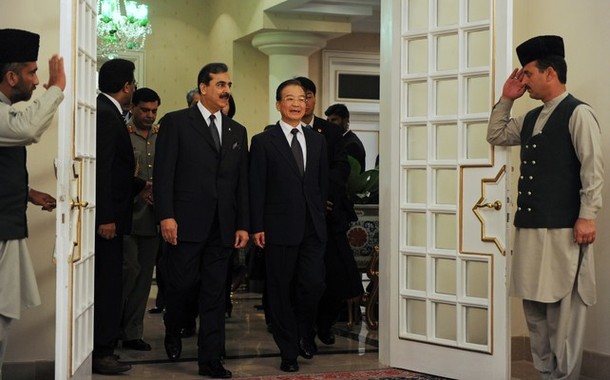
But the China is reluctant to admonish Pakistan in public because it is gaining clout over the country's economy. Two months ago, Pakistan transferred its strategically located deep-sea Gwadar port to China. To please China, Pakistani President Zardari aligned his country's financial regulations to match those of China, and a free trade agreement was signed in 2006. He has also given Chinese investors privileges on investments in Pakistan, and special economic zones are created specifically for the Chinese.
China has recently pledged to greatly increase its investment in Pakistan, from $7 billion to $30 billion a year. The Chinese are investing in everything in Pakistan from energy, infrastructure, agriculture to the technology sectors. They have helped Pakistan build the port of Gwadar in Balochistan, and the Karakoram Highway bridging northern Pakistan to western China. This connect China to the Arabian Sea and Strait of Hormuz, a gateway for a third of the world's traded oil.
State-owned China Mobile now have 15 percent market share in Pakistani telecom market, up from 9 percent in 2011. The Chinese are currently handling 35 mega projects in Pakistan, investing $36 billion, over the course of five years from 2011 to 15. It includes 13 projects by the public sector, and 22 by the private sector.

China invests into everything in Pakistan, including taking control of its strategic port
The projects include: energy, oil and gas, mining, infrastructure development, power - including projects based on coal, hydel electricity - and gas, information technology, electronics, telecommunications, chemicals fertilizers, value-added textile manufactures, automobile assembly, automotives, agricultural implements, agriculture and agro-based industry, pesticides, cool chains, food and fruit processing, and packaging, livestock and dairy farming.
Chinese companies have also expressed interest to control Pakistan's Thar coalfield - the 6th largest coal reserves in the world, after Prime Minister Yousuf Raza Gilani invited them to tap into the country's massive energy resources.
Investments from China however, did not go without controversies. Some politicians and activists feared a Chinese economic domination of Pakistan, accusing China of trying to be a new colonial power. Bashir Qureshi, a politician in his late 40s and an outspoken critic of Chinese economic activities in Pakistan, died unexpectedly last year. His last speech was directed against China: "The enemy won't break us. Long live Sindh." There is no evidence linking China to Qureshi's death.

From 2013 onwards, Chinese studies is to made compulsory in the Sindh province of Pakistan
Qureshi was opposing the Chinese mega construction project in Zulfiqarabad, a 1 million-acre industrial megacity that is designed to be some sort of quasi Chinese special economic zone in Pakistan. The government of the Pakistani province of Sindh decreed that learning Chinese would be compulsory in schools from 2013 onwards.
Others believe China is good for Pakistan. Maleeha Lodhi, former Pakistani ambassador to the U.S. and Britain, says that the money couldn't come at a better time. "Let's face it: Foreign direct investment into Pakistan has plunged to a historic low," she says. "In this environment, when you have China - the second-largest economy in the world - stepping up to the plate and saying, 'We're prepared to help you,' at a time when others are shy of coming into Pakistan, I think that more than offsets the fears that some may have."
That is exactly the thoughts of those middle class students rushing to learn Mandarin. Mushtak Ahmed, 19, said he has enrolled under Rashid, the teacher who taught Chinese for 30 years, because of the Chinese economic influx into Pakistan's northern province of Gilgit-Baltistan, where China is widening the highway to its border. "Lots of Chinese people are coming to our area and they just speak Chinese and we cannot understand it... so there is a need for translators," he said.

Religious violence wrecked Pakistan and turned it into one of the poorest in Asia
Pakistan is the second most populous Muslim country after Indonesia, who is fighting to reduce the economic power of its ethnic Chinese. The Chinese is estimated to control 70 percent of the Indonesian economy and make up 20 of the 25 wealthiest Indonesian billionaires listed in Forbes 2013.
Regarded as the mightiest Muslim state - the only one equipped with nuclear weapons, Pakistan is now a mere shadow of its past. In the 1960s, Pakistan's average economic growth rate outperformed the rest of the world. Average annual real GDP growth rates was 6.8 percent and the country was seen as a model of economic development across the globe. There was much praise for its economic progression, and the talks about a potential Muslim industrial power like that of Japan.
Karachi was seen as an economic role model around the world at that time, and many countries sought to emulate Pakistan's economic planning strategy. One of them is South Korea, whose living standard was no better than African state of Ghana in the 1960s, copied the city's second "Five-Year Plan" and modeled the World Financial Center in Seoul after Karachi.
The entire Pakistani economy isn't worth more than a Hong Kong
But the so-called "Pakistani golden age 1960s" faltered as fast as it ascended. After decades of economic mismanagement and religious violence, various East Asian countries that were behind Pakistan in the 1960s have surged far ahead in most economic and social indicators today. South Korea for instance, now has a per capita income 12 times higher than Pakistan and an economy 5 times bigger despite having a population of only 50 million compared to Pakistan's 180 million. Even the poorest of East Asia, North Korea, has a better per capita GDP than Pakistan.
By 1969, Pakistan’s manufactured exports were higher than the exports of Thailand, Malaysia and Indonesia combined. International observers speculated the possibilities that over the next two decades, Pakistan would emerged as another Asian miracle economy. In 2012 however, any one of the three mentioned countries (Thailand, Malaysia and Indonesia) could easily beat Pakistan. All of them individually export at least $200 billion worth of goods while Pakistan $31 billion.
Even though Pakistan is the sixth most populous in the world with 180 million people, its economy, measured in nominal GDP, is smaller than Singapore and Hong Kong. Extremist militancy and terrorism have effectively derailed the economy and brought the country to its knees. 50 years ago, per capita income in Pakistan was 3 times that of India. Today, India is 25 percent richer than Pakistan.

Pakistani middle class, fed up with religious extremism, see China as an economic model
The country who was once touted as potentially the first modern Muslim industrial powerhouse is now wrecked by tribal strife and terrorism, with a mere literacy rate of 55 percent - the third lowest in Asia after Afghanistan and Bhutan. Human Development Index (HDI) is worse than neighboring India, and 60 percent of Pakistanis under absolute poverty. It is of no wonder the country's middle class is seeking for guidance from China.
Source:
http://sg.news.yahoo.com/pakistan-middle-c...-062731054.html
http://www.ndtv.com/article/world/in-pakis...-chinese-339842
http://tribune.com.pk/story/517662/pakista...comment-1385995
http://shanghaiist.com/2013/03/09/pakistan-chinese.php
http://www.khaleejtimes.com/displayarticle...ernational&col=
http://dawn.com/2013/03/08/for-many-pakist...s-the-new-west/
http://articles.timesofindia.indiatimes.co...nis-china-costs
http://www.worldfinance.com/inward-investm...ntinues-to-grow
http://www.taipeitimes.com/News/biz/archiv...3/10/2003556690
http://www.npr.org/2012/08/21/159531740/ch...some-pakistanis
http://www.chinadaily.com.cn/cndy/2011-05/...nt_12545018.htm
http://www.thenews.com.pk/Todays-News-6-16...sights-on-China
This post has been edited by rivost: Mar 11 2013, 09:04 AM
 Quote
Quote













 0.0304sec
 0.68
0.68
 5 queries
 GZIP Disabled