The video above is what the Navy’s top officers view as the future of their dominance on the surface of the world’s waterways. A laser cannon, its magazine limited only by the amount of energy pumped into it and costing pocket change to fire, punching through an adversary’s cheap anti-ship weapons — at the speed of light.
Long in testing and even older in ambition, the chief of naval operations, Adm. Jonathan Greenert, triumphantly heralded the dawn age of the shipboard laser gun during the Navy’s annual conference outside Washington. In tests aboard the destroyer USS Dewey last summer off the California coast, the Laser Weapon System successfully shot down surveillance drones and fast boats in its first round of sea trials aboard a surface combatant, according to Rear Adm. Thomas Eccles, one of the Navy’s top engineers. (Three of the shoot-downs were aboard the Dewey, while nine others happened on shore, Eccles clarifies.)
“This system,” Greenert told the naval community at the Sea Air Space conference, showing the above video to a hushed crowd, “it works.”
The tubular Laser Weapon System (LaWS) is a solid-state laser that’s been in development for six years, at a cost of $40 million. It’s a directed-energy descendent of the the radar-guided Close In Weapons System (CIWS; it rhymes with “Gee Whiz”) gun already aboard surface ships. In December, following the successful Dewey tests, Greenert ordered the laser “out to the fleet for an operational demonstration,” said Rear Adm. Matthew Klunder, the Navy’s chief of research. And so next year, LaWS will have its trial by fire, when the Navy puts it on the deck of its new afloat staging base USS Ponce for its maiden voyage to the Middle East — right in Iran’s backyard.
It just so happens that the LaWS’ ability to track and kill surveillance drones and swarming fast boats matches with Iran’s development of surveillance drones and swarming fast-boat tactics. And it just so happens that the Ponce will spend most of 2014 deployed in Iran’s backyard. Neither Klunder nor Eccles will come out and say it exactly, but the maiden deployment of the LaWS has immediate implications for the U.S.’ ongoing sub rosa conflict with the Iranians — and provides a new weapon for the Navy at a time when it’s had to scale back its aircraft carrier presence off of Iran’s shores.
“Any country that operates the kinds of threats this system is designed to deal with should pause and say, ‘If the United States Navy can take a challenge like that and muster the scientific expertise from industry, academia and inside the government and pull together a solution that can be fielded as rapidly as this one’s been fielded, and go from a test environment directly to a forward-deployed unit for demonstration in the field and in the Fifth Fleet,’” Eccles said, “they should recognize that when we say ‘quick-reaction capability’ we truly deliver on a quick reaction capability.”
Within initial limits. The Navy won’t say just how many kilowatts of energy the LaWS’ beam is, but it’s probably under the 100 kilowatts generally considered militarily mature. The fact that LaWS can kill a surveillance drone and a fast-attack boat has more to do with the vulnerabilities of those systems than it its own prowess. It cannot stop an anti-ship missile, and its beam, about the circumference of a dime, will do little more than singe a fighter jet. And there remain significant challenges with cooling a shipboard high-energy laser, a necessary safety feature.
But Greenert, Eccles, and Klunder are confident that the next wave of Navy lasers will be more powerful. The laser programs, long in development, lacked focus for years: should the Navy do the harder work of developing a vastly more powerful Free Electron Laser; or get the less impressive but more practical solid-state lasers into the fleet first? The threat of a congressionally-mandated death helped answer the question in favor of the latter, which use crystals or glass to generate their beams — as did a successful 2011 test with a different laser system on a ship.
Integrate the lasers on ships today, the Navy’s thinking goes, and they’ll become lasting features aboard the cruisers, destroyers, afloat staging bases and other surface ships of the future, in increasingly powerful variants. Sailors on the Ponce will be using the LaWS, not lab technicians, allowing them to generate tactics, techniques and procedures for laser weaponry; and integrating the lasers into the other systems on the ship.
The LaWS presently generates its own power. “As we move into future fielding, the opportunity is there to go into the ship’s power grid,” Eccles says — a key step to eventually scale up to a megawatt’s worth of power, which can burn through 20 feet of steel in a second. Generating that level of power, still an engineering challenge, will allow the Navy to neutralize anti-ship missiles and fighter jets. Klunder said he believes that while getting up to a megawatt is “certainly part of a longer-term future, there’s a power level significantly less than that that will give us greater effects” against similar challenges.
But the biggest advantage that Eccles and Klunder advertise for the age of the laser weapon is financial. “We’re not talking about something that costs millions of dollars or multi-thousands of dollars,” said Klunder. “We’re talking something — and this is true data; remember, I’m a test pilot, so I deal in data, I don’t deal in PowerPoints, I deal in real performance data — we’re talking about a pulse of directed energy that costs under a U.S. dollar.” Greenert beamed as he noted that the Navy’s shipboard gun and missile arsenal, at its cheapest, costs $5,000 per shot.
A lot about that cost figure depends on successful integration aboard a ship’s deck; successfully drawing from a ship’s power without compromising the propulsion systems; and the cost of fuel per shot. And it also factors out the cost of the weapon itself. But if it turns out to be genuine, the Navy will have developed the rare high-end weapons system that undercuts the cost of adversary weapons.
The big concern in surface warfare is that anti-ship missiles are way cheaper than ships. The Navy can’t make ships cheaper. (Let’s be real.) But it might be able to develop a countermeasure to those anti-ship weapons cheaper than those weapons themselves. “I have the ability now, with a directed energy pulse weapon, to take out something that may cost millions of dollars, or multi-thousands of dollars, with a weapon round that costs about one dollar to shoot,” Klunder said.
As the Navy sees it, that’s the ultimate promise of laser guns: a weapon that undercuts the increasing cheapness and availability of powerful missiles and robots. It’s by no means certain that the Navy can realize the promise. But it’s now fully committed to trying.
“Could, someday, [the LaWS] be missile defense? Perhaps,” Greenert said. “I want to get it out to the environment so it can one day deploy.”
i dont see the purpose of drone heli.... better off using RC heli with camera.
A drone heli is very useful for small patrol ship under 1500tonnage displacement which is too small to land an actual heli. such drone heli can use to scout small island is suspicious activities spotted for example of scenario.
QUOTE(cks2k2 @ Apr 16 2013, 10:15 PM)
google: Kedah Class is armed with an Oto Melara 76mm medium range gun at the front and an Oto Melara 30mm short-range gun fitted at the aft side of the vessel. It also has provisions to add Exocet MM40 surface-to-surface missile system and SeaRAM anti-ship missile defence system.
don't see any vertical launchers, so no AA missiles. no surprise since only patrol vessel.
It can be fitted with VLS. probably a 8 cells.
QUOTE(hafizushi @ Apr 16 2013, 11:42 PM)
that what I thought this kedah class should hv at least exocet in place, I mean if it just gun then no point having warship this day where everything fight in long range type of warfare
hope they put exocet in future
We currently pushing the government to upgrade the Kedah class. new radar + SSM. possible SAMs if we are getting enough funding for it.
QUOTE(kerolzarmyfanboy @ Apr 17 2013, 07:33 PM)
what happen to the RM27bil that was supposed to fund the last NGPV program? surely all are not wasted on trying to save the late PSC corporation rite..must have some leftover's money..
The contract signed for 27 ship worth RM27bil. first stage we build 6 kedah class. PSC failed and the whole company were being taken over by Boustead instead. currently Government still ties with the contract of building 27ships with boustead already honors the first 6 kedah class. and currently undergoing another 6 gowind class. which means we are going to have 15more ship to go.
Royal Malaysian Navy Gowind class Corvettes for LCS program to be fitted with stealth 57mm Guns
» Click to show Spoiler - click again to hide... «
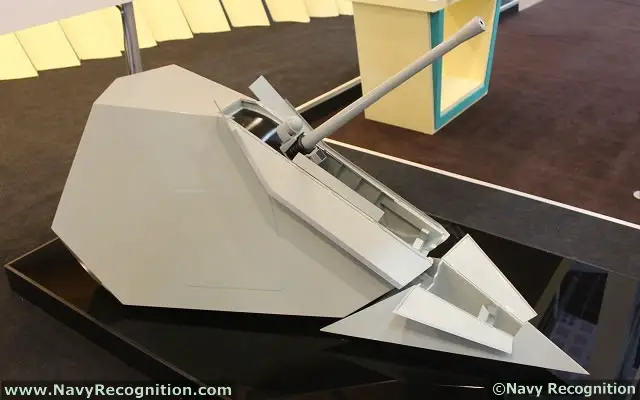
At the Langkawi International Maritime and Aerospace exhibition 2013, Navy Recognition exclusively learned that the 6 future Gowind class Corvettes (Littoral Combat Ship program) will be fitted with 57mm Mark 3 main guns with stealth cupola from BAE Systems Bofors. We also took the opportunity to get the latest updates on the Malaysian LCS program from Anuar Murad, Director of Defence and Security at Boustead Heavy Industry Corporation.
Anuar Murad, Director of Defence & Security Division at BHIC, gave us the latest updates on the Gowind design for the Royal Malayasian Navy Littoral Combat Ship program.
It was confirmed during LIMA that the combat management system will be the SETIS by DCNS, the Fire Control Systems will be provided by Rheinmetall, and the engines will be provided by MTU. The design seems to have increased in size with the length of the LCS now at 111 meters (compared to 107 as previously reported) with a displacement of about 3,000 tons (compared to full load displacement of 2,730 tonnes as previously announced).
Integrated with SETIS, a combat system derived from FREMM class Frigates, Gowind Combat can tackle air, surface and submarine threats. The shock-resistant platform (built according to military standards), the small radar cross-section together with an excellent acoustic signature makes it a high-performance surface combatant.
Gowind Combat can be operated by a limited crew and has been designed to offer great at-sea availability and reduced life cycle costs.
At the Langkawi International Maritime and Aerospace exhibition 2013, Navy Recognition exclusively learned that the 6 future Gowind class Corvettes (Littoral Combat Ship program) will be fitted with 57mm Mark 3 main guns with stealth cupola from BAE Systems Bofors. We also took the opotunity to get the latest updates on the Malaysian LCS program from Anuar Murad, Director of Defence and Security at Boustead Heavy Industry Corporation. During LIMA 2013 a Letter of Award was signed for the procurement of BAE Systems Bofors 57mm Mark 3 with stealth Cupola. In this picture taken during LIMA 2013, the gun is seen in open position.
BHIC Bofors Asia Sdn Bhd, the joint venture between Boustead Heavy Industries and BAE Systems (Bofors Asia), created in 2004, is set to benefit following the award to BAE Systems of a sub-contract for the sale of six 57mm Mk 3 naval guns for the Royal Malaysian Navy in a deal worth approximately RM175m.
The contract ‘letter of award’ was granted to BAE Systems during LIMA 2013 by the systems integrator, Contraves Advanced Devices, which is a joint venture between Boustead Heavy Industries and Rheinmetall Air Defence AG.
The 57mm naval gun, designed by BAE Systems in Karlskoga, Sweden, will equip the Malaysian Navy’s Second Generation Patrol Vessel – Littoral Combat Ships (SGPV-LCS). The contract includes ammunition hoists, simulator and initial support.
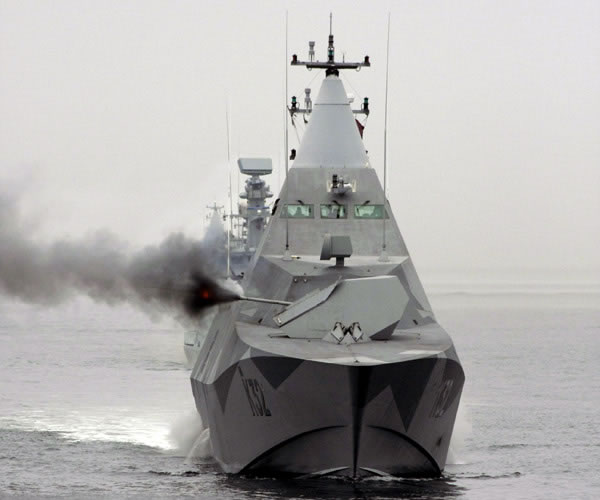
The 57mm Mk 3 naval gun with stealth cupola is already fitted on the Royal Swedish Navy Visby class stealth corvettes. Like on the Visby class, the stealth cupola will greatly contribute to lower the stealth signature of the Malaysian Gowind corvettes. An engineer from BHIC Bofors Asia SDN. BHD. told us during LIMA 2013 that the shape of the stealth cupola for the Gowind Corvettes will slightly differ from the one found on the Visby class to maximize the stealth characteristics of the corvette designed by DCNS.
At the Langkawi International Maritime and Aerospace exhibition 2013, Navy Recognition exclusively learned that the 6 future Gowind class Corvettes (Littoral Combat Ship program) will be fitted with 57mm Mark 3 main guns with stealth cupola from BAE Systems Bofors. We also took the opotunity to get the latest updates on the Malaysian LCS program from Anuar Murad, Director of Defence and Security at Boustead Heavy Industry Corporation.
HMS Helsingborg (Visby class Corvette) opens fire with its 57mm Mark 3 cannon Picture: Royal Swedish Navy / Jimmie Adamsson
A drone heli is very useful for small patrol ship under 1500tonnage displacement which is too small to land an actual heli. such drone heli can use to scout small island is suspicious activities spotted for example of scenario. It can be fitted with VLS. probably a 8 cells. We currently pushing the government to upgrade the Kedah class. new radar + SSM. possible SAMs if we are getting enough funding for it. The contract signed for 27 ship worth RM27bil. first stage we build 6 kedah class. PSC failed and the whole company were being taken over by Boustead instead. currently Government still ties with the contract of building 27ships with boustead already honors the first 6 kedah class. and currently undergoing another 6 gowind class. which means we are going to have 15more ship to go.
but why we opt for Gowind instead of sigma 10614, I mean what are the reason is it because price?
I prefer we get MEKO CSL instead. anyway. Sigma, meko csl, even boustead own meko design all lost in the bidding. the reason were not disclosed.
widely know in Defance industry... Germany not select due to political reason... believe is bcos germany support NGO funding.... gov not really happy on it.
widely know in Defance industry... Germany not select due to political reason... believe is bcos germany support NGO funding.... gov not really happy on it.
the whole issue happen after the SGPV announcement. The Gowind chose more likely because many high ranking like the design. During the bidding the wind on gowind were blowing so hard.
USS Freedom arrives in Singapore as part of US 'pivot' By Mariko Oi BBC News, Singapore
A US Navy ship has arrived in Singapore as part of US plans to increase its military presence in the region. The USS Freedom will be stationed in South East Asia for 10 months. It joins the US 7th Fleet, which is responsible for more than 48 million sq miles (124 million sq km) in the Pacific.
By 2020, 60% of the US Navy's assets will be deployed to the Asia-Pacific as its forces leave Iraq and Afghanistan. China views the move with concern.
"It is the much talked about 'pivot' or rebalancing of the US policy towards Asia," said Nicholas Fang, executive director of the Singapore Institute of International Affairs.
"The US wants to maintain a stable open sea trade lane which is important for global trade and the US economy but it also shows that it is committed to the stability of the region." 'Existing relationship'
According to the US Navy, the US 7th Fleet's area of responsibility covers 35 maritime countries including those involved in the current crisis on the Korean peninsula such as China, and North and South Korea. The fleet's home port is in Yokosuka, Japan.
Sitting at the Changi naval base in the east of Singapore, the USS Freedom looks enormous but it is in fact one of the smallest combat ships the US has.
"It is the first ship of its kind," said Rear Adm Thomas Carney, commander of the US Navy's Logistics Group Western Pacific.
The USS Freedom is known as a littoral combat ship, designed to operate in shallow water close to shore. It also requires a much smaller crew of fewer than 100 which allows the Navy to cut costs.
"Its capabilities are very closely matched to many of the other navies in the region, and deploying it out here to South East Asia gives us the opportunity to test what it can and cannot do," Rear Adm Carney said.
During its deployment, it will participate in joint military exercises with most South East Asian nations, which tend to operate on a much smaller scale.
The USS Freedom is one of four littoral combat ships which Singapore has agreed to host on a rotational basis.
'Pockets of unrest'
Its arrival in Singapore coincides with escalating tensions in the region and continuing threats from North Korea, although it is unlikely the vessel will be deployed to the Korean Peninsula in the near future.
According to Mr Fang, many countries in the region will find the US military presence reassuring.
"Threats from North Korea are not new but we have seen other little pockets of unrest such as the situation in Sabah, Malaysia, which had cross-border tensions with the Philippines," he notes.
But one country which has repeatedly expressed its objections over America's military "pivot" to Asia is China.
In its defence white paper released on Tuesday, China accused the US of destabilising the region by strengthening its military alliances.
"There are some countries which are strengthening their Asia-Pacific military alliances, expanding their military presence in the region and frequently making the situation there more tense," the report said, referring to the US.
Military spokesman Yang Yujun told reporters that such moves "do not accord with the developments of the times and are not conducive towards maintaining regional peace and stability".
During Chinese President Xi Jinping's recent visit to Russia, China also agreed to buy 24 fighter jets and four submarines in what was reportedly its first large-scale military purchase from Russia in a decade.
The state-run China Daily described the visit as China's own "pivot" to Moscow.
"China's views are very clear and they see the US involvement in the region as not in their interest," says Mr Fang.
"But what the USS Freedom is suited for - closer operations with smaller navies in the region - signals that it is not necessarily a force for offensive action or intimidation but it is a force for collaboration and co-operation."
"It can also be interpreted as a way to co-operate more with its allies and build a more balancing effect vis-a-vis China," he added.
While the US cuts military spending, China has become the world's second largest spender. Its defence budget has increased 175% since 2003 according to the Stockholm International Peace Research Institute.
the whole issue happen after the SGPV announcement. The Gowind chose more likely because many high ranking like the design. During the bidding the wind on gowind were blowing so hard.
it happened on 2010, and gov should know about it ... SGPV gowing LOI to bousted on end Dec 2011. i also heard alot defance industry people said like that. for me i think we should get something like 3300tons, not 2700tons, MICA VLS too weak performance
This post has been edited by waja2000: Apr 18 2013, 12:52 PM
it happened on 2010, and gov should know about it ... SGPV gowing LOI to bousted on end Dec 2011. i also heard alot defance industry people said like that. for me i think we should get something like 3300tons, not 2700tons
The whole issue break out in 2012. __________________
For SAMs high probably we going to get ESSM. SSM we might get NSM.
Anyway the initial requirement 2750tonnage. later they increase the budget and the initial requirement from 2750tonnage to over 3000tonnage
This post has been edited by yinchet: Apr 18 2013, 12:56 PM
The whole issue break out in 2012. __________________
For SAMs high probably we going to get ESSM. SSM we might get NSM.
Anyway the initial requirement 2750tonnage. later they increase the budget and the initial requirement from 2750tonnage to over 3000tonnage
not only SGPV, i heard germany defance product will not consider by ATM in future .... hopefully SGPV at lease come with aster 15/30 16 hole VLS. not current 2750tons with mica 8 VLS, 8 vls too little liao.
not only SGPV, i heard germany defance product will not consider by ATM in future .... hopefully SGPV at lease come with aster 15/30 16 hole VLS. not current 2750tons with mica 8 VLS, 8 vls too little liao.
2750tonnage can put 32cell if we are going for Sylver A43.
This post has been edited by yinchet: Apr 18 2013, 01:08 PM
2012 Was the Year of the Drone in Afghanistan By Spencer Ackerman
An armed MQ-9 Reaper drone taxis on an Afghanistan runway, November 2007. The drones have been busier in Afghanistan in 2012 than ever before. Photo: U.S. Air Force
The soldiers and marines are packing their bags. The pilots are sitting on the tarmac. But the armed robotic planes are busier than they’ve ever been: Revised U.S. military statistics show a much, much larger drone war in Afghanistan than anyone suspected.
Last month, military stats revealed that the U.S. had launched some 333 drone strikes in Afghanistan thus far in 2012. That made Afghanistan the epicenter of U.S. drone attacks — not Pakistan, not Yemen, not Somalia. But it turns out those stats were off, according to revised ones released by the Air Force on Thursday morning. There have actually been 447 drone strikes in Afghanistan this year. That means drone strikes represent 11.5 percent of the entire air war — up from about 5 percent last year.
Never before in Afghanistan have there been so many drone strikes. For the past three years, the strikes have never topped 300 annually, even during the height of the surge. Never mind 2014, when U.S. troops are supposed to take a diminished role in the war and focus largely on counterterrorism. Afghanistan’s past year, heavy on insurgent-hunting robots, shows that the war’s future has already been on display.
It’s not just that the drone war in Afghanistan is so big. It’s that the broader air war is winding down. As the chart above shows, the Air Force flew fewer intelligence, surveillance and reconnaissance missions in 2012 than it did in 2011, although the number of spy missions in 2012 is still greater than in 2010 or 2009. This year has seen over 1,000 fewer aerial attacks, by manned and remotely piloted aircraft alike, than there were during the surge years of 2010 and 2011. Total sorties are even lower than their 2009 levels. The only exception to the downward slope: drone strikes.
That suggests a pattern that may endure through the next two years of troop reductions. As the humans leave, the robots take up the slack.
The U.S. and Afghanistan have begun negotiations on what a residual troop presence is supposed to look like. So far, it’s believed that the Pentagon wants to leave behind between 5,000 and 10,000 troops, to continue to train the Afghan military, hunt terrorists and generally ensure Afghanistan doesn’t collapse. And before the New Year, Gen. John Allen, the outgoing commander of the war, is supposed to recommend to President Obama how fast next year’s troop drawdowns ought to proceed. Pentagon officials insist nothing’s etched in stone.
But we might not have to wait for 2014 to see the future of the Afghanistan war. “We may well see the development of counterterrorism become more important as time goes on,” Allen told the Senate last year. This year proved Allen wasn’t blowing smoke. U.S. special operations forces underwent a major command overhaul and now operate out of a private base run by the company formerly known as Blackwater. Super-sizing the drone war is fully in line with that broader shift. This may have been the year of the drone in Afghanistan, but the drones aren’t going home any time soon.
Joined: Jun 2007
From: 3°50'**.**"N - 103°16'**.**"E
QUOTE(yinchet @ Apr 18 2013, 12:42 PM)
the whole issue happen after the SGPV announcement. The Gowind chose more likely because many high ranking like the design. During the bidding the wind on gowind were blowing so hard.
IINM German company was found trying to sabotage the other bidding company at the end there was 2 company that left to win, it was Damen and DCNS At first the party that surely positive to win is Damen, there are already started their finalize their terms and during this process the contract talks broke down iirc Damen refuse for TOT as much as the RMN wanted (only small things iinm) while DCNS do.
IINM German company was found trying to sabotage the other bidding company at the end there was 2 company that left to win, it was Damen and DCNS At first the party that surely positive to win is Damen, there are already started their finalize their terms and during this process the contract talks broke down iirc Damen refuse for TOT as much as the RMN wanted (only small things iinm) while DCNS do.
yup these what happen back then. German were quite desperate back than their Meko CSL is the most expensive 1 among all competitors.
A drone heli is very useful for small patrol ship under 1500tonnage displacement which is too small to land an actual heli. such drone heli can use to scout small island is suspicious activities spotted for example of scenario. It can be fitted with VLS. probably a 8 cells. We currently pushing the government to upgrade the Kedah class. new radar + SSM. possible SAMs if we are getting enough funding for it. The contract signed for 27 ship worth RM27bil. first stage we build 6 kedah class. PSC failed and the whole company were being taken over by Boustead instead. currently Government still ties with the contract of building 27ships with boustead already honors the first 6 kedah class. and currently undergoing another 6 gowind class. which means we are going to have 15more ship to go.
so the RM27bil is already exclusively given to the navy for the NGPV then? kita tak guna or xpayah tggu budget baru la maksudnya for the NGPV?
so the RM27bil is already exclusively given to the navy for the NGPV then? kita tak guna or xpayah tggu budget baru la maksudnya for the NGPV?
bukan macam itu. During that time, The whole project going to build phased by phased. Money were not given. cuma contract signed sign aje. "contract worth" and "money given" is a huge differ there.
probably we will use the same design as the USS freedom. the stealth gun is not expensive. widely use now days. yes there will be. probably after AV8. after 2015.
2750tonnage can put 32cell if we are going for Sylver A43.
hopefully can see final design soon .... at lease 16 cell VLS acceptable ..... just i think hard to accept sgpv cost USD 500mil per-ship with 8Cell compare to DCNS offer Fremm to Greece less than usd 500m with 32 Cell VLS and land attack missile


 Apr 18 2013, 03:56 AM


 Military Thread V8, Ops Daulat
  Quote
Quote







 0.0341sec
 0.71
0.71
 5 queries
 GZIP Disabled