

Wow, you a lego employee?

QUOTE(sherwin @ Dec 20 2012, 10:44 AM)
A rare Ole Kirk's house set given to Lego employees for the holidays 

» Click to show Spoiler - click again to hide... «

Toys The Official LEGO Enthusiast Club V5, Vroom...
|
|
 Dec 20 2012, 11:02 AM Dec 20 2012, 11:02 AM
Return to original view | Post
#1
|
 
Senior Member
633 posts Joined: Apr 2006 
|
Wow, you a lego employee? QUOTE(sherwin @ Dec 20 2012, 10:44 AM) A rare Ole Kirk's house set given to Lego employees for the holidays » Click to show Spoiler - click again to hide... « |
|
|
|
|
|
Dec 24 2012, 10:25 PM
Return to original view | Post
#2
|
|
Senior Member
633 posts Joined: Apr 2006
|
Anyone knows offhand which HOBBIT sets will complete the whole team of dwarves? I noticed it stops at 79003 and then jumps to 79010. Where are the in-betweens (79004 to 79009)? |
|
|
Dec 27 2012, 11:58 AM
Return to original view | Post
#3
|
|
Senior Member
633 posts Joined: Apr 2006
|
Kastam issue ... infamous topic in world of collectibles. Kena hold up - $$$ , but if never kena feel like strike lottery. Some pics of upcoming 2013 back to future :    |
|
|
Dec 29 2012, 10:04 PM
Return to original view | Post
#4
|
|
Senior Member
633 posts Joined: Apr 2006
|
Which set is this? Looks nice QUOTE(sherwin @ Dec 29 2012, 09:30 PM) Finally opened the Winter boxes after keeping them sealed for over a year  » Click to show Spoiler - click again to hide... « |
|
|
Jan 2 2013, 10:28 PM
Return to original view | Post
#5
|
|
Senior Member
633 posts Joined: Apr 2006
|
For minifigs, sorry for japan collectors ... their TRU protect the packets in gashapon capsules. Cannot raba raba. 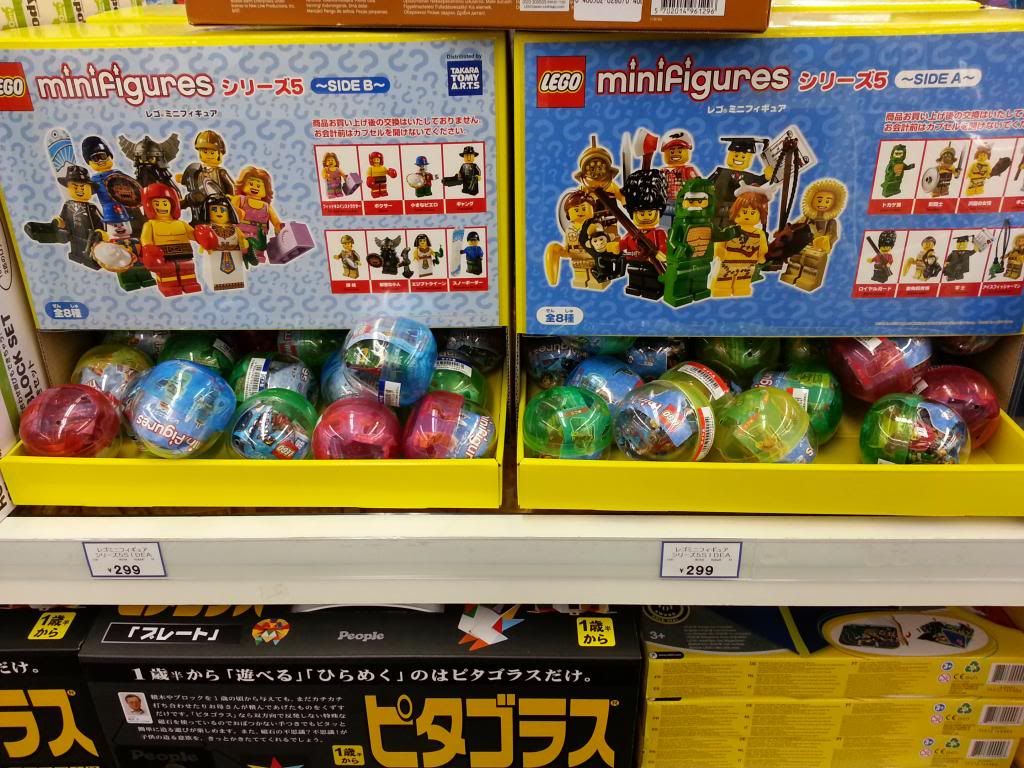 |
|
|
Jan 4 2013, 10:26 AM
Return to original view | Post
#6
|
|
Senior Member
633 posts Joined: Apr 2006
|
Have you guys seen this article before? What do you think? Really good investment?
http://www.usatoday.com/story/money/busine...profit/1732525/ QUOTE Just as stock investors have portfolios of all different sorts of stocks, Lego investors hold massive collections of Lego sets and can make annual profits that beat stocks. Investors understand the value of stocks and bonds. But Lego bricks? Those ubiquitous interlocking bricks, usually seen stuffed in closets, tucked under toy boxes and scattered across playrooms, aren't what most people typically think of as an investment. But to some, like David Schooley, Lego bricks are serious money, and buying them and selling them, just as some investors trade stocks, is turning into a way to turn a profit, brick by brick. Schooley, a 49-year-old information technology professional in Memphis and father of six, is one of small but growing niche of people who buy and hold Lego bricks, not as toys, but investments that will appreciate when sold later. Just as stock investors have portfolios of all different sorts of stocks, Lego investors hold massive collections of Lego sets. Schooley, for instance, has more than 3,000 Lego sets piled high in a climate-controlled storage facility. Most of the sets he bought years ago, with the plan of selling them a year from now for a profit. Doing this again and again generates Schooley a tidy 10% to 15% annual profit, he says. That tops even the 10% long-term average return of stocks. "You start to realize these are worth a lot of money," he says. "It's more of an investment." Investing in Lego bricks may sound ludicrous to those who see them just as kids' toys. But savvy investors can get a big score if they know how to buy the toys from stores, hold them and then sell them online later. It's not just a theory. Let's say two investors had $10,000 to invest at the end of 2011. One investor bought 174 shares of the Vanguard S&P 500 index exchange traded fund for $57.45 apiece, while the other bought 100 boxes of the Emerald Night Lego train set for $99.99 apiece. The Emerald Night is a 1,085-piece Lego set that, when built, looks like a classic steam engine with a tender and a passenger car. Fast forward to today. The stock investors would have done pretty well, with a 15% gain, including dividends paid. But the Lego investor would be able to sell the Lego Emerald Night trains for $203 each, for a total 103% profit. In other words, the Lego train would have outperformed the stock market by 587%. And that's not an anomaly. Lego bricks, have become lucrative investments due to a confluence of bullish factors. Driving the market is the strong underlying demand for Lego bricks and sets. The toys are craved by older consumers, who now have their own money to spent on the sets rather than waiting for a birthday gift. Building toy sets are also a fast-growing corner of the toy business for young kids. Americans spent $1.6 billion on building-set toys last year, up 23%, from 2010, the latest data available from industry tracker The NPD Group. Building-set toys account for nearly 10% of all toys sold. And while Lego does have some competition in the business, the rivals are bit players and come nowhere near Lego's dominance. Lego possibilities galore Meanwhile, there's a new cadre of Lego consumers growing up. The Lego universe is reinforced not just by the hundreds of building sets on the shelves at major retailers, but by a multimedia push. There are several lines of Lego sets that are tied to popular movies and TV shows, including Star Wars, Harry Potter, Lord of the Rings, and soon, even the Teenage Mutant Ninja Turtles. There are sets that look like haunted houses, ninja battlegrounds and there's even a line designed for girls with pastel-colored bricks and female figurines. But such product tie-ins are just the start. Cartoon Network runs Lego-themed shows all day, with characters made out of Lego bricks, or so-called minifigs, or mini-figures. There's also a line of Lego-themed video games that allow players to traverse digital terrains made out of Lego bricks and tied to popular characters such as Batman and Harry Potter. Yet, what makes Lego bricks a potential bonanza for investors is how the Lego Group controls the supply of sets. The company often produces new sets, say a new Star Wars spaceship for a year or two, and then will stop producing it. Once popular sets are "retired," or no longer being produced, consumers who want one have no other choice than to hit eBay or other online marketplaces to buy it, often for multiples above the original price. The scarcity of desired sets can drive their prices to unbelievable heights. Huge gains for Millennium Falcon One example still considered a pinnacle success story of Lego investing is a set released in 2007 for $500, called the Ultimate Collector's Millennium Falcon. The 5,195-piece re-creation of Han Solo's battered noble star fighter from Star Wars now sells, new, for $2,165, according to data collected by BrickPicker.com, a site dedicated to Lego investors. That's a staggering 34% compound average annual gain over the five years. "It keeps ticking up. I wonder where it will stop," says Ed Maciorowski, co-founder of BrickPicker.com, and a Lego investor himself. Maciorowski has more than 3,000 sets, with an estimated value of more than $100,000, he says. He's accumulating the sets, holding onto them, waiting to sell them in a few years to accumulate money to pay for his son's college tuition. They're stuffed in his house, closets and in his office. After seeing a few of his sets skyrocket in value a few years ago, Maciorowski approached his brother Jeff a year ago, a computer whiz, to design a website that would help Lego investors boost their returns. BrickPicker keeps a "portfolio" of all the sets owned by an investor and fetches market prices by seeing how the sets are selling on online marketplaces such as eBay and Amazon. "These things are gold," Jeff says. Investing in Lego bricks, to Maciorowski, is much more prudent that most mainstream investments, especially stocks, which he isn't fond of. He narrowly ended up selling many of his stocks and other investments just before the tech bubble burst, but watched as other investors lost fortunes in paper wealth. To him, the tangibility and global appeal of Lego bricks makes them a worthwhile investment. "Even if the price of the set tanks, I still have the set," he says. "I have a couple of mutual funds, but I don't pay much attention to them." BrickPicker, though, does borrow a page from traditional investing. The site presents Lego set prices much like an online broker would spotlight stocks by providing price charts that look much like stock price charts. There are more than 9,000 Lego sets on the BrickPicker database, which is actually a bigger universe of stocks than most investors consider. For some investors, the stakes are lower. Joshua Hanlon, 16, is a high school sophomore in Osceloa, Indiana. He's holding 50 sets, which range in value from $10 to $400. He started investing a year ago, mainly after realizing he could use profit from selling sets to buy more. After making a tidy profit selling the Lego Emerald Night and a large Star Wars Republic Dropship set, Hanlon first saw the potential. Now Hanlon's parents and siblings give him money to invest in Lego bricks, too. While investors report making money, there are major perils to be aware of. One of the biggest problems is storage. Lego sets come in large boxes filled with hundreds of tiny bricks and an instruction manual. Lego investors need to keep the boxes in pristine new condition in order to get top dollar for the sets. The issue of storage can be especially problematic if a set is physically large and the Lego Group keeps producing it. The Lego Death Star set, which sells for $400, is an example. Investors keep accumulating the set, which comes in a 23-inch by 20-inch box. Investors are stockpiling the large boxes, thinking the set will be worth twice the $400 list price once the set is discontinued. But the Lego Group keeps making it, even though it was introduced in 2008. Water damage, theft and fire are also big risks, Ed Maciorowski says. Most investors must get special insurance policies that cover collectibles, because the value of most Lego portfolios exceeds the limits offered on most homeowner policies. There's also a risk that an investor won't buy the right sets. Some themes of Lego sets don't resonate with consumers, so the resale value can be below the price the investors paid. One theme, Atlantis, which featured underwater themes and vehicles, "didn't pan out," Maciorowski says. Neither did sets based on the an Egyptian theme, called Pharaoh's Quest, nor sets based on the movie Prince of Persia. There's also the risk that the Lego market might fade if consumers lose interest in the plastic bricks, Maciorowski says. And there's a constant fear by investors, who are making money, that the run will end if the Lego Group started to flood the market with more sets than the market can bear or if too many speculators buy sets and dump them at the same time in the future. Other collectible markets, like baseball cards, have crashed due to oversupply, he says. And commissions to sell the sets can be high, with Amazon and eBay taking 15% of the selling price depending on which service sellers use. So far, the Lego Group doesn't appear to have much interest in controlling the buying and selling of sets by investors, Maciorowski says. The company is primarily focused on kids, and does produce some more advanced sets that appeal to collectors. "We are very fortunate to have fans of all ages, all of whom have different passions and interests related to the Lego brand, but we don't closely follow after market activity," Michael McNally, brand relations director of Lego, says in an e-mailed response. But as long as the money keeps rolling in, investors are willing to take the bet. "I'm looking to grow and go larger scale," Hanlon says. "I've never thought about investing in anything else." |
|
|
|
|
|
Jan 4 2013, 06:14 PM
Return to original view | Post
#7
|
|
Senior Member
633 posts Joined: Apr 2006
|
Not easy to keep everything in mint condition for investment, need lots of space and $$$. Also deliver from overseas, risk of damage means loss of investment.  Need big capital, imagine buying few UCS or modulars or technics or city etc. One box already painful, imagine a few at a time. I think some sets may be risky especially star wars cos lego keep reissuing new versions eg. x-wing, tie fighter, death star, vehicles, etc.. QUOTE(littleprawn @ Jan 4 2013, 10:30 AM) Lego as investment later collector keep their set all misb without playing them~ ;p QUOTE(acougan @ Jan 4 2013, 11:53 AM) rgd the usatoday article, i guess some ppl can scalp and hoard anything when they spot a bubble. good luck to all them investors. mb next time those genneva traders will trade lego sets instead  QUOTE(alanyuppie @ Jan 4 2013, 12:16 PM) And I thought this thread is all about "LEGO AS A HOBBY". There are dedicated section for investors in LYN anyway. from gold to cows to birds nest. A new LEGO-centric thread there with members promoting their stocks wouldnt hurt  |
|
|
Jan 11 2013, 08:47 AM
Return to original view | Post
#8
|
|
Senior Member
633 posts Joined: Apr 2006
|
Anyone knows what kind of paint LEGO uses? Do they actually fade or come off after a while?
Custom stark and banner from forums ...  |
|
|
Jan 11 2013, 08:50 AM
Return to original view | Post
#9
|
|
Senior Member
633 posts Joined: Apr 2006
|
Daily Bugle revealed
» Click to show Spoiler - click again to hide... « This post has been edited by waeguk: Jan 11 2013, 08:54 AM |
|
|
Jan 11 2013, 08:53 AM
Return to original view | Post
#10
|
|
Senior Member
633 posts Joined: Apr 2006
|
Nice moc
» Click to show Spoiler - click again to hide... « This post has been edited by waeguk: Jan 11 2013, 08:53 AM |
|
Topic ClosedOptions
|
| Change to: |  0.0544sec 0.0544sec
 0.65 0.65
 7 queries 7 queries
 GZIP Disabled GZIP Disabled
Time is now: 5th December 2025 - 05:00 AM |
 Quote
Quote


