Welcome Guest ( Log In | Register )

Outline · [ Standard ] · Linear+

 Chocolate, Q&A about chocolate

views
     
missysleepy
post Apr 7 2014, 09:55 AM

Enthusiast
*****
Senior Member
718 posts

Joined: Mar 2014
QUOTE(Kenzany @ Feb 2 2012, 05:13 PM)
yes malaysia cadbury is made in malaysia. try cadbury australia, i got mine from my hometown store only selling at rm9, cold storage selling rm19  at sweat.gif

actually, self make chocolate taste best D: thats because i've made before and love it bezt  thumbup.gif
*
Hi, care to discuss and share where u bought your chocolate chips from and what brand did you used last time?
missysleepy
post May 28 2014, 04:56 PM

Enthusiast
*****
Senior Member
718 posts

Joined: Mar 2014
QUOTE(iluvlipstick @ May 28 2014, 01:24 PM)
i love the chocolate ice cream at heaven premium ice cream cake outlet located at damansara
*
have you tried Awfully Chocolate from Singapore? I had once and it's so rich and it's way heavenly than Baskin or even Haagen. Never buy any tub ice cream after that. the chocolate ice cream is so real.
missysleepy
post Dec 17 2014, 02:13 PM

Enthusiast
*****
Senior Member
718 posts

Joined: Mar 2014
QUOTE(GloryKnight @ May 29 2014, 04:48 PM)
Dark Chocolate - What constitutes a dark chocolate and what's best for a dark choco?

>70 to 80% of dark choco is best to consume on a daily basis - good for heart and some other health reasons.

Lower than that %, it is not a good dark choco.
*
hi glory, right and also wrong.
it really dependent on the roasting and conching. Pure Dark Chocolate with lesser time in the process have higher anti oxidants or flavonoid in the chocolate thus it helps heart but also depend on daily consumption or intakes.

All chocolates flavonoids will be destroyed or reduced once heat was introduced.

I think theres a trend in europe that seeks the word Pure or Organic now . Over here, many people still thought all dark chocolate percentage mades the Quality of the chocolates which were wrong.
wink.gif

This post has been edited by missysleepy: Dec 17 2014, 02:39 PM
missysleepy
post Dec 17 2014, 02:33 PM

Enthusiast
*****
Senior Member
718 posts

Joined: Mar 2014
QUOTE(nebulaguava @ Dec 8 2014, 10:16 PM)
I'm excited to see so many choc lovers in this forum. I'm somewhat of a chocolate surveyor, (other passion is durian surveyor), and i'm happy to share my findings of chocoalte brands.

First thing to understand about chocolate is that bitterness in chocolate is not desirable. Chocolate comes from cocoa, which is a tropical fruit (just like coffee berries). A good chocolate must be made from quality beans. The best beans that are produced are not sold in the commodity market, and they have to be booked or sold via contract. So only the reputable chocolate makers will buy them because of the higher price per tonne.

Good cocoa bean is like fine wine, it can be complex, it has character and flavours that are multi-faceted. So the chocolate maker's objective is to retain and bring out as much as possible the bean's complexity and flavours. This is done by careful processing, especially roasting, as over-roasting will produce a bitter chocolate.

To achieve bitterness, it is easy and cheap to do, start with a lousy bean (or broken beans with twigs, leaves, etc) and then over-roast at high temperature. Done.

A good test before buying any chocolate is to ask this question: where is your bean origin. If they say something like Belgium, Swiss, French, then they are clueless, as none of these countries grow cocoa. The more premium chocolates (one in Royce's offering, several in Lindt, most in Amedei, just an example)  are single origin. Meaning all the beans come from one region, and I don't consider a country a reagion.

Also a higher % doesn't mean better quality.  It just means more cocoa and less sugar. A 75% choc means 25% sugar (roughly, after subtracting vanilla and emulsifing agent, if any.) Read the ingredient list too, if the first ingredient is sugar, put it back on the shelf, because ingredient list is sorted by most first.

Difference between choc maker and chocolatier: Chocolate makers will acquire beans, clean, roast, winnow (deshell), mill / grind, blend, conch in the process to make chocolate. Chocolatiers most likely acquire chocolate and process into confections, by melting, tempering, flavoring, making ganache, etc.
*
nice write up, just to add . just to highlight the origin part. Single Origin chocolate have been labeled according to the country of the cocoa beans like Madagascar, Ecuador, Peru etc.

Why do we asked the origin of chocolate, to know who made my chocolates
Swiss emphasize a lot on smoothness, Belgium probably taste and aroma, French chocolate probably for details and perfect concoction of ingredients(Valrhona wins) , Italy for Nut based choc. (gianduja)


Now , the european marketing of chocolates have been making new statements and expanded further which were now using the words Local Plantation, estate or Pure chocolates . Reason: theres a collection of cocoa beans from different small planters and all those beans were mixed up before it were sent for processing. As you know , different soils and climates alter the dna of the taste. So , now those who were seeking the ultimate ONE is sourcing for one estate. Quality of chocolate is measured till this sector and not the percentage of chocolates where most people thought.

To find out a good chocolate,

since you and i knew these stuff, hopefully we can create more awareness and discussion group to expand this knowledge , what do you think if we do a meet up among those who love chocolate so much. There's so many false information spreading outside.

This post has been edited by missysleepy: Dec 17 2014, 02:46 PM
missysleepy
post Dec 25 2014, 05:23 PM

Enthusiast
*****
Senior Member
718 posts

Joined: Mar 2014
QUOTE(nebulaguava @ Dec 24 2014, 03:21 AM)
Let me qualify why I've stated that I don't consider a country a region that constitutes a single origin. That is because of the diversity found in any growing country, to the point that it is not beneficiallly descriptive to the consumer. Imagine buying a wine that is "Wine of France" rather than the expected regional labels ie "Rhone, Asace, Loire" ... The reason that "wine of france" is not acceptable is the same reason we should not stop at country origins ie "Ghana / Madagascar / Cote d'ivoire" for bean origin and insist on more specifics. Why? Because this is an indication (one of many) that the chocolate makers who source their beans cares (or not) about what happens at the plantation level where they source their beans. It is a much harder argument to make that the choc maker cares if the beans are acceptable from any growers in the country rather then specific ones.
*
Precisely , the single origin thing is just a marketing gimmick. Most chocolatiers will be keen on the specific species of the cacao beans like Criollo , fostero and trinitario . If my knowledge was correct, criollo beans the most prefered one is originated in south america and very scarce. So usually, chocolatiers needs some sort of indicators i guess about the origins. They probably assume if one has to look for real chocolatey experience, they go for south american beans as compared to south africa which has fruity and all kind of different notes . Whereas like malaysian chocolates, most trees were hybrids . Still learning, correct me if i swayed from some details. wink.gif


missysleepy
post Dec 25 2014, 05:23 PM

Enthusiast
*****
Senior Member
718 posts

Joined: Mar 2014
QUOTE(nebulaguava @ Dec 24 2014, 03:22 AM)
Oh, and yes, we should have a chocolate tasting tour. biggrin.gif
*
shall pm you soon for some tasting tour. wink.gif
this goes to any of you interested to share chocolate knowledge and improve your experience in chocolate quality and say goodbye to chocolate compound made of vegetable oil. Chocolate is made purely with their very own cocoa butter and liquor. wink.gif

This post has been edited by missysleepy: Dec 25 2014, 05:26 PM
missysleepy
post Dec 25 2014, 11:55 PM

Enthusiast
*****
Senior Member
718 posts

Joined: Mar 2014
QUOTE(nebulaguava @ Dec 25 2014, 11:33 PM)
The Ciollo, forestero and trinitario differenciation mirrors arabica, robusta, liberica.. somewhat... Just to qualify, I've made it a point to visit the plantations in central america, africa and asia, spent a couple weeks in costa rica few months back to visit various planations and the regional CATIE headquarters. http://www.catie.ac.cr/en/products-and-ser...ocoa-collection

Those categories (criollo, etc) are now superceded with some 25+ and counting dna groups. The situation is not as clean cut as wine varietals, as it is common for a single plantation to have up to 20 clone types. These clones are identified by unromantic names like CR15, BR01 etc.. Situation is the same in malaysia, I have visited two of the cocoa board HQ and they are giving out multiple clonal material to farmers, KKM25/22, PCB123 etc. In the past there could have been more cocoa hybrids as farmers were not trained on grafting. But it is safe to say that most productive farms, especially new farms now are relying on clones (much like durian), not hybrids. Assuming by hybrid you were not referring to Trinitario.

This means that the general grouping of criollo F and T is still useful in discussing in general terms the traits related with these groups, but not necessary relatable at the plantation level.

Speaking in these general terms, it is worth pointing out that the Forestero was bred out of the Criollo, and the generalization is that it was bred for larger bean size, yield, cocoa butter, desease resistance, self-polinating traits, adaptability to lower altitudes, etc, and not so much for flavanoids. In truth, the same mindset is being perpetuated here and now, where breeders are prioritizing for these quantitative traits over qualitative ones.
*
Interesting facts. Is there any chance we could get criollo pod in sabah? Yeah, pardon my mistake , instead of hybrid, it should be clone instead . Im a bit skeptical about the cloned cacao tree, i believe the aroma wont be that good as compare to those from africa and america. Well you knows better and ahead of us in the characteristics of the beans. Lets hope we could gather more people to share the chocolate knowledge and experience.
missysleepy
post Jan 1 2015, 12:29 AM

Enthusiast
*****
Senior Member
718 posts

Joined: Mar 2014
QUOTE(jimlim007 @ Dec 31 2014, 01:14 PM)
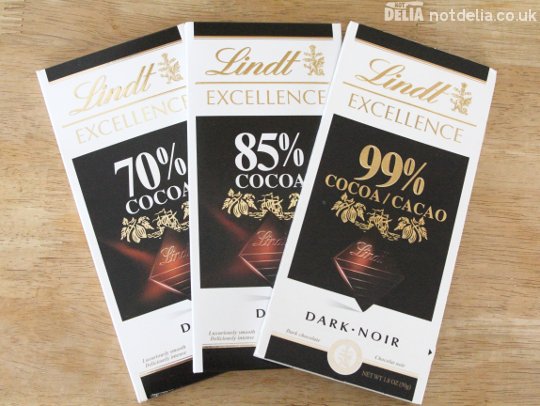
Lindt choco - go for the highest choco (taste bitter) and healthy.

85% choco 100g rm14.00 - taste very bitter
99% choco 50g  rm1400  - taste extremely bitter

take choco, take the most pure choco and not those fatty milk, high sugar, etc ingredient in choco  tongue.gif

user posted image
*
I have something to add for discussion sakeA couple of american chocolatiers i knew dont really like the taste of commercial Lindt chocolate made for the mass market. First of all, the aroma is too subtle and not even present to some . The taste of it some attest it tasted metallic or plastics. Lindt is swiss and they were famous for their milk chocolate. Do take note of other things like melt in mouth experience . Even whitakers with cocoa butter will not have good melting point due to different types of emulsifiers or additives added for shelf life . Highest percentage of cocoa can be consider good if you eat almost daily and provided you dont eat junk or fatty food like nasi lemak, it wont happen. it wont affect your overall health if lifestyles does not change.
missysleepy
post Jan 1 2015, 08:25 AM

Enthusiast
*****
Senior Member
718 posts

Joined: Mar 2014
QUOTE(nebulaguava @ Jan 1 2015, 08:11 AM)
haha, if I"m honest with myself, I enjoy ideally 75-85. Sometimes I love chocolate as low as 65 but
only if the origin and aroma is amazing. But if I'm honest with myself, the 99% or 95% is just not pleasurable
to me at all. I would taste it but I won't buy it for enjoyment.

Do you seriously find the 99% pleasurable? There are other ways to reap the benefit of cocoa without having
to eat a 99% bar, which is to incorporate cocoa nibs into your diet, you can use it as a topping in your
yoghurt, or put it in your cereal, muesli, coockies, nut mix, and vege juice (<- that's what i do).
*
Me too, i cant take even if its 85-90 % , first its too bitter and dry . Most of the dark chocolate i made starts from 60% . That way, one might not avoid dark chocolate totally. Imagine if new taster had the highest percentage of choco and dislike dark chocolate totally. When gourmet chocolate is concerned, those who were thrifty will said i dont like it after first try and its very common here. Generalizing is very common and as a chocolatier we cant avoid this stages and accept its reality. Its still an infant market in malaysia. Hopefully we can change that. icon_rolleyes.gif

This post has been edited by missysleepy: Jan 1 2015, 08:28 AM
missysleepy
post Jan 4 2015, 06:51 AM

Enthusiast
*****
Senior Member
718 posts

Joined: Mar 2014
QUOTE(nebulaguava @ Jan 1 2015, 06:59 PM)
IC. Thanks for sharing. You might be interested to know that Bitterness is a trait that is very easy for a chocolate maker to achieve, regardless of the quality of the bean,
by over-roasting the cocoa beans. Overly black chocolate, therefore is a sign of that. Sure, some people like kopi-o kao, and some look for artisan roast. To each their own. biggrin.gif

If I had presented to you with some other specialty chocolates, i wonder if you might like the more flavor-intense chocolate over the bitter-only one.
*
True. Flavors of the chocolate ,Mouth feel , smell were other significant aspects that determine the art of chocolate making . Found thisin wiki and quite an interesting read up.


Last edited 3 months ago by Deli nk
Mouthfeel
Watch this page
For the Magnapop album, see Mouthfeel (album).
Mouthfeel is a product's physical and chemical interaction[clarification needed] in the mouth, an aspect of food rheology. It is a concept used in many areas related to the testing and evaluating of foodstuffs, such as wine-tasting and rheology. It is evaluated from initial perception on the palate, to first bite, through mastication to swallowing and aftertaste. In wine-tasting, for example, mouthfeel is usually used with a modifier (big, sweet, tannic, chewy, etc.) to the general sensation of the wine in the mouth. Some people, however, use the traditional term texture. Mouthfeel is often related to a product's water activity, hard or crisp products having lower water activities and soft products having intermediate to high water activities.

Contents
Qualities perceived
See also
Further reading
External links
Qualities perceivedEdit

Cohesiveness: Degree to which the sample deforms before rupturing when biting with molars.
Density: Compactness of cross section of the sample after biting completely through with the molars.
Dryness: Degree to which the sample feels dry in the mouth.
Fracturability: Force with which the sample crumbles, cracks or shatters. Fracturability encompasses crumbliness, crispiness, crunchiness and brittleness.
Graininess: Degree to which a sample contains small grainy particles.
Gumminess: Energy required to disintegrate a semi-solid food to a state ready for swallowing.
Hardness: Force required to deform the product to given distance, i.e., force to compress between molars, bite through with incisors, compress between tongue and palate.
Heaviness: Weight of product perceived when first placed on tongue.
Moisture absorption: Amount of saliva absorbed by product.
Moisture release: Amount of wetness/juiciness released from sample.
Mouthcoating: Type and degree of coating in the mouth after mastication (for example, fat/oil).
Roughness: Degree of abrasiveness of product's surface perceived by the tongue.
Slipperiness: Degree to which the product slides over the tongue.
Smoothness: Absence of any particles, lumps, bumps, etc., in the product.
Uniformity: Degree to which the sample is even throughout; homogeneity.
Uniformity of Bite: Evenness of force through bite.
Uniformity of Chew: Degree to which the chewing characteristics of the product are even throughout mastication.
Viscosity: Force required to draw a liquid from a spoon over the tongue.
Wetness: Amount of moisture perceived on product's surface.
See alsoEdit


Dollase, Jürgen, Geschmacksschule [engl.: Tasting School], 2005 Tre Tori, Wiesbaden, Germany (ISBN 3937963200). German-language textbook by a renowned food critic covering some, but not all of the above mentionend properties/mouthfeelings.
Katz, E.E. and Labuza, T.P. (1981) Effect of water activity on the sensory crispness and mechanical deformation of snack food products. J. Food Sci. 46: 403–409

missysleepy
post Jan 6 2015, 10:31 AM

Enthusiast
*****
Senior Member
718 posts

Joined: Mar 2014
QUOTE(anzen600 @ Jan 5 2015, 09:56 PM)
Choco tasting session?  New to this wor.  Where?  Need$$?
*
like wine tasting. we can do a small gathering among us. i can bring some chocolates for tasting. you can bring your favourite chocolate if you want . some might not go back to cadbury , kit kat or even beryl base on individual taste bud. when do you guys want to do it? how bout sunday when traffic not so bad , The Curve starbuck ? just some suggestion.

missysleepy
post Jan 8 2015, 07:30 AM

Enthusiast
*****
Senior Member
718 posts

Joined: Mar 2014
QUOTE(nebulaguava @ Jan 7 2015, 07:46 PM)
Nice, do you read/speak german? The tasting literature I find useful are mostly wine education (in studying for the courts of masters sommalier certification), Gulp (Mary Roach) and Clay Gordon's book on chocolates. I run tastings almost weekly, had one before christmas at BSC, impromptu, at the wine section. I think coffee would go nicely for a casual session, at one of the specialty brew cafes.
*
No buddy, i still have lots to learn from you. Coffee indeed , im not good in coffee either but would love to study the pairing with different types of coffee. Mean while thanks for recommending the author to me. Clay gordon, chocolate life .com owner right? His site is wonderdul . We should do chocolate tasting soon.
missysleepy
post Jan 11 2015, 07:35 PM

Enthusiast
*****
Senior Member
718 posts

Joined: Mar 2014
QUOTE(nebulaguava @ Jan 10 2015, 09:00 PM)
Hey I'm organizing some chocolate education and tasting with Berjaya Hospitality school at the end of this month 28,29th. Having a guest speaker discuss origins, processes, and chocolate tasting and pairing.  Interested to join? I have limited invitations. biggrin.gif
*
Hey great! I would love to join this talk to expand my knowledge and also to get together and introduce ourselves. thumbup.gif thanks
missysleepy
post Jan 14 2015, 08:42 AM

Enthusiast
*****
Senior Member
718 posts

Joined: Mar 2014
QUOTE(nebulaguava @ Jan 13 2015, 11:07 PM)
I know how you feel about pricey food... being frugal is definitely a virtue in life haha. Having said that, I prefer quality over quantity, even on things that are free.

I skip most food not because of the financial cost but for their cost on health, being in the food line, we are faced with food 24/7. this morning I had a cheese cake tasting,
cold cheese cake in the morning, just imagine, some were made with raspberries, omg. Usually I will just spit it out but today I let myself induge because I love cheese and a good
cheesecake is hard to come by. I don't even drink the wines served during weddings, they are just empty calories, I don't buy candy-type chocolates off the shelves, which means I save quite a bit from not buying all these things like potato chips, candy, sweets, chewing gum, bad wine, bad coffee, bad tea. Then once in a while I buy a really good chocolate, really good tea, really good wine. and I prefer to pay for that one glass of wine (in calories and in RM) then 20 glasses of wine that I won't even remember after 10 minutes. Forgive the rambling.
*
I think its time for me to indulge in the good and freshness of quality food. I just get to know someone who prepare such a good yogurt with a steeper price but it could fill my tummy for the rest of the afternoon and i dont feel lethargic after that as compare to eating my usual economy rice. Now in the morning, i just took about 4-5 gm of dark chocolate for an empty stomach. Me too sharing the same experience when reading labels in chocolate shelf, i dont even tempted to buy even the most branded chocolate bcos its now under my nose. Without much hassle, i just made praline anytime. If i want gianduja, i freshly made it by doing hand temper , some kind of theraphy for me. I will only buy the expensive chocolate once in a while .

This post has been edited by missysleepy: Jan 14 2015, 08:44 AM
missysleepy
post Feb 1 2015, 05:04 PM

Enthusiast
*****
Senior Member
718 posts

Joined: Mar 2014
QUOTE(nebulaguava @ Jan 13 2015, 11:09 PM)
OK will PM you the details once the invitation is out. Cheers.
*
Thanks for the invitation ,nebulaguava .
Felchlin is a good brand and i will try out some of the chocolate recipe with felchlin .
I really like the milk choc, it's incomparable . honestly speaking, it's so smooth and have a fabulous mouthfeel.
missysleepy
post Feb 10 2015, 12:04 PM

Enthusiast
*****
Senior Member
718 posts

Joined: Mar 2014
QUOTE(nebulaguava @ Feb 4 2015, 10:27 PM)
Pleasure. I'm with you on the mouthfeel. and Felchlin is technically sound -- texture, particle size, finish, flavor profile, it is all there. I'm hoping to do a cross tasting some day perhaps with Valrhona thrown into the mix. Cheers.
*
Thats great, i shall bring some of my finished chocolate for tasting and let you judge too . Perhaps we could do it after new year . I like to try your cocoa , how lucky you are . My dad used to plant cocoa trees when i was young but never had a chance to appreciate it in the 80s.

We hope to see more taster join us and taste for themselves. See ya


Change to:
| Lo-Fi Version
0.0228sec    0.66    6 queries    GZIP Disabled
Time is now: 9th December 2025 - 08:04 PM