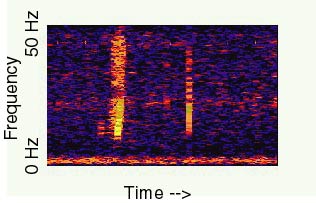
The Bloop is the name given to an ultra-low frequency and extremely powerful underwater sound detected by the U.S. National Oceanic and Atmospheric Administration (NOAA) in 1997. The source of the sound remains unknown. The sound, traced to somewhere around 50° S 100° W (a remote point in the south Pacific Ocean west of the southern tip of South America), was detected several times by the Equatorial Pacific Ocean autonomous hydrophone array,[1] which uses U.S. Navy equipment originally designed to detect Soviet submarines.
According to the NOAA description, it "rises rapidly in frequency over about one minute and was of sufficient amplitude to be heard on multiple sensors, at a range of over 5,000 km." The NOAA's Dr. Christopher Fox does not believe its origin is man-made, such as a submarine or bomb, or familiar geological events such as volcanoes or earthquakes. While the audio profile of the Bloop does resemble that of a living creature, the source is a mystery both because it is different from known sounds and because it was several times louder than the loudest living animal, the blue whale.[2] Five other significant unexplained sounds have been named by NOAA: Julia, Train, Slow Down, Whistle, and Upsweep.[3][4][5] Dr. Christopher Fox of the NOAA speculated that the Bloop may be ice calving in Antarctica.[6] A year later journalist David Wolman paraphrased Dr. Fox who suggested it was likely animal in origin
During the Cold War, when Soviet ballistic missile submarines went to patrol northern seas, their crews started reporting the mysterious frog-like sounds, which soon were dubbed "quackers", from the Russian rendition of a frog noise. These sounds appeared when submarines passed certain zones in the sea and behaved as if they were emitted by some moving underwater object that failed to register on the active sonar. When the sub left their "patrol zone", the objects disappeared after emitting one final "quack".
These objects exhibited behavior not unlike some living being or manned vessel, showing obvious interest in the passing submarine, circling around it, trying to actively avoid sonar pulses, and so on. The speed of some of these objects (estimated from Doppler shift of their sound frequency) was in the range of 200 km/h, much higher than any then-known man-made vessel. Contact was attempted on several occasions, but, apart from some obvious reactions to these attempts (such as changing the pitch of the sounds or movement of the apparent sound source), nothing came of it.
The peak of quacker observations occurred at the end of the 1970s, when the areas where the sounds appeared started to multiply and spread over from the Barents Sea to other areas including the North Sea and the North Atlantic in general. The Soviet Academy of Sciences was invited to create a joint commission with the representatives of the Navy, as this phenomenon was identified as a potential national security risk. This commission worked for about a decade, but despite extensive investigations results remained inconclusive, and it was eventually disbanded. In the 1980s the phenomenon slowly faded, and now quackers may have disappeared completely.
» Click to show Spoiler - click again to hide... «
Was unearthed in Khujut Rabu, in the ruins of a Parthian village outside Baghdad in 1938 by German archaeologist Wilhelm Konig. It is a five-inch-long (13 cm) clay jar containing a copper cylinder that its edge was soldered with a 60-40 lead-tin alloy, and bottom was capped with a crimped-in copper disk and held in place with asphalt or bitumen. Another insulating layer of asphalt sealed the top and also protected an iron bar suspended into the center of the cylinder. This one is known as the Baghdad Battery and is about 2,000 years old. A dozen of other similar batteries were unearthed in Iraq. Most sources date the batteries to around 200 BC - in the Parthian era, circa 250 BC to AD 225. However the Parthians were skilled warriors rather and their scientific achievements were not known. It would appear then that they inherited these batteries from one of the earliest known civilizations. According to the experts, the device after being filled with an acid or alkaline liquid could create an electric charge. It is believed that this old battery might have been used to electroplate silver, but it is only one of the theories. Important is to emphasize that electric batteries were not invented until 1799 by Alessandro Volta.
ANCIENT GLIDER FROM EGYPT
» Click to show Spoiler - click again to hide... «
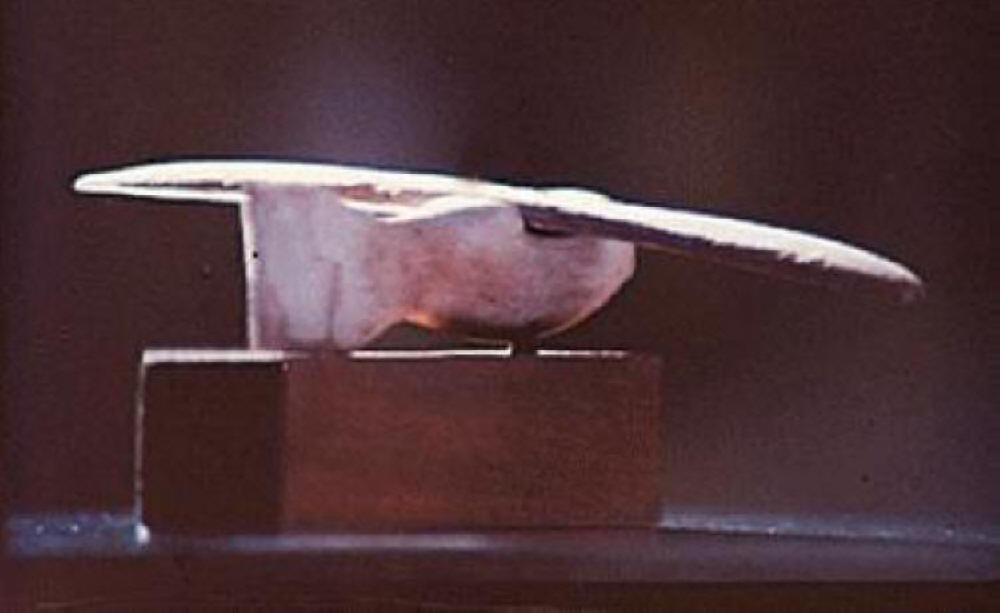
In 1898 a small wooden, winged object was found in the tomb of Pa-di-Imen in north Saqqara, Egypt. The model has the exact proportions of a very advanced form of "pusher-glider" however it was identified as a "bird model". Made of very light sycamore the craft weighs 0.5 oz. with straight and aerodynamically shaped wings, spanning about 7 inches. It looks like modern-day aircraft though it is 2,000-year-old. According to analysis it was discovered that the object was aerodynamically sound.
THE ANTIKYTHERA MECHANISM
» Click to show Spoiler - click again to hide... «
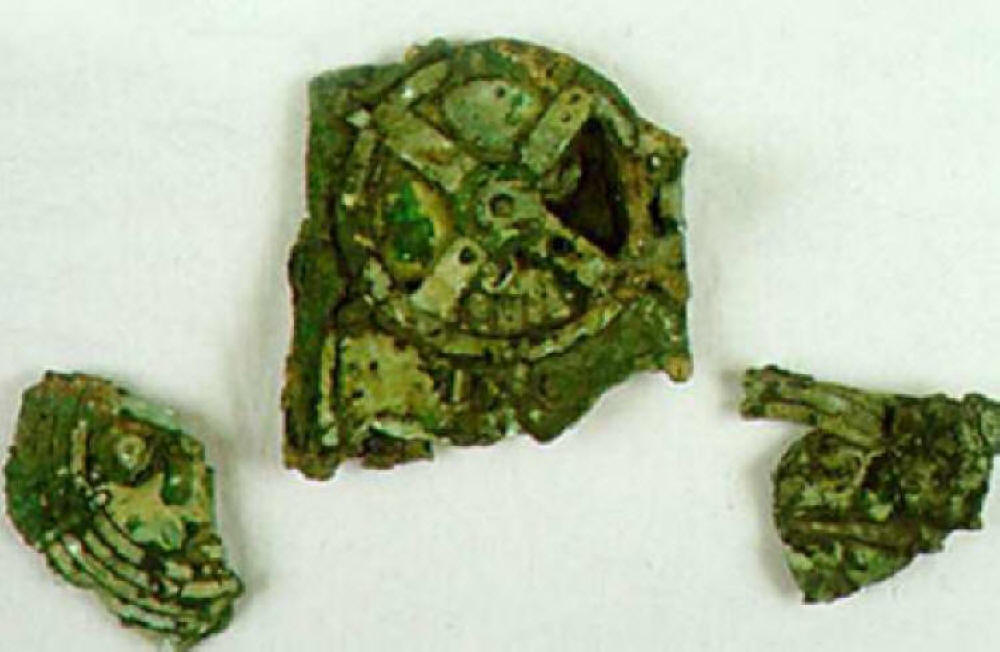
Dated to 80 A.D, probably used as calendar and astronomical calculator for the motions of stars and planets. It is very sophisticated device that consists of 30 toothed wheels, of diameter from 9 to 132 mm, being able to rotate at a different speed each, dials and scaled metal plates with inscriptions related to the signs of zodiac, names of the planets. The engraved signs inform about the equinoxes, months, winds and constellations being in their different phases. This device was created 1,000 years before the gear was invented.
MYSTERIOUS CHINA STONE
» Click to show Spoiler - click again to hide... «
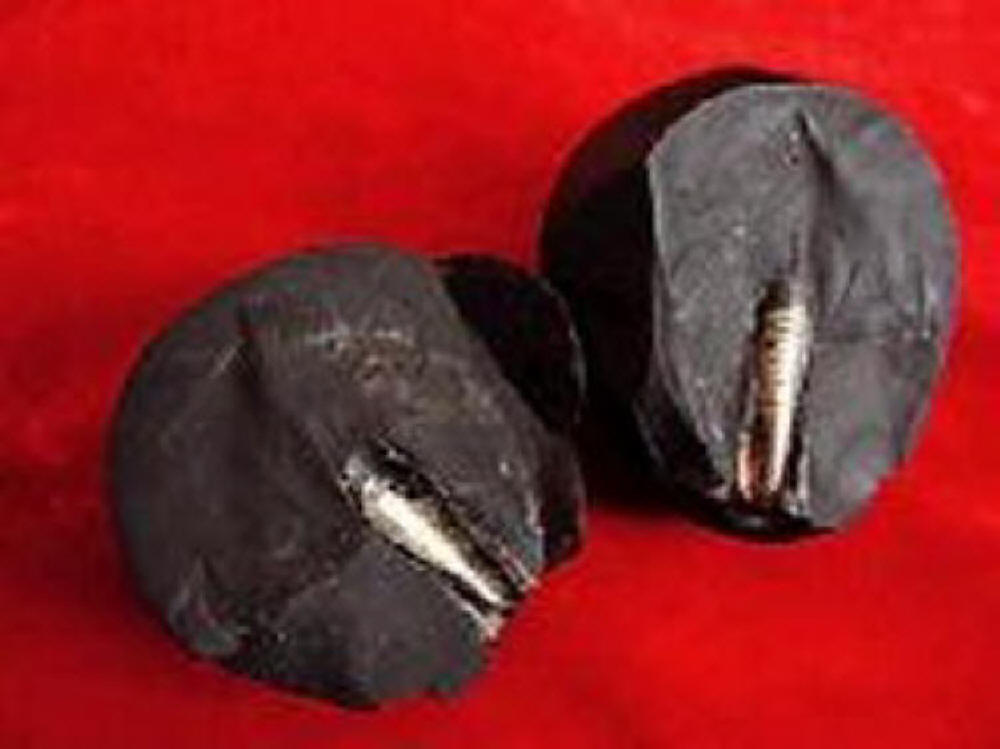
An uncommon stone imbedded with screw-threaded metal bar from a collector in Lanzhou Mr. Zhilin Wang. He found this stone on a field research trip to the Mazong Mountain area located on the border of Gansu and Xijiang provinces. The pear-shaped stone is extremely hard and has a mysterious black color. It is about 8 x 7 cm and weighs 466 grams. The most surprising part of the stone is the imbedded 6 cm cone-shaped metal bar which bears clear screw threads. The stone is one of the most valuable in China and in the world. There are many hypotheses about the formation of this stone, but all seem to be incredible. The screw-threaded metal bar is tightly enclosed in the black lithical material. Moreover, the screw thread width remains consistent from the thick end to the thin end, instead of varying due to the growth of organisms. Is this a relic from a prehistoric civilization?
ANCIENT PLANES FROM SOUTH AMERICA
» Click to show Spoiler - click again to hide... «
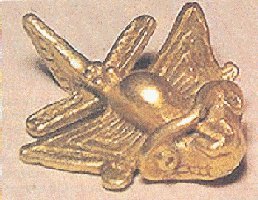
The mechanical features of the object suggest a highly sophisticated level of aerodynamics and construction. The objects are very old and small, approximately 2 inches long, objects, made of gold are estimated to be AT LEAST 1,000 years old. For archaeologists the artifacts were depicting animals and were classified as Sinu, a pre-Inca culture from A.D. 500 to 800... But only for them. For aeronautical engineers these objects more looked like airplanes with delta-shaped wings. So in 1997 they built a scaled up version of the objects to the exact specifications of the prototypes with the simple addition of an engine and propeller. The test was successful. The radio controlled aircraft flew performing airborn loops, rolls and other maneuvers, and then performed perfect landing. According to Dr. Ivan Sanderson, who studied the artifacts, these look too "mechanical" like an airplane, to be a natural object. Other similar objects have been discovered in Costa Rica, Venezuela and Peru.
THE PIRI REIS MAP
» Click to show Spoiler - click again to hide... «
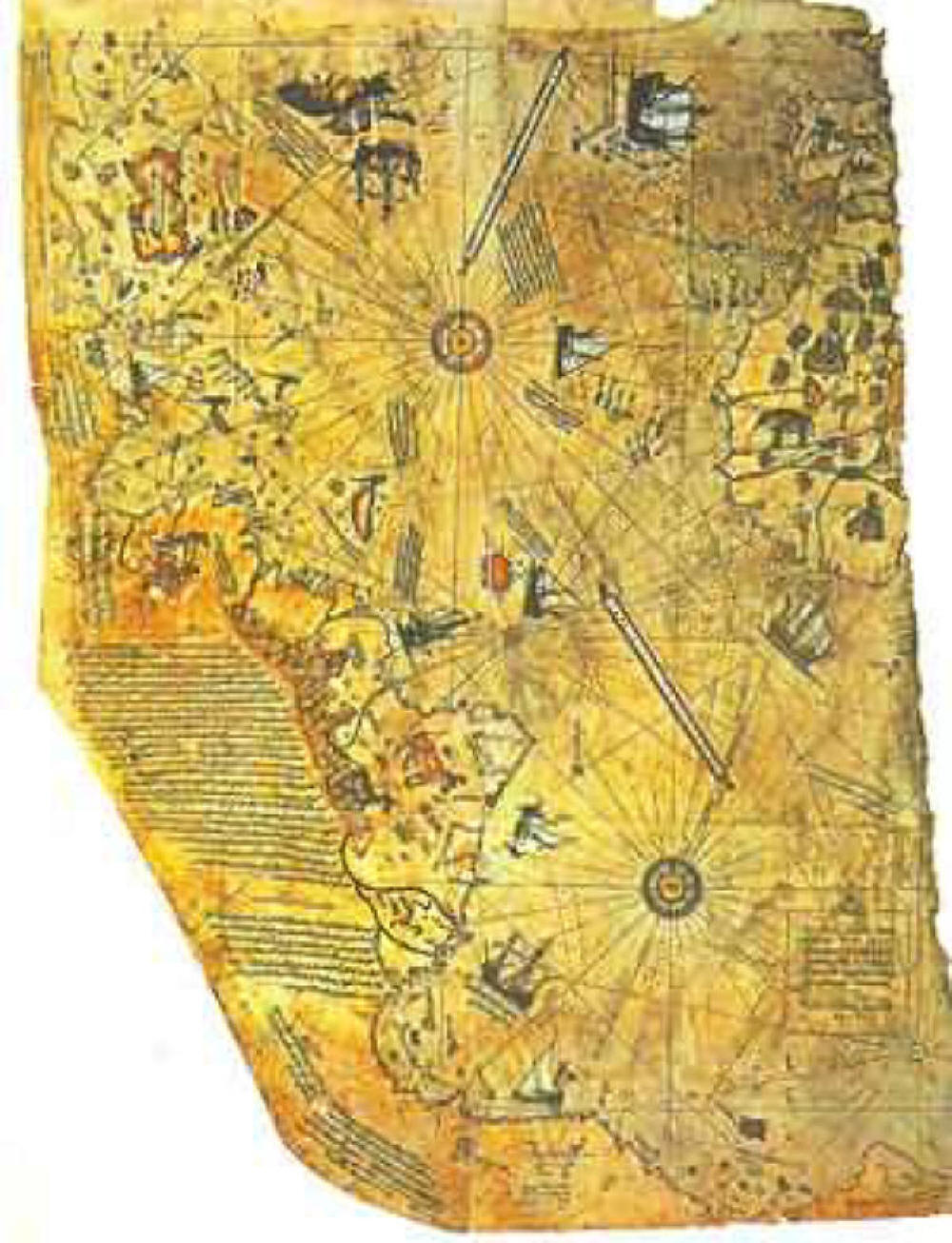
In 1929, a group of historians found an amazing map drawn on a gazelle skin. Research showed that it was a genuine document drawn in 1513 by Piri Reis, a famous admiral of the Turkish fleet in the sixteenth century. His passion was cartography. His high rank within the Turkish navy allowed him to have a privileged access to the Imperial Library of Constantinople.The Turkish admiral admits in a series of notes on the map that he compiled and copied the data from a large number of source maps, some of which dated back to the fourth century BC or earlier.
The Controversy... The Piri Reis map shows the western coast of Africa, the eastern coast of South America, and the northern coast of Antarctica. The northern coastline of Antarctica is perfectly detailed. The most puzzling however is not so much how Piri Reis managed to draw such an accurate map of the Antarctic region 300 years before it was discovered, but that the map shows the coastline under the ice. Geological evidence confirms that the latest date Queen Maud Land could have been charted in an ice-free state is 4000 BC.
THE WAFFLE ROCK
» Click to show Spoiler - click again to hide... «
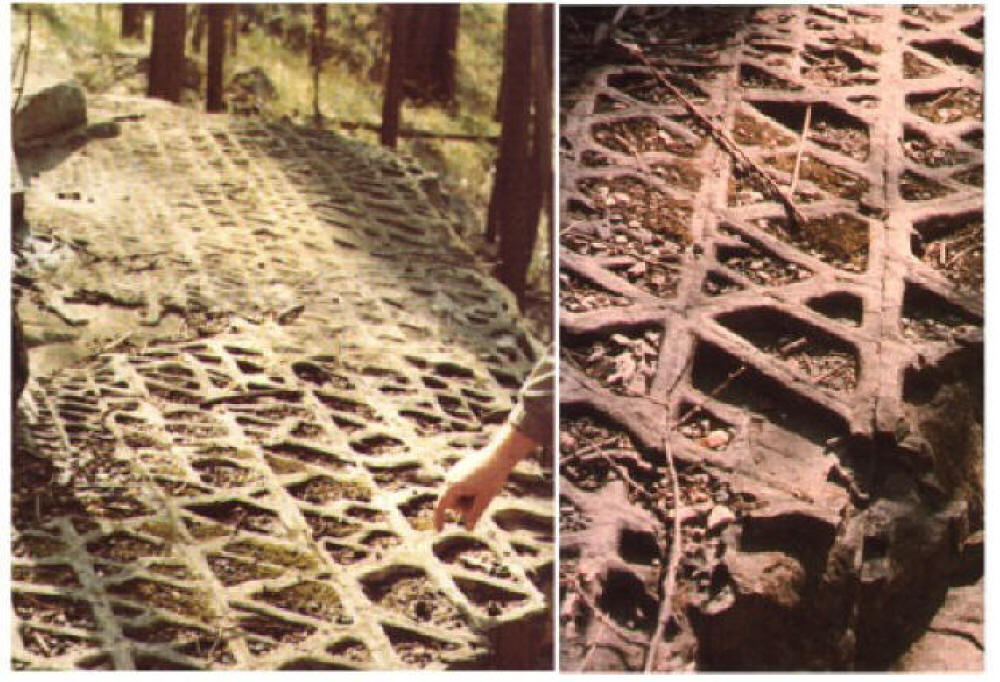
Waffle Rock (Jennings Randolph Lake, Mineral County, West Virginia, USA) is a strange patterned rock in America. Although the lines look to be connected in a set pattern they are slightly off in places. Also in the middle or between 2 lines, depending on how you look at them, you can see thin straight lines or breaks.
FIGURINES OF DINOSAURS
» Click to show Spoiler - click again to hide... «
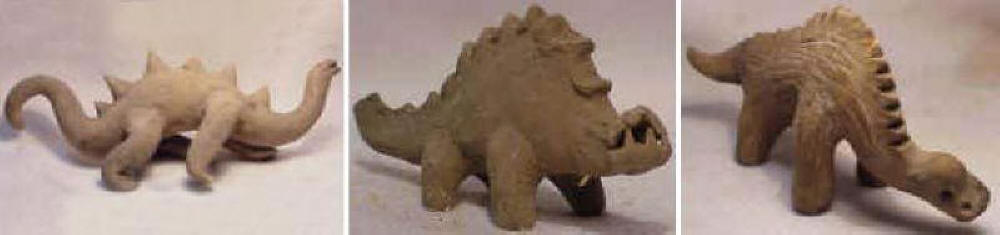
In 1945 Waldemar Julsrud, a German immigrant and an experienced archeologist, discovered some little clay statues, buried at the foot of El Toro Mountain, near Acambaro, Guanajuato, in Mexico. Near El Toro and at the other side of the town, in the vicinity of Mount Chivo, more than 33,000 figurines made of porcelain were discovered. Similar relics found nearby were associated to the Chupicuaro pre-classical Chupicuaro Culture (800 BC to 200 AD). The figurines are representations of various species of dinosaurs, which are believed to have disappeared 65 millions years ago.
I think the Bermuda triangle is a magnetic anomaly area. Ships were lost since most ships back then relied on magnetic compass for navigation. The most famous of this incident is the lost of flight 19. Five TBM Avenger Torpedo bombers on training flight were lost. The last communication from the flight leader stated that his compass became haywire and radio communication became difficult. All this point out exactly to electromagnetic disturbance.
what about that story about project MKULTRA or sumthing.. regarding the research of trying to make a ship invisible but gone wrong and the crews body was attached to the ship...
or about the woman that looks like an alien with the big black pupil and scaled skins or sumthing...
I heard it somewhere, and wish to know more, can post?
» Click to show Spoiler - click again to hide... «
The battle of Carrhae ended 53 years before the birth of Jesus Christ, in the last day of the month of may, with a shameful disaster for the Roman army. Seven legions having the strength of 45,000 soldiers were humiliated and routed by 10,000 Parthian archers.
Carrhae, an ancient biblical city now known as Harran, is located on Turkey’s oriental border.
The commanding officer of this unfortunate expedition was Marcus Licinius Crassus, a 62 years old tribune who had organized that campaign eager to gain glory and wealth, even though he was already one of the most rich and powerful men in Rome.
Perhaps he did it just because he envied the military successes of Pompeius Magnus and Caesar, and foolishly thought that he may equal them, even though Pompeius Magnus and Caesar were war professionals while Crassus was a mere amateur. His only triumph had been the bloody defeat of Spartacus, but achieved with Pompeius’ help: in fact he had too little experience and genius to embark on a large-scale operation abroad.
The Republican government loathed to let him depart with such a sizeable army as there was no real emergency in the east, but Crassus eventually enlisted the support of Pompeius Magnus and Caesar, who did not fail to see the opportunity to free themselves of a powerful competitor whilst waiting to settle the score with each other.
During the hot public debate in the Senate a tribunus plebis named Ateius attempted to stop him. Plutarcus writes that, when he realised that his efforts were in vain and that he would not receive enough supporting votes, he lit a brazier and, while throwing grains of incense into the flames, started to curse Crassus and evoke the infernal gods. Judging from the name and the behaviour of this man, we can guess that he was of Etruscan descent.
Some metropolitan legions grouped in Rome and marched through Campania and then met at Brindisi with the others coming up from Calabria and then left in spite of the stormy sea. Not all the ships reached the other shore.
Crassus had fortune, the blind goddess, on his side during his youth: he came out unscathed from the civil wars; then was implicated in the Catiline conspiracy but bore no consequences; he paid the debts of a spendthrift Caesar whilst being tightfisted himself and with his family.
But things had changed and while aging he became a blunderer, making mistakes which were numerous and serious.
For instance, in a speech to his soldiers he proclaimed that he would destroy a bridge “so that none of you will be able to return”. Noticing their dismayed expression, Crassus corrected himself by explaining that he was referring to the enemy, not his own soldiers.
He ordered the distribution of lentils and salt to the troops, oblivious of the fact that this was the meal offered at funerals.
The worst possible omen occurred when Crassus dropped on the floor the slippery entrails of a sacrificial animal that were placed in his hands by a haruspex. (a soothsayer) Crassus attempted to correct this mistake by crying, “Fear not, despite my age, the hilt of my sword will not slip out of my hand”.
On the day of the battle, Crassus wore a black tunic, instead of the purple one de rigeur for Roman generals. Even though Crassus quickly returned to his tent to change, he left his officers speechless. We can still imagine those officers crossing their fingers (“fare le corna”, forefinger and little finger raised, a very efficacious propitiatory gesture of Etruscan origin) and grasp a certain part of their body.
Moreover, Crassus refused to listen to his veterans who were in favour of marching on the coast and avoid the desert to reach the Parthian capital. Rather, he trusted the arab Arimanes and his six thousand horsemen, who had secretly sided with the Parthians and abandoned the Romans few minutes before the battle.
Crassus, facing the enemy, ordered his soldiers to form a square, packed like sardines, instead of scattering them so that they ended up being slaughtered by enemy arrows before they could even attempt a response.
The Parthians were using reflex bows: those with recurved edges, such as the ones used by Mongols and Chinese. These bows doubled the propulsion power of the arrows enabling them to be shot to a distance of up to 400 metres – so that they were as lethal as Kalashnikov bullets. This kind of bow was a Chinese invention, and was further perfected by the Chinese themselves in the 16th century, with their arrows capable of reaching up to 600 metres.
Seeing the danger, Crassus’ son, Publius, attempted a sally with a thousand gaulish cavalrymen, but half of them were slain and ran through with arrows and the remainder were taken prisoners. The head of Publius was put on a spear and shown to the Romans and to his father, and on this tragic occasion we can see the only glimpse of roman greatness in Crassus, who for a while ceased to act like an old fool, as he told his soldiers to keep up the fight and that the death of his son was only his private injury, not theirs.
At nightfall, Crassus accepted to negotiate with the enemy but was caught instead in a trap and his head was also cut off. 20,000 Romans died that day, 10,000 were taken prisoner, and the remainder managed to escape and return to Italy.
This setback was partially redressed by Marcus Antonius few years later and a diplomatic solution with the Parthians was reached under Augustus in 20 BC when a peace treaty was stipulated and the lost insignia were retrieved. The Parthians agreed on the return of the eagles and the banners of the seven Roman legions, but when Augustus sought the return of the prisoners abandoned in 53 BC they maintained that there were no prisoners to repatriate.
The Parthian practice had always been to shift prisoners caught in the west to Turkmenistan in the east. By so doing they would secure their loyalty against their worst enemies - the Huns - and this is probably what happened to the unfortunate Romans whom the Parthians had caught. The Roman historian Plinius also upholds this theory in explaining the disappearance of so many men.
What happened then to those 10,000 legionaries? No plausible answer could be found for two thousand years until an American sinologist, Homer Hasenpflug Dubs, announced a possible answer during a conference in London in 1955 called, “A Roman City in Ancient China”.
Dubs had found out that in the annals of the Han dynasty there is the record of the capture of a Hun city, by the chinese army, in 36 BC named Zhizhi, now known as Dzhambul, located close to Tashkent, in Uzbekistan.
It made a deep impression on Dubs that the Chinese recorded that they found palisades of tree trunks, and that the enemy had used a previously unseen battle formation at the gates of the city, namely a testudo of selected warriors forming a cover of overlapping shields in front of their bodies in the first row and over the heads in the following rows. These facts are reported in the biography of Chen Tang, one of the victorious Chinese generals, written by the historian Ban Gu (32 – 92)
Many prisoners were taken during this battle and it appears that the Chinese were so struck by the military skills of those warriors that they moved them, after enlisting, further east, in a place that by imperial decree was named Li-Jien (which sounds in Chinese as the word “legion” and is the name by which the Chinese called Rome) in Gansu province. The legionaries numbered 145, and formed a garrison protecting the inhabitants from Tibetan raids. It was uncommon for Chinese to name their cities after barbarian names: the only two other known cases, Kucha and Wen-Siu, occurred where large colonies of foreigners had settled.
The difficulty was to locate this outpost, as the name Li-Jien is not found on modern maps any longer. Dubs claimed to have found it, and identified the location as Zhelaizhai, not far from Lanzhou.
Subsequent archaeological expeditions made by Chinese, Australians and Americans teams appear to support the choice of this Chinese city even though the smoking gun which may finally solve the mystery has yet to be found.
During excavations in 1993 some fortifications were unearthed as well as a trunk fixed with stakes, possibly dating back to the time of the arrival of the legionaries. The trunk was a kind of hoist used by the Romans to build fortifications, but was unknown in China. It is now on display in the Lanzhou museum.
The physical features of the inhabitants, in some cases, are also strange. A certain Sung Guorong, for instance, seems to confirm the hypothesis advanced by Dubs. He has been interviewed and filmed by several journalists: he is 46 years old, 1.82 meters tall, blond, with an aquiline nose and big blue eyes, and he loudly proclaims that he is a Roman, not a Chinese. He also claims that there are at least 100 people that look like him in the area.
Not that real Romans had such features, but certainly among the Latin legionaries there were some german as well as gaulish auxiliaries. Perhaps one of Mr. Song’s ancestors is one of those 500 gaulish horsemen that were captured during Publius Crassus’ tragic sally. Lanzhou University has conducted DNA tests on the population of Zhelaizhai and findings show that 46% of them have genetic sequences that are similar to Europeans.
They must have been very tough these ancestors of ours to resist, to put down new roots over there, and to avoid falling prey to discouragement. They had left Rome 20 years earlier, abandoning their wives and children. Or perhaps, who knows? they may have called themselves very lucky seeing the fate of their unfortunate companions left on the field. At least they were still alive. They remarried with local chinese women, different indeed from their perfumed and refined Calpurnias, Messalinas and Clodias whom they had left behind in Rome but with them they did built a new house and a new family.
In the future, deeper examinations conducted on the Y chromosome (which is subject to little variation as it is transmitted directly from father to son) will further shed light on this mystery. This will help gather more precise information to assess kinship ties with people now living in Europe, and will help to prove the hypothesis of Dubs.
From the point of view of the artifacts, Roman coins and pottery have been unearthed in Zhelaizhai, as well as an helmet bearing the engraving in Chinese characters, “One of the prisoners”. However, since this village is located along the Silk road, these are natural discoveries and similar artifacts have been found in distant places such as Vietnam and Korea.
One of Zhelaizhai’s specific characteristics, worth mentioning, is the passion for bulls and tauromachy which continues to this day, and is not shared by neighboring areas.
Local authorities have immediately sensed the tourist potential offered by this possible link and have built a pavilion with Roman marble statues to attract visitors.
The Chinese were aware of the existence of a big empire in the west and sent a legation in the year 97 AD, headed by Kan Ying. This legation arrived in Mesopotamia but, prior to boarding a ship to Rome, the Parthians (always them!) convinced the Chinese that two years of sailing would be necessary to reach the Eternal City.
The Parthians did not have any interest, commercially speaking, in having their two main customers meet, as this would have cut them out of a lucrative trade. For istance it is well-known that Caesar spent a considerable amount for silk bespoke-tailored togas, and that he gave Servilia, his mistress and mother of Brutus, a pearl from the south seas for which he paid 60,000 sesterces and Caesar was a trend-setter, imitated by other wealthy romans. Something like few years ago with Italians imitating FIAT’s chairman Giovanni Agnelli habits and choices.
The naïve Kan Yin trusted them and decided to return back to China empty handed.
Marcus Aurelius in 166 AD sent an official delegation of Romans carrying presents to the Chinese capital of Luoyang and their arrival is recorded in the dynastic annals.
The Chinese however did not respond to the Roman openings, perhaps because of the occurrence in 184 AD of the peasant rebellion known as the Yellow Turbans, which caused a frightful civil war and the fall of the Han dynasty, which had ruled over China for four centuries.
The legend holds that some residents of Siberia (Russia) had drilled a hole that was nine miles (14.5 km) deep before breaking through to a cavity. Intrigued by this unexpected discovery, they lowered an extremely heat tolerant microphone, along with other sensory equipment, into the well. The temperature deep within was 2,000 °F (1,100 °C) — heat from a chamber of fire from which screams of the damned could be heard.
The Soviet Union had, in fact, drilled a hole almost eight miles deep, the Kola Superdeep Borehole, located not in Siberia but on the Kola Peninsula, which shares borders with Norway and Finland. Upon completing the borehole in 1989, the Soviets found some interesting geological anomalies, although they reported no supernatural encounters.[1] Temperatures reached 180 °C (360 °F), making deeper drilling prohibitively expensive
Since its publicity, many alternate versions of the story of the Well to Hell have been published. In 1992, US Tabloids published an alternative version of the story, which was set in Alaska where 13 miners were killed after Satan came roaring out of Hell. Other alternative stories included an alleged story where Jacques Cousteau quit diving after hearing "screams of people in pain" underwater. Additionally, another story told of one of Jacque's men fainting in terror after hearing screaming voices in a trench in the Bermuda Triangle.
I first heard about this story from people who started calling my radio program to ask about it in the early 1990s. There was such a flurry of calls that I finally promised the listeners I'd look into it. Most of the callers said they'd heard the story on Trinity Broadcasting Network, a Christian television network that originates from Southern California.
I called Trinity Broadcasting headquarters and asked about the story. I was transferred to a woman who said, 'Oh yes, it's true all right. We've got documentation. It's in our latest newsletter.'
I was on the network's mailing list, so I looked through a pile of recent mail and found the article. The newsletter said the details had come from the translation of an article in a Finnish newspaper named 'Ammennusatia'. It claimed:
A geological group who drilled a hole about 14.4 kilometers deep in the crust of the earth are saying that they heard human screams. Screams have been heard from the condemned souls from earth's deepest hole. Terrified scientists are afraid they have let loose the evil powers of hell up to the earth's surface.
'The information we are gathering is so surprising, that we are sincerely afraid of what we might find down there,' stated Dr Azzacov, the manager of the project in remote Siberia.
According to the story, the geologists were dumbfounded. After they had drilled several kilometers through the earth's crust, the drill bit suddenly began to rotate wildly. 'There is only one explanation,' said Dr Azzacov. 'The deep center of the earth is hollow!' The report continued:
The second surprise was the high temperature they discovered in the earth's center. 'The calculations indicate the given temperature was about 1,100 degrees Celsius, or over 2,000 degrees Fahrenheit,' Azzacov pointed out. 'This is far more then we expected. It seems almost like an inferno of fire is brutally going on in the center of the earth.'
'The last discovery was nevertheless the most shocking to our ears, so much so that the scientists are afraid to continue the project. We tried to listen to the earth's movements at certain intervals with supersensitive microphones, which were let down through the hole. What we heard turned those logically thinking scientists into a trembling ruins. It was a sometimes a weak, but high pitched sound which we thought to be coming from our own equipment,' explained Dr Azzacov.
'But after some adjustments we comprehended that indeed the sound came from the earth's interior. We could hardly believe our own ears. We heard a human voice, screaming in pain. Even though one voice was discernible, we could hear thousands, perhaps millions, in the background, of suffering souls screaming. After this ghastly discovery, about half of the scientists quit because of fear. Hopefully, that which is down there will stay there,' Dr Azzacov added.
According to the Trinity Broadcasting Network newsletter, the Finnish article had been given to them by a Texas evangelist, R.W. Schambach, who was a frequent guest on their network.
We checked with Schambach's office and were assured that the story was 'absolutely true' and had been substantiated. They said they had an article from a 'respected scientific journal' in Finland, as well as a letter from a Norwegian man, Age Rendalen, who had confirmed it. Rendalen had sent his letter directly to Trinity Broadcasting Network and the details he revealed added a new dimension to the story.
Rendalen told the network that he had visited United States a few weeks earlier and happened upon their telecast about the Drilling to Hell story. He wrote:
I must confess that I laughed when I heard your account... I did not believe one word of it, and commented to my friend that Americans sure were gullible to believe that hell could be physically located to a hole in the ground. I cannot even begin to tell you what a shock it was to me when I returned to Norway and found the newspapers full of reports about this incident. I knew immediately that if there was a hell, I for sure would end up in it. A tremendous fear took hold of me, and for two nights I dreamed about fire and screams until I surrendered to God and committed my life to his hands for safe-keeping.
In the letter, Rendalen went on to encourage the network not to let 'skeptics' interfere with their telling of the story. He included a copy and translation of what he claimed was an article from Norway's largest and most reputable newspaper, with more information about the drilling.
Rendalen's translation of the article told of opposition to the drilling by Russian atheists, as well as government intimidation to keep the scientists from telling the rest of the world about their discovery. The account, which drew on the eyewitness testimony of a Mr Nummedal, also added a new detail:
What really unnerved the Soviets, apart from the voice recordings, was the appearance that same night of a fountainhead of luminous gas shooting up from the drill site, and out of the midst of this incandescent cloud pillar a brilliant being with bat wings revealed itself with the words (in Russian): 'I have conquered,' emblazoned against the dark Siberian sky.
'The incident was absolutely unreal; the Soviets cried out in terror,' says Mr Nummedal. Later that night, he saw ambulance crews circulating in the community. A driver he knew told him that they had been told to sedate everybody with a medication known to erase short term memory. The Soviets use this drug in the treatment of shock victims.
So we now had not only a story about drilling into hell, but an additional version with a bat-like creature making an appearance.
My staff and I decided to roll up our shirt sleeves and trace the story as far as we could, especially since we had the names of newspapers and at least one individual who might know the facts.
The Finnish newspaper 'Ammennusastia,' which is quoted in nearly every account of the story, is located in an area called Levasjoki. We had a phone conversation with a staff member who told us the publication is not a 'respected newspaper' or a 'scientific journal', as we had been told, but a monthly publication of a group of Finnish Christians. The Drilling to Hell story, he said, had been based on the word of mouth recollection of another staff member, who had remembered reading it as a 'major article' in a Finnish daily newspaper called 'Etela Soumen'.
We contacted this newspaper and at first they couldn't recall or find the story. However, we later received a call saying they had discovered that the tale had appeared in their paper. It was not in an article, however, but in a feature section that included letters from readers who could write about almost anything they wished.
Through the newspaper, we tracked down the person who wrote the letter with the Drilling to Hell story. He was a kind, elderly man who, in spite of being reluctant to talk with us initially, told us through an interpreter that he couldn't vouch for the credibility of the story. He got it, he said, from a Christian newsletter called 'Vaeltajat', which was published by a group of Finnish missionaries.
We next contacted 'Vaeltajat'. The editor said the story had been printed in their July 1989 issue. Where did he hear about it? He had received it from one of their readers, who claimed it had appeared in a newsletter called 'Jewels of Jericho', published by a group of Jewish Christians in California. And that is where the Finnish trail came to an end.
One thing was clear at this point: The Drilling to Hell story was looking and smelling like a pretty typical urban legend. It was sensational, impossible to document, and only had life because of all the small publications that were quoting one another's unsubstantiated stories.
However, there was still the Norwegian man, Age Rendalen, who had told the story of the ominous, bat-like creature emerging from the drill-hole. The article in the Trinity Broadcasting Network newsletter said he lived near Oslo, so we called directory assistance and found him in about 45 seconds. I talked with him on the phone myself:
'Are you the one who sent information to a Christian television network in the United States about scientists drilling into hell?' I asked.
'Yes,' he said without hesitation.
'Well,' I continued, 'Do you have any way of knowing whether it is true?'
'Yes I do,' he replied.
'Tell me about it,' I asked.
'None of it is true,' he said. 'I fabricated every word of it!'
Rendalen went on to explain that he had visited the US a few weeks earlier and had seen the host of a Christian television program enthusiastically relating the Drilling to Hell story. He told me: 'I couldn't believe that the hosts really thought the story was true and that they would broadcast it without apparently having checked it out.'
When he returned to Norway, Rendalen sat down and fabricated the graphic story of the bat-like creature and sent his letter to the television network. His prediction was that they would use the story without investigating it. To make an investigation easy for them, he included his name, address and telephone number on his letter. He also included what he claimed was an article on the story from 'Norway's largest and most reputable newspaper'. In fact, the article, which he falsely translated, was a piece in his local community paper about a building inspector.
Rendalen also included the name and telephone number of a pastor friend based in Southern California. This pastor knew about the hoax and was prepared to reveal the truth if someone called to research it further with him.
However, as predicted, Trinity Broadcasting Network ran the story without contacting Renalden or the Californian pastor, and it appeared on television, radio and in a large number of publications. None of those who used the story attempted to research it before going public.
'2000 PEOPLE HAVE FOUND CHRIST!'
On 6th February 1990, a listener of mine sent me a letter. She had videotaped and documented all three occasions when this story was discussed on the Christian TV show put out by the network. On 29th January 1990, the show host is documented as saying:
Let me just say, all of you that have written me all those nasty letters about the 'hole in hell', let me tell you I finally got the newspaper article which is from 'The World Weekly'. This is an international newspaper that has been translated into English from Finnish. 'Scientists fear they've opened gates of hell! Geologists drilling nine-mile hole hear human shrieks.'
I got a letter today from a geologist in Oklahoma and he's really giving me a rough time. He says that there isn't anything that could drill that deep. Folks, I'm just reporting what people have been sending to me and I don't know if this is true or not. I know one thing, if this is a trick of the Devil, he sure has blown it, because I know of about 2,000 people that have found Christ because of it!
True or false, I'll tell you what I'm doing, though. We're now going to do some investigative reporting of our own and we're going to check with the Finnish government and the Department of the Interior and we're really going to follow this up and see if they really did drill a hole nine miles down there, if they really did have a microphone down there, if they really did hear human shrieks of agony and pain as this newspaper article and as did many letters I have received from over there have indicated to us. If I'm wrong and they're right, I've got nothing to lose. But if I'm right and you're wrong, you've got everything to lose.
Unfortunately, the investigation by the show took place too late to prevent the damage of a widely spread rumor in the Christian community.
Rendalen has now issued an official statement about his actions and the whole incident, which says: 'The story is nothing more than a Christian "urban legend" without basis in reality.'
There are a couple of postscripts to this incident. One is that the respected magazine, 'Biblical Archaeology Review', printed a story about the Drilling to Hell story, thinking it was so outrageous that readers would get a kick out of it. Many of the readers took the article seriously, however, and either started passing it around as substantiation of the story, or wrote to the magazine to complain that it shouldn't have given it respectability.
Secondly, in August of 1990, I was contacted by the pastor of a small church in Flagstaff, Arizona, who informed me that he had proof that this story was true. Apparently, a man from his church, who was believed to be a PhD in Physics from MIT, came forward in private to claim that he was a scientist who had been on a secret mission in Russia for the past year and had met with Mikhail Gorbachev several times. He verified that the Drilling to Hell story was indeed true. He claimed:
A hole was drilled deep into the crust of the earth in Siberia and a large cavity was found. Unfortunately, news of this was leaked to the press and was distorted. It is true that a recording was made of the sounds from deep in the hole, but the intense heat destroyed the microphone in spite of special cooling material around it, so that only seventeen seconds of sounds could be captured. At the present time, scientists are drilling a second hole to confirm what was found the first time. And a better system is being developed for cooling the microphone.
The scientist went on to claim that he was helping to design this microphone and was returning to Siberia shortly to further document the phenomenon. He planned to return in about a year with more confirming information on this amazing phenomenon.
Six months later, I got a letter from another member of the church saying that this man had turned out to be neither a graduate of MIT nor a scientist. In fact, he had skipped town with over $20,000 collected from church members who wanted to help finance his expedition.
How did this story originate? Again, we will never really know. It is possible that somewhere in the world there has been a spooky experience during deep drilling operations. I don't know. According to an August 1989 article in 'Science' magazine, there is a Russian deep hole drilling project in Kola, near Murmansk, about 150 miles north of the Arctic Circle. Another German deep drilling experiment in north-east Bavaria has discovered warmer temperatures than were expected at certain drilling levels, although nothing even close to 2,000 degrees Fahrenheit.
Characteristic of many urban legends, this story was alleged to have occurred in an obscure part of the world where it would be virtually impossible to track down the facts. And once the story got started, people began quoting one another's newsletters to validate their own. This is the stuff of which tabloid newspapers are made.
I had this thought before....And I kinda believe it could be true...
» Click to show Spoiler - click again to hide... «
QUOTE
Cendiakiawan agama terutama Muhammad Isa Dawud (MID) percaya bahawa terdapatnya hidupan sebelum penciptaan Adam. Dalam buku bertajuk "Siapa penghuni Bumi Sebelum Manusia" karya MID, ada persoalan yang dibangkitkan iaitu bagaimana malaikat tahu bahawa hamba Allah yang bakal dicipta nanti (Adam & keturunannya) akan membuat ‘kerosakan’ dan ‘menumpah darah’ (berperang). Ini membuktikan sudah ada kehidupan makhluk lain sebelum manusia yang telah diturunkan syariat Islam. Cuma bezanya makhluk sebelum Adam berbeza dari segi jasad dan kemampuan intelektual. Namun mereka derhaka kepada Allah SWT selepas Allah melimpahkan kemewahan dunia kepada mereka. Akibat kebiadapan mereka menyekutukan, Allah SWT telah mengazab mereka dengan ‘kiamat’ untuk keseluruhan mereka sehingga tidak tertinggal walau sedikitpun.
Also, please open Google Earth and enter this coordinate into the search.
50.010083, -110.113006
The ancient Mahabharata, one of the sources on Vimanas, goes on to tell the awesome destructiveness of the war:
QUOTE
"...(the weapon was) a single projectile charged with all the power of the Universe. An incandescent column of smoke and flame As bright as the thousand suns rose in all its splendor...
An iron thunderbolt, A gigantic messenger of death, Which reduced to ashes The entire race of the Vrishnis And the Andhakas.
... the corpses were so burned As to be unrecognizable. The hair and nails fell out; Pottery broke without apparent cause, And the birds turned white.
... After a few hours All foodstuffs were infected... ... to escape from this fire The soldiers threw themselves in streams To wash themselves and their equipment..."
notice "Charged with all the power of the universe". As we know, Our Sun and all the stars was powered by a fusion reaction in it's core. And also notice and "An incandescent column of smoke and flame As bright as the thousand suns rose in all its splendor". So this maybe indicate the ancient peoples used fusion type WMD in their wars.
This post has been edited by MrUbikeledek: Oct 20 2011, 12:51 PM


 Mystery Cases Unsolved
  Oct 18 2011, 01:54 PM



 Quote
Quote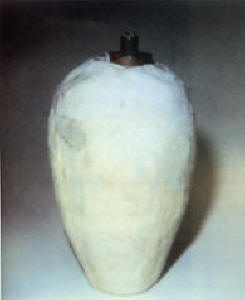

 0.0282sec
 0.79
0.79
 6 queries
 GZIP Disabled