this is neither a buy, hold, sell nor short recommendation on aapl
those who uses 50dma or 200 dma as support or resistance line. u can see where aapl stands, no need explanation
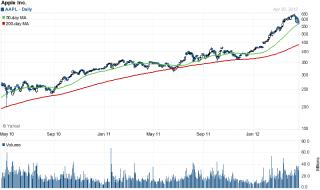
here is some lesson for any newbies out there
1)
http://kurtishemmerling.suite101.com/how-t...selling-a170092How to Spot Institutional Buying and Selling
The Secret of Timing Trades With Institutions
Nov 15, 2009 Kurtis Hemmerling
Most investors would love to trade with Warren Buffet. By following changes in institutional ownership a trader can do just that. Here are the steps how...
It makes sense to time stock purchases and sales with the ‘big money.' These financial giants have heavy financial clout! Hitching a ride on their trading bumper will generally translate into dollars and cents.
Institutions are Accumulating Which Stocks?
Institutions need to keep their purchases quiet so as to quietly accumulate shares at the best possible price. One tactic to maintain a good share price is to buy shares on market down days. Or they may buy a certain amount of shares and then sell a portion to drive the price back down. Once they have accumulated the desired amount, the institution may quickly drive the price up with a large purchase to notify other investors that it is time to trade.
A reduced float with increased buying will lift the stock nicely. To find out which publicly traded companies institutions have been heavily investing into last month, investors can use the MoneyCentral link
Selecting the Right Stock
Illiquid and low capitalization stocks usually have increased volatility which raises risk. Among the stocks listed at MoneyCentral as having increased institutional support, traders should generally pick the ones with 100 million market capitalization or more. Also, many will choose to weed out the stocks that are below five dollars per share.
Following Institutional Trading with Precision Timing
If an investor simply bought shares based on the provided institutional ownership list, he may be disappointed. Buying wantonly even with good stock picks is not recommended because the profit boat may have already left the dock. Purchasing shares at inflated prices is not a wise strategy even when following the market giants.
These are simple Do Not Buy If rules:
• The boat may have left if the stock rocketed up 20% or more in the last few trading days.
• Share price should be within 20 to 25% of the 50 day moving average.
By using this link and entering in the desired stock from the MoneyCentral institutional ownership list, investors will be able to see if the share price is close to the 50 day moving average. The red line is the 50 day moving average and the blue lines represent a 20% envelope above and below the average. When the price is far above the upper blue line, a wise trader will wait for a better entry point.
Sell the Shares When This Happens
There are a few different signals to bail on a trade. These are some easy to follow exit rules:
• When the share price drops ten percent from his purchase point, the investor should sell.
• If net institutional selling occurs, the investor should likewise liquidate his position.
• For a profit point, the trader could have a trailing stop-loss of five to ten percent.
Trading With the Institutional Giants Strategy
The investor who follows institutional support can profit from having a heavy hitter on his side, without the liquidity problems large firms may have. The key is to pick the right stock early on, and expertly time the purchase and sell orders to maximize gains. As is true with all strategies, problems do occur, and having a stop-loss in place will keep wise investors trading for a very long time to come.
2)
http://finance.yahoo.com/q/it?s=AAPL+Insider+Transactionsizit increasing or decreasing
Net Institutional Purchases - Prior Qtr to Latest Qtr Shares
Net Shares Purchased (Sold) 110,648
% Change in Institutional Shares Held 0.02%
3)
http://finance.yahoo.com/q/mh?s=AAPL+Major+Holdersare their reported date consider quite new or many moons ago?
» Click to show Spoiler - click again to hide... «
http://www.gilmoreport.com/gilmoreport.htmlMy biggest bias, and probably my only significant one, was that at first I tended to want to buy 15-20 dollar stocks, instead of realizing that 50,60, 100 or more dollar stocks were of much higher quality
Institutions may, in some cases, take positions in smaller, thinner stocks, particularly if they are small-cap mutual funds. However, since the relatively low trading volume and float of these types of stocks makes it difficult to buy a large position, they will often just buy a very small position. I myself prefer to trade in "big stocks," or stocks that 1) are above $10 in price, because most institutions adhere to some price rule where they will only look at stocks that are a minimum of $10 to $15 a share, and 2) trade at least $35 to $40 million in average daily dollar volume (share price x average daily volume, so that a $10 stock that has average daily volume of 1 million shares has an average daily dollar volume of $10 x 1 million, or $10 million average daily dollar volume)
http://www.aaii.com/computerized-investing...-procsss.mobile


 Apr 18 2012, 06:24 PM


 Quote
Quote


 and not even 1 month
 stay tuned, I also no idea


 and earnings season aint' over yet, still holding positions
 the 'dips pullback trap works out quite fine for now. the bears here MUST work triple hard with overtime too




 0.0370sec
 0.50
0.50
 6 queries
 GZIP Disabled