QUOTE(http://en.wikipedia.org/wiki/AC_power)
"Engineers use the following terms to describe energy flow in a system (and assign each of them a different unit to differentiate between them):
Real power (P) or active power : watt [W] Reactive power (Q): volt-ampere reactive [var]
Complex power (S): volt-ampere [VA]
Apparent Power (|S|), that is, the absolute value of complex power S: volt-ampere [VA] Phase of Voltage Relative to Current (φ), the angle of difference (in degrees) between voltage and current; Current lagging Voltage (Quadrant I Vector), Current leading voltage (Quadrant IV Vector)"
"
The unit for all forms of power is the watt (symbol: W), but this unit is generally reserved for real power. Apparent power is conventionally expressed in volt-amperes (VA) since it is the product of rms voltage and rms current."
"Practical loads have resistance, inductance, and capacitance, so both real and reactive power will flow to real loads. Power engineers measure apparent power as the magnitude of the vector sum of real and reactive power.
Apparent power is the product of the root-mean-square of voltage and current."
Link to full article : AC powerQUOTE(http://en.wikipedia.org/wiki/Electricity_meter)
Electricity meters operate by continuously measuring the instantaneous voltage (volts) and current (amperes) and finding the product of these to give instantaneous electrical power (watts) which is then integrated against time to give energy used (joules, kilowatt-hours etc.). Link to full article : Electricity meter Simple experimental test setups :
System A = Computer with
50% efficiency power supply unit
System A = Computer with
80% efficiency power supply unit
Calculation using
Apparent Power (Pavg
= Vrms
x Arms
)System A = 227v x 0.57A x 10hour =
1.294kWhSystem B = 227v x 0.50A x 10hour =
1.135kWhCalculation using
Real Power (power=voltage X current X power factor)System A = 227v x 0.57A x 0.5 x 10hour =
0.649kWhSystem B = 227v x 0.50A x 0.8 x 10hour =
0.908kWhFrom the examples above, it shows that
if TNB is using
Apparent Power to calculate & charge it's customers, those with
higher efficiency electrical appliances are
paying less than customers with lower efficiency electrical appliances. In contrast, those with
higher efficiency electrical appliances will have to
pay more if
Real Power is used to calculate
TNB bills.
As you might know that computer power supplies with higher efficiency are much more expensive that those of lower efficiency and this is the same for electrical appliances such as those with inverter technologies are much more expensive as well. So if
Apparent power is used to calculate
TNB bills, it will be
silly to spend extra on getting
higher efficient models as you will be
paying more for
monthly electrical bills. 
If you or any electrical engineers with experience or knowledge on the design of electrical meters used by TNB for residential and industrial can provide some details/explanations on
'spending more money on higher efficiency products will result in paying more for electrical bills' we will gladly remove the accuracy test as it will be deem improper & misleading.
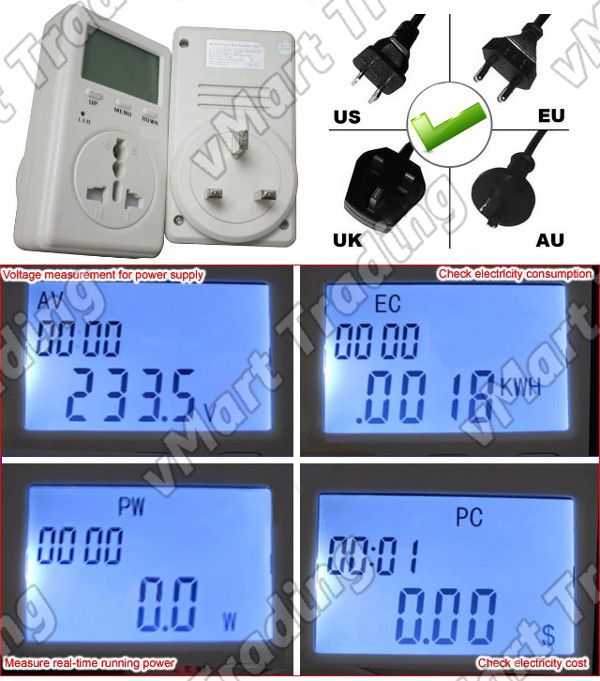
In any case, the Multifunctional Watt meter is not meant for professional who require utmost accuracy in his/her equipment or tools as professional tools does not comes in $100 price range. It is a device market for it's Plug and Play, easy and safe to use by user of all age and technical knowledge. Below are examples of usages :
Usage Example 1 - Determine which water boiler is greener before purchasing1. At your parents/relatives/friends house, plug-in the wattmeter & write down the power usage when it is boiling the water.
2. Switch the wattmeter to total power consumption mode (kWh) & write down the numbers after 12/24 hours.
3. Test again with other brand/model of water boiler.
4. You will be surprise that the brand/model with a lower max power (watt) indicated by the manufacturer does not always translate to lower electrical bill. The frequency of the re-heating is crucial too.Usage Example 2 - Determine when to service your air-con1. Plug your air-con into the wattmeter when it is new or newly serviced.
2. Write down the max power consumption & the temperature setting on the air-con.
3. Plug your air-con into the wattmeter again after a few months.
4. If the power consumption increase at the same temperature setting, it is time to service your air-con.Usage Example 3 - Determine the electricity use by your tenant.1. If you rent out a room or sharing a rented house, it is wise to charge the electrical bills according to usage.
2. Plug in the air-con or other electrical appliances (1 appliance for 1 wattmeter) into the wattmeter in the rented room.
3. Switch the wattmeter into total power consumption or power consumption cost mode.
4. Charge the tenant periodically base on his/her usage.For those who require utmost accuracy in their tools, we would like to recommend Uni-T UT231/UT233 (without calibration certificate) or Fluke 345 (with calibration certificate). Both models can be use to measure Active Power, Apparent Power, Reactive Power, Power Factor and many more. Kindly send us a pm for pricing. Below are links to official product page :
Official web page :
UT231 (Single phase with PC interfacing and temperature measuring features)Official web page :
UT233 (Three phase with PC interfacing feature)Official web page :
Fluke 345QUOTE(endau02 @ Oct 22 2011, 09:15 AM)
lu sin kar lan ar...
Power (W) is less than or equal to VA, bcoz power=voltage X current X power factor.
from ur testing, power= 129.8W
Voltage X Current= 129.65 VA
shows that there is inconsistency in ur instruments d.
dunno about AC power calculation, dun talk rubbish here. the measurement is all OUT!!
is ur instrument calibrated? dont mind show us the calibration cert?
Lastly,
we sincerely appreciate your efforts on sharing your knowledge but your vulgarity & rude attitude are unwelcome.If you are going to rant, at least buy a unit to test it with your certified calibrated equipment & send us the result. We will gladly replace our simple test result with yours & give you the credit that you deserves. In the future, kindly stay cool & refrain from using vulgarity (in any language or dialect) in your choice of words if you are to post in our topics.
This post has been edited by vMart@lowyat: Nov 1 2011, 02:26 PM 


 Aug 30 2011, 02:47 AM, updated 8y ago



 Quote
Quote








 sit there don't know what to do for days until the tech is free to resolve the situation and finally put an end to her torment.


 how people respond when I ask them silly question)











































 0.1393sec
 0.30
0.30
 6 queries
 GZIP Disabled