I posed something a year back:
The Journey - Wood flooring (Enigma of Building Material) Part 1
Based on the building plan, the first floor, ground floor bedroom,lower ground floor and all staircase will be covered with timber flooring. In addition, at least two of the exterior decks will be wooden deck as well. This translates to almost 3000 ++ sq ft of wooden flooring. Timber flooring is expected to add 'softness' to the supposedly cold modern contemporarist structure that envelopes the exterior of the house. Given the extensive use of wood flooring, this is one of the area we have spent researching over the last one or two months. To my surprise, the technicalities, choices available and practical considerations are so extensive in relation to wood flooring. Sometimes, I am thankful I did the research so as to make an informed decision later on, on the contrary at times I also wonder whether I have read too much and got confused along the way. In any case, I attempt to put in perspective the analysis I have made after months of research and also the discussion I had with various suppliers and people who are in the building industry.
Other than species choices, a buyer like me needs to consider types of wood flooring which can be categorised into:
(a) Solid hardwood
(b) Engineered hardwood
© Laminate flooring.
In this case, laminate flooring is not being considered for the current journey at hand.
In addition, I also need to consider pre-finished or on site finished hardwood. Pre finished means the finishing is done at the factory whereas the latter, the finishing will be completed on site after the flooring is fixed in the house.
Finally, the choice of species is key as different wood species bring different grain, colour and durability into the picture.
Solid vs engineered hardwood
A surfing exercise of the internet will reveal millions of references to this perennial issue in wood flooring. Solid or engineered - that is the question.
Note that '+' is for pros and '-' for cons
Solid hardwood
+ Can be resand many times
+ Cheaper to install : Merbau is RM14++ to supply install, whereas engineered wood hovers around RM18-20++
+ Psychologically feel better, as you are perceived to pay for the whole exotic wood plank
+ Full 18mm plank can be obtained
- May have a problem if installed at the lower ground floor
- Buckling and ripping
- Gaps appear in the long run
- Workmanship very dependent on the 'master' on site
- Need to make sure the wood is really really kiln dried otherwise big problem will emerge
Engineered wood
+ 70% more stable than solid hardwood
+ Easier to install
+ Minimum buckling and ripping
+ Can install at lower ground floor with proper waterproof underlay
+ Enviromentally friendly. The sub-surface layers are made from "junk" or "scrap" wood, not the ornamental wood. This approach saves more forests because each tree of the desired ornamental wood can go further than it does with solid wood flooring.
- Can be more expensive than solid hardwood
- Psychologically feel cheated if its more expensive than solid hardwood
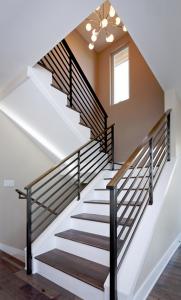
- Not nice for staircase as engineered wood normally come in tounge and groove version (T&G)and not the Surfaced Four Side (S4S) version
- Only come in 14mm thickness rather than 18mm
- Limited sanding
What you can see is that there is always a compromise somewhere and one cannot have the cake and eat it in this situation. In this respect,personal priorities will likely to determine the option chosen.
Prefinished vs unfinished flooring
I always thought prefinished is superior as the finishing is likely to be more durable and that is an important consideration as I have a young family with little gals and boys running around. Because sanding and finishing are not required, a pre-finished floor is completed relatively quickly without the dust, noise and fumes that can accompany the on-site finishing process.
The species
We have actually narrowed down to about a number contenders with some dark horses. The contenders are as follows:
Doussie
What we like about Doussie is the grain and the colour. The grain being wavy is unusual and its not too reddish compared to Jatoba.The unique grain feature displays a perfect fit and finish every time, which creates an instant modern, chic environment. As with most exotic species, Doussie will become darker in color and richer looking as the floor ages - something we are looking for. One final strong point is that it is considered a hard species, this selection comes in at a durable 1,770 PSI (pounds per square inch) under the Janka Hardness Ranking.
Walnut
Walnut floors are proving to be so popular because the wood here is actually considered to improve in the way it looks as time passes. The natural veining and curling grain effect of this wood also often give it an individual style that you simply will not get with many other flooring woods. Many walnut floors are laid for their colour depth and richness. One reservation I have is that a slight variation of colour may result in a country rather than a modern contemporary feel hence a risk of mismatch. Also, given its a temperate wood, not sure how would it adapt to the tropical weather in Malaysia.
Belian
This is more for external deck. What interest us to this species is the durability. Its not called ironwood for nothing and apparently it also darkens as it ages. One thing though is that the grain is not exactly very striking.
Merbau
Merbau is the dark horse here as it is easily available in Malaysia and is cost effective given its local nature. Durable and easily adaptable to local environment but could be 'too common' for liking.
Well, currently these are the species we are seriously considering and it may change between now and when we make the final decision
what was your final decision and how was the outcome? mind sharing any pictures? thanks.


 Sep 13 2012, 02:40 PM


 Quote
Quote



 and engineered wood.
  .
. .
.



 0.0267sec
 0.42
0.42
 6 queries
 GZIP Disabled