

Astronomy Photography, Lunar Eclipse on 4 March 2007
|
|
 Nov 20 2013, 06:58 AM Nov 20 2013, 06:58 AM
Return to original view | IPv6 | Post
#1
|
 
Senior Member
3,617 posts Joined: Oct 2010 
|
Canon Powershot S120 is great camera for Astrophotography. It makes Milky Way timelapse video by itself.
|
 Quote
Quote|
|
|
|
|
Nov 27 2013, 01:43 PM
Return to original view | Post
#2
|
|
Senior Member
3,617 posts Joined: Oct 2010
|
ISON COMET this Friday Morning 1am to 3am Malaysia's night sky?
  Read: http://newswatch.nationalgeographic.com/20...on-cliffhanger/ |
|
|
Nov 29 2013, 10:44 AM
Return to original view | Post
#3
|
|
Senior Member
3,617 posts Joined: Oct 2010
|
QUOTE(dianqing99 @ Nov 27 2013, 06:22 PM) Nope,it's on Sunrise (6~7 am) So did you see it this morning?    BBC reported that the comet was destroyed by the sun corona this morning (good riddance) http://www.bbc.co.uk/news/science-environment-25143861 |
|
|
Dec 1 2013, 10:54 AM
Return to original view | Post
#4
|
|
Senior Member
3,617 posts Joined: Oct 2010
|
Another candidate for saving ton of time and effort for making starttrail and milkyway time lapse apart of S120. No other camera can do this yet in-camera except for these two powershots (S120 & G16) afaik.
But i still prefer S120 coz its been a while since canon make nice look pocketable camera after the discontinuation of IXUS series. While the black one is ugly, Look at this silver one so cute and match with your other apple devices Imagine you're on vacation away from city lights in few countries or around Malaysia. Every single places you visited you're able to produce nightscape timelapse videos of the star & milkyway without having to download thousand of photos into your computer, then spend hours of batch editing in Lightroom, hours of time waiting for your computer to process before uploading to youtube. Remember you're on vacation, time better spent doing other things than infront of the computer. Put this baby on gorilla pad in the balcony of the resort or even better if you have motorized rail track like stage zero dolly for hyperlapse video. In few hours while you're sleeping or having sex with your partner, your video is ready to be uploaded using the resort wifi connection for the world to see without any computer intervention. This post has been edited by chokia: Dec 1 2013, 07:05 PM |
|
|
May 23 2014, 09:41 AM
Return to original view | Post
#5
|
|
Senior Member
3,617 posts Joined: Oct 2010
|
Get Ready your gear people, we are going to witness an amazing celestial event this weekend.
 QUOTE SAKSIKAN HUJAN METEOR KOMET 209P/LINEAR Source http://www.bernama.com/bernama/v7/bm/ge/ne....php?id=1037211Siaran Media - Rakyat Malaysia berpeluang menyaksikan juraian hujan meteor daripada Komet 209P/Linear pada 23 dan 24 Mei ini. Agensi Angkasa Negara (Angkasa) menyatakan kira-kira 100 hingga 400 meteor sejam dapat dilihat dengan mata kasar pada malam itu. "Titik hujan meteor ini adalah daripada buruj Camelopardalis di langit utara dan dijangka masa puncak hujan meteor ini adalah pada 6UTC hingga 8UTC iaitu dari 2 petang hingga 4 petang waktu tempatan," kata Angkasa dalam kenyataan hari ini. Hujan meteor itu boleh dilihat di kawasan yang kurang mengalami pencemaran cahaya dan bergantung kepada keadaan cuaca langit malam kawasan itu. Selain keadaan cuaca dan awan tebal, kebarangkalian untuk menyaksikan meteor itu berkurangan sedikit kerana terdapat bulan sabit tua yang akan terbit kira-kira 3 pagi pada tarikh hujan meteor itu. Justeru itu, orang ramai yang ingin melihat hujan meteor disaran berbuat demikian sebelum bulan terbit iaitu sebelum 3 pagi kedua-dua hari berkenaan. Untuk maklumat lanjut, orang ramai boleh menghubungi Planetarium Negara di talian 03-22734303 atau Observatori Negara Langkawi di talian 04-9668870. -- http://solarsystem.nasa.gov/scitech/display.cfm?ST_ID=2630 Astronomy camera kaki should be getting photos like these if the weather is good     |
|
|
May 23 2014, 06:12 PM
Return to original view | Post
#6
|
|
Senior Member
3,617 posts Joined: Oct 2010
|
QUOTE(blackstar88 @ May 23 2014, 02:29 PM) any good spot in penang? Gertak Sanggol Bayan Lepas   |
|
|
|
|
|
May 23 2014, 10:27 PM
Return to original view | Post
#7
|
|
Senior Member
3,617 posts Joined: Oct 2010
|
I just called National Observatory in Langkawi, they said it's tonite and tomorrow nite.
They havent spot anything yet cause it's cloudy in langkawi They also said you should be able to see it anywhere across the sky not specifically in any direction. That is if you can spot any. It'll be best to get away from light pollution area. It's clear sky in penang and i see stars but meteor shower is 404 Good luck and dont forget to make a wish if you see it. |
|
|
May 23 2014, 11:08 PM
Return to original view | Post
#8
|
|
Senior Member
3,617 posts Joined: Oct 2010
|
Live but when USA become nightime
QUOTE Scheduled for May 23, 2014 It's not every day that we experience a brand new meteor shower. After all, the most reliable showers, like the famous Perseids every August 11, have been observed annually for over two thousand years. Sure, there are famous sometimes-showers that occasionally perform but are mostly yawners. The greatest of these is the amazing Leonid shower. In the wee pre-dawn hours of November 18, 2001, it produced six brilliant green shooting stars each minute, nearly all of which left behind long lingering trails like Cheshire cat smiles. That was probably the best meteor display of the past half century. But now, famed meteor expert Peter Jenniskens joins Russian astronomer Mikhail Maslov in predicting a rich new meteor shower created by passages though our celestial neighborhood of comet Linear. They think we'll get a rich enough shower to produce at least three or four "shooting stars" per minute. It will be a brand new event. Other meteor experts are slightly more conservative, but still think we should see a solid display on the night of May 23-24, and the individual meteors could be unusually brilliant. All of this will unfold during a two or three hour period. Of all places in the world, the United States and southern Canada alone will be best positioned to observe these brief and potentially spectacular fireworks. It should occur starting just before 2 AM and last almost until dawn. It's even a convenient Friday night or, rather, early Saturday morning. The moon will be a harmless crescent, so the sky won't be spoiled by bright moonlight. And of course, SLOOH will be employing its special low-light, super-sensitivity equipment to bring the event to your computer monitor live, in real-time. As for direction, expect the meteors to emanate from the north, radiating from the very faint constellation of Camelopardalis the Giraffe, which will be located exactly beneath Polaris, the North Star. We'll keep you updated in the days to come. But for now, mark your calendar to set the alarm the night of May 23 - 24, the early hours of Saturday morning. This post has been edited by chokia: May 23 2014, 11:11 PM |
|
|
Oct 14 2015, 10:10 AM
Return to original view | Post
#9
|
|
Senior Member
3,617 posts Joined: Oct 2010
|
Jupiter Great Red Spot is shrinking, last chance to get your gear up before its gone
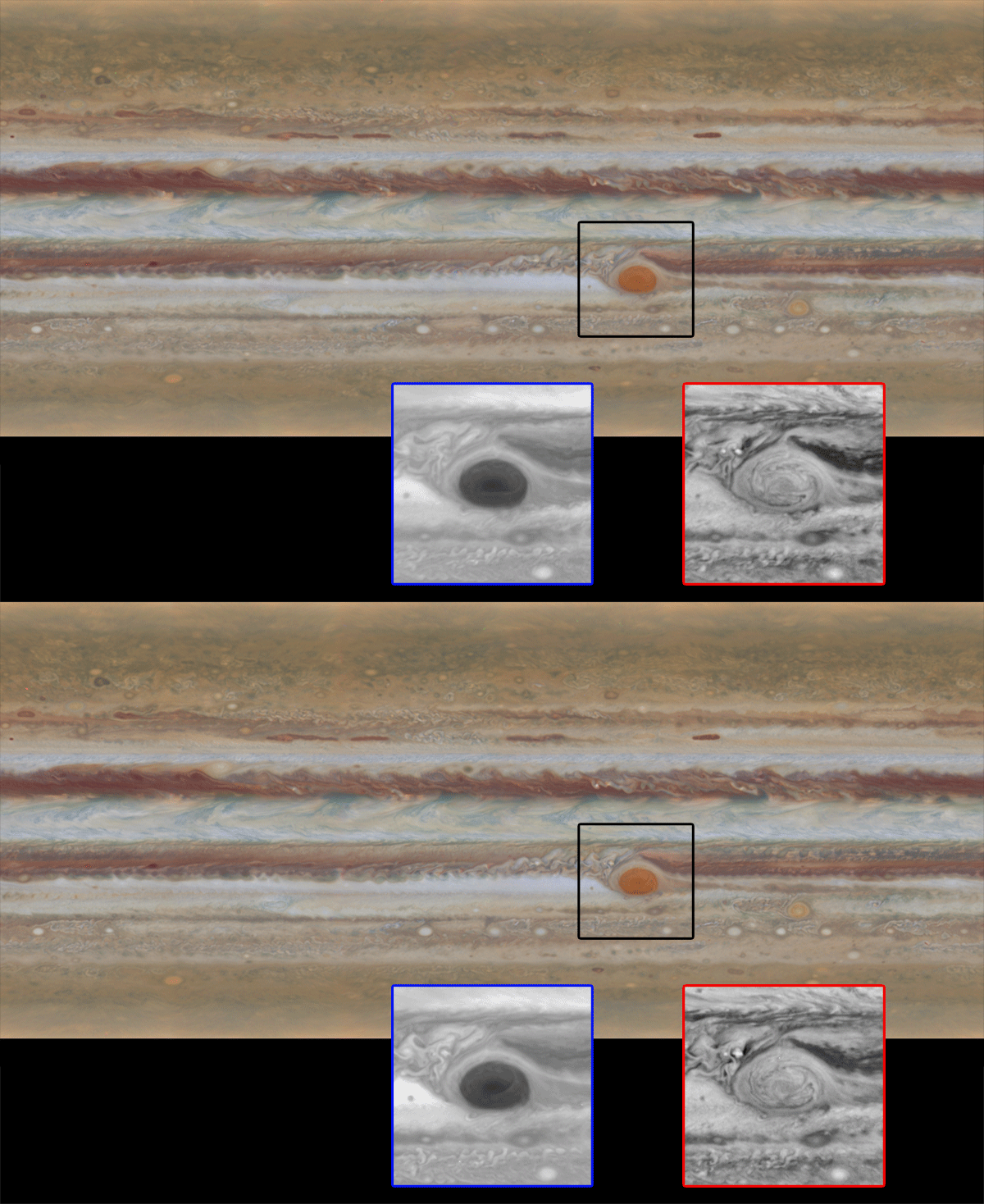 http://www.nasa.gov/press-release/goddard/...great-red-spot/ |
|
|
Nov 10 2015, 09:18 PM
Return to original view | Post
#10
|
|
Senior Member
3,617 posts Joined: Oct 2010
|
iPad Pro for Astrophotography now?
|
|
|
Apr 5 2016, 01:48 PM
Return to original view | Post
#11
|
|
Senior Member
3,617 posts Joined: Oct 2010
|
QUOTE(kvn1080 @ Apr 2 2016, 11:38 PM) Hi, Gertak SanggolI'm new here. Need to learn from all sifu here. Btw I'm from Penang island. |

| Change to: |  0.0357sec 0.0357sec
 0.77 0.77
 7 queries 7 queries
 GZIP Disabled GZIP Disabled
Time is now: 17th December 2025 - 07:58 PM |
All Rights Reserved © 2002- 2025 Vijandren Ramadass (~unite against racism~)
Powered by Invision Power Board © 2025 IPS, Inc.