

 May 8 2011, 02:31 AM


Lionel Messi : one of Barcelona amazing outcome from La Masia de Can Planes youth player project
Cesc Fabregas is also from La Masia de Can Planes youth player project.
Barcelona really make alot of talented players nowaday like before this the Ajax from Netherland
Barcelona B
Juvenil A 16–18 years old players
Juvenil B 16–18 years old players
Cadet A 14–15 years old players
Cadet B 14–15 years old players
Infantil A 13–14 years old players
Infantil B 13–14 years old players
Alevi A 11–12 years old players
Alevi B 11–12 years old players
Benjamí A 9–10 years old players
Benjamí B 9–10 years old players
Prebenjamí 7–8 years old players
La Masia de Can Planes, often shortened to La Masia is the name given to FC Barcelona's training facilities located near the Camp Nou in the Les Corts district of Barcelona, and is often used to generically describe the youth academy of Barcelona.
The youth academy of Barcelona holds more than 300 young players, and has been praised since 2002 as one of the best in the world, being a significant factor in FC Barcelona's European success as well as the Spanish national teams' success at the 2010 FIFA World Cup. In 2010, la Masia achieved a record breaking honor becoming the first youth academy to have all three finalists for the Ballon d'Or in one same year, with Andrés Iniesta, Lionel Messi and Xavi Hernández.
The building itself is an ancient country residence built in 1702, and once Camp Nou was inaugurated in 1957, the building was remodelled and extended for use as the club's social headquarters. With the gradual expansion of the club, the building became too small for headquarters, and, on 20 October 1979, La Masia was converted into a dormitory for young players from outside of Barcelona.
La Masia received more publicity after Barcelona B's success with homegrown players; Rory Smith reported in The Daily Telegraph that La Masia "has replaced the fabled Ajax Academy as football's foremost production line." The recent fame and success of La Masia as a talent school was ascribed by Ian Hawkey of The Times to the class of 1987, which featured prominent members as Cesc Fàbregas, Lionel Messi, Gerard Piqué and Pedro Rodríguez.In 2000, Louis van Gaal, coach of FC Barcelona's first team, was widely ridiculed by the city for his dream to win the Champions League with 11 home-grown players. The first team won the trophy in 2009 with eight home-grown players.
In the 30 years since La Masia's inauguration, more than 500 youngsters have left their homes and families to stay at the academy. About half of them were from Catalonia, and the rest came from other regions of the Kingdom of Spain and beyond, including 15 from Cameroon, 7 from Brazil, 5 from Senegal and 3 from Argentina. Of those 500, about 10 percent made it into the first team.
CF Barcelona have 15 teams for their La Liga project!!
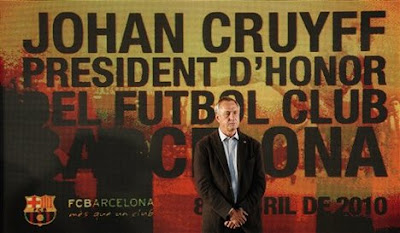
Former technical director, Pep Segura, attributes the club's success to its "philosophy of play": "It is about creating one philosophy, one mentality, from the bottom of the club to the top. The philosophy consists of the application of total football mixed with traditional Spanish one-touch play (tiqui-taka). The total football approach was derived from the Netherlands football team through Cruyff.The total football approach requires the players to move in a fluid formation, where players can interchange positions quickly. In the youth academy, there is a large focus on technical ability, which is seen as a pre-requisite for inter-changes.An often-quoted reason for Barcelona's success is the continuity and commitment with which Barcelona follow the current philosophy of pass and move. "Guardiola was the prototype of the pivotal midfielder; current midfielders Xavi and Iniesta are its custodians.
Another aspect of La Masia is regional nationalism—local talent in the service of a club with a strong, defining sense of the cultural make-up of Catalonia. The supporters often prefer locally-developed players to foreign players if the players are equally talented. In this way, the emphasis on homegrown talent concurs with UEFA's attempts to curb the influx of foreign players in clubs. The head of UEFA, Michel Platini said: "Barcelona represent my philosophy, not only for the game, but also for the training of athletes"
http://www.fcbarcelona.com/web/english/clu...ia/lamasia.html
this is what Malaysia really need if want to qualify for World Cup.. we need to make a youth player factory first like Barcelona and Ajax just did,
not just playing media speculations like what English Premier League always did..


This post has been edited by hack3line: May 8 2011, 02:34 AM
 Quote
Quote


 who is your dad??


 0.0430sec
 0.28
0.28
 7 queries
 GZIP Disabled