I was busy buying

earnings season r here again, oil is > $106 & the outlook is

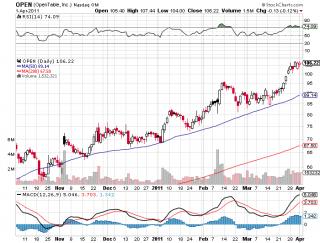
open blast thru $100 no sweat, after tidur for 1 month. see below for then & now prices

for call options guideline, every $1 up, ur 1 contract earns $100, as time decay monthly, if stock no move, knock off $50

$27.40 msft $25.48
$356.20 aapl $344.56
$617.39 goog $591.80
$226.10 nflx $242.09
$94.2 open $106.22
With stocks breaking out and the indexes rising, it's useful to review what the recent decline and developing rebound have accomplished. A correction can be constructive, allowing new bases to form and rotating the leadership.
The market correction — 7% or 8% depending on the index — appears to have shuffled the leadership. At the Feb. 18 peak, the Philadelphia semiconductor index was up 14% for the year while the broad indexes were up by about half that amount.
As of Friday's close, the Philadelphia semiconductor index was up only 5% for the year — roughly in line with the major indexes. The new leaders are the midcap S&P 400 and the small-cap S&P 600, up 10% and 8% respectively for the year.
Sector leadership also has shifted. On Feb. 18, the top two sectors were chips and electronics. Now the top two are energy and real estate.
Industry groups are another way to gauge leadership. The chief change was the demotion of chipmakers and chip designers from the top 20.
Yet the biggest change in the market in recent weeks is the rise in breakouts. About a dozen and a half stocks broke out last week — the most in any week for at least two months.
The tenor of those breakouts has changed as well. In February and early March, about a dozen breakouts fizzled as they triggered the 8% sell rule. They included restaurant chain Chipotle Mexican Grill (CMG), apparel retailer Deckers Outdoor (DECK) and mining financier Silver Wheaton (SLW) .
But later in March, breakouts began to work. None has failed outright, though one showed bad action Friday. Oilfield services and equipment company RPC (RES) plunged as much as 15% Friday before recovering. It closed down 6%. Volume was triple its usual pace.
On Friday, four top-rated stocks joined the breakout parade: farm equipment maker Deere (DE), apparel maker Under Armour (UA), mining equipment maker Joy Global (JOYG) and Stericycle (SRCL), a medical waste handler. Volume was 40% or greater for all but Stericycle, which stepped up trade 34%.
But other stocks communicated a conflicted message. Chipotle broke out early, but then volume faded as it fell back into the cup base. Robotics surgery company Intuitive Surgical (ISRG) cleared a nearly yearlong cup-with-handle base, but volume was only 20% above average. Intuitive retreated and closed under the 346.89 buy point.
Borg Warner (BWA) closed just below an 81.17 buy point in below-average trade
QUOTE(sulifeisgreat @ Feb 12 2011, 12:23 AM)
tis is for discussion purpose & about forward pe. pay ferrari, get ferrari, pay kap chai, get kap chai
http://quote.morningstar.com/stock/s.aspx?t=msft$27.40 msft 9.9
$356.20 aapl 13.9
$617.39 goog 15.5
$226.10 nflx 36.7
$94.2 open 82.1
msft need to grow revenue or it continues to lumber, definitely not part of my watchlist

but y choose it?
[attachmentid=2038460]
aapl, breakout to new high, under normal circumstances, will enter, but after indices does a pullback
[attachmentid=2038468]
goog, tidur sideways, not part of my watchlist as they attempt shakeout gamblers, if breakout, then can consider
[attachmentid=2038471]
nflx, another breakout to new high, under normal circumstances, will enter, but after indices does a pullback
[attachmentid=2038475]
open, another breakout to new high, since not yet triple digit & the no. of momo low, very high chance can achieve $$$

[attachmentid=2038482]
all the fa r public known info, which 1 to choose? I need to use ta/ chart for clearer picture. if to choose either 1 from the 5 choices above.
I take open

wat about the rest of u?
» Click to show Spoiler - click again to hide... «
EPS Views Brighten As 1st Qtr Wraps Up
Despite a still-sluggish U.S. recovery,soaring oil prices, Middle East violence and Japan’s massive earthquake, Wall Street is getting more optimistic about corporate earnings growth. S&P 500 earnings likely rose 12.9% in Q1 vs. a year earlier, according to analysts tracked by Standard & Poor’s Capital IQ unit. Views for the quarter and year have gotten a little rosier from earlier in 2011, analysts say.
“Large-cap U.S. corporations have stronger balance sheets than do governments and consumers,” said Alan Zafran, partner with investment advisory Luminous Capital. He called Q1 “the Teflon quarter. Because whatever bad news the economy threw at it, it didn’t stick.” The major averages ended Q1 mildly mixed. Despite a long run and gloomy headlines, they ended March essentially flat and up for the quarter.
Growth rates in the teens are lower than the blistering growth rates in the 30s and 50s seen last year. But it’s still historically good, says Alec Young, Equity Strategist with S&P Equity Research Services. “As we move further and further from the crises, the comps are getting harder, so the growth
rates are slowing,” he said. S&P sees strong growth from the materials and energy sectors of 36.1% and 24.9%, respectively.
Big industrials should enjoy a 22.4% gain and techs 15.9%. Utilities and telecom sectors are expected to lag with 1.4% and 6.8% declines, respectively. Nick Bohnsack, a sector strategist with Strategas Research Partners, thinks the economy is transitioning from a recovery phase to
expansion, as government fiscal and monetary stimulus ebbs. “What’s got the market more excited is that maybe these earnings are more indicative of the true economic conditions,” he said.
A clearer picture of 2011 won’t emerge until executives open up in their earnings conference calls. The earnings season unofficially kicks off with aluminum giant Alcoa’s AA earnings on April 11. Almost two-thirds of S&P500 companies should report over the month. That leaves investors pondering bigger macro questions. The Federal Reserve’s second round of quantitative easing is set to end June 30, but will there be a QE3? How seriously will Japan’s continuing woes disrupt global supply chains? How hard will rising commodity prices hit corporate earnings? Will companies
finally step up hiring, boosting consumer spending and related companies?
Zafran thinks still-downward pressure on wages will help firms absorb rising commodity costs without too much pain.


 Feb 14 2011, 02:39 PM


 Quote
Quote


 0.0239sec
 0.53
0.53
 6 queries
 GZIP Disabled