Fender Stratocaster (credit to led_zep_freak, Wikipedia and Fender)
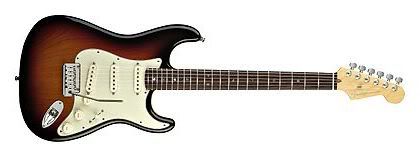
Model: Stratocaster
Brand: Fender
Nickname: Strat
Genre: Blues, Rock & basically everything else too (Strats are very versatile!).
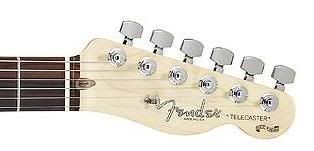
What ? The Stratocaster is a model of electric guitar designed by Leo Fender in the early 1950s, and manufactured continuously to the present. The Stratocaster has been used by many leading guitarists and on many historic recordings: Along with the Gibson Les Paul and the Strat's older cousin, the Fender Telecaster, it is one of the most enduring and common models of electric guitar in the world.
 The headstock shape of the Statocaster is actually copyrighted.
That's why other "Stratocaster" copies cannot replicate its recognizable shape exactly. The Stratocaster has been widely copied, such that 'Stratocaster' or 'Strat' can also denote a type of guitar, by various manufacturers, showing the same general features as the original (see strat copy). However, in many jurisdictions the word 'Stratocaster' is reserved for Fender guitars.
Where did it come from ? The Fender Electric Instrument Manufacturing Company (now known as Fender Musical Instruments Corporation) developed the first commercial solid-body 'Spanish' (as opposed to 'Hawaiian,' or lap steel) electric guitar in the Telecaster, a simple design whose earliest models were offered under various names like Broadcaster or simply Esquire, beginning in 1950. Though the Telecaster and its variants were successful, many guitar players of the day insisted on using a Bigsby unit, a fairly primitive spring-loaded vibrato device with which players could bend notes up and down with their pick hand. Instead of adding a Bigsby, Fender decided to produce a new, more expensively-made ash or alder line of guitars with his own design of vibrato (see tremolo arm for more on the evolution of such mechanisms). His decision was also influenced by guitarists Rex Gallion and Bill Carson, who requested a contoured body to temper the harsh edges of the slab-built Telecaster; the new ash body design was based on that of the 1951 Precision Bass.
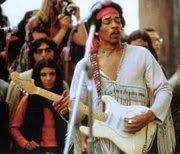 Jimi Hendrix at Woodstock with a 1969 Stratocaster, a right-handed
model played left-handed, with the strings in the standard order relative to the guitarist. The name, 'Stratocaster,' was intended to evoke images of newly emergent jet-aircraft technology (such as the Boeing B-52 Stratofortress), and to express Fender's modernistic design philosophy. In designing the Stratocaster's body, a significant area of the back of the guitar, and the area where the strumming arm rests, were beveled to accommodate the player's chest and arm. The upper bouts featured two cutaways, for easier access to the higher frets. The new 'Custom Contour Body' and 'Synchronized Tremolo' bridge made the Stratocaster a revolutionary design. The guitar also featured more complex electronics than the Telecaster: three single coil pickups, each with staggered magnetic poles; a three-way selector switch; one volume knob, and two tone controls. (A three single-coil pickup design was an innovation already in use by Gibson in their ES-5 model since 1949. However, Fender's pickups were much more compact.)
How about it's sound and playability ? Much of the popularity of the Stratocaster can be attributed to its versatility. The neck, middle, and bridge (in the original manual, labelled "rhythm", "normal tone", and "lead", respectively) pickups provide a wide range of tones. The standard singlecoil pickups often found in Stratocasters produce a trebly sound with a high top end and bell-like harmonics. The Stratocaster has been used for a variety of purposes, from the classic "Fender twang" to the slicing solos of Jimi Hendrix and Eric Clapton to the fat, crunching tones in Ritchie Blackmore's "Smoke on the Water".
Is the Design and popularity still the same ? In 1959-1967, the Stratocaster was refitted with a rosewood fretboard, as well as color choices other than sunburst, including a variety of colorful car-like paint jobs that appealed to the nascent surfer and hot-rod culture, pioneered by such bands as the Ventures and the Beach Boys. d*** Dale, the godfather of surf-rock, was a prominent Stratocaster player who also collaborated with Leo Fender in developing the Fender Showman amplifier. In the early 60's, the instrument was also championed by Hank Marvin - guitarist of the Shadows, a band which originally backed Cliff Richard and then produced instrumentals of its own. So distinctive was the Hank Marvin sound that many musicians - including the Beatles - initially deliberately avoided the Stratocaster and chose other marques. However, by 1965, George Harrison and John Lennon of the Beatles both acquired Stratocasters at about the time of the Rubber Soul recording sessions. It was Jimi Hendrix who widely popularized its use once again in the late 1960s.
The one-piece maple neck was discontinued in 1959; however, a maple neck with a glued-on maple fretboard was offered as an option in 1967. The rosewood fretboard over maple neck remained as the other neck option. In 1969, one-piece maple necks were again offered.
 Eric Clapton plays his signature model
at the Tsunami Relief concert, January 22nd 2005. Many artists (including Eric Clapton, Jimi Hendrix, and Mark Knopfler) discovered that the pickup selector could be lodged in between the basic three settings for further tonal variety; since 1977, Stratocasters have been fitted with a five-way switch to make such switching more stable. Other, often subtle changes were made to the guitars over the years, as though in the spirit of tinkering for which Leo Fender was famous, but the basic shape and features of the Strat remained unchanged. In the 1980's some popular guitarists began modifying their Stratocasters with a humbucker pickup in the bridge position. This was intended to provide a more suitable sound for the heavier music of the day. The popularity of this modification grew and ultimately Fender began releasing factory built models with a bridge humbucker option.
Players first perceived a loss of the initial high quality of Fender guitars after the CBS takeover in 1965. So-called 'pre-CBS' Stratocasters are, accordingly, extremely sought-after and expensive. In recent times, original 1954 to 1958 Stratocasters have sold for more than $75,000. Many now reside in Japan, cached away as collectible pieces of Americana.
 TheWhacker
  , with a 70's Stratocaster, playing at a
Tsunami Relief concert St.Andrews, April 2005 The Stratocaster fell out of fashion in the mid-sixties, to the point where the Fender company (Leo Fender had sold it to CBS for $13 million in January 1965) reduced its price and considered removing it from their production line. However, Jimi Hendrix and many other blues-influenced artists of the late '60s soon adopted the Stratocaster as their main instrument, reviving the guitar's popularity. Both George Harrison and Eric Clapton used Stratocasters in the 1971 Concert For Bangladesh, giving the Strat additional high visibilty in rock circles.
After a peak in the 1970s, driven by players such as David Gilmour of Pink Floyd, Eric Clapton, and Mark Knopfler of Dire Straits, another lull occurred in the early '80s. During that time, CBS-Fender cut costs by deleting features from the standard Stratocaster line, despite a blues revival that featured Strat players such as Stevie Ray Vaughan, Robert Cray, and Buddy Guy. (Buddy Guy had actually been a Strat player since the mid-1960s, and is sometimes credited with influencing Jimi Hendrix, Eric Clapton, and Stevie Ray Vaughan in their choice of the Stratocaster as a primary blues-rock guitar.) However, this lull abated once the company became independent of CBS, and a rise in mainstream popularity for vintage (and vintage-style) instruments resulted.
This post has been edited by TheWhacker: Aug 21 2006, 07:37 PM 

 Jun 24 2005, 10:28 AM


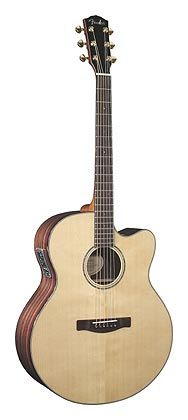
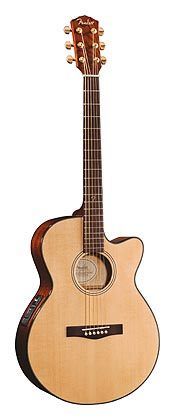
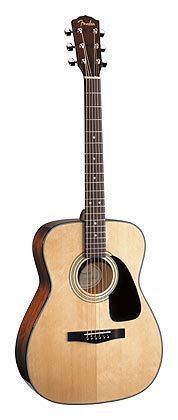
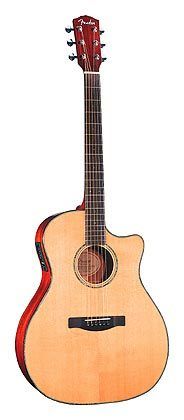
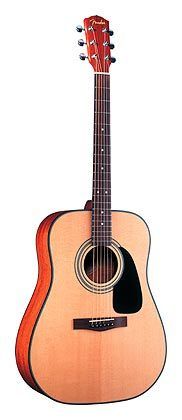
 , Coz i did my own research before i bought my Dreadnought and this all the research i did
 Quote
Quote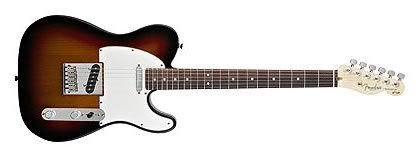

 and saves you 15 quid as well.

 0.0236sec
 0.39
0.39
 6 queries
 GZIP Disabled