shame this isn't made in Medieval: Total War
RTS Nusantara Total War, Modification of RTW:BI focusing on SEA
RTS Nusantara Total War, Modification of RTW:BI focusing on SEA
|
|
 Jan 28 2011, 03:23 PM Jan 28 2011, 03:23 PM
|
 
Junior Member
43 posts Joined: Dec 2008 
|
shame this isn't made in Medieval: Total War
|
|
|
|
|
|
Jan 28 2011, 03:45 PM
|

Newbie
0 posts Joined: Dec 2010
|
QUOTE(gestapo @ Jan 28 2011, 03:10 PM) wahh.. can i be one of the ingame actor? i do it for free How do you want to be ingame actor? Well, PM me…. QUOTE(justinlee999 @ Jan 28 2011, 03:23 PM) shame this isn't made in Medieval: Total War We will stuck for long time and make no release if we do that in M2TW, like 2 other mods  |
|
|
Apr 25 2011, 09:36 AM
|

Newbie
0 posts Joined: Apr 2011
|
This is the first mod base on South East Asia!
Good work! |
|
|
Jun 17 2011, 01:52 AM
|
|
Newbie
0 posts Joined: Dec 2010
|
 note: - Royal Decree is for Javanese/Sundanese factions, specifically to build high-level factional barracks outside Java (and Bali) - Colonial Administrations also used by Europeans to facilitate European soldiers recruitment, they're slow to establish, but give bonus on trade revenues as well QUOTE(Adi Jagat @ Apr 25 2011, 09:36 AM) This is the first mod base on South East Asia! Thanks.Good work! |
|
|
Jun 17 2011, 03:57 PM
|

Junior Member
11 posts Joined: Jun 2011 From: Under the bridge, trolling passerby
|
Wow, wonder will Imperial Chinese Dynasty will included in this game? Like the Chinese voyage through the Malacca strait that would invade the land if hostile act were done on them
 |
|
|
Jun 18 2011, 10:09 PM
|
|
Newbie
0 posts Joined: Dec 2010
|
QUOTE(Umadbro? @ Jun 17 2011, 03:57 PM) Wow, wonder will Imperial Chinese Dynasty will included in this game? Like the Chinese voyage through the Malacca strait that would invade the land if hostile act were done on them Thanks for the interest in our mod project.FYI, for Nusantara Total War: Portuguese Invasion (NUTWPI), our mod start at 1511, during the Portuguese invasion of Malacca. Regarding China (Ming Dynasty at that time), At that time, the Ming Dynasty no longer active in their naval activities and exploration not as active as early 1400. As they began to practice more close-door policy. Meanwhile, our campaign map will include the Archipelago, and for Peninsular, only until some land north of Kedah and Kelantan (area of Phuket to Patani) and the land beyond the north of them will not be included. (even Siam will not be in the map). As conclusion, the NUTWPI will focused the European invasions in South East Asia, and no China will be included. Anyway, we do planning a parallel project, namely "Twilight of The Dragon" (TTD). The project focused on South East Asia mainland, and the factions are Siam, Khmer, Dai Viet, Burma, Champa, Lan Xang (Pre-Laos), Kedah and Patani. The project somewhat run smoothly with the help of several Vietnamese abroad who knowledgeable about their history. For the campaign map, Some area at the south of China will be included, and we are discussing whether to put Ming as a faction or not. It depend on the researcher availability, if we get a Chinese who knowledgeable about Ming history that willing to join and help us. If not, we will just make China Southern Provinces as rebel provinces. |
|
|
|
|
|
Nov 26 2011, 09:32 PM
|
|
Newbie
0 posts Joined: Apr 2011
|
Any news?
|
|
|
Nov 26 2011, 09:36 PM
|
|
Newbie
0 posts Joined: Dec 2010
|
THE GUI Greeting Nusantara Total War fans. Today we are proud to present the graphic user interface (GUI) for each culture. The GUI will be yet another way to represent the uniqueness and cultural identity of the people of Nusantara, in addition to the soundtracks, portraits and unit voices (which we plan to use the native tongues, not English). Malay-Minangkabau Culture The Malays are the natives of the Malay Peninsula, the east coast of Sumatra, and the coast of Borneo; the Minangkabau are native to central and western Sumatra. Various elements of foreign civilizations and cultures had a hand in the creation of both ethnicities' cultures. Indian, Islamic, and Western European culture each had their turn of influence on these peoples. Islam would end up the dominant religion of both ethnic groups, but each of the others had their own profound impact as well. The factions that belong to this culture group are Melaka, Pagaruyung, Palembang, and Kota Merdeka (Malay Free States).  Stratmap UI  Battle UI For both UIs, the main panels depicted are the wood-carved motifs of “Pucuk Rebung” (Bamboo Sprout) and “Pucuk Paku” (fiddlehead fern). Wood-carved reliefs frequently adorn the doors, walls, and windows of traditional Malay houses. These reliefs frequently depict the various flowers and plants common in Nusantara, such as bamboo sprout and fiddlehead fern, which are parts of many native dishes. The side panels for both UIs depict the “songket”, a type of brocade fabric hand-woven in silk or cotton and intricately patterned with gold or silver threads. Songket is a luxury product traditionally worn in royal courts or during ceremonial occasions, and frequently features various kinds of flowers and plants as motifs. Javanese Culture The Javanese, natives of central and eastern Java, are the largest ethnic group in Nusantara. After centuries of migrations, they can now be found in most areas of Nusantara. Due to intensive contact with India, the Javanese developed a culture parallel with, but not identical to, the Indian. Hindu, Buddhist and Javanese faiths blended into a unique local culture that has strongly influenced the Javanese, even more so than their embrace of Islam. The factions in this culture group are Majapahit, Demak Bintara and Bhumi Mardika (Javanese Free States).  Stratmap UI The main panels show the “Kayon” used in “Wayang Kulit” (shadow puppet) plays that are prevalent in Java and Bali. The puppets are made of leather that is carefully chiseled with fine tools and are supported by stick handles and control rods. The stories in the plays are usually drawn from the Hindu epics of the Ramayana and Mahabhārata. “Kayon”, from the Malay word, "kayu" (wood) is the “Tree of Life” in Javanese culture and faith. The side panels depict “Batik”, a cloth that traditionally uses a manual wax-resist dyeing technique. Batik cloths have a diversity of patterns, and there are patterns specifically for infants, brides and bridegrooms, the dead, royal members and nobles. A person's status could be determined by the pattern of the batik he or she wore.  Battle UI The main panel depicted the Javanese painting of Bhāratayuddha. Bhāratayuddha means "India's War" or "War of Bharat" - referring to the great battle of Kurukshetra, fought between the Kauruvas and Pandavas in the Mahabhārata. The side panels show “batik” motifs. Sundanese Culture The Sundanese are an ethnic group native to the western part of the island of Java. Although geographically close to the Javanese homeland, Sundanese culture before the invasion of the Mataram Sultanate was very distinct from that of the Javanese. Their system of social heirarchy was noticeably less rigid. The common identity that binds the Sundanese together is their "Wiwitan" (Custom and tradition). Despite being exposed to Indian Hindu-Buddhist influences, the Sundanese did not embrace these religions, but maintained their own traditional religion until the arrival of Islam. The only faction in this culture is Pajajaran.  Stratmap UI The main panel depicts the Sundanese Batik of "Banyak Ngantrang", used by the Pajajaran King Ratu Jayadewata during his coronation ceremony. The side panels depict the Sundanese Batik of "Ragen Panganten", used by Ratu Jayadewata during his marriage to Nyi Ambet Kasih.  Battle UI The main panel depicts the Sundanese Batik of "Hihinggulan Resi" mainly used by Pajajaran resi (Rishi). The red batik panel on the side depicts the motifs of “Kembang Loa”, the 'Ficus racemosa' or cluster fig tree. This plant is a symbol for the Sundanese philosophy about life. Acehnese Culture The Acehnese are an ethnic group whos homeland is located on the northern-most tip of the island of Sumatra, and who have a history of political struggles against the Dutch. Their language belongs to the Aceh–Chamic group, and it is the only commonly spoken language in Indonesia that arrived, through migration, from mainland Southeast Asia. Malay texts describe that the Acehnese originated from the lands of the Champa Kingdom (in the region that is now Vietnam). The Acehnese migrated en masse to Aceh after the fall of Champa capital, Vijaya, in 1471. Situated at the doorstep of Nusantara, the Aceh homeland was the first region to receive the influence of Islam and established an Islamic Sultanate. The people developed into loyal Muslem devotees, generally considered the most conservative Muslim ethnic group in Nusantara. Aceh saw herself as an heir to Pasai, the first Muslim state in Southeast Asia. Aceh has often been called the "Veranda of Mecca," and became a major center of Islamic scholarship. The only faction in this culture is the Aceh Sultanate.  Stratmap UI The motifs on the main and side panels depict the designs used by Gayo people, known as 'Kerawang Gayo'. The Gayo are a tribe native to the central highlands of Aceh. The Gayonese language is distinct from Acehnese, but their culture, including song, dance, clothes, textile designs, architecture and carvings have influenced Acehnese culture. Kerawang Gayo is used extensively as a decoration on textile and wood carvings. Historically, before being conquered by the Sultanate of Aceh and subsequent introduction of Islam, it is speculated that the Gayonese established their own pre-Islamic kingdom, known as 'Linge', in central Aceh. During the war between Aceh and the Dutch, Gayo was the last province in Indonesia to be subjugated by Dutch, remaining an Aceh stronghold used by Acehnese militants to launch guerilla attacks against Dutch, until being conquered and pacified in the 20th century.  Battle UI The main panel depicts the Pinto Aceh, the design used to by the Acehnese to make gold and silver ornaments and adornments. The red coloured textiles on the side panels are the Acehnese 'Songket'. |
|
|
Nov 26 2011, 09:40 PM
|
|
Newbie
0 posts Joined: Dec 2010
|
Sulawesian Culture The people of Eastern Nusantara are often referred to as the ‘people of the current’, reflective of their close ties to the sea. The peoples of Sulawesi, such as the Bugis, Makassan, Mandarese, and Butonese, as well as the Moluccans, Tausug and Bajau in the Philippines and Borneo, have long been renowned throughout Nusantara as excellent seafarers, whether as shipbuilders, traders, pirates, mercenaries, or migrants. They sailed as far as northern Australia and New Guinea, to collect forest and sea products and trade them in the markets of Asia. The sea was their highway, and they are famed for their adventures, migrations and capacity to undertake the most dangerous of enterprises. The factions in this culture are Gowa-Tallo and Nagara Daha.  Stratmap UI The main panel depicts the Padekawang ship, one of the traditional vessels of the Makassan and Bugis people. The side panels depicts the Tenun Bugis, the traditional Bugis textile.  Battle UI The main panel depicts two crossed 'Badik Makasar', the traditional weapon of the Makassan people, with the Kelasak, the traditional shield used by the peoples of that region. The textiles on the side panels are the Tenun Bugis. European Culture Europeans first came to Southeast Asia in the 16th century. It was the lure of trade that first brought Europeans to Southeast Asia, while missionaries also came in ships to spread Christianity into the region. Portugal was the first European power to establish a bridgehead into the lucrative Southeast Asia trade route with the conquest of the Sultanate of Malacca in 1511. The Dutch followed and soon superceded Portugal as the main European power in the region. The factions in this culture are Portugal and the VOC.  Stratmap UI The main panel depicts a European painting of a trading city, while the side panels depict an old European map of Southeast Asia.  Battle UI The main and side panels depict a European painting of a sea battle. Credits:
|
|
|
Oct 19 2012, 02:45 AM
|

Junior Member
167 posts Joined: Jan 2009 
|
How do your mod do now? are you still working on it?
|
|
|
Mar 29 2013, 03:33 PM
|
|
Newbie
0 posts Joined: Dec 2010
|
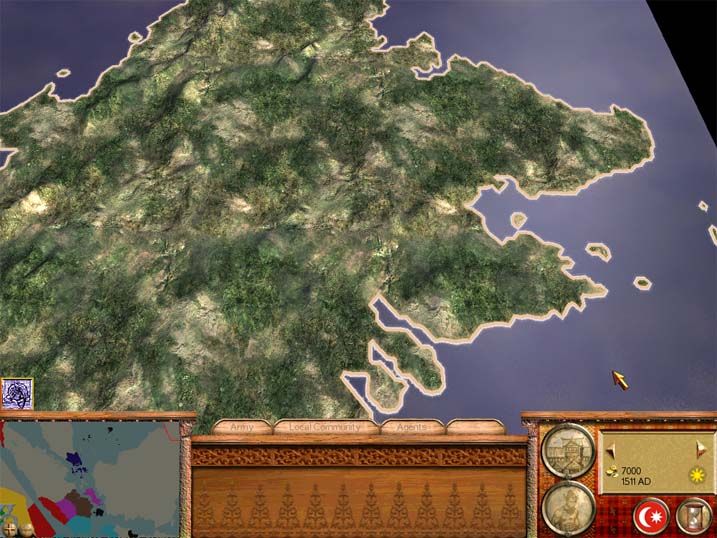
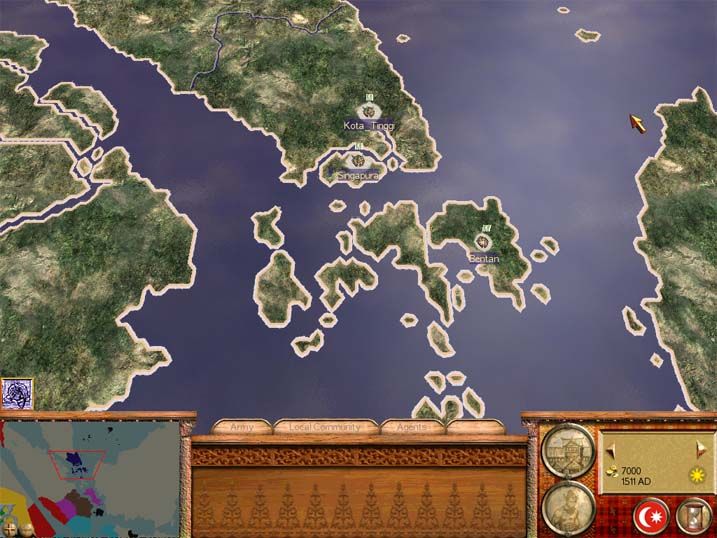
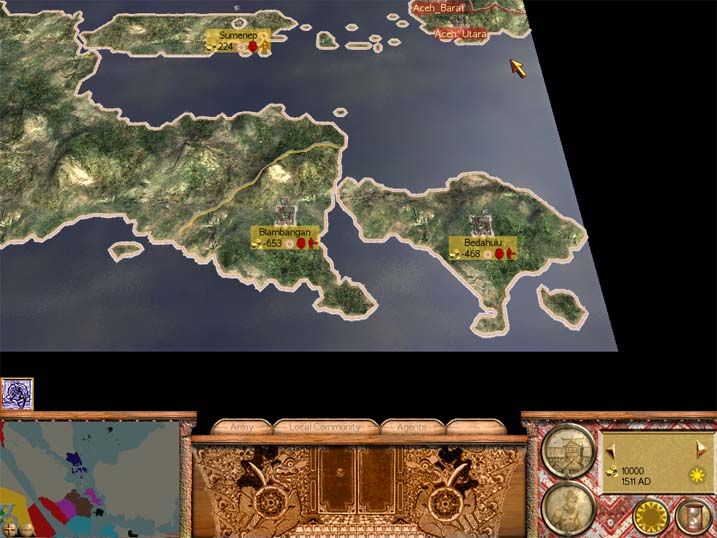
QUOTE(baabaaer @ Oct 19 2012, 02:45 AM) How do your mod do now? are you still working on it? Sorry for the long hiatus.Anyway, right now, we are focusing in making campaign map. » Click to show Spoiler - click again to hide... « |
|
|
Mar 29 2013, 04:16 PM
|

Junior Member
131 posts Joined: Sep 2009 From: Behind you 
|
great job.....
|
|
|
Mar 30 2013, 02:46 AM
|

Junior Member
210 posts Joined: Mar 2010 From: time after time 
|
seriously
this is awesome |
|
|
|
|
|
Mar 31 2013, 04:19 PM
|
|
Junior Member
167 posts Joined: Jan 2009
|
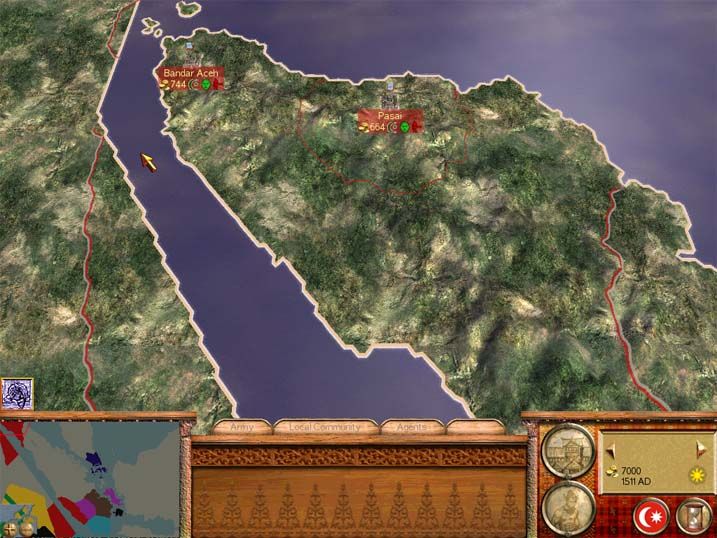
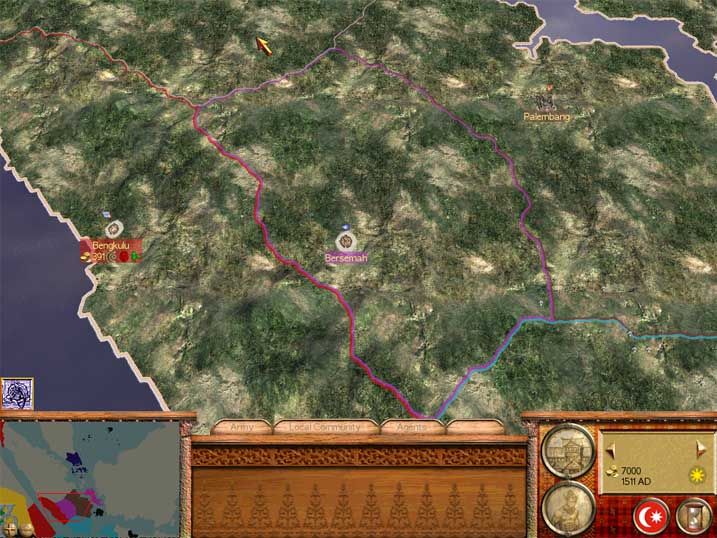
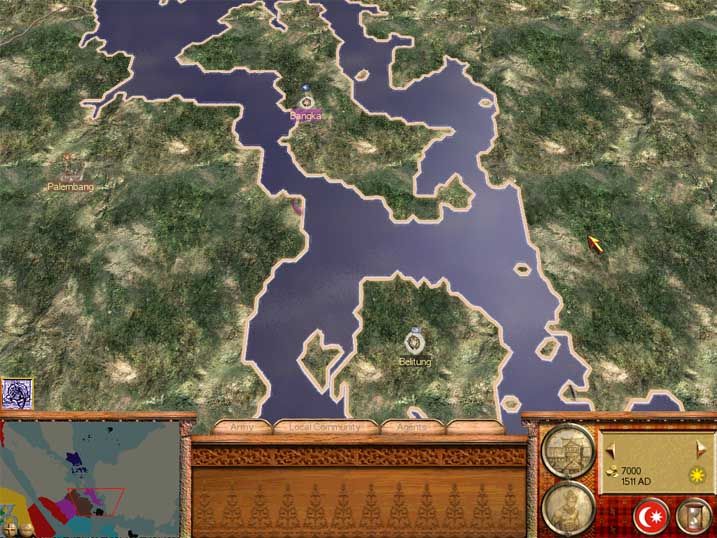
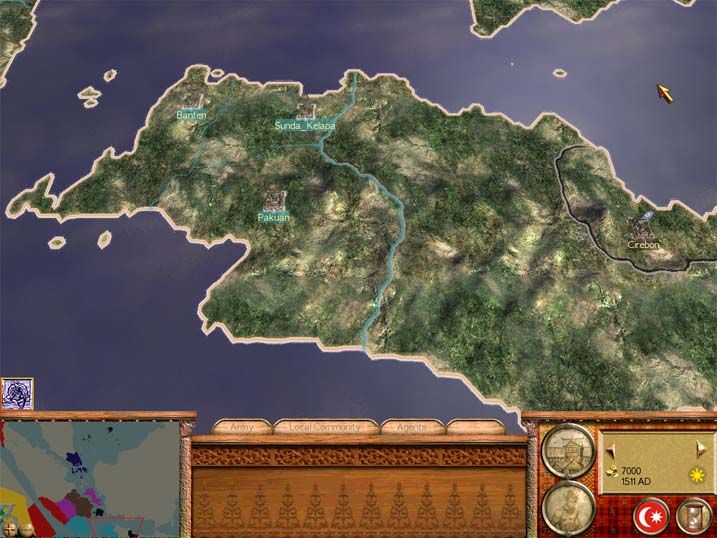
QUOTE(intifadanyz @ Mar 29 2013, 03:33 PM) Sorry for the long hiatus. Excellent! There is Sabah too! But there's no sarawak? I guess you're working on it. Anyways, good to hear you're working on campaign. Will the language be local, or English?Anyway, right now, we are focusing in making campaign map. |
|
|
Mar 31 2013, 08:34 PM
|
|
Newbie
0 posts Joined: Dec 2010
|
QUOTE(baabaaer @ Mar 31 2013, 04:19 PM) Excellent! There is Sabah too! But there's no sarawak? I guess you're working on it. Anyways, good to hear you're working on campaign. Will the language be local, or English? I made the whole Borneo island. Of course Sarawak and Kalimantan will be there. I show Sabah because people will recognize her right away, coz of "bunny shape".The language will be English, until somebody want to help us translating the menus, ui, buttons into Malay or any language that use alphabet ABC. (There are Chinese version of original RTW, but that sole separately) This post has been edited by intifadanyz: Mar 31 2013, 08:38 PM |
|
|
Mar 31 2013, 08:39 PM
|
|
Newbie
0 posts Joined: Dec 2010
|
for the time being we follow Europa Barbarorum style, which army units names are in local language + English translation in bracket such as :
Malay : Penjurit (Malay Skirmisher) Javanese : Jago Karyo (Javanese Levy) Portuguese : Cavaleiros Fidalgos (Portuguese Knights) For the name, we aim to use the name as close as what being used in Medieval times, so you will fined that the unit names somewhat archaic words, as the names are taken from Malay and Acehnese Hikayat, Javanese Babad, Minangkabaus Tambo and Kaba, Sureq Galigo for Makassan etc. So instead of direct translation, "Malay Spearmen" should be not translated as "Tentera Tombak Melayu" but should be "Pertikaman", as Pertikaman is the medieval Malay word used in Hikayat. "Malay Royal Elephant Bodyguard" should not directly translated as "Pengawal Bergajah Diraja Melayu" but "Bentara Gajah Kenaikan" "Sumateran Pikemen" not "Tentoro Tumbak Dhowo" (direct translation : Long spear troop) but should be "Sindang Merdike". And we are planning to use their local name for local unit such as Urak Lawoi (Sea People) Urang Gayo (Gayo cavalry) Ono Niha (Nias tribesmen) Ureng Madura (Madurese) To' Riaja (Torajan Tribesmen) Kalak Karo (Batak tribesmen) This post has been edited by intifadanyz: Apr 1 2013, 01:01 AM |
|
|
Apr 2 2013, 11:56 PM
|
|
Junior Member
167 posts Joined: Jan 2009
|
QUOTE(intifadanyz @ Mar 31 2013, 08:39 PM) for the time being we follow Europa Barbarorum style, which army units names are in local language + English translation in bracket such as : Deep research. I applaud your hard work.Malay : Penjurit (Malay Skirmisher) Javanese : Jago Karyo (Javanese Levy) Portuguese : Cavaleiros Fidalgos (Portuguese Knights) For the name, we aim to use the name as close as what being used in Medieval times, so you will fined that the unit names somewhat archaic words, as the names are taken from Malay and Acehnese Hikayat, Javanese Babad, Minangkabaus Tambo and Kaba, Sureq Galigo for Makassan etc. So instead of direct translation, "Malay Spearmen" should be not translated as "Tentera Tombak Melayu" but should be "Pertikaman", as Pertikaman is the medieval Malay word used in Hikayat. "Malay Royal Elephant Bodyguard" should not directly translated as "Pengawal Bergajah Diraja Melayu" but "Bentara Gajah Kenaikan" "Sumateran Pikemen" not "Tentoro Tumbak Dhowo" (direct translation : Long spear troop) but should be "Sindang Merdike". And we are planning to use their local name for local unit such as Urak Lawoi (Sea People) Urang Gayo (Gayo cavalry) Ono Niha (Nias tribesmen) Ureng Madura (Madurese) To' Riaja (Torajan Tribesmen) Kalak Karo (Batak tribesmen) |
| Change to: |  0.0206sec 0.0206sec
 0.56 0.56
 5 queries 5 queries
 GZIP Disabled GZIP Disabled
Time is now: 5th December 2025 - 03:45 PM |
 Quote
Quote