Welcome Guest ( Log In | Register )

Outline · [ Standard ] · Linear+

 Renovation Advise Needed, Structural of House Frame

views
     
TSgkl83
post Jun 8 2010, 08:23 PM, updated 16y ago

Look at all my stars!!
*******
Senior Member
8,377 posts

Joined: Nov 2004
Doubt of the house frame extension (example kitchen extend to backyard)...

usually we know that the house frame (top and side pillar) must be complete before wall up with bricks...

but recently found out that many house extension done in other method, the contractor build the side pillar only (without top pillar) and wall up with bricks, later will do the top pillar after wall up with bricks...

example like picture below:
user posted image

the proper method to build house frame as right bottom part of the picture, used wooden stick to hold the wet cement and dry up...

but the other method that current contractors working with start with side pillar > wall up > top pillar, same as the middle part of the picture... is the method can be accept? will this method effect the house structure in long term? because i thinking that the brick wall was holding the weight of the top pillar, also the roofing material such as roof tiles, the total weight may pressuring the wall and may lead the cracks after some times...

if used the proper method, complete the frame 1st before wall up, at least the total weight only pressuring onto strong pillar instead of weak wall...

This post has been edited by gkl83: Jun 8 2010, 08:25 PM
skng03
post Jun 8 2010, 11:03 PM

Regular
******
Senior Member
1,450 posts

Joined: Oct 2008


can't c any pic..

your side pillar =vertical = column ?
top pillar = horizontal = beam ?

there r no difference whether wall up 1st or the beam up 1st, as the beam is more like a tie between column and the roof tile's load is no much.

the more important element should be on the foundation, if foundation r not properly done/ under design sure the building will sag/ cracks...


TSgkl83
post Jun 9 2010, 10:55 AM

Look at all my stars!!
*******
Senior Member
8,377 posts

Joined: Nov 2004
here the picture link
http://i643.photobucket.com/albums/uu156/K...on/LGIM0347.jpg

yup....
side pillar =vertical = column
top pillar = horizontal = beam or row

bcos as i see around all the building construction... they will complete the building's frame 1st till the roof level and only allowed to wall up with brick...

so doubt on most of house extension used "bottom-top" method instead, can the structural last long?

if the "bottom-top" was efficient especially the speeding up construction's time, by sense most of construction should use this method instead bcos at least they no need to stack up the temporarily frame to hold the wet beam for drying purpose, hence also can cut cost and reduce the wastes for stack up...
klang-valley
post Jun 9 2010, 11:01 AM

Getting Started
**
Junior Member
178 posts

Joined: Jul 2009
From: Petaling Jaya


QUOTE(gkl83 @ Jun 8 2010, 08:23 PM)
Doubt of the house frame extension (example kitchen extend to backyard)...

usually we know that the house frame (top and side pillar) must be complete before wall up with bricks...

but recently found out that many house extension done in other method, the contractor build the side pillar only (without top pillar) and wall up with bricks, later will do the top pillar after wall up with bricks...

example like picture below:
user posted image

the proper method to build house frame as right bottom part of the picture, used wooden stick to hold the wet cement and dry up...

but the other method that current contractors working with start with side pillar > wall up > top pillar, same as the middle part of the picture... is the method can be accept? will this method effect the house structure in long term? because i thinking that the brick wall was holding the weight of the top pillar, also the roofing material such as roof tiles, the total weight may pressuring the wall and may lead the cracks after some times...

if used the proper method, complete the frame 1st before wall up, at least the total weight only pressuring onto strong pillar instead of weak wall...
*
You better can the local council approval first regarding the extension, or it will affect your property value in the future when you intend to sell it off.
skng03
post Jun 10 2010, 09:23 AM

Regular
******
Senior Member
1,450 posts

Joined: Oct 2008


QUOTE(gkl83 @ Jun 9 2010, 10:55 AM)

if the "bottom-top" was efficient especially the speeding up construction's time, by sense most of construction should use this method instead bcos at least they no need to stack up the temporarily frame to hold the wet beam for drying purpose, hence also can cut cost and reduce the wastes for stack up...
*
actually there r lot of high rise building using wall form construction method to save $$$$$ now.


by building the wall up 1st, they save on timber support & some time, most important they want to claim the money fast tongue.gif

by looking at the connection btwn beam & column, the lintol beam above the window opening..... hmm.gif hmm.gif i doubt this contractor can deliver good quality icon_rolleyes.gif


bk user
post Jun 12 2010, 10:28 PM

New Member
*
Junior Member
41 posts

Joined: May 2010
Wall form construction is a different structural design. The photo shows low quality construction - brick mortar seems inadequate, steel link seems too few, concrete should be done for whole beam at one go.
TSgkl83
post Jun 13 2010, 12:14 AM

Look at all my stars!!
*******
Senior Member
8,377 posts

Joined: Nov 2004
QUOTE(bk user @ Jun 12 2010, 10:28 PM)
Wall form construction is a different structural design. The photo shows low quality construction - brick mortar seems inadequate, steel link seems too few, concrete should be done for whole beam at one go.
*

u means the bottom-top method are acceptable if the contractor giving good workmanship, more raw material provided?
bk user
post Jun 13 2010, 12:19 AM

New Member
*
Junior Member
41 posts

Joined: May 2010
No. It is not a good practice.

I think the other guy was referring to precast wall form construction ie: load bearing wall. It's a completely different design.
skng03
post Jun 13 2010, 03:19 AM

Regular
******
Senior Member
1,450 posts

Joined: Oct 2008


is norm. for the reno. contractor using this sequence to build the extension, as they wanted to save cost & claim the payment fast. the owner too want the lower/best price. icon_rolleyes.gif

i think this kind of reno. don't have any calculation/ design (additional COST) on the structure frame, those reno. contractor just put whatever steel bar nos./size/ spacing they think is adequate & mixed the concrete without follow any ratio shakehead.gif shakehead.gif

anyway, the extension part won't collapse since its only single story with roof tiles but u can expect cracks very soon.


edyek
post Jun 13 2010, 03:23 PM

Business Rating :
*******
Senior Member
3,820 posts

Joined: Jan 2009
From: Land of the Hornbills & Land Below the Wind


QUOTE(gkl83 @ Jun 8 2010, 08:23 PM)
Doubt of the house frame extension (example kitchen extend to backyard)...

usually we know that the house frame (top and side pillar) must be complete before wall up with bricks...

but recently found out that many house extension done in other method, the contractor build the side pillar only (without top pillar) and wall up with bricks, later will do the top pillar after wall up with bricks...

example like picture below:
user posted image

the proper method to build house frame as right bottom part of the picture, used wooden stick to hold the wet cement and dry up...

but the other method that current contractors working with start with side pillar > wall up > top pillar, same as the middle part of the picture... is the method can be accept? will this method effect the house structure in long term? because i thinking that the brick wall was holding the weight of the top pillar, also the roofing material such as roof tiles, the total weight may pressuring the wall and may lead the cracks after some times...

if used the proper method, complete the frame 1st before wall up, at least the total weight only pressuring onto strong pillar instead of weak wall...
*
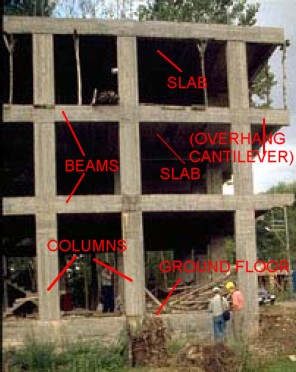
1) Side column (side pillar) and top beam (top pillar) constructed first before brickwall laying = Because the unit is going to have a 1st floor slab which will hold live and dead load. That why you need top beam to hold the weight down.

2) Based on the picture, the contractor is constructing side column and brickwall laying then putting a precast lintol to support the brickwall laying. This a cost saving method, as the structure itself only hold dead load, that is the roof itself. So no top beam is required.
bk user
post Jun 13 2010, 05:23 PM

New Member
*
Junior Member
41 posts

Joined: May 2010
The top beam is meant to hold the deadload of the roof. Note that the brickwall is not meant to be a load bearing wall. However, agree that the roof may not collapse and most renovation contractors do not know and don't practise good construction practices.
TSgkl83
post Jun 15 2010, 07:37 AM

Look at all my stars!!
*******
Senior Member
8,377 posts

Joined: Nov 2004
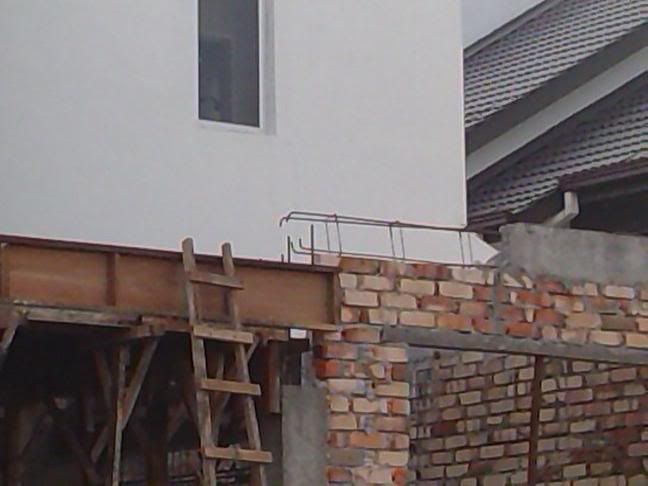
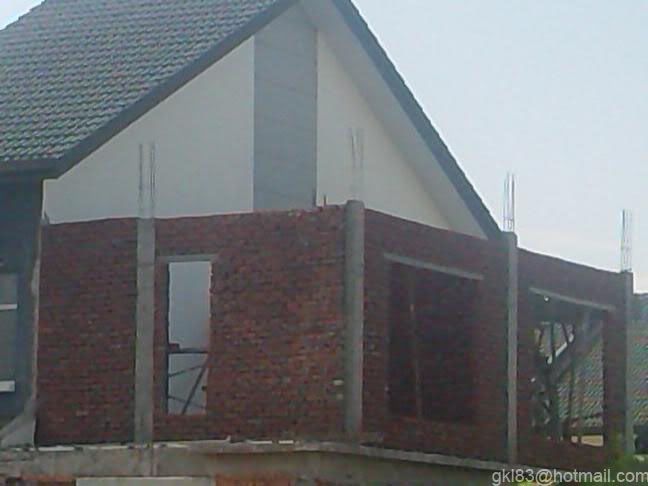
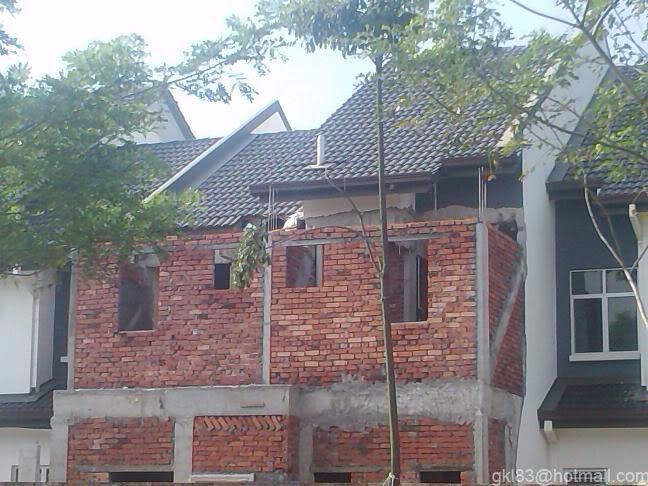
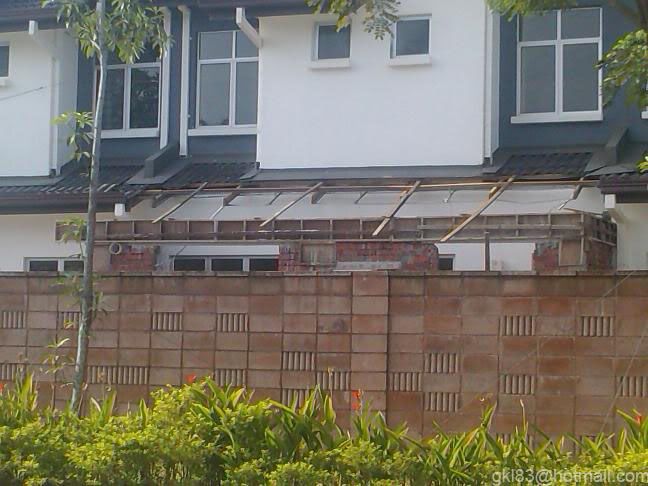
Here some of the pictures i taken from my neighbour which used "bottom-top" method... any comments?
user posted image
user posted image
user posted image
edyek
post Jun 15 2010, 08:40 AM

Business Rating :
*******
Senior Member
3,820 posts

Joined: Jan 2009
From: Land of the Hornbills & Land Below the Wind


QUOTE(gkl83 @ Jun 15 2010, 07:37 AM)
Here some of the pictures i taken from my neighbour which used "bottom-top" method... any comments?
user posted image
user posted image
user posted image
*
1) It only has column and lintol beam (which the roof stucture will directly be construct on top)

2)
a) It has column and beam - Bottom part (which the whole structure is used to support the 1st floor)
b) It only has column and lintol beam - Top Part(which the roof stucture will directly be construct on top)

3) It has column and beam (which might have 1st floor or roof structure install on top)

Colum and beam are constructed using Reinforcement bar + concrete and cast on site to have permanent location.

Lintol beam are cast off site, and after the whole lintol beam has harden, it will be move to the site to install. (Normally used for window and door opening. How can you lay bricks on top of the window frame if you do not have lintol beam? Sames goes to door frame. That is the purpose of lintol beam)

This post has been edited by edyek: Jun 15 2010, 08:41 AM
TSgkl83
post Jun 15 2010, 10:19 AM

Look at all my stars!!
*******
Senior Member
8,377 posts

Joined: Nov 2004
QUOTE(edyek @ Jun 15 2010, 08:40 AM)
Colum and beam are constructed using Reinforcement bar + concrete and cast on site to have permanent location.

Lintol beam are cast off site, and after the whole lintol beam has harden, it will be move to the site to install. (Normally used for window and door opening. How can you lay bricks on top of the window frame if you do not have lintol beam? Sames goes to door frame. That is the purpose of lintol beam)
*

seem u misunderstood... my concern wasnt the lintol beam for door and window...

the main concern is whether the steps of extension whether correct or not... here the building construction we can see... most of building completed with frame with before wall up with bricks...
user posted image

and the picture above i showing, seem the structural frame no complete yet and they starting to wall up... the contractor used the brick wall to supporting the top beam... imagine the top beam carrying the weight of roof tiles, house furniture, etc which may giving more pressure the brick wall in the future...
4n5 Workshop
post Jun 15 2010, 11:32 AM

New Member
*
Junior Member
23 posts

Joined: May 2010
From: KL - Selangor


Technically speaking; load bearing system preaches beams are used to transfer the horizontal load to vertical column and directly divert to ground.

However, if you are having ground floor extension while 1st floor will not be occupied; 1st floor beam will be replaced with timber beam instead of RC beam (Reinforcement concrete) and ground beam will still be RC beam.

Bricks and mortars do not help much in sustaining the load. Besides, a strip foundation design is more than enough to sustain the load of a residential unit.

So in your case, this is a typical load bearing wall and I can say the construction method is tolerable.

edyek
post Jun 15 2010, 01:15 PM

Business Rating :
*******
Senior Member
3,820 posts

Joined: Jan 2009
From: Land of the Hornbills & Land Below the Wind


QUOTE(gkl83 @ Jun 15 2010, 10:19 AM)
seem u misunderstood... my concern wasnt the lintol beam for door and window...

and the picture above i showing, seem the structural frame no complete yet and they starting to wall up... the contractor used the brick wall to supporting the top beam... imagine the top beam carrying the weight of roof tiles, house furniture, etc which may giving more pressure the brick wall in the future...
*
Dint really notice your starter post. Now I see it clearly. That contractor is not experience or hentam saja the work. There will be issue later on, if the brickwall is not tie with starter bar to the column and beam.
4n5 Workshop
post Jun 15 2010, 02:01 PM

New Member
*
Junior Member
23 posts

Joined: May 2010
From: KL - Selangor


QUOTE(edyek @ Jun 15 2010, 01:15 PM)
Dint really notice your starter post. Now I see it clearly. That contractor is not experience or hentam saja the work. There will be issue later on, if the brickwall is not tie with starter bar to the column and beam.
*
Nope, I would not say the contractor is doing a hentam job however it is a practice in the industry due to "work efficiency"
Technically speaking, we use 4 Y12R (iron bar) to work as a concrete beam core (bone structure) So an iron bar comes in a standard size of 12ft.

Understanding that an iron bar is 12ft but the given site is 25ft (assumption) which means we have to link 2 iron bars horizontally to form a perfect bone structure and we still have a 1ft gap. So, here comes the gimmicks of the contractor by adjusting the beam position to leave a 6 inches gap and by "abusing" the Load bearing wall theory, it does help to explain why the brick-wall does not attach to the column.

If the upper floor will not be occupied or it is just roof structure, I could compromise with it.

This post has been edited by 4n5 Workshop: Jun 15 2010, 02:01 PM
skng03
post Jun 15 2010, 08:57 PM

Regular
******
Senior Member
1,450 posts

Joined: Oct 2008


QUOTE(4n5 Workshop @ Jun 15 2010, 02:01 PM)
Nope, I would not say the contractor is doing a hentam job however it is a practice in the industry due to "work efficiency"
the contractor of TS is lousy one.....the lintol is under size, wonder got any steel bar inside!!! the hook at the beam also too short, the link for beam is too far C/C, column bar not proper terminated, and most of all... cast the concrete half way to leave a cold joint (weak point) to the already lousy design beam.

its normal practice for those renovation contractor to build the wall 1st then beam on brick wall, as i said before, to save some timber support/ scaffolding & claim the payment fast, this method is acceptable and the load from roof will distribute to the beam then the column, then foundation, provided they have design/ build the beam with sufficient reinforcement bar/ link/ width/ depth, after the beam casted & mature, it will strong/ more than enough to withstand the load and transfer it to column, those brick wall laid underneath r only temporary support the beam & will act as infill to the structure frame.

QUOTE
 
Technically speaking, we use 4 Y12R (iron bar) to work as a concrete beam core (bone structure) So an iron bar comes in a standard size of 12ft.

Understanding that an iron bar is 12ft but the given site is 25ft (assumption) which means we have to link 2 iron bars horizontally to form a perfect bone structure and we still have a 1ft gap. So, here comes the gimmicks of the contractor by adjusting the beam position to leave a 6 inches gap and by "abusing" the Load bearing wall theory, it does help to explain why the brick-wall does not attach to the column.

If the upper floor will not be occupied or it is just roof structure, I could compromise with it.
*
4 Y12R rclxub.gif rclxub.gif don't quite understand how to provide the bar........ tongue.gif
it should be in this format : 4Y12 R6-125 --- mean 4 pcs of main bar(Y / T = high tense) size 12mm dia , with link of 6mm (R= round bar) at 125mm spacing.

and all standard steel bar come in 12m length = 40 ft NOT 12ft, if any span of the beam/ column greater than the steel bar length/ the engineer design the beam/ column with difference size of bar, you need to over lap the bar, then there is a minimum lap length of X time of bar diameter( normally 37D-47D for column, 40D-50D for beam depends on the location of the lap & the concrete's grade).


correct me if i'm wrong tongue.gif and any C&S engineer here can give some comment tongue.gif



bk user
post Jun 16 2010, 01:52 PM

New Member
*
Junior Member
41 posts

Joined: May 2010
Yes, steel bars come in 12m length. On the lapping of steel bars, it ranges from 35D to 50D, depending on the locations etc.

It should be noted that good practice is not the same as normal practice. If we use brick as support, can we ensure that the water in the concrete is not lost through the gaps in the brick or absorbed by the bricks? If this happened, the concrete strength of the beam will be affected. Concrete needs water to gain strength.

Another point to note is that all beams and columns should be cast at one single stage. If it is not, then we will need to roughten the surface to ensure better bonding. In some cases, bonding agent is required but not usually used in renovation. Even in two stage casting, we should not leave the joint at the maximum bending moment location which the guy in the photo is doing.

On the links in the beam, the code of practice states that it must not be more than half the depth of the beam. In the above photos, it is nearly 2X depth of beam.

So, if this is the normal practice, it only prove that normal practice does not comply to good practice.
skng03
post Jun 16 2010, 05:49 PM

Regular
******
Senior Member
1,450 posts

Joined: Oct 2008


QUOTE(bk user @ Jun 16 2010, 01:52 PM)

So, if this is the normal practice, it only prove that normal practice does not comply to good practice.
*
this one i 100% agree nod.gif nod.gif

but nothing is perfect lar, otherwise the contractor may ask for 50% more $$ for the same job..
edyek
post Jun 17 2010, 10:53 AM

Business Rating :
*******
Senior Member
3,820 posts

Joined: Jan 2009
From: Land of the Hornbills & Land Below the Wind


QUOTE(4n5 Workshop @ Jun 15 2010, 02:01 PM)
Nope, I would not say the contractor is doing a hentam job however it is a practice in the industry due to "work efficiency"
Technically speaking, we use 4 Y12R (iron bar) to work as a concrete beam core (bone structure) So an iron bar comes in a standard size of 12ft.

Understanding that an iron bar is 12ft but the given site is 25ft (assumption) which means we have to link 2 iron bars horizontally to form a perfect bone structure and we still have a 1ft gap. So, here comes the gimmicks of the contractor by adjusting the beam position to leave a 6 inches gap and by "abusing" the Load bearing wall theory, it does help to explain why the brick-wall does not attach to the column.

If the upper floor will not be occupied or it is just roof structure, I could compromise with it.
*
Iron bar comes in standard size of 12m (not 12ft).


Added on June 17, 2010, 10:54 am
QUOTE(skng03 @ Jun 15 2010, 08:57 PM)
the contractor of TS is lousy one.....the lintol is under size, wonder got any steel bar inside!!! the hook at the beam also too short, the link for beam is too far C/C, column bar not proper terminated, and most of all... cast the concrete half way to leave a cold joint (weak point) to the already lousy design beam.

its normal practice for those renovation contractor to build the wall 1st then beam on brick wall, as i said before, to save some timber support/ scaffolding & claim the payment fast, this method is acceptable and the load from roof will distribute to the beam then the column, then foundation, provided they have design/ build the beam with sufficient reinforcement bar/ link/ width/ depth, after the beam casted & mature, it will strong/ more than enough to withstand the load and transfer it to column, those brick wall laid underneath r only temporary support the beam & will act as infill to the structure frame.
4 Y12R  rclxub.gif  rclxub.gif  don't quite understand how to provide the bar........ tongue.gif 
it should be in this format : 4Y12 R6-125 --- mean 4 pcs of  main bar(Y / T = high tense) size 12mm dia , with link of 6mm (R= round bar) at 125mm spacing.

and all standard steel bar come in 12m length = 40 ft NOT 12ft, if any span of the beam/ column greater than the steel bar length/ the engineer design the beam/ column with difference size of bar, you need to over lap the bar, then there is a minimum lap length of  X time of bar diameter( normally 37D-47D for column, 40D-50D for beam depends on the location of the lap & the concrete's grade).
correct me if i'm wrong tongue.gif  and any C&S engineer here can give some comment tongue.gif
*
Correct.

This post has been edited by edyek: Jun 17 2010, 10:54 AM


Change to:
| Lo-Fi Version
0.0215sec    1.07    5 queries    GZIP Disabled
Time is now: 19th December 2025 - 07:41 PM