Welcome Guest ( Log In | Register )

Outline · [ Standard ] · Linear+

Household inverter A/C - really works?, high electricity bills

views
     
KLsooner
post May 12 2010, 03:53 PM

Enthusiast
*****
Senior Member
737 posts

Joined: Dec 2007
Some suggestions which may help:

1. Set your target temperature of AC to 24-26 degree, then your AC should run at partial-load if your room is not too big. The inverter type AC is doing more saving than conventional type during partial load condition; if you set 18-20 every time you turn on, you must as well just use the conventional type as inverter AC will run at max load when it cannot meet the setting temperature.

2. Side by side fridge (280L -350L) is too big for a small family, I suggest you change to a smaller one. Fridge run 24/7, and our country does not implement energy labeling standard, so the one you have could be those low energy efficient type fridge that cannot be sold in advance country. Most fridge use its metal body to do heat exchange, cold inside so heat must be thrown outside; so do not cover up your fridge with plastic cover and make sure some room around the fridge.

3. Unplug all the electrical appliances when they are not in use because standby mode also consume power. Most electrical appliances consume few W to few tens of W, if add all up, could be 100+ W all day just on standby, add those up in a month, you will see the difference. In EU, very strick standby power is being implemented now; of cause, those who fails to enter EU will be sold in Malaysia.

4. Is your apartment located on commercial land? If so, you are charge using commercial rate for your electric bill, so it is naturally higher. Nothing to complain.

5. Electric kettle, washing machine, microwave, oven and water heater consume A LOT of POWER when operating, you should ask yourself how often you use them and how you use them each time. Those electric thermos also "eat electricity" if you have a >5L one.

6. How about your lights? what type? did you turn on lights during night time?

You can't save electric bill by just buying inverter air-cond or energy efficient appliances; you need to have energy saving concious and maintain a good habit to start to see some results.

My 2 cents worth of advice. Good luck.
KLsooner
post May 13 2010, 02:21 PM

Enthusiast
*****
Senior Member
737 posts

Joined: Dec 2007
QUOTE(daryl.k @ May 12 2010, 04:39 PM)
thanks for your input & comments..really useful tips...yes my A/C is at 18deg most of the time  whistling.gif that's cos i feel hot all the time  sweat.gif i too was wondering if switching the A/C on at 18deg cud cos the inverter thingy no operating as it should.  i shall try to practice the habit of going 24deg from now on  nod.gif

the side-by-side fridge, yes i do admit is big.  but not too big.  even tho it takes up more space than i wanted, i've always wanted a side-by-side.  and my wife absolutely love the design. so nothing i can do about changing it.  and i do believe its not one of those energy efficient type fridge.  especially now that you mentioned non-energy eff fridge cant be sold to countries under EU..cos i couldn't even find the fridge i have in the LG website.
but the again, there's nothing i can do about the fridge.

like i mentioned, i've begun to switched all applicances (with exception of fridge & alarm) off when not using since last month.

just ran a check on TNB website..my charges are based on Domestic tariffs.

i have various types of lightings.  down lights with energy saving bulbs, florescent lights, spot lights and those hanging and ceiling mounted light fixtures.  most with energy saving bulbs, not all.  most of the time, i only switch on the down lights.  spot lights almost never switched on.  and i only switched on the lights when someone's there.  if there's no one in the kitchen, i dun switched the on. 

i like being in the dark.  especially when i watch tv at night.  light switched on during the night is quite minimal i would say.

shud i be switching off the electric thermos during the day? that is another appliances' switched 24x7.  and mine is 5l if not mistaken.  maybe i will switched them off from now on when not using.  microwave & oven is rarely used.  but when oven is used, its usually for 1-2 hours.

my wife need to sleep with a night light.  so we switched on the bathroom light but kept the door close.  i think that is not very energy efficient.  do you feel if i use those plug in to socket outlet type night light will conserve more energy than switching on the bathroom ceiling light (energy saving bulb)??
for your info, i didn't get to choose what type of electrical supply i want.  i don't think anyone get to choose when u buy property.  you can upgrade from 1-phase to 3-phase with proper application.  but not sure if you can downgrade.

it comes like that.  what can i do?
*
IF you are feeling hot when AC is set to 18 degree, meaning you have a undersized AC installed. 24 degree is the most comfortable level for human being, if the AC is undersized, setting 18 degree does not mean the room temperature will get to 18.

There are many inverter myth in the forum that I think some people are being misled by AC salesman and advertisement. Inverter air-cond operates all the time when turn on, its operating frequency (compressor motor rotation) range from 15Hz to 85Hz for cooling condition. Conventional AC runs at fixed frequency decided by the grid which in Malaysia is 50Hz, US/canada is 60Hz. Compressor is off when the room temeprature reach the target frequency and on again when temperature rise 1 degree above target temperature.

For inverter type, if you set your target temperature at 24 degree, first it will check the room temperature compare to the target temperature, let say room at enviroment temperature is 30 degree, so difference is 6 degree. The the AC will run at high frequency to cool the room, when the room temeprature reach 24, the inverter AC will reduce the speed to a point it could maintain the 24 degree target frequency. So depend on size of AC, wheather condition and room size, the actual speed that stay at 24 degree varies. If you choose the right AC HP for the right room size, normally the AC will run between 15 to 40 Hz at night time and 40-60 at day time. The energy saving comes when the AC is operating lower than 50Hz compare to conventional type, less speed means less power. If you set 18 degree all the time, the difference of enviroment and target is 12 degree, so the AC will run at max speed to cool it down, if the room temperature only cool down to 24 degree at full speed, the AC will keep running at max speed in order to reach 18, so in this case, it is running at 85 Hz all day. There is no energy saving at 85Hz, in fact you waste more energy because conventional AC at full speed all day only running at 50Hz.

So you need to be very careful when buying inverter products including fridge and AC. Inverter AC does save 50% energy (as advertised) if you set target frequency at 24 degree running at night time when enviroment temperature is 26 degree but if you run at full speed all day, it costs you more.

Set the temperature setting of fridge depend on the amount of food you store inside the fridge, it saves energy. put it in a ventilated room also help the heat discharge of the fridge and hence reduce the load apply to the compressor.

For TV, LCD type should be more energy efficient than CRT type.

You don't have to switch off the thermos during day time, just change to a smaller size, enough for your family use is enough. Change to 3L thermos could have save you enough money to buy a new one for 1 year of power waste on a 5L one. If you turn off at day time, then at night you need to reboil again, boiling also sucks a lot of energy.

Leave lights on all night long means 8hrs a day, check the wattage of the bulb you use, normally night light 2-3W is enough.

KLsooner
post May 13 2010, 02:56 PM

Enthusiast
*****
Senior Member
737 posts

Joined: Dec 2007
QUOTE(art6969 @ May 13 2010, 01:50 PM)
i dont agree with you on no2

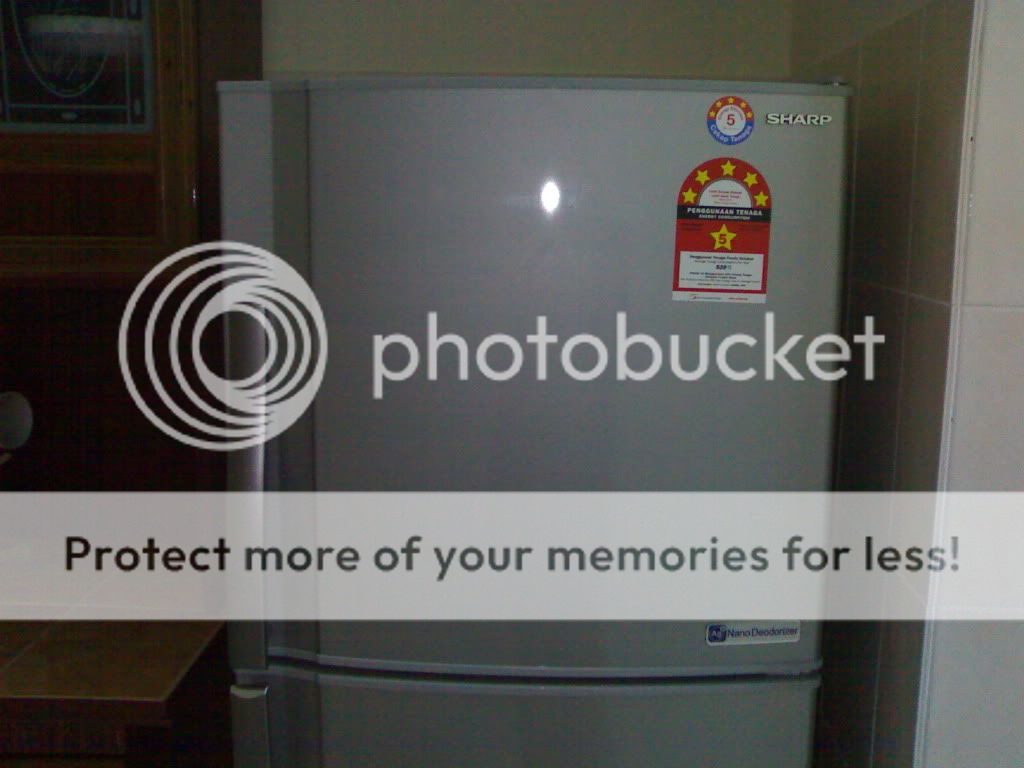
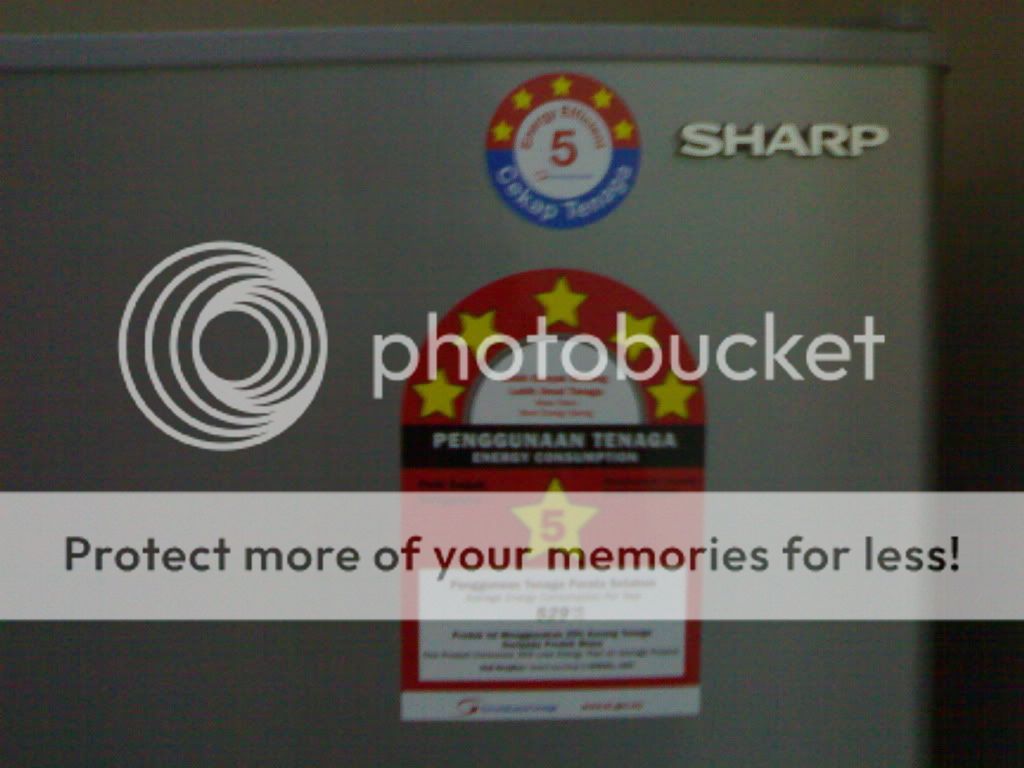
we have implement energy efficiency (EE) on fridge with star labelling

here my fridge

user posted image

user posted image
info

user posted image
source: http://www.st.gov.my/index.php?option=com_...333&Itemid=1238
*
Good point. My mistake.

I am away from the country for almost 3 years, didn't know we did have energy labeling now. But I didn't notice it when I walked around Jusgo last time. Is it mandatory for all appliances or just for advertisement?

This post has been edited by KLsooner: May 13 2010, 02:57 PM
KLsooner
post Jul 15 2010, 10:52 AM

Enthusiast
*****
Senior Member
737 posts

Joined: Dec 2007
QUOTE(Kantao @ Jul 15 2010, 04:15 AM)
1.) AC for living area 1.5hp normally not enough, but it depend how big the area, facing north or south, window, etc. If size of AC not enough cover the tempeture of the area, compresor will fully run, use more electricity.

2.) The AC better setting 23deg or below, cause the lower tempeture setting the cold can be maintain, if setting above 23deg the air will warm more easy then the compresor will fully running againt to keep the tempeture u setting it. This is bcos last time my AC has problemn after using 1 year+, the tecnical guy told me.
*
You never read my post. Your technician is definately 100% wrong.

For conventional air cond, compressor on/off base on +/- 1 degree on top of setting temperature, meaning compressor will turn on when temperature rise 1 degree above setting temperature and off when temperature falls below 1 degree of setting temperature. so setting 25,26 or 23 is no difference. The only diference is for the initial turn on, setting 23 will take longer time to cool your room from 28-30 to 22 degree before it turn off. If your AC is undersize, it will never cool your room to 22, so it will be running forever. The only advantage you enjoy when setting 23 is after you turn off the AC, you still feel cool a little longer compare to setting to 25/26 degree. Heat transfer is largely depend on the medium of transfer but not degree of temperature.

For inverter type, the compressor never stop after turn on, the operating speed of compressor varies according to the setting temperature. If setting temperature to 23, the AC will drive the compressor to 23 degree and stay at the speed to maintain the temperature. Then the energy consumed depend on the actual speed of the compressor to maintain 23 degree, it could be a much higher speed compare to conventional type so end up addition consumption of electricity. As I said b4, conventional compressor running at fix speed of 50Hz from the grid whicle Inverter type running from 15Hz to 90Hz depends on " load". Eventhough at 50Hz, Inverter compressor is more efficient than conventional type due to the Compressor motor (Inverter using DC brushless motor has higher effiecientcy) but running over 70 Hz is definately taking more energy.

Do not believe anything AC technician tells you except about installation and maintenance, they are just the expert of installation, other than that they know close to nothing.

Did you ever ask what is the problem of your AC? Is it mechanical or electrical problem? I can tell you 99% of problems are gas leak (bad welding) and electronics controller (PCBA, motor, remote...etc) problems. You hardly find compressor problem, even there is, it can be caused by installation problem like under charge of gas or air/water trap inside the copper tube.

This post has been edited by KLsooner: Jul 15 2010, 10:56 AM


Change to:
| Lo-Fi Version
0.0187sec    0.44    6 queries    GZIP Disabled
Time is now: 4th December 2025 - 03:46 AM