Sandy Bridge roadmap leaked, Intel plays with the numbers
QUOTE
Details of Sandy Bridge CPUs have turned up on the web thanks to a leak by a German magazine.
Computer Base seems to have managed to get its paws on some details of some of the mobile Sandy Bridge processors. They are a little different to the roadmap slides which have been seen so far.
To throw a spanner in the works, Intel has made some changes to its model number scheme. Desktop CPUs will carry K, S, T as their suffixes. K is the same as the current K models, S is similar again to Intel's current S suffix CPUs. Models with a T on the end have a TDP of 35-45W, will a reduced clock speed. All Sandy Bridge processors will have a four digit model number, plus a potential suffix letter. We are glad they sorted that one out.
Looking at less esoteric details, it seems that Intel has almost completely dropped support for hyperthreading on the quad core models. Only the Core i7 LGA-1155 processors still support it.
The Core i7s are also the only models that will have 8MB of L3 cache. The Core i5's have 6MB of L3 cache. The Core i5 2930T has 3MB L3 cache.
The Core i3s become dual core processors with Hyperthreading, but no Turbo boost and a mere 3MB of L3 cache.
Only two K models will see the light of day. These are the Core i7 2600K and the Core i5 2500K.
There might be a Core i7 2600S with a default clock of 2.8GHz instead of 3.4GHz.
There are seven Core i5 models mentioned, but only three model numbers so we can't really tell what Intel is up too here.
The new mobile Sandy Bridge processors seem to have four Core i7 models and only two Core i5 models. There is an Extreme Edition here which uses the XM suffix and two quad core models that carries the QM suffix. Those listed alongside the XM model are all quad cores.
The 2920XM and the 2820QM come with 8MB of L3 cache while the 2720QM has 6MB. The Core i7 2620M is dual core with Hyper-Threading and 4MB of L3 cache. The Core i5 models are both dual core, but with 3MB of L3 cache.
The leaked slides are mostly for Intel's business platforms so it is fairly likely that we will see other models for other markets.
There are some other interesting stuff in the slides. The Sandy Bridge processors will use AES-NI with Advanced Vector Extensions support which can improve performance for some tasks.
It looks like Intel has been tinkering with its Turbo Boost feature if only because it is called version 2.0 which is supposed to manage clock speeds better.
Intel has been talking about a new IGP which is referred to as "GT2" on the roadmaps. Intel has been talking about sticking the IGP on die for a while.
Source: www.computerbase.de
Sandy Bridge Core i7 2600K name explainedThe second generation CoreQUOTE
The name of the fastest Sandy Bridge is Core i7 2600K and we can give you an inside in the new naming scheme. First of all you will know that it’s a Sandy Bridge if you see a name with four digits starting with a number two.
Let’s dissect the Core i7 2600K moniker in segments and explain it. Intel Core is the brand of the CPU, i7 is the brand modifier that will help you distinct the features on a different cores. Number two in 2600 is the generation indicator meaning that this is the second generation of Intel’s Core architecture.
The 600 is the SKU numeric digits that will tell you which CPU you are getting and of course once again bigger numbers mean a better CPU.
The suffix K tells you that the CPU is unlocked and the other iterations such as suffix S will tell you that this is a CPU with performance optimised for lifestyle computing and T has Power Optimised Lifestyle whatever that would mean.
Once again, Intel has new chipset, new socket, new names and of course if you want the Sandy Bridge you will have to throw or sell your Nehalem Core i based system and get a new one with a socket that is only one pin shy of its predecessor
http://www.fudzilla.com/processors/process...-name-explainedThe Sandy Bridge Preview by AnandTech
QUOTE
The mainstream quad-core market has been neglected ever since we got Lynnfield in 2009. Both the high end and low end markets saw a move to 32nm, but if you wanted a mainstream quad-core desktop processor the best you could get was a 45nm Lynnfield from Intel. Even quad-core Xeons got the 32nm treatment.
That's all going to change starting next year. This time it's the masses that get the upgrade first. While Nehalem launched with expensive motherboards and expensive processors, the next tock in Intel's architecture cadence is aimed right at the middle of the market. This time, the ultra high end users will have to wait - if you want affordable quad-core, if you want the successor to Lynnfield, Sandy Bridge is it.
Sandy Bridge is the next major architecture from Intel. What Intel likes to call a tock. The first tock was Conroe, then Nehalem and now SB. In between were the ticks - Penryn, Westmere and after SB we'll have Ivy Bridge, a 22nm shrink of Sandy.
Did I mention we have one?
While Intel is still a few weeks away from releasing Sandy Bridge performance numbers at IDF, we managed to spend some time with a very healthy sample and run it through a few of our tests to get a sneak peak at what's coming in Q1 2011.
http://www.anandtech.com/show/3871/the-san...e-wins-in-a-rowIntel's Core 2011 Mobile Roadmap Revealed: Sandy Bridge Part IIQUOTE
Late last week we pulled back the covers on Intel's next-generation Core architecture update: Sandy Bridge. Due out in Q1 2011, we learned a lot about Sandy Bridge's performance in our preview. Sandy Bridge will be the first high performance monolithic CPU/GPU from Intel. Its performance was generally noticeable better than the present generation of processors, both on the CPU and GPU side. If you haven't read the preview by now, I'd encourage you to do so.
One of the questions we got in response to the article was: what about Sandy Bridge for notebooks?
While Sandy Bridge is pretty significant for mainstream quad-core desktops, it's even more tailored to the notebook space. I've put together some spec and roadmap information for those of you who might be looking for a new notebook early next year.
Mobile Sandy Bridge
http://www.anandtech.com/show/3876/intels-...-bridge-part-iiSandy Bridge Graphics UpdateQUOTE
A big unknown was the state of Sandy Bridge graphics. As I mentioned in the preview, there will be two types of integrated graphics enabled on Sandy Bridge parts: 1 core and 2 core parts. Intel refers to them as GT1 and GT2, respectively. The GT1 parts have 6 execution units (EUs), while the GT2 parts have 12.
http://www.anandtech.com/show/3885/sandy-b...graphics-updateIDF: Intel's Sandy Bridge Architecture Exposedhttp://www.anandtech.com/show/3922/intels-...tecture-exposedQUOTE
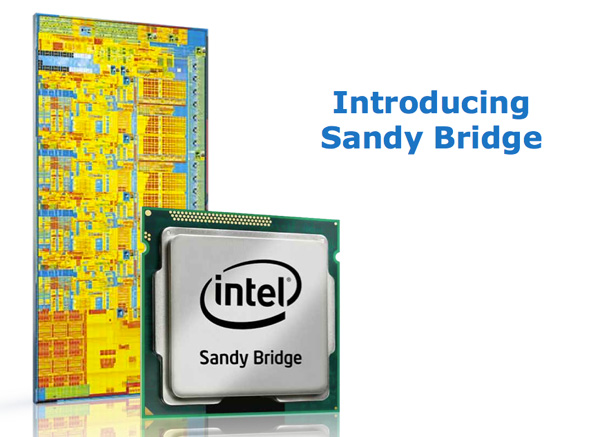
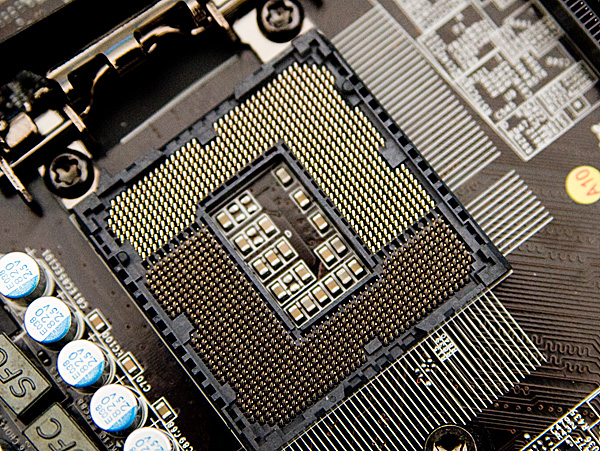 The new socket
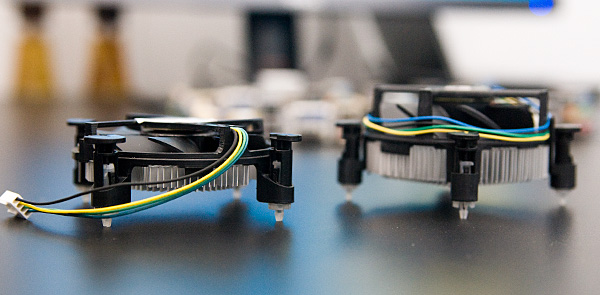 New low-profile 45W Sandy Bridge heatsink (left)

 Jun 4 2010, 09:35 PM


 Quote
Quote
 i never knew that....


 0.0478sec
 0.49
0.49
 7 queries
 GZIP Disabled