Joined: Nov 2007
From: Butterworth, PG / Machang, Kelantan
QUOTE(Lurker @ Mar 11 2012, 11:01 AM)
Aisde from the native usb3, any other improvements over z68 in these z77 boards? And why is native usb3 important?
basically only difference in native USB3 no need 3rd party controller will result in cheaper board, supported by Intel driver, performance wise should be better in terms of latency because the USB controller is built in the CPU itself instead of having a separate path.
actually this Ivy platform has more advantages/features on the CPU department, rather than the Z77 chipset. Higher PCIe 3.0 lane bandwidth than the what has been offered by SB. native SATA3 ports are still limited to 2 pcs only though.
Joined: Nov 2007
From: Butterworth, PG / Machang, Kelantan
Re-read it carefully Only Asus P67/Z68 (GEN3) boards that have PLX PCIe 3.0 chipset will get the PCIe 3.0 add on. But then you would need an Ivy Bridge (IB) 22nm CPU to use the PCIe 3.0 advantage. Bios flashing is supposed to allow support for IB which has the PCIe 3.0 controller built inside the CPU.
so if your P67/Z68 mobo is not a GEN3 then u won't get the PCIe 3.0 speed or whatsoever.
Joined: Nov 2007
From: Butterworth, PG / Machang, Kelantan
QUOTE(don^don @ Mar 30 2012, 11:11 AM)
guys, when will ivy bridge i5 and i7 arrive in malaysia? the replacements for i5 2500k and i7 2600k. need to start building a pc for d3, eventhough d3 can run on c2d
p/s: do you guys think asus x58 sabertooth still available around? coz my old p6t don't have sata3, so pointless to upgrade to ssd, and x58 saber got sata3 port. or i should just ditch the whole system and go for ivy bridge i7 ?
If can better wait for ivy dude. ETA in Msia is unknown, until it really reach here. You can actually get a Z77 board of some brands in LYP now.
X58 doesnt have SATA3 controller as native. So its mobos use 3rd party SATA3 which is slower than native speed as on P67/Z68/Z77 etc.
Joined: Nov 2007
From: Butterworth, PG / Machang, Kelantan
Lucid Vurtue MVP on Z77 looks interesting
QUOTE
The Lucid Vurtue MVP software is really quite good. I've been able to convert a few movies using quicksync which is extremely useful. I've noticed that certain games also gain an increase in FPS when it's enabled.
A good example is 3DMark 11.
PC @ Stock with Lucid Vurtue MVP ON = P8792 PC @ Stock with Lucid Vurtue MVP OFF = ~P6700
Lucid Vurtue = ON + 5Ghz on 2600K and a mild overclock on the GTX 580 netted me P9651.
So gains are to be had with the technology. More FPS as well as Intel quicksync.
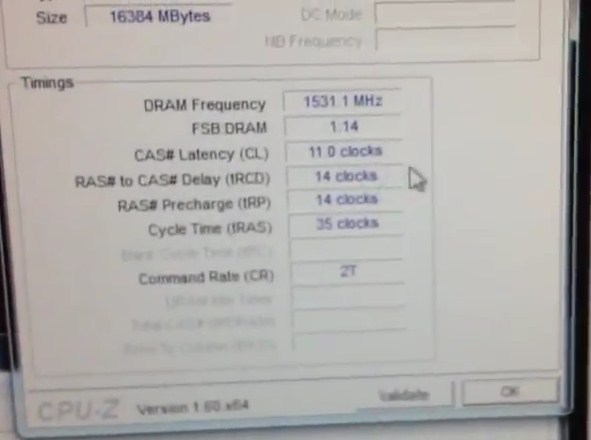
Memory overclocking feats over 3000 MHz, aren't new. Last month, we've seen G.Skill and and GIGABYTE achieve a whopping 3736 MHz on the dual-channel AMD "Llano" platform. The duo has now cracked the 3000 MHz mark with four modules, achieving 3077 MHz. The record (>3000 MHz with four modules) was set by Coolaler, using an Intel Core i7-3770K "Ivy Bridge" processor, and GIGABYTE Z77X-UD5H motherboard. The memory of course was four 4 GB G.Skill DDR3-2600 MHz modules. The entire setup was air-cooled.
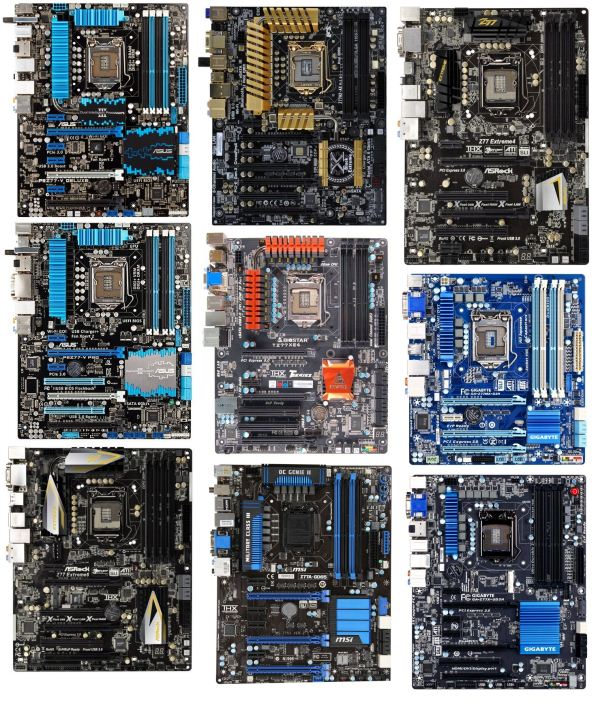
Well, today is a day that everyone was expecting, but perhaps not the most exciting day of the month. Today, Intel officially releases the spate of 7-series chipsets for their 3rd generation Core microarchitecture processors (read – Ivy Bridge), despite the actual release of the processors being another three weeks away. This means that today we can actually look at, test, or purchase the range of motherboards that natively support Ivy Bridge. However, we can’t officially publish all the benchmarks for these products using Ivy Bridge until that date three weeks away (to be honest, we are still testing!). So today we are going to have a good in depth look into the Z77 chipset itself, and the review products we have received to let you know what we think looks good. All these boards today will be fully reviewed, warts and all, with Ivy Bridge, as close to official release as possible.
This post has been edited by owikh84: Apr 9 2012, 12:15 AM
Intel's USB 3.0 controller remains the fastest overall. It transfers our file sets substantially faster than the A75 in both directions. The A75's SuperSpeed USB controller is still plenty quick, especially if you're pairing it with a mechanical hard drive rather than the wicked-fast SSD we used for testing. AMD also deserves credit for getting its integrated USB 3.0 solution onto the market more than nine months ahead of Intel. However, the Intel controller appears to have been worth the wait.


 Mar 11 2012, 12:04 AM



 Quote
Quote


 ?
?



 0.0561sec
 0.36
0.36
 7 queries
 GZIP Disabled