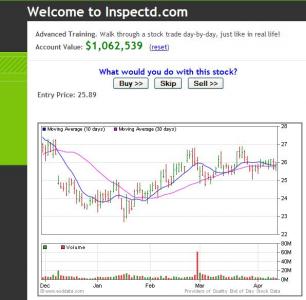
QUOTE(瘟神 @ Jul 25 2009, 09:20 PM)
Thanks for the game but you post it in a wrong thread, isn't it ?

no its not. depending on what you've learn, trading skills can apply in various market.Forex V6
|
|
 Jul 26 2009, 12:28 AM Jul 26 2009, 12:28 AM
Return to original view | Post
#21
|
 
Junior Member
188 posts Joined: Jul 2009 From: Kuching  
|
QUOTE(瘟神 @ Jul 25 2009, 09:20 PM) Thanks for the game but you post it in a wrong thread, isn't it ? no its not. depending on what you've learn, trading skills can apply in various market. |
|
|
|
|
|
Jul 26 2009, 02:04 PM
Return to original view | Post
#22
|
|
Junior Member
188 posts Joined: Jul 2009 From: Kuching
|
|
|
|
Jul 26 2009, 09:41 PM
Return to original view | Post
#23
|
|
Junior Member
188 posts Joined: Jul 2009 From: Kuching
|
QUOTE(small-jeff @ Jul 26 2009, 08:38 PM) if one has extra time and wish to make money out of the financial market, imo, it's always better to read some books on economics, rather than to "play" some "financial games" during the weekends. i dont think trading is same as reading books and pass the exam at school.(if trading was this easy huh?  ) if you have done it please tell me. ) if you have done it please tell me.  This post has been edited by gslearning: Jul 26 2009, 10:07 PM |
|
|
Jul 27 2009, 10:11 AM
Return to original view | Post
#24
|
|
Junior Member
188 posts Joined: Jul 2009 From: Kuching
|
Added on July 27, 2009, 10:13 am QUOTE(mphpopular @ Jul 27 2009, 07:41 AM) Then I also dont think trading is same as demo ing a game and winning the game. (if trading was this easy huh? you can come here and see my live account. ) if you have done it please tell me. kelvin_tan, small-jeff and adam : - market simulator, inspectd.com and other training material is basic tools to improve trader, it is used by hedge fund also. i dont bother say much with what you all are thinking This post has been edited by gslearning: Jul 27 2009, 10:49 AM |
|
|
Jul 27 2009, 04:26 PM
Return to original view | Post
#25
|
|
Junior Member
188 posts Joined: Jul 2009 From: Kuching
|
» Click to show Spoiler - click again to hide... « please stop baiting, i have said what you need to do at post #86, those who have read it should just keep quiet. otherwise, maybe its not your day. This post has been edited by gslearning: Jul 27 2009, 04:29 PM |
|
|
Jul 27 2009, 07:18 PM
Return to original view | Post
#26
|
|
Junior Member
188 posts Joined: Jul 2009 From: Kuching
|
open a first order followed by 2nd position on the same pair. then try to close the 1st position, if the 2nd position able to close without needing to close the 1st position first. then ibfx has taken care of the clients order in the back office.
This post has been edited by gslearning: Jul 28 2009, 11:05 AM |
|
|
|
|
|
Jul 29 2009, 01:33 PM
Return to original view | Post
#27
|
|
Junior Member
188 posts Joined: Jul 2009 From: Kuching
|
QUOTE(atrocitines @ Jul 29 2009, 10:04 AM) hey guys, anyone of you heard of forex asia academy? i plan to attend their free seminar. any good feedback on koon lip and his forex asia academy? free usually is only introduction part. wont really tell you the strategy until you've paid |
|
|
Jul 31 2009, 03:06 PM
Return to original view | Post
#28
|
|
Junior Member
188 posts Joined: Jul 2009 From: Kuching
|
QUOTE(mcko @ Jul 31 2009, 02:51 PM) One newbie question about FX: Spot FX has no expiry date, you can hold it as long as you want.Once I do a spot buy or sell, how much time do I have until I need to close that position? I mean, is there an equivalent of like T+3 like in stocks? |
|
|
Aug 13 2009, 04:07 PM
Return to original view | Post
#29
|
|
Junior Member
188 posts Joined: Jul 2009 From: Kuching
|
please provide your trading history first..?
|
|
|
Aug 14 2009, 04:04 PM
Return to original view | Post
#30
|
|
Junior Member
188 posts Joined: Jul 2009 From: Kuching
|
just for sharing
QUOTE Novice traders who first approach the markets will often design very elegant, very profitable strategies that appear to generate millions of dollars on a computer backtest. The majority of such strategies have extremely impressive win-loss and profit ratios, often demonstrating $3 wins for just $1 of losses. Armed with such stellar research, these newbies fund their FX trading accounts and promptly proceed to lose all their money. Why? Because trading is not logical but instead psychological in nature, and emotion will always overwhelm the intellect in the end, typically forcing the worst possible move out of the trader at the wrong time. This post has been edited by gslearning: Aug 14 2009, 04:05 PMAs E. Derman, head of quantitative strategies at Goldman Sachs, once noted, "In physics you are playing against God, who does not change his mind very often. In finance, you are playing against God's creatures, whose feelings are ephemeral, at best unstable, and the news on which they are based keeps streaming in." This is the fundamental flaw of most beginning traders. They believe that they can "engineer" a solution to trading and set in motion a machine that will harvest profits out of the market. But trading is less of a science than it is an art; and the sooner traders realize that they must compensate for their own humanity, the sooner they will begin to master the intricacies of trading. Reference : Boris & Kathy (dailyfx) |
|
|
Aug 14 2009, 11:46 PM
Return to original view | Post
#31
|
|
Junior Member
188 posts Joined: Jul 2009 From: Kuching
|
QUOTE(shakiraa @ Aug 14 2009, 10:05 PM) Hi all, what if i tell you the only way to become successful trader is having an ability to give up your old idea how the world and market works?Being a newbie, i have tried to read out some forum recomended below. What is the next step that i need to do to learn what currency combination is best to trade, basic strategy on when to buy and when to sell? thx www.babypips.com www.dailyfx.com www.forexfactory.com - World famous forex forum This post has been edited by gslearning: Aug 14 2009, 11:54 PM |
|
|
Aug 16 2009, 12:38 AM
Return to original view | Post
#32
|
|
Junior Member
188 posts Joined: Jul 2009 From: Kuching
|
QUOTE(penanghomes @ Aug 15 2009, 07:27 PM) A PERSON WHO DOES NOT ASK IS A FOOL FOREVER,A PERSON WHO ASK IS A FOOL FOR 5 MINUTES honestly there are many people just want the money, but never really want to care 'how' and 'what' it takes to be successful. thats why you see some of the mentor prefer to charge RM4 - 5k per person yet going through basic knowledge or something simple, but to be successful in this field urge & willingness to be success is much more important than what youre about to learn..for eg: majority people want to eat bread and likes it very much, but in reality how many people actually cares how bread is made? what process is involved to make a tasty bread? not very much is interested i believe. This post has been edited by gslearning: Aug 16 2009, 01:20 AM |
|
|
Aug 19 2009, 02:08 PM
Return to original view | Post
#33
|
|
Junior Member
188 posts Joined: Jul 2009 From: Kuching
|
QUOTE(adraxx @ Aug 19 2009, 12:54 PM) thanks for the info, they provide both forex & commodities trading, but too bad read some bad reviews on admiral while googling bout it, guess i have to go to Singapore to look for one (i prefer dealing with 1 which has an office nearby. lol.. how much money you planning to put? and i guess you must been able to trade profitably before? |
|
|
|
|
|
Aug 19 2009, 04:39 PM
Return to original view | Post
#34
|
|
Junior Member
188 posts Joined: Jul 2009 From: Kuching
|
QUOTE(Juggernout @ Aug 19 2009, 04:25 PM) may i ask which indicator really help in FOrex exchange money 3 days i lost already 500 usd ??? do the opposite and in 3 days you would make 500 usd  |
|
|
Aug 20 2009, 09:52 PM
Return to original view | Post
#35
|
|
Junior Member
188 posts Joined: Jul 2009 From: Kuching
|
just for sharing, reference : Kathy & Boris (dailyfx)
QUOTE Never Let a Winner Turn Into a Loser Repeat after us: Protect your profits. Protect your profits. Protect your profits. There is nothing worse than watching your trade be up 30 points one minute, only to see it completely reverse a short while later and take out your stop 40 points lower. If you haven't already experienced this feeling firsthand, consider yourself lucky - it's a woe most traders face more often than you can imagine and is a perfect example of poor money management. The FX markets can move fast, with gains turning into losses in a matter of minutes therefore making it critical to properly manage your capital. One of our cardinal rules of trading is to protect your profits - even if it means banking only 15 pips at a time. To some, 15 pips may seem like chump change; but if you take 10 trades, 15 pips at a time, that adds up to a respectable 150 points of profits. Sure, this approach may seem as if we are trading like penny-pinching grandmothers, but the main point of trading is to minimize your losses and, along with that, to make money as often as possible. The bottom line is that this is your money. Even if it is money that you are willing to lose, commonly referred to as risk capital, you need to look at it as "you versus the market". Like a soldier on the battlefield, you need to protect yourself first and foremost. There are two easy ways to never let a winner turn into a loser. The first method is to trail your stop. The second is a derivative of the first, which is to trade more than one lot. Trailing stops requires work but is probably one of the best ways to lock in profits. The key to trailing stops is to set a near-term profit target. For example, if your "near-term target" is 15 pips, then as soon as you are 15 pips in the money, move your stop to breakeven. If it moves lower and takes out your stop, that is fine, since you can consider your trade a scratch and you end up with no profits or losses. If it moves higher, by each 5-pip increment, you boost up your stop from breakeven by 5 pips, slowly cashing in gains. Just imagine it like a blackjack game, where every time you take in $100, you move $25 to your "do not touch" pile. The second method of locking in gains involves trading more than one lot. If you trade two lots, for example, you can have two separate profit targets. The first target would be placed at a more conservative level that is closer to your entry price, say 15 or 20 pips, while the second lot is much further away through which you are looking to bank a much larger reward-to-risk ratio. Once the first target level is reached, you would move your stop to breakeven, which in essence embodies our first rule: "Never let a winner turn into a loser." Of course, 15 pips is hardly a rule written in stone. How much profit you bank and by how much you trail the stop is dependent upon your trading style and the time frame in which you choose to trade. Longer-term traders may want to use a wider first target such as 50 or 100 pips , while shorter-term traders may prefer to use the 15-pip target. Managing each individual trade is always more art than science. However, trading in general still requires putting your money at risk, so we encourage you to think in terms of protecting profits first and swinging for the fences second. Successful trading is simply the art of accumulating more winners than stops. QUOTE Logic Wins, Impulse Kills More money has been lost by trading impulsively than by any other means. Ask a novice why he went long on a currency pair and you will frequently hear the answer, "'Cause it's gone down enough - so it's bound to bounce." We always roll our eyes at that type of response because it is not based on reason - it's nothing more than wishful thinking. We never cease to be amazed how hard-boiled, highly intelligent, ruthless business people behave in Las Vegas. Men and women who would never pay even one dollar more than the negotiated price for any product in their business will think nothing of losing $10,000 in 10 minutes on a roulette wheel. The glitz, the noise of the pits and the excitement of the crowd turn these sober, rational business people into wild-eyed gamblers. The currency market, with its round-the-clock flashing quotes, constant stream of news and the most liberal leverage in the financial world tends to have the same impact on novice traders. Trading impulsively is simply gambling. It can be a huge rush when the trader is on a winning streak, but just one bad loss can make the trader give all of the profits and trading capital back to the market. Just like every Vegas story ends in heartbreak, so does every tale of impulse trading. In trading, logic wins and impulse kills. This maxim isn't true because logical trading is always more precise than impulsive trading. In fact, the opposite is frequently the case. Impulsive traders can go on stunningly accurate winning streaks, while traders using logical setups can be mired in a string of losses. Reason always trumps impulse because logically focused traders will know how to limit their losses, while impulsive traders are never more than one trade away from total bankruptcy. Let's take a look at how each trader may operate in the market. Trader A is an impulsive trader. He "feels" price action and responds accordingly. Now imagine that prices in the EUR/USD move sharply higher. The impulsive trader "feels" that they have gone too far and decides to short the pair. The pair rallies higher and the trader is convinced, now more than ever, that it is overbought and sells more EUR/USD, building onto the current short position. Prices stall, but do not retrace. The impulsive trader who is certain that they are very near the top decides to triple up his position and watches in horror as the pair spikes higher, forcing a margin call on his account. A few hours later, the EUR/USD does top out and collapses, causing trader A to pound his fists in fury as he watches the pair sell off without him. He was right on the direction but picked a top impulsively - not logically. On the other hand, trader B uses both technical and fundamental analysis to calibrate his risk and to time his entries. He also thinks that the EUR/USD is overvalued but instead of prematurely picking a turn at will, he waits patiently for a clear technical signal - like a red candle on an upper Bollinger band or a move in RSI below the 70 level - before he initiates the trade. Furthermore, trader B uses the swing high of the move as his logical stop to precisely quantify his risk. He is also smart enough to size his position so that he does not lose more than 2% of his account should the trade fail. Even if he is wrong like trader A, the logical, methodical approach of trader B preserves his capital, so that he may trade another day, while the reckless, impulsive actions of trader A lead to a margin call liquidation. The point is that trends in the FX market can last for a very long time, so even though picking the very top in the EUR/USD may bring bragging rights, the risk of being premature may outweigh the warm feeling that comes with gloating. Instead, there is nothing wrong with waiting for a reversal signal to reveal itself first before initiating the trade. You may have missed the very top, but profiting from up to 80% of the move is good enough in our book. Although many novice traders may find impulsive trading to be far more exciting, seasoned pros know that logical trading is what puts bread on the table. QUOTE Never Risk More Than 2% Per Trade This is the most common and yet also the most violated rule in trading and goes a long way towards explaining why most traders lose money. Trading books are littered with stories of traders losing one, two, even five years' worth of profits in a single trade gone terribly wrong. This is the primary reason why the 2% stop-loss rule can never be violated. No matter how certain the trader may be about a particular outcome, the market, as John Maynard Keynes used to say, "can stay irrational far longer that you can remain solvent." Most traders begin their trading career, whether consciously or subconsciously, by visualizing "The Big One" - the one trade that will make them millions and allow them to retire young and live carefree for the rest of their lives. In FX, this fantasy is further reinforced by the folklore of the markets. Who can forget the time that George Soros "broke the Bank of England" by shorting the pound and walked away with a cool $1 billion profit in a single day? But the cold hard truth of the markets is that instead of winning the "Big One", most traders fall victim to a single catastrophic loss that knocks them out of the game forever. Large losses, as the following table demonstrates are extremely difficult to overcome. Amount of Equity Loss Amount of Return Necessary to Restore to Original 25% 33% 50% 100% 75% 400% 90% 1000% Just imagine that you started trading with $1,000 and lost 50%, or $500. It now takes a 100% gain, or a profit of $500, to bring you back to breakeven. A loss of 75% of your equity demands a 400% return - an almost impossible feat - just to bring your account back to its initial level. Getting into this kind of trouble as a trader means that, most likely, you have reached the point of no return and are at risk for blowing your account. The best way to avoid such fate is to never suffer a large loss. That is why the 2% rule is so important in trading. Losing only 2% per trade means that you would have to sustain 10 consecutive losing trades in a row to lose 20% of your account. Even if you sustained 20 consecutive losses - and you would have to trade extraordinarily badly to hit such a long losing streak - the total drawdown would still leave you with 60% of your capital intact. While that is certainly not a pleasant position to find yourself in, it means that you only need to earn 80% to get back to breakeven - a tough goal but far better than the 400% target for the trader who lost 75% of his capital. The art of trading is not about winning as much as it is about not losing. By controlling your losses - much like a business that contains its costs - you can withstand the tough market environments and will be ready and able to take advantage of profitable opportunities once they appear. That's why the 2% rule is the one of the most important rules of trading. |
|
|
Aug 21 2009, 12:26 AM
Return to original view | Post
#36
|
|
Junior Member
188 posts Joined: Jul 2009 From: Kuching
|
theres no point talking how much actually your account traded on the market, because it still need to divide the amount by the leverage.
1:200 leverage can control 200k if you deposit 1k, and when calculating the profit still need to divide by 200 again. |
|
|
Aug 24 2009, 07:36 PM
Return to original view | Post
#37
|
|
Junior Member
188 posts Joined: Jul 2009 From: Kuching
|
Hi all... i want to ask, how many of you ever try to deposit fx account using CREDIT CARD?
i have heard people getting EXTRA CHARGES using credit card, the bank is MAYBANK and they say if you want to fund trading account using credit card or for any investment purpose, they will charge extra 5% of the amount transferred. is this true? lol This post has been edited by gslearning: Aug 24 2009, 07:47 PM |
|
|
Aug 24 2009, 07:48 PM
Return to original view | Post
#38
|
|
Junior Member
188 posts Joined: Jul 2009 From: Kuching
|
QUOTE(vivienne85 @ Aug 24 2009, 07:45 PM) my friend and I are interested in playing FOREX.. so wondering which forex traders is the best |
|
|
Aug 24 2009, 08:33 PM
Return to original view | Post
#39
|
|
Junior Member
188 posts Joined: Jul 2009 From: Kuching
|
QUOTE(penanghomes @ Aug 24 2009, 08:23 PM) Hi traders, i think you should have tell people here how long you've been trading this way..?I have a technique which is suitable for EU pair only.You can demo 1st. Time suitable to open position=8am Malaysian Time. Exactly 8am,watch the currency pair EU,if the pair is going upward,after 10-15 pips,you can go SHORT,sell Euro,buy Usd.Take profit 10-20pips. If the pair is going downward after 10-15 pips at 8am,then open LONG,buy Euro,sell USd,take profit 10-20 pips. Remember,this only suitable at 8am and only for EU pair only. The reason is Asian Morning session,asian banks will come in and there will be some retracement. Do try this technique,99% success rate.I wont post this tech if i am not confident. |
|
|
Aug 24 2009, 11:15 PM
Return to original view | Post
#40
|
|
Junior Member
188 posts Joined: Jul 2009 From: Kuching
|
QUOTE(rstusa @ Aug 24 2009, 10:52 PM) No such thing!!! yes.. thats what im thinking as well.. but.. hmm.. i sent you a pm for more info.Added on August 24, 2009, 11:17 pm QUOTE(sleepwalker @ Aug 24 2009, 11:10 PM) But... you have to be careful as some broker will only allow you to withdraw back to your credit card if you use it to fund your account. Just like funding with Paypal and they'd only let you withdraw back to your paypal account. hi.. have you ever fund your trading account using credit card? if yes, have you heard of such charges by local bank? thanksJust go to the bank and do it with cash. Takes only 1 day since we are almost 1 day ahead of US. This post has been edited by gslearning: Aug 24 2009, 11:17 PM |
|
Topic ClosedOptions
|
| Change to: |  0.0552sec 0.0552sec
 0.73 0.73
 7 queries 7 queries
 GZIP Disabled GZIP Disabled
Time is now: 16th December 2025 - 12:24 AM |
 Quote
Quote