Outline ·
[ Standard ] ·
Linear+
Health 30-Day LYN FATSO Challenge Rendezvous, 17April - 16 May
|
Disciple
|
 Apr 26 2009, 04:00 PM Apr 26 2009, 04:00 PM
|

|
QUOTE(charge-n-go @ Apr 26 2009, 02:32 PM) wow  Can you share your weekly exercise routine? mondays, weds, fridays, and sundays - OVT (Optimized Volume Training) + 20 minutes post workout cardio. tues, thurs, sats - fasted cardio for about 30 minutes + some abs workout pretty boring routine. i hate cardio, time consuming, energy wasting and worst of all PLAIN BORING!! |
|
|
|
|
|
Disciple
|
Apr 26 2009, 09:23 PM
|
|
|
QUOTE(fearz @ Apr 26 2009, 04:08 PM) you better read this article by Layne Norton http://www.bodybuilding.com/fun/layne36.htmabout fasted cardio specifically thats one long article, i will read it as soon as im finish with my exam stuff. for now i gotta concentrate whats is it about in short? |
|
|
|
|
|
Disciple
|
Apr 26 2009, 11:42 PM
|
|
|
QUOTE(fearz @ Apr 26 2009, 11:04 PM) » Click to show Spoiler - click again to hide... « Perhaps the most dreaded word in a bodybuilder's vocabulary is "cardio." Unfortunately, cardio is a necessary evil of pre contest prep for most people. Few are able to achieve contest bodyfat levels through diet alone (i.e. ectomorphs with extremely fast metabolisms).
In men, cardio increases lipolysis in visceral fat (surrounding organs), especially in the stubborn abdominal area. In women, cardio increases lipolysis in the stubborn subcutaneous buttocks and thigh area in women. This is due to innervation and blood flow, which aerobic activity influences much more than diet alone 17.
Cardiovascular exercise has several myths surrounding it. The largest myth being that one should perform low intensity cardio in a fasted state. The logic being that if one is in a fasted state, their glycogen levels will be low and will force their body to burn fat. Unfortunately, this idea is misguided.
While performing cardio in a fasted state may indeed increase the amount of calories that are burned from fat stores, it will also increase amino acid oxidation. Cardiovascular exercise while in a fasted state is a great way to increase cortisol release. Cortisol will liberate amino acids to produce glucose (glucose cannot be synthesized from fats) and can lead to muscle loss.
Additionally, I find it ironic that many people take such great care to time their meals so that they do not go for more than 2-3 hours without eating in order to prevent muscle loss. However, they purposefully induce this state and then perform work on top of this!
Research has shown that the type of substrate used during cardiovascular work makes little overall difference on fat loss. This is most likely due to the fact if one relies mostly upon fat stores during cardio (i.e. low intensity cardio), the body will burn predominantly glucose at other times of the day. Likewise, if one mainly utilizes glucose for energy during cardio (i.e. high intensity cardio) the body will customarily rely on fat at other times of the day in order to spare muscle glycogen.
Training in and of itself causes the body to preferentially spare muscle glycogen and burn fat. It makes sense that one should strive to do their cardio on their 'off days' from lifting (as to not further hinder their recovery), and plan their carbohydrate intake similar to their lifting regime.
Cardiovascular work will increase nutrient partitioning towards muscle tissue and away from fat tissue. One should take advantage of this by consuming the bulk of their carbohydrate intake around this time. The benefits are that these nutrients induce fat storage, but will rather be stored in muscle tissue.
Why would you want to deny your muscles nutrients at the most crucial time of the day, but then provide them during rest? It does not make sense. Treat your cardiovascular work like your lifting.
Another question that often arises regarding cardio is the argument "Low-Intensity vs High-Intensity" cardio. Many people automatically assume that low-intensity cardio is better; citing that high-intensity cardio primarily utilizes glucose (anaerobic metabolism), while low-intensity cardio primarily burns fat (aerobic metabolism).
Once again, the substrate used during cardiovascular work is not as important as the caloric deficit created by the cardiovascular work. In actuality, high-intensity cardiovascular work is superior to low-intensity cardio for several reasons
High intensity cardio has a much stronger effect on GLUT-4 translocation in muscle cells due to the increased force of muscle contraction. This means that high-intensity cardio creates a much stronger nutrient partitioning effect towards muscle tissue than low-intensity cardio.
Low periods of low-intensity exercise tend to "overtrain" the fast-twitch muscle fibers and convert the intermediate muscle fibers to slow-twitch fibers. This is not a desirable effect as the fast twitch muscle fibers are those that have the greatest chance to hypertrophy. If your body has less fast twitch fibers, then you will experience less hypertrophy from training.
Understanding Muscle Fiber Types.
This article will deal mainly with how people think the muscle type makes no difference, how muscle type is over-rated and how it gets more credit...
[ Click here to learn more. ]
The body's hormonal response to high intensity cardio is similar to the body's hormonal response to resistance training (i.e. increased insulin sensitivity, gh release, Igf-1 release, etc) without placing the same strain on the nervous system as resistance training.
High-intensity cardio causes the body to preferentially store more carbohydrates and burn more fat.
High-intensity cardiovascular exercise increases oxygen expenditure and forces the body to adapt by becoming more efficient at oxygen transport (increase in VO2 max). More efficient oxygen transport to the muscles will increase fat oxidation as fat oxidation is dependant upon the presence of oxygen.
High-intensity cardio seems to be more muscle sparing. Several studies have shown that high-intensity interval training (aka HIT) burns less calories when compared to continuous lower intensity cardio. However, the skinfold losses were greater with the HIT group than in the continuous intensity group. This means not only did the HIT group lose more fat, they also spared more muscle tissue by burning less overall calories .  oh crap. ive been doing the wrong thang all this while?  but i do drink BCAAs during workout. and im endo. that applies to ecto or other body types? |
|
|
|
|
|
Disciple
|
Apr 29 2009, 05:26 PM
|
|
|
QUOTE(Gr3yL3gion81 @ Apr 29 2009, 10:19 AM) Didn't notice this thread before, should have joined it early.  Anyway keep it up, you guys can do it.  yoh can join the next challenge, meh thinks there will be another one... |
|
|
|
|
|
Disciple
|
Apr 29 2009, 09:29 PM
|
|
|
QUOTE(charge-n-go @ Apr 26 2009, 07:43 PM) haha, family day! syiok ~~ WIKI-san, this is sooo tempting wei... 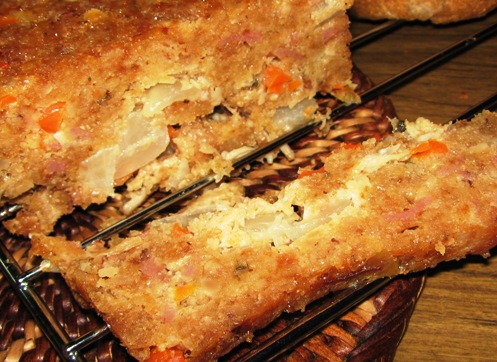 guys, whats that? it sure looks delicious and i have never seen anything like that before? whats the name of this dish? |
|
|
|
|
|
Disciple
|
Apr 30 2009, 07:32 AM
|
|
|
QUOTE(myremi @ Apr 29 2009, 10:38 PM) I got it out of a roasting book. It's suppose to be a mushroom roast. [attachmentid=935144] If you follow the recipe exactly, it's 715 calorie per slice. I change some of the ingredients : -1 teaspoon olive oil to stir-fry the veggie -mushrooms, i use the Enoki type. -brazil nuts, i swapped with normal peanuts. -used low-fat cheddar -didn't put in any parmesan -used 2 slices of wholemeal bread With the changes above, the calorie per slice got half to about 485 calorie each, according to calorie counter on NuritionData.com .
Added on April 29, 2009, 10:39 pmOK, how does it taste like? My Granny says it's like a cake but a bit more nutty and not sweet at all. It's kinda savory, like a savory bread. thanks for the recipe...im gonna try it this saturday... |
|
|
|
|
|
Disciple
|
May 3 2009, 06:10 PM
|
|
|
only 2 weeks left? crap i thought i still have 3 weeks...
and i've been slacking on the cardio last week swt
|
|
|
|
|
|
Disciple
|
May 3 2009, 11:10 PM
|
|
|
QUOTE(tengster @ May 3 2009, 09:04 PM) I had a solid 2.5hours burning 1000kcal....will do a lighter one tomorrow..... wow continuous 2.5 hours? isn't that a little excessive? |
|
|
|
|
|
Disciple
|
May 7 2009, 08:30 PM
|
|
|
QUOTE(bata @ May 7 2009, 08:17 PM) @Syd G, hey thanks, i found the Darabif  holy mama its pricey, but 20g protein per 100g serving, its not too bad  come people lets bulk upppppppppppp...ops wrong thread, this is for people who want to lean down » Click to show Spoiler - click again to hide... « Chow those patties must have cost a fortune...i bought the lamb burger before...its okay, you should try it bata |
|
|
|
|
|
Disciple
|
May 9 2009, 10:13 AM
|
|
|
QUOTE(charge-n-go @ May 9 2009, 10:08 AM) sure sure. I am doing very minor weight lifting on right hand only, did left leg squat as well, hahaha. Right leg and left hand cacat-ed I'll back to action once I am healed.  Thanks ! sorry to hear that, you get well soon dude |
|
|
|
|
|
Disciple
|
May 11 2009, 09:51 PM
|
|
|
QUOTE(Sky.Live @ May 11 2009, 04:49 PM) 5 more days left.. omg, sore throat already now yeah 5 days left, im weighing in tomorrow. perhaps take some pictars too |
|
|
|
|
|
Disciple
|
May 12 2009, 09:07 PM
|
|
|
i think ima weigh in on Sunday. be fair lol...
|
|
|
|
|
|
Disciple
|
May 17 2009, 11:14 AM
|
|
|
failed the challenge, 1 kg heavier i think its water weight or maybe i just ate breakfast or something because i was 75kg on wednesday before i went for a vacation pics here, disgusting inside. and bad quality » Click to show Spoiler - click again to hide... « This post has been edited by Disciple: May 17 2009, 11:15 AM |
|
|
|
|




 Quote
Quote


 0.0326sec
 0.36
0.36
 7 queries
 GZIP Disabled