

 Jul 7 2008, 06:34 PM, updated 15y ago


I myself knew nothing about PSUs and wanted to know more about it. So, in the quest to find out more about PSUs, I did my own reading, from whatever available sources on the net. As such, this guide was created to help other noobs (like me) who wants to understand more about the PSU.
All information was pulled from the net and references are listed at the end.
Any help/advice/comments are most welcomed, especially PSU gurus!
Index:
1st post
- The Power Supply Unit (PSU) - Definition
- The basics
- Before we begin - ATX form factor
- How to read the specification of a PSU
- The very very important 12v rail
- Multiple 12V rails vs. Single 12V rail
2nd post
- The basic components of a PSU
- Connectors
- Modular PSUs
3rd post
- Efficiency
- The "80 PLUS" standard
- Power Factor Correction (PFC)
4th post
- Which brand is a good brand?
- How much watt does my rig need anyway?
- Tips on buying a good PSU
- References
The Power Supply Unit (PSU) - Definition
Everybody knows what a PSU is but here’s a simple definition anyway:
A component that supplies power to a computer by converting AC power drawn from your main socket to usable low-voltage DC power for the internal components of your computer. The output of DC power are through rails (see below).
AC – Alternating current
DC – Direct current (no, I’m not going to explain this, google it up yourself!
 )
)Take a look at this picture for better understanding:

The basics
Important terms
Watt – The accepted market rating for power supplies
- Watts = Volts(v) x Amps(A)
- This formula is important to calculate the wattage on each rail. Read on for further understanding
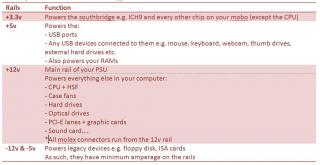
Rails – Every power supply has many rails. Each rail is rated for a specific voltage, and will always carry that voltage no matter how many devices are connected to it
- However, each rail has an AMPERE RATING (A). The more devices you connect to each rail, the lower the available amperage to the rest of your computer system will be on that specific rail.
- Examples of the rails available on a typical PSU:
Before we begin - ATX form factor
Know that most common PSUs are build to conform to the ATX form factor @ standard (google this for more info). As such, the guide is based mainly on ATX power supplies unless stated otherwise.
ATX – Advanced Technology Extended
The ATX form factor has had 5 main power supply designs throughout its lifetime:

ATXv12 v2.2 is the current standard. However, there’s a new Intel ATX12V v2.3 specification.
Additional notes on the 24-pin main connector: PCI-E requires a 75-watt power requirement that was not capable with the older 20-pin connector. To handle this, 4 additional pins were added to the connector to supply the addition power through 12V rails
Most PSUs nowadays comes with a 24-pin connectors actually have pins arrange in a 20+4 setup….. The detachable 4-pins connector will allow the connector (20-pins) to fit into older motherboards that uses the ATX12V 1.0/1.3 specification (see the part on "connectors").
How to read the specification of a PSU
So, if you understand the basics, you should be able to read the specification of a PSU.
Take a look at the specs of my Enermax Liberty 500W:
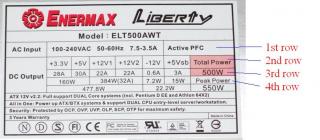
1st row - shows your AC input (your wall socket voltage i.e. 240v for Malaysia)
2nd row – shows the DC output to all the rails (i.e. +3.3v, +5v, dual 12v rail (+12V1 & +12V2), -12v, +5vsb)
3rd row – shows the Amperage (A) for each rail
4th row – shows the maximum wattage for the rails
- Note that the +3.3v rail and the +5v rail both comes under the maximum wattage of 160W.
- This means that the PSU cannot feed both the rails maximum amperage at once. It can feed the +3.3v rail to 28A, or it can feed the +5v rail to 30A. However, it cannot feed both the rails to their maximum at the same time i.e. (3.3v x 28A) + (5v x 30A) = 92.4 watts + 150 watts = 242.4 watts (which exceeds the 160 watt limit)
- Also note that this PSU has two 12V rails - +12V1 & +12V2
- Why 2 rails instead of 1?
--- +12V1 max Ampere is 22A and +12V2 max Ampere is also 22A
--- However, when added together, the maximum Ampere is 32A and NOT 22A + 22A = 44A
--- This is because this kind of PSU only has one set of circuitry inside the PSU which generates the 12 volts, capable of supplying 32A in total (32A x 12v = 384w). However, due to various reasons (see below on "Multiple 12V rails vs. Single 12V rail"), it is split into 2 separate 12 volt outputs each with its own current limit circuitry (i.e. +12V1 & +12V2), each capable of supplying 22A for each rail (22A x 12v = 264W). As such, if you try to draw more than 22 amps from either of the +12v rails, the PSU will shut down. If you try to draw more than 32 amps of total current from BOTH of the rails, the PSU will also shut down.
Note : So now you know why your rig keeps on shutting down!!!

- In other words, just like the 3.3v and the 5v rails, the two +12v rails are also NOT additive. Peak power is for one or the other, but not both at the same time i.e. (12v x 22A) + (12v x 22A) = 264w + 264w = 528w. The peak power is indicated as 384w (32A) which is 12v x 32A = 384w.
Right most column – shows the:
Total power = 500w (which is what we commonly refer to as “True power” or equivalent)
Peak power = 550w (which can be deceiving……more on this later)
Note that when you buy a PSU, you want to see the amount of CONTINUOUS power that the PSU can supply. For my Enermax, it is 500w.
Some manufacturers provide PEAK power, to make it more attractive for buyers. However, peak power is considered as false advertising, trying to make users buy their product based on their cheap but falsely high PSU wattage.
The very very important 12V rail.....
From the table above, you can see that the 12V rails supply important components especially the CPU and the graphic card.
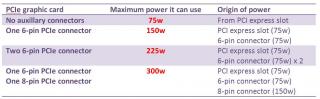
Nowadays, the graphic card needs more and more power and it is a must for you to check the requirements of a graphic card before you buy the graphic card or PSU. Manufacturers usually do state the PSU requirement on their website or on the product box.
Here are some examples of some graphic card power requirements:

Here's some examples of actual power consumptions at idle and load - GPU, CPU & mobo:
http://www.anandtech.com/casecoolingpsus/showdoc.aspx?i=3413
http://www.tomshardware.com/reviews/GeForc...ck,2028-22.html
Very good link on what PSU wattage is required for which card (updated 5/5/2010):
http://forum-en.msi.com/index.php?topic=104805.0
Example 1
Wait a second. Take a look at my Enermax Liberty specification:
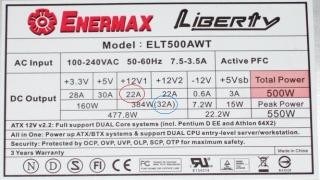
If you look at the specification of my PSU, you'll notice that my +12V1 is only 22A (red circle) and my +12V2 is also 22A. So, how can I run my 8800GT (requiring 26A on the 12v rail) with this PSU?????

Well, the answer is that the rating on the 12v rail is the COMBINED amperage. For my Enermax, the combined rating on the 12v rail is actually 32A (blue circle), which would run the 8800GT just fine. Note that this PSU would not be recommended to run the GTX260 or GTX280 as their amperage rating is far higher.
Example 2
Take a look a this PSU:
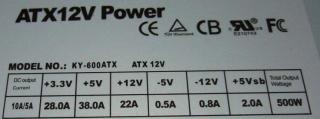
From the specs, it is obvious that this PSU has only one 12v rail which is rated at 22A. As such, this PSU is not recommended to run any of the Nvidia GPU listed above!
For the above statement,Note the word "not recommended" as opposed to "cannot". I didn't say that this PSU CANNOT run, say, the 8800GT. What is important is that this PSU does not meet the requirements of the manufacturer and thus NOT recommended to run on that PSU. You might still be able to use it if you want, but might encounter instability, BSODs, reboots and worse of all, damage to your graphic card or your whole rig.
Example 3
Here's another example. It's a Cooler Master Real Power 550w PSU:

Let's concentrate on the +12v rails.
From the specs, you can see that the PSU as 3x +12v rails. It also states the "Peak" amperage and "continuous" amperage. Remember that the "continuous" amperage is the important one.
You can see that the total wattage on the +12v rails is 360W. Wait a second. There is no amperage stated!
That's easily solve by calculating the amperage as you already the the voltage and wattage.
Remember the formula : Watts = Voltage x Amperes
So, Amperes = Watts / Voltage = 360w / 12v = 30A
So, this PSU has 30A on it's 12v rails
Multiple 12V rails vs. Single 12V rail
I'm getting a BIG headache regarding this. Will try to summarize these issues if possible. In the meanwhile, take a look at some good references:
http://www.playtool.com/pages/psumultirail/multirails.html
http://www.hardwaresecrets.com/article/181/12
http://www.xcpus.com/forums/cases-psus/109...-101-102-a.html
http://www.silentpcreview.com/article28-page3.html
This post has been edited by kmarc: May 5 2010, 02:37 PM
 Quote
Quote





 ):
):


 (Google if you want to know more)


 0.0205sec
 0.67
0.67
 6 queries
 GZIP Disabled