eGPU ConfigurationsA. PCIe x1 link.This setup only require
one PCIe x1 port. This can be either mPCIe port or ExpressCard (34mm/54mm) slot. There are two
flavors of PCIe x1 link setup:-
- Raw PCIe x1 link setup.
Any notebooks can support this setup. However, eGPU will perform worst on any pre-Sandy Bridge (SB) notebooks with this setup. This is because of the PCIe x1 bandwidth on pre-SB notebooks is only 2.5Gb/s at each direction (5Gb/s concurrent). eGPU will perform better on SB notebooks because PCIe x1 link speed is 5Gb/s at each direction (10Gb/s concurrent). However, SB notebooks can only utilized this using newer PE4L v2.0 or PE4H v3.0 which will be available soon (Jan/Feb 2012). - PCIe x1 + Optimus = x1.Opt or x1.2Opt
Opt=Optimus will provide PCIe data compression which boost performance over PCIe x1 link. Optimus only possible if your notebook have either active Intel GMA 4500MHD or Intel HD Graphics or Intel HD 3000 or Intel GMA x3150 (e.g. Asus Eee PC 1015PEM netbook) iGPU. Combination with either of these iGPU & Nvidia Fermi (Nvidia GT4xx, GTS4xx, GTX4xx & above) desktop graphic card, you will be able to do x1.Opt setup. x1.Opt will provide way better performance than raw PCIe x1 link setup. It's equivalent to PCIe x2 link setup & on certain games, way better. You also will be able to get acceleration on internal LCD but the performance will almost half because graphic card need to transmit the frames through PCIe x1 link, the same link which notebook use to transmit data to eGPU for processing. The PCIe data compression provided by Optimus will reduced/eliminate any lags during gaming. You will get full performance if using external monitor (~80% compared to desktop).
SB notebooks chipset support PCIe 2.0 5Gb/s x1 link. The performance is equivalent to PCIe 2.5Gb/s x4 link. The PCIe 2.0 5Gb/s compliant kit will be available soon (Jan/Feb 2012).
B. PCIe x2 link.This setup require
two PCIe x1 ports. This can be either combination of ExpressCard + mPCIe slot OR two mPCIe ports. x2 link setup only possible with either of these combinations:-
- PCIe port#1 & port#2.
OR - PCIe port#3 & port#4.
OR - PCIe port#5 & port#6.
You can use AIDA64 software to check the PCIe port numbers, for example:-

Remember, the PCIe port(s) that is/are reported "Empty" doesn't means they are available
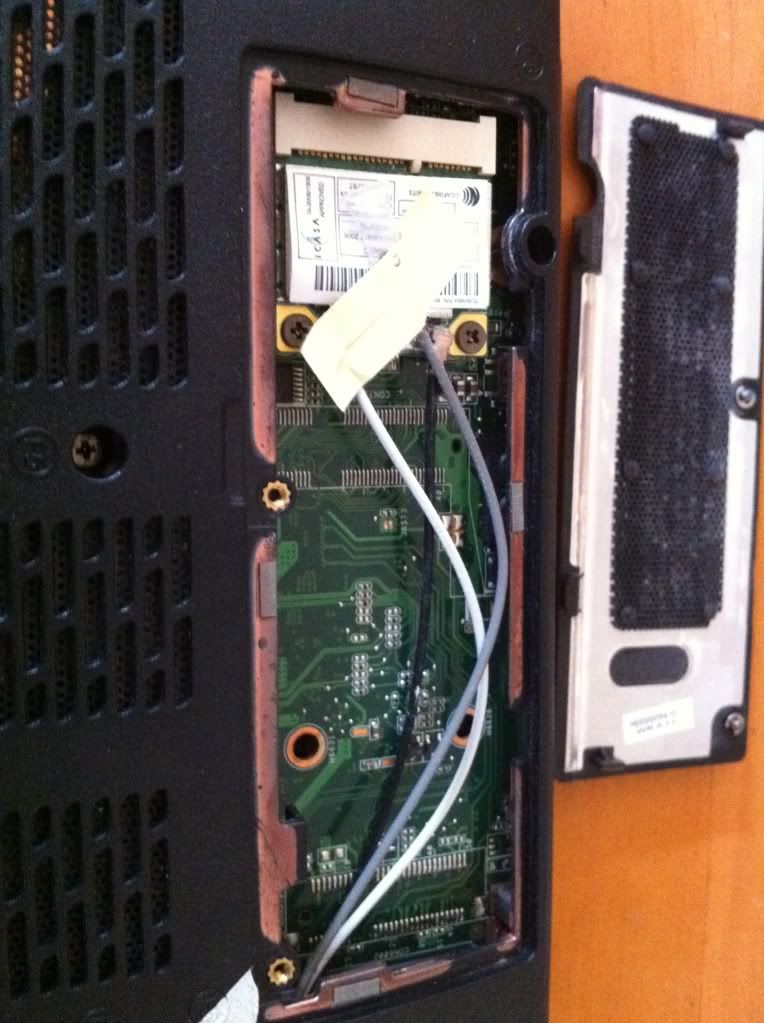
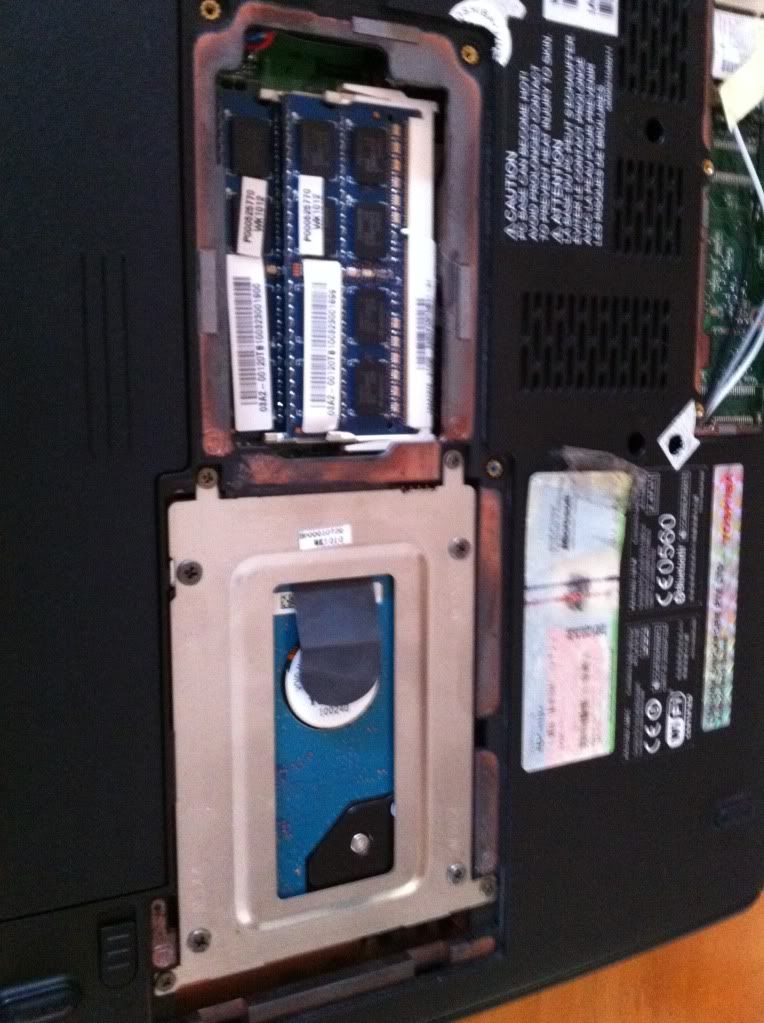
physically. You need to check them yourself. mPCIe port(s) usually located at the bottom of your notebook, in HDD/RAM compartment. For ExpressCard slot, you need to connect, for example, ExpressCard to eSATA/USB adapater to know the ExpressCard PCIe port number.
This is an example of x2 link connections; PCIe port#1 (WWAN) & port#2 (WLAN):-

This setup provide performance equivalent to x1.Opt setup, except the internal LCD support/acceleration. External monitor is a must for this setup since notebook doesn't have compatible iGPU to project frames to internal LCD. You can use either ATiAMD or Nvidia graphic card for this setup.
C. PCIe x4 link.This is rare setup. This setup require 4 PCIe x1 ports;
PCIe port#1 + port#2 + port#3 + port #4 OR
PCIe port#5 + port#6 + port#7 + port #8. Only some notebooks have PCIe ports arrangement that can support this setup, e.g. Dell Studio XPS 1645.
NOTE: x2 & x4 link setup are not possible on SB notebooks due to hardware/BIOS limitation.ExpressCard (34mm/54mm)(
Source: www.expresscard.org)
Comparison between CardBus & ExpressCard. Only ExpressCard useful for eGPU.

 eGPU vs. PCI space
eGPU will require 256MB of PCI space for it to work.
TOLUD register defined available PCI space on notebooks. On some notebooks,
TOLUD register is set too high which means there is not enough PCI space for eGPU. In this situation, the only way you can get eGPU to work is by reducing RAM to 2GB/3GB of RAM. With more RAM, eGPU will be detected but with
Error 12 in Device Manager. To know the value set in TOLUD register, you can use
Device Manager; set
View to "
Resources by connection" & expand the
Memory tree; like this:-

The
first PCI bus with 8 digits memory address is what you're looking for. In the above example, the firs PCI bus with 8 digits memory address is 0xA8000000. The calculation is simple:-
0xA8000000 = 2818572288 (dec) bytes = 2818572288 / 1024 / 1024 / 1024 = 2.625 GB
As long as
TOLUD is equal or lower than 3.25 GB, you will have no problem using eGPU & 4GB or more RAM. You can use this table for quick calculation:-
- E0000000 = 3.5 GB
- D0000000 = 3.25 GB
- C0000000 = 3 GB
- B0000000 = 2.75 GB
- A0000000 = 2.5 GB
Usually, even with low TOLUD, you can get
Error 12 in Device Manager since the PCI space are, let say,
scattered. For this, you can do PCI compaction using
eGPU Setup 1.x. USD 25 license fee will be impose if you use
eGPU Setup 1.x software with eGPU kit from any supplier other than HIT (Harmonic Inversion Tech).
+++++++++++++++++++++++++++++++++++++++++++++++++++++++++++++++++++QUOTE(kimchoo @ Sep 3 2011, 09:44 AM)
oh ya , someone selling the real Vidock in garage sale. it did boost the gaming performance few times if compared with just igpu alone like intel hd graphics in my vostro v130. em.. playable framerates in crysis 2 with "very high" setting and maxed out setting in bulletstorm even with 2x anti-aliasing. and my notebook cpu is quite hot actually, hitting 80c semetimes : D . anyway, u cant expect very high performance from my egpu setup, the intel i5 ulv might be the one that slowed everything down. haha
You can easily
supercharged the ULV processor using ThrottleStop.
Anyway, kimchoo DIY eGPU setup is
x1 link with Optimus which is better than PCIe x2 setup. With PCIe x2 setup the eGPU will perform roughly 80% from it actual capability. There is several video on youtube. You'd be surprise how well it perform on PCIe x2 or PCIe x1.Opt (with optimus).
This post has been edited by kizwan: Jan 19 2012, 03:01 PM 

 Sep 3 2011, 08:11 AM, updated 15y ago


 Quote
Quote




 it look nice if not look messy... the wire make headche...










 Also make sure you put correct home address in your PayPal account.












 0.0800sec
 0.35
0.35
 6 queries
 GZIP Disabled